Category: Field Trips

  • Northern Saw-whet Owl Banding at Highland Retreat

    Northern Saw-whet Owl Banding at Highland Retreat

    SawwhetOwls8.bb.crop

    On Saturday, November 10th members of the HMN chapter participated in the Saw-whet Owl banding at Highland Retreat in western Rockingham county.

    Saw-whet Owls are migrating through our area this time of the year from their northern nesting grounds.

    Dr. Clair Mellinger, assisted by Charles Ziegenfus and HMN trainee Ben Spory, collected the birds and performed the data gathering.

    Mist nests higher up the ridge are set up near an electronic call, and as the owls fly through the area they are captured and brought down for banding, measuring and aging. The bands and permits to band are supplied by the US Fish and Wildlife Service. The information from the project is added to a database with the US Geological Survey Bird Banding Laboratory.

    SawwhetOwls5.bb

    After banding and measuring, the birds are aged using ultraviolet light. Owls and some other birds have pigments in their feathers called porphyrins that fluoresce bright red in UV light. As the feathers age the pigment is reduced and an older bird that has molted some of its feathers will fluoresce less. After the second year, this technique cannot be used to determine age because all feathers are not molted every year. The owls are aged HY (hatching year), SY (second year) and ASY (after second year).

    After banding and measuring, the birds are placed on a table outside to recover and continue their journey.

    Most of the birds we saw were HY with one older owl. Previously banded owls have been caught including an owl banded near Lake Superior. This year’s recaptures included an owl banded on November 3rd and one banded October 2016 from Peterborough, Ontario.

    This year only trained or trainee volunteers are allowed to collect the owls.

    On Saturday night over 40 people were there with 13 from HMN, including some family members, and 25 owls were banded.

    For more information about the Northern Saw-whet Owl, a good source is the Cornell Lab of Ornithology at https://www.allaboutbirds.org/guide/Northern_Saw-whet_Owl/id.

    For more information about the Saw-whet Owls banding project, go to highlandretreatowls.wordpress.com.

    Information about the Bird Banding Laboratory can be found at https://www.usgs.gov/centers/pwrc/science/bird-banding-laboratory.

    If you find a banded bird you can report it to www.reportband.gov.

    – B. Blessing, II, Cohort VI, November 2018

    Top photo: Dr. Mellinger talks to the group about Saw-whet Owl behavior, diet and the banding process.

    Second photo: Porphryin pigments fluoresce in UV light. 

    All photos are by B. Blessing, II.

    Click on a photo below to see a slide show of the photos and find their captions.


    Find Elaine Smith’s photos from this event on flickr HERE.

  • Herp Hike 2018

    Herp Hike 2018

    cowknob.10.18.eli.lianez

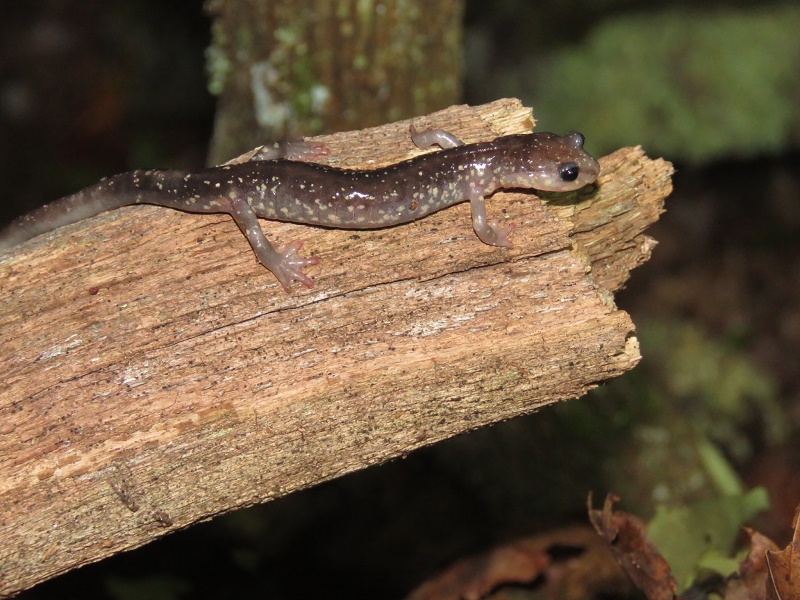
    October 8 was a cool, foggy and breezy night on Reddish Knob when 10 Headwaters Master Naturalists and friends joined Billy Flint of James Madison University to look for and learn about terrestrial salamanders. The thick fog made driving up the narrow road tricky, but conditions were perfect for salamanders.

    The Cow Knob Salamander is an endangered species found only on Shenandoah Mountain and Elliot Knob. We also hoped to see the endangered Shenandoah Mountain Salamander. A quarter mile walk down the road from where we parked on top of Reddish Knob brought us to the Timber Ridge Trail on the east slope. This proved to be great habitat for Cow Knob Salamanders.

    We hit the jackpot and saw 8 or 9 Cow Knob Salamanders of various ages which had ventured out from beneath rocks and logs on a perfect night for them to feed. Billy Flint explained how they preferred rocky, north-facing slopes and moist conditions to keep them from drying out.

    Wet weather will bring out up to 10% of the area’s population according to Billy. They take turns emerging from the ground to check out feeding opportunities. Like other terrestrial salamanders, the Cow Knob Salamanders lay their eggs in the ground, nurture them there until they hatch and do not have an aquatic stage to their life cycle as do many other salamanders.

    We did not, unfortunately, see any Shenandoah Mountain Salamanders. These terrestrial salamanders also require selective habitats which are threatened by ongoing development and climate change.

    The more common and also terrestrial Eastern Red-backed Salamanders were maybe easiler to spot and found in even larger numbers this evening than the Cow Knob Salamanders.

    Many thanks to Billy for his fearless leadership and expertise; Malcolm for organizing the trip; the daring drivers who navigated the dark and foggy, narrow, winding road up Reddish; and to all the other participants for making it a rewarding and fun night out!

    – Malcolm Cameron, Cohort III, October 2018

    Photos at top and bottom are of Cow Knob Salamanders taken by HMN Merrilee Lianez’s son Eli Lianez.

    cowknobsalamanderonReddish.eli


  • Ribbit!

    Ribbit!

    frogcall.augustawetlanda.5.4.18

    On the evening of Friday, May 4th a group of four Headwaters Master Naturalists and one guest journeyed to the Augusta Springs Wetlands Trail to try our ears at frog and toad call identification. Under the tutelage of HMN and Frogwatch Monitor Kate Guenther we listened to the recorded voices of the frogs and toads native to our area. Kate encouraged everyone to create their own description of what the call sounded like to them, sort of a word association game.

    We learned that frogs call most readily in their own “season”. The Wood Frog is the earliest, beginning sometimes as early as January and going until April. Spring Peepers begin in February and go until June, but may also call again as late as October.

    Then, after dark when the chorus really geared up, we headed out onto the trail to put our newfound knowledge to use. We first heard the “house of chicks” cacophony that is the song of thousands of Spring Peepers. We heard the “sustained trill” of the American Toad, the “vu, vu, vroom” of the American Bullfrog, the “gunk, gunk, gunk” of the Green Frog, and the “woodpecker call-like” sound of the Gray Treefrog. Sometimes what you always thought was a bird is actually a frog! We also observed crayfish, bats, and one snake, possibly a Queensnake, but we had our frog hats on so we weren’t sure.

    Who knew frogs and toads could be so fascinating? Their calls, their appearance and their homes are unique. Thanks for a great time Kate!

    – Allen Baker, Cohort V, May 2018

    Photo by Sandy Greene. Left to right are Shelley and Allen Baker, guest Jane Cox, and Kate.

  • Stony Man Environs at Shenandoah National Park

    Stony Man Environs at Shenandoah National Park

    SNP.4.30.18.1

    HMN Jerry Hopkins has an affinity for the Shenandoah National Park. Spending time there since he was a kid, he currently makes frequent trips to his adopted stretch of trail in the Park to keep it welcoming by clearing brush and obstacles which might impede travelers.

    On a recent beautiful sunny spring day, he generously shared some of the history, ecology, geology, and general fun facts about the Park he has learned over the years, with members of the current basic training class and a few other HMNs. The group parked near Skyland and slowly made its way up the Stony Man Trail and back along the Passamaquoddy Trail, with frequent stops for readings and discussions. These ranged from the impacts of fuel needs of surrounding iron ore furnaces in the 1800s, chestnut blight in the early 1900s, the woolly adelgid hemlock parasite introduced in the mid-1900s, current emerald ash borer threats, and acid rain impacts, to George Washington’s army subsisting on rock tripe at Valley Forge and synchronized lightning bugs creating too much human attention in another part of the Park.

    As a bonus, the group was treated to the extensive wildflower expertise of HMN Betty Forrest who at 82 can still ably navigate 5 miles of trail. She spent three years as a Shenandoah National Park ranger and knows the local flora well. Golden ragwort abundantly lined the trails but was not yet in bloom. Wild phlox was in bloom at the Stony Man summit within view of a wind blown, icy, rock-lined puddle.

    George Freeman Pollock featured prominently in Jerry’s discussions along the Passamaquoddy Trail. Relying heavily on his wife Addie’s wealth, George Pollock created and financed much of Skyland before it became the cornerstone of Shenandoah National Park. He oversaw the establishment of the Passamaquoddy Trail including its name. The  Passamaquoddy Indians, who lived in northeastern North America, are named for the pollock fish important in their lives.

    Jerry’s work with trail maintenance for the Park is through its contract with the Potomac Appalachian Trail Club. The club provides volunteer service to help keep up all the Park’s trails. The Park also partners with the Shenandoah National Park Association, a membership driven nonprofit organization which helps fund educational opportunities throughout the Park. There are many member benefits to joining!

    Check out the website of the Shenandoah National Park for comprehensive coverage of everything it has to offer.

    – Adrie Voors, Cohort II, April 2018

    Top photo is of the group having lunch near Stony Man summit. Click on a photo below to see a slide show of the photos and find their captions. Photos taken by Adrie.


  • Geology Field Trip in Shenandoah National Park

    Geology Field Trip in Shenandoah National Park

    geology.snp.4.12.18.mc

    Geology Field Trip in Shenandoah National Park
    April 12, 2018

    After being snowed out in December and postponed in early April, this field trip was finally held on Thursday, April 12. Malcolm Cameron led the trip with Jerry Hopkins attending.

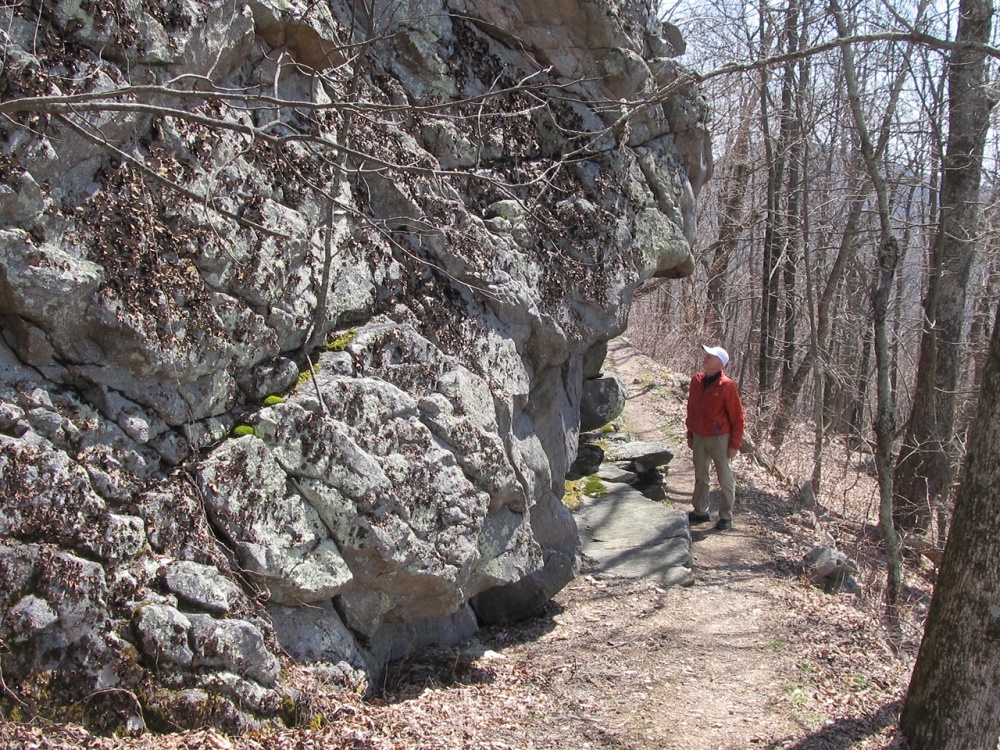
    Malcolm gave an overview of geologic history of the Blue Ridge and Shenandoah National Park (SNP) area and then the pair headed south on Skyline Drive from Swift Run Gap. They stopped at Sandy Bottom Overlook to see mountain ridges with younger sedimentary rocks to the west and an outcrop of Pedlar formation granite, the oldest rock formation in SNP. Next they stopped at Loft Mountain Overlook and examined the Catoctin formation greenstone, formed by metamorphism from ancient lava flows. They spent time examining several interesting features of this rock by the parking lot. The rocks in the stone wall nearby contained skolithos, the only fossil found in SNP. Next they stopped at Rocky Top Overlook which has sedimentary layers from the Hampton-Harpers formation. Their final stop was Doyles River Overlook with a short hike on the AT to see the Weverton formation, metamorphosed sedimentary rock.

    Malcolm provided handouts with a general overview, a road log, and the basic geologic history and structure of the Blue Ridge and surrounding area. The handouts may be accessed here:

    – Malcolm Cameron, Cohort III, April 2018

    Top photo shows Jerry checking out the metamorphosed sedimentary rock at the Weverton formation. Below he is at the Loft Mountain Overlook Catoctin formation greenstone. Photos by Malcolm.

    geology.snp.4.12.18.2.mc