Category: Naturalist Book Nook

  • HMN Book Group Inaugural Meeting

    HMN Book Group Inaugural Meeting

    Thanks to Stephanie and Sandy for both sharing their reflections on the HMN Book Group’s first selection! It sounds like a winner. And thanks to Peggy for facilitating and hosting the group. Stay tuned for the next selection.

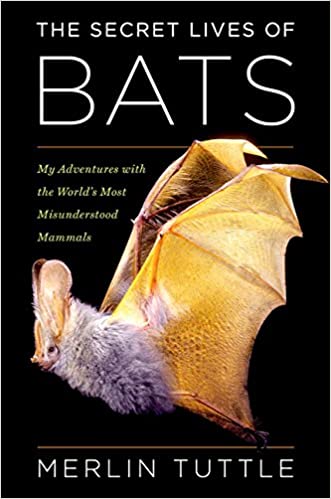
    Books and bats enthusiasts gathered at the home of Peggy Plass on the afternoon of Sunday, February 26 for the inaugural meeting of a HMN book group. Host Peggy, Sandy Greene, and Stephanie Gardner discussed Merlin Tuttle’s 2015 book, The Secret Lives of Bats: My Adventures with the World’s Most Misunderstand Mammals.

    We all gave positive reviews to this account. It is an autobiographical celebration of Dr. Merlin Tuttle’s nearly lifelong work in bat research and advocacy and consists of chapters on the major bat species that he studied and photographed worldwide over many years.

    The book drew us in with Dr. Tuttle’s accounts of harrowing experiences with advanced caving, dangerous nature, poachers, brawlers, and bandits in the field. Sandy and Stephanie found it to be a page turner. And of course, the bats and their ecosystems are endlessly fascinating. 

    The author has made a lifework of advocating for bats as charismatic and beneficial wild neighbors, not the fearsome pests as they are often imagined. He recounts his methods of engaging people worldwide in one-on-one conversations about the benefits of bats, the formation of Bat Conservation International, scientific study, hard-won bat photography, changing legislation, and habitat preservation.

    We partook of snacks, Googled Bumblebee Bats (the world’s smallest mammals), talked about which of Dr. Tuttle’s adventures were the most hair-raising, checked out the book’s bibliography, and discussed bat work in this region. The book also raised larger questions, with Peggy especially contemplating appreciation of wildlife for its own sake and not how a certain species benefits humans.

    It was an engaging discussion, and more nature reading is forecasted for the future. Stay tuned for other opportunities to join the HMN book group in learning about and discussing aspects of the natural world. While book reading does not count for VMN continuing education credit, discussion does, and the conversation (and snacks) were excellent.

    – Stephanie Gardner, February 2023


    After long months of anticipation and planning, the Headwaters Book Group was launched on Sunday afternoon, February 26th, at Peggy Plass’s house. Around a coffee table full of delicious snacks, and tea brewing in the kitchen, we talked about The Secret Lives of Bats, by Merlin Tuttle. Honestly, I wasn’t very excited to read this book – thinking I had already been exposed to a lot of bat facts. Stephanie was kind enough to loan me her copy, leaving it in a bag on her doorknob the week before. 

    Was I ever surprised! This book is not just about bats, although I learned a lot about them. It is a gripping Indiana Jones movie, set in every dangerous and extreme location in the world. Why is Merlin Tuttle even alive?  Not just treacherous caves (where the  head lamps always go out), but tides and tugboats, lions, ammonia poisoning, poachers and moonshiners. All at night, and all at a time when researchers were still using real film and cassette tapes for National Geographic articles. I couldn’t put it down!

    Even better, this book is about careful and respectful observation and documentation of whole natural systems, with carefully designed research projects, and dozens of questions remaining. Bottom line, we are only scratching the surface of complex ecology on earth.

    One constant emerged: Longterm commitment of a lot of people. It takes tough and dedicated people to hold mist nets and climbing ropes, drive the boats and dig out of quicksand. It also takes committed funders and organizations. (Tuttle founded Bat Conservation International, and wrote many articles for National Geographic). 

    Most important, Tuttle had to make friends with the individual bats, so they were trusting enough to tolerate all the intrusions, and give us a photographic glimpse of their secret lives. I can’t wait for the next book, and will definitely not judge it by its cover!

    – Sandy Greene, March 2023
  • Book Review: Healing Spaces

    Book Review: Healing Spaces

    Book Review by HMN Elizabeth Pass

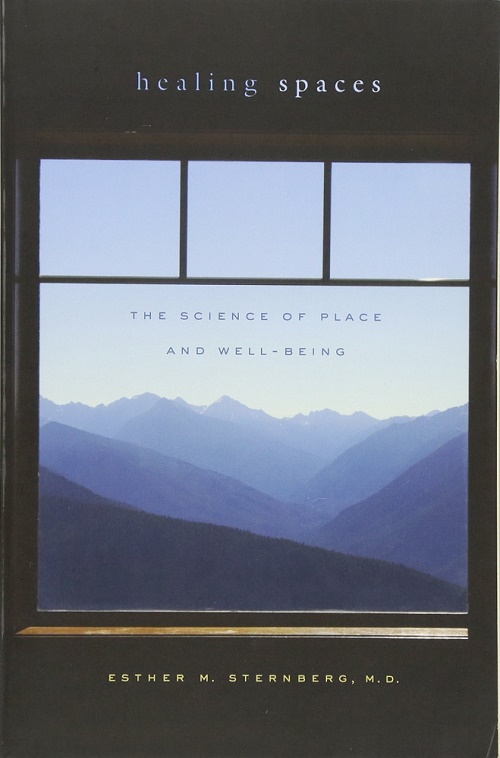
    Healing Spaces: The Science of Place and Well-Being

    by Esther M. Sternberg

    Harvard University Press, 2009

    If you have access to JMU libraries, you can read the book for free: Stable URL: https://www.jstor.org/stable/j.ctvjghtgs.1

    In some of my recent research, I ran down the rabbit hole of ecopsychology, a relatively new field focusing on the psychological processes that bond us with and alienate us from nature. This research led me to Esther Sternberg, author of the book Healing Spaces: The Science of Place and Well-Being, a Professor of Medicine in the University of Arizona College of Medicine – Tucson, and Research Director of the Andrew Weil Center for Integrative Medicine and Director of the University of Arizona Institute on Place, Wellbeing & Performance.

    She starts Healing Spaces: The Science of Place and Well-Being by posing an interesting idea:

    “Physicians and nurses know that a patient’s sudden interest in external things is the first sign that healing has begun. But do our surroundings, in turn, have an effect on us? Can the spaces around us help us to heal?”

    She proceeds to show how, through research and narrative examples, the spaces around us can either heal or harm. What I was so interested in is the idea of fluidity: that the healing that occurs in our body isn’t an all-over linear occurrence when it happens but can occur in several areas around our bodies and in several stages at the same time. More interestingly I thought, is that our perception of space and place is fluid and changes with how we perceive the physical elements, our moods, and health.

    Sternberg shows that our communication with nature is more interactive, and therefore more fluid, and thus why it’s more healing.

    What I like about this book is its readability and affirmation of nature’s healing abilities. What I find great about this book is that it demonstrates the fluidity of the spaces of nature, as well as everyday places around me, offering a new way to experience my environments.

    – Elizabeth Pass, Cohort VI, June 2021

  • Naturalist Book Nook

    Naturalist Book Nook

    Fire Season: Field Notes from a Wilderness Lookout
    by Philip Connors

    fireseasonSet in the Gila Wilderness, this book seemed to be an appropriate read while I was on the road for my November adventure in New Mexico and Arizona.  Connors, a copy editor for the Wall Street Journal, leaves his existence of a concrete city in New York City for a 7’x7′ wilderness outlook tower at 10,000 feet in the wilds of the Gila.  Connors has participated as a lookout for a decade and for this book, he journals his day to day activities and contemplations for one fire season, April through August, in 2009.  Each chapter is exclusive to the month with amusing ‘subtitles’ of sort…….  “helicopter beer run,” “trout fishing by moonlight,” ” an encounter with the Electric Cowboy,” etc.

    He is great writer and storyteller and touches on many topics including the establishment of wilderness areas (Gila was the first ever), the changing views of fire management, the problems of cattle ranching on public lands, Chief Victorio of the Apache as well as naturalist writers, Leopold and Abbey and Beat author Kerouac who was a fire lookout once in the Cascades.  Connors manages weaving all of this into a beautiful reflection of nature, solitude, and our place in the wild.  It’s an engaging and  informative read from a writer with a typewriter in the middle of nowhere!!  Connors never wants his fire season to end and I, in turn, did not want this book to end.

    à la Thoreau… Connors writes ” …. since, as we know,
    every day spent in a lookout is a day not subtracted
    from the sum of one’s life.”

    – Penny Warren, Cohort I, December 2016
    Past president, Augusta Bird Club

  • Naturalist Book Nook

    Naturalist Book Nook

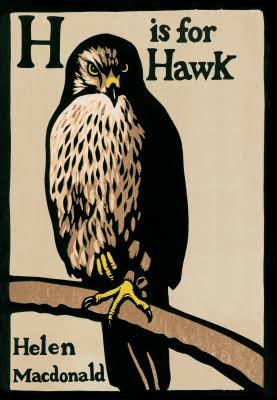
    H is for Hawk
    by Helen MacDonald

    H.isforHawkSpiraling in a tail spin with the loss of her father, MacDonald, a seasoned falconer, acquires a goshawk, a notoriously difficult predator to train with the notion it will help her to disappear into another world and momentarily forget about her loss, her grief. Part memoir, part natural science, and part reflection on the life of T.H. White and his life’s struggles and his disastrous account of training a goshawk, the book recounts an impressive journey on many levels.
    Although many books have been written about the restorative power, healing tonic of a relationship with animals, MacDonald’s book crosses the threshold into the core of the hawk’s world, her ‘hawk’ world, informing her existence all along the way. It is an eloquently written, deeply layered read where prose soars!!

    – Penny Warren, February 2016

  • Naturalist Book Nook

    Naturalist Book Nook

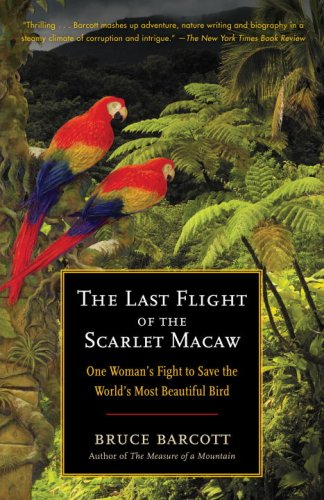
    Last Flight of the Scarlet Macaw: One Woman’s Fight to Save the World’s Most Beautiful Bird
    by Bruce Barcott

    lastflightI had this book in my possession for a good six months before picking it up to read, encouraged by a fellow birder who said it was a great story.  And although it was published in 2009, I have come to find out that many do not know of this book.

    Sharon Matola, an unlikely hero, former circus performer, and now an ‘expat’ zoo keeper in Belize and not one of the best with diplomatic skills to say the least, decides to try to stop a dam being built in Belize. The dam would flood the habitat where the last 200 Scarlet Macaws are residing in Belize.

    Under the skillful writing of Bruce Barcott, the book is a page-turner.  He creates a dramatic, suspenseful, quick pace portrayal of the blatant corruption, greed, conspiracy (e.g. a geologist hired by the government erases seismic fault lines on the survey where the dam is to be located) and the backroom politics of this tiny nation.  Barcott winds in and out of the regional geopolitics, history of dam building in the world and the destruction of free-flowing rivers, colonialism, environmental and globalization issues all the while highlighting the personal fervor and passion of one woman trying to save the macaws.  Her efforts ‘won’ her being named an “enemy of the state.”

    Matola’s website states that this book is now part of the required reading for environmental science courses in at least five universities in the US.

    A most engaging book!

    – Penny Warren, President, Augusta Bird Club, February 2015


    Copy of april's 30th 3Learn more about Sharon Matola’s current activities through The Belize Zoo Blog.

    Find out more about her and her love of Belize in this 2006 interview with BELIZEmagazine.com.