Interested in joining us? You can apply here.
Applications will remain open until December 18 or we reach 24 applications, whichever comes first.
Questions? Read more about what we do and the training itself, or contact us.
Interested in joining us? You can apply here.
Applications will remain open until December 18 or we reach 24 applications, whichever comes first.
Questions? Read more about what we do and the training itself, or contact us.
On a recent Friday I got the call from stalwart master naturalist Andrea Dono: The library was reporting that their seed bins were overflowing with walnuts and acorns donated for planting at the Department of Forestry nursery in Crimora. The situation sounded desperate. Since I had signed on to make the delivery run that week, I sprang into action.

When I arrived at the library I found somewhat less than a bushel of seeds from various donors, each bagged and labeled to species more or less in accordance with the guidelines DoF publishes for contributors. I hoped for the sake of the nursery staff that the collectors were able to identify the oaks to species, considering the challenge that can sometimes present even to seasoned botanists. Those oaks are so tribal, so regionally diverse. Hopefully the humans referred to the acorn nut identification guide also provided by DoF.
After transferring the seeds to my truck, and releasing the grubs and maggots emerging from them into the gutter, I made a call to Kathleen Fish with DoF. Andrea had told me she was our point person for the seed drive, and I needed to find out when I could drop off the goods in Crimora. I knew from an earlier visit that they run a lean operation, and sure enough, there isn’t even an office phone number published for the place. I learned from Kathleen when I could expect to find someone on site, and another interesting detail about the operation: In answer to my question, she said the donated seeds comprise a large part of those planted at the nursery. And the financial benefit is considerable, because the nursery operation is funded entirely by the proceeds from the trees they sell. And by providing the drop-off of seeds, Master Naturalists, true to our mission of supporting our sponsoring agencies, save staff resources formerly spent on the leg work I was engaged in. Good for us!
I dropped off my cargo on a drizzly morning, adding the proceeds to a collection growing within one of the barns that comprise the nursery headquarters. I followed an elderly gent toting a bucket of acorns. From my view they could have been Quercus rubrum, but I couldn’t
rule out velutina.

On my way out the drive I stopped to take a peak at the progress of some American chestnut hybrid seedlings I had helped plant last spring, curious to gauge our success. These seedlings are a project of the American Chestnut Foundation, which uses space at the nursery for its ongoing efforts to develop a strain of that legendary lost species that can self-perpetuate in its historic range.
I was amazed at the growth our seedlings had attained in barely six months! A tribute to regular care and consistent moisture. If only my tomatoes had fared as well through the summer. As I reflect on the experience I find myself thinking, there’s not much that compares to the satisfaction of contributing to the flourishing of the life of small but mighty things.
– Wick Fary

On a coolish, cloudy Saturday morning, August 15, the Lake Shenandoah pollinator meadow is at the height of summer bloom. Everything is refreshed from yesterday’s rain, and eight-foot-high cup plant towers over the trail, almost making a tunnel. Cindy Westley, Tricia Buckley, Bill Howe, and I, are here for our chapter’s monthly trail-trimming session.
A man with binoculars is looking for hummingbirds. A woman photographs flowers with her phone. Later, she stops to ask what we’re doing and admits that even though she loves the pollinator meadow, the trail can feel uncomfortably closed in sometimes.
And that’s why we’re here with our electric hedge trimmers and weed whackers, clippers, rakes, and wheelbarrow. While the plants are beautiful, summer’s abundant growth narrows the trail causing discomfort for some people who use it. Through our monthly work, we hope to make the trail more enjoyable for people who already appreciate it, and to be good pollinator meadow ambassadors for those who haven’t yet discovered its beauty.

This is a special place. A family comes along and Bill shows a very eager young boy how to tell poison ivy apart from the other plants. Two women tell us the pollinator meadow is “one of the best things about summer” that makes it “worth putting up with the rest of what summer brings.” Everyone we meet thanks us. Happy to do it. And we are.
– Scott Jost
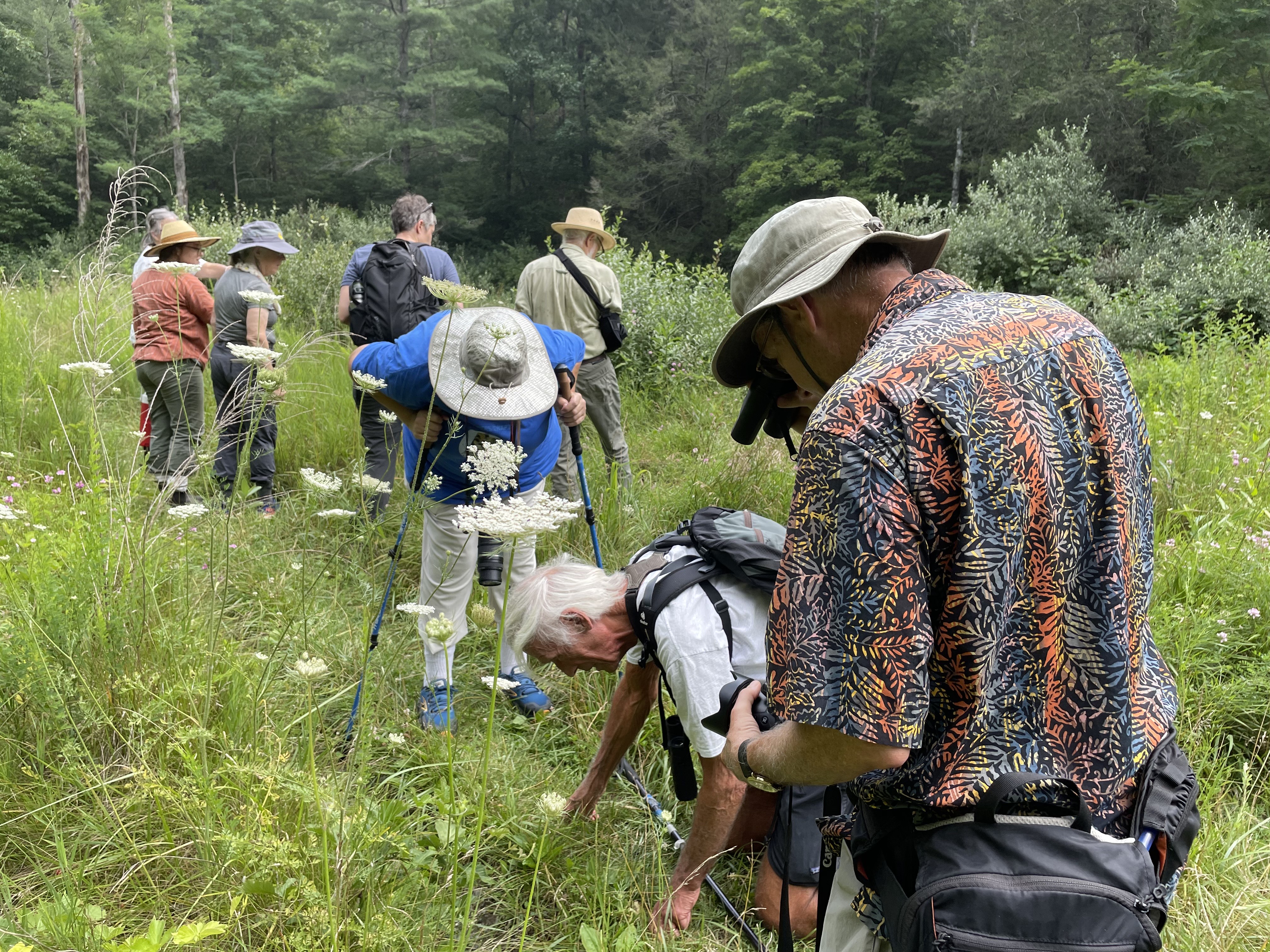
The morning began with John spending about 40 minutes at the picnic grounds giving us a lively lecture and summary of his knowledge about butterflies and moths as well as the preferred host plants of the often seen and rarely seen butterfly species in our part of Virginia. He had excellent enlarged photos of species we might see and some resource materials such as field guides. John highly recommended the book A Swift Guide to Butterflies of North America (second edition) by Jeffrey Glassburg. He also showed us detailed information sheets for specific species available from butterfliesandmoths.org which show things like life history, caterpillar host plants, adult foods, habitats and range in North America.
We then proceeded on our hike around the north shore of Braley Pond and up the trail to stop at two wildlife meadows and places in between with some blooming wildflowers. The weather was a mix of clouds and sunshine, so adequate for spotting butterflies and moths, but not ideal. We saw several Silver Spotted Skippers and a Clearwing Hummingbird Moth on bergamot in first meadow, and John also found a Clearwing Hummingbird Moth in the grass which allowed him to let it perch on his thumb for us. A few species of black swallowtails also appeared on thistle blossoms.
At the pond in the second clearing, which was created by the Forest Service, John pointed out that the site was excellent for Spotted Salamanders which could be seen in late March and April.
The exciting find at the small pond was a type of Saddleback Caterpillar moth that was brownish orange. It stayed quite still while we photographed it.
On the way back to Braley Pond the clouds were slowly on the increase so not as many butterflies were out. We took the trail on the opposite side of the pond from our morning route and were rewarded with the sight of some brilliant Cardinal Flowers and a great view of the pond and Shenandoah Mountain in the distance from on top of the dam. Our timing proved to be good since a thunderstorm was approaching soon after we left for home.
I highly recommend both Braley Pond and especially taking any chance you get to go on an outing with John Holden.
– by Malcolm Cameron


In May, members of the Virginia Master Naturalists and the Friends of the Middle River teamed up to offer members of the current training cohort and other certified naturalists to have a hands-on experience learning about macroinvertebrates at the Sandy Bottom Park in Bridgewater. Andrea Dono (VMN) and Pete Cooper (FoMR), both certified water monitors, lead the outing and invited participants to trytheir hand at taking samples from the river and practice sorting. About a dozen people got to learn about how to use macros for water quality monitoring. We hope that this “macros petting zoo” was a step to inspire new people to one day become certified. Special thanks to Jeanine Botkin, John Bauman, and Lindsay Kilborne for joining Andrea and Pete and assisting the group with set up and identification. Contact Andrea if you would like to join a fall session. One is not currently planned but if there is interest, we could explore hosting another session again this year.
– Andrea Dono