Pictured (from left): Zack Perdue, Chip Brown, Joyce Maxwell, Scott Jost, and Andrea Dono
On a beautiful Saturday morning, April 11, HMNs and community members installed around 30 native plants and weeded in the City of Harrisonburg pollinator garden on North Liberty Street across from the L&S Diner.
Through this event, and more like it in the future, we hope to demonstrate public support for Harrisonburg’s Pollinator Friendly City Program and raise awareness about the importance of pollinators and pollinator habitat on public and private property.
The next event is being planned for June, which is Pollinator Month in Harrisonburg.
For more about how Virginia Master Naturalists are contributing to vernal pool monitoring and salamander conservation (as well as the work of local conservation photographer Steven David Johnson), see the feature in this month’s issue of Virginia Wildlife, a publication of the Virginia Department of Wildlife Resources.
Photo by Tim Showalter Ehst
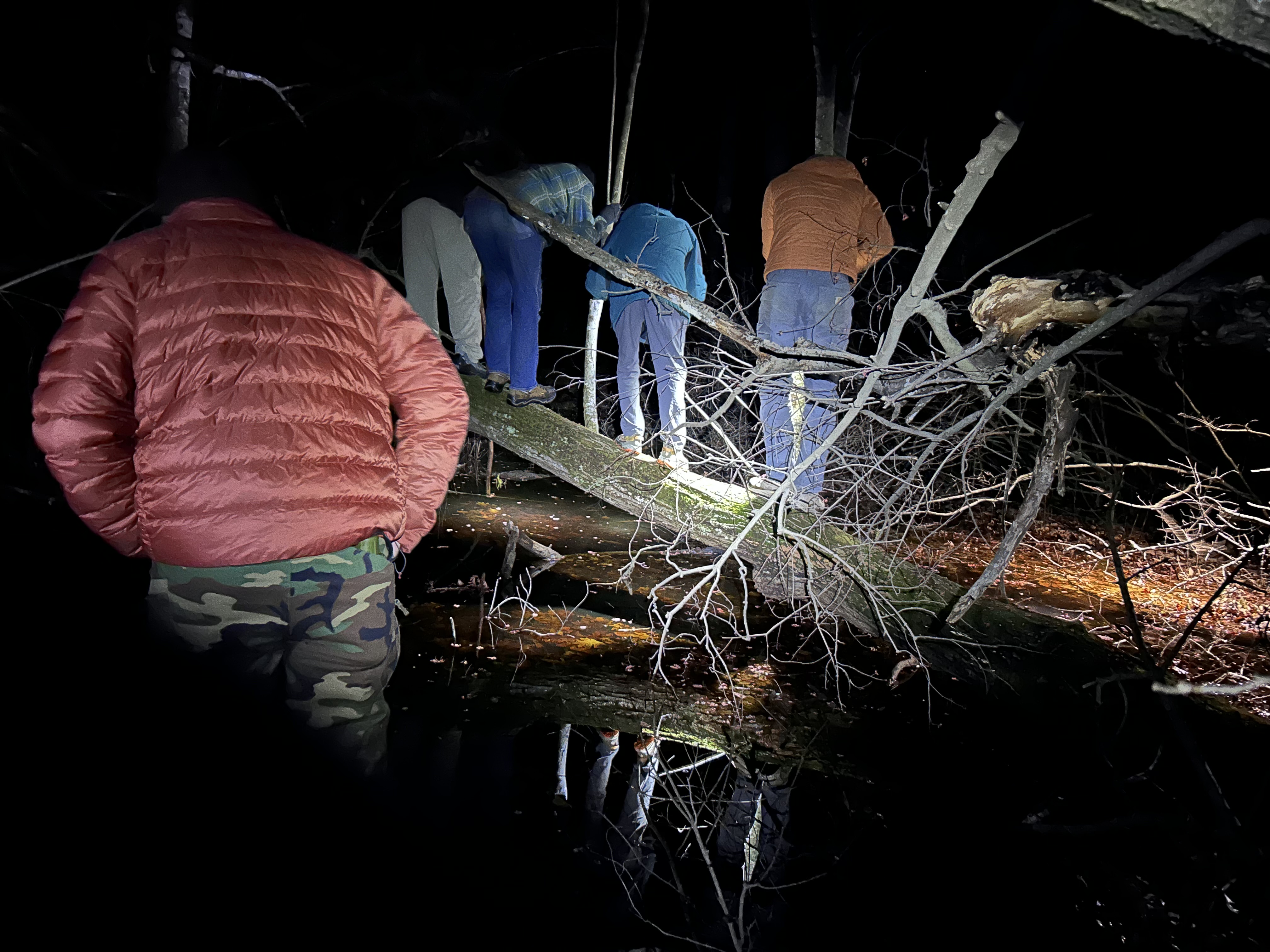
Walking carefully among the undergrowth and dodging greenbriers on a dark night on Thursday, March 12, Billy Flint, a JMU salamander ecologist, led 13 Headwaters Master Naturalists and three guests on a two-hour search around the perimeter of a private sinkhole pond. Their goal was to find spotted salamanders on the move or their egg masses during the annual mating time, usually mid-February to mid-March, depending on the weather and pond water levels.
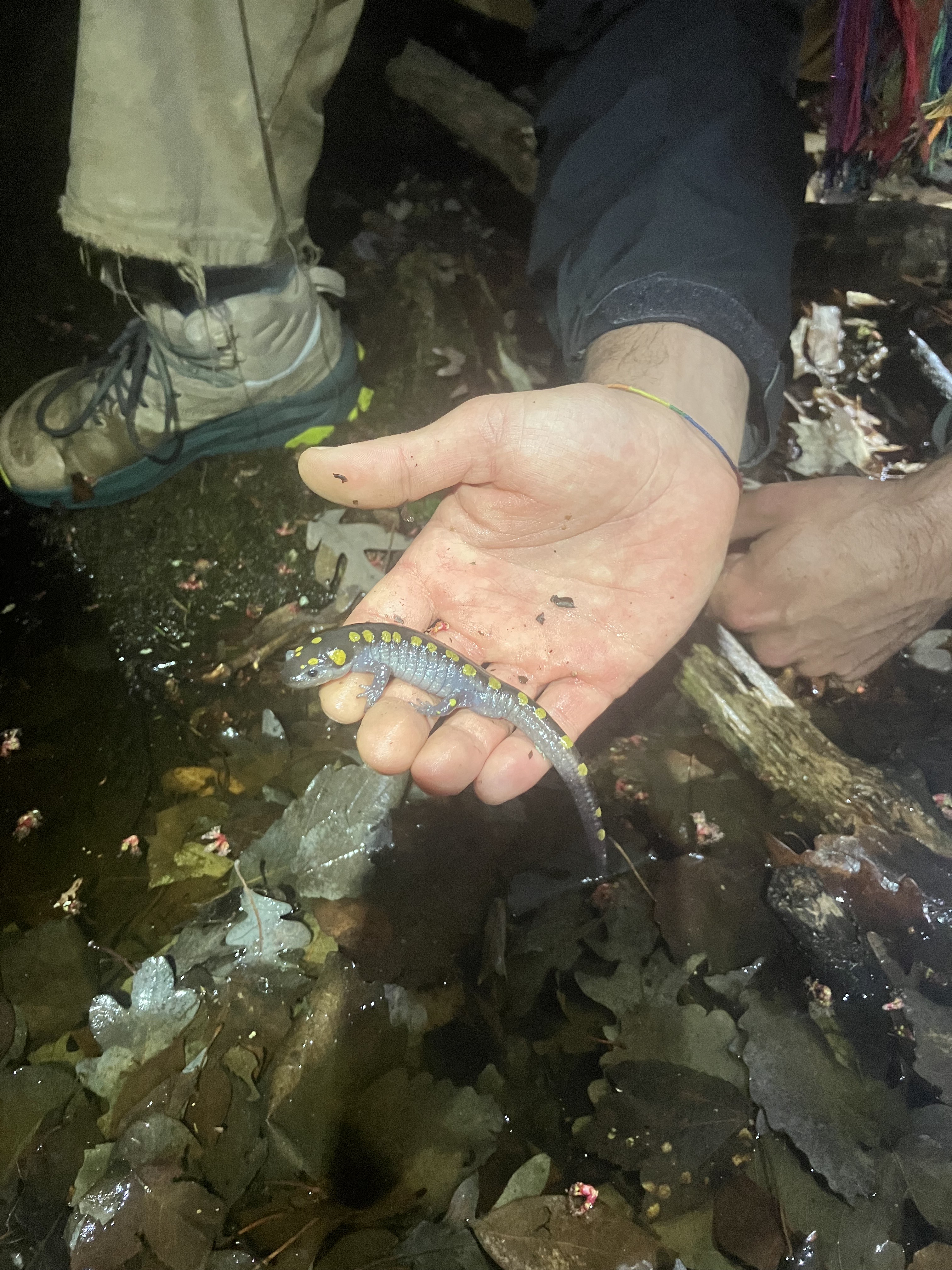
Malcolm and Lynn Cameron hosted the outing on forested land they own in eastern Augusta County which has two sinkhole ponds amidst a mixed mesophytic forest along the eastern edge of the Blue Ridge. The land has a conservation easement held by the Virginia Outdoors Foundation because of the unique ecosystems within and around the ponds. The HMN group was exploring the largest pond in hope of at least finding spotted salamander egg masses and/or the salamanders themselves. The weather conditions were not optimal, which would require that it be raining. There had been about 0.7 inches of rain that morning during a cold frontal passage, but the sunshine and strong winds that afternoon had dried out a lot of the leaf litter. The pond had enough water due to rains over the previous month, but was still only up to about 8 to 10 inches below the full level. Although the temperature was in the mid-30s, we did find a few salamanders and at least one was laying eggs in the water. These salamanders are not affected by the cold, but a fairly heavy rain is needed to signal to them that it’s time to move out from under logs and rocks on higher, dryer ground and to head to a vernal pool. In this case the site was a sinkhole pond of about 1/2 acre. The fact that we did not see other egg masses probably meant that most of the salamanders in the area were waiting for heavier rains. Our group also found a dead Northern Water Snake, which was possibly killed by a raccoon or other predator.
These vernal ponds host numerous invertebrates in the late winter and early spring months thus providing plenty of food for salamanders. In late spring, summer and fall, the ponds usually dry up and the salamanders bury in the muddy ground beneath the leaf litter, logs and loose rocks. If their favorite vernal pool becomes consistently dry, they will move over dry ground to get to new locations.
Photo by Lynn Cameron
Even though they bury themselves in mud they do not have keratin on the ends of their toes to dig. They also have lungs but can absorb oxygen through their skin when spending time in the water. They spend their overwintering in a mud-encased torpor.
Spotted salamanders often return to the same body of water in which they were hatched, reach sexual maturity after five years and can live more than thirty years. They only travel to and from vernal pools when it’s actively raining, and only then to mate; the rest of the year they remain underground. They average 6-8 inches in length, as wide as your thumb, with females usually larger than males. Males deposit silvery spermatophores throughout the vernal pool or springs and females take them into their bodies through cloaca to fertilize the eggs. A female can lay up to 300 eggs per season in multiple clutches; eggs are gelatinous clusters often attached to twigs or detritus in vernal pools. If the pools dry out before the larvae are ready to hatch, the moist gelatinous casings protect them long enough to ensure that most of them survive.
Photo by Tim Showalter Ehst
We left for home about 10 p.m., but most of us could have easily stayed longer. I found that one advantage of a clear night was that being able to see known constellations in the sky helped to keep me oriented in the dark, even in a familiar place.
Story by Malcolm Cameron with assistance from Charlie Lovewell and Bill Howe
Wick Fary affixes labels to identify each individual plant. Photo by Rob Beaton
On February 19, Rob Beaton and Wick Fary joined members of the Rivanna Chapter and American Chestnut Foundation staff and volunteers at the Virginia Department of Forestry Crimora Nursery, to plant some 800 stratified chestnut seeds.
The Virginia Chapter of TACF maintains a greenhouse at the nursery, where select hand-pollinated seedlings are grown for a year before transplanting to trial growing plots at Lesesne State Forest State Forest and elsewhere in the state.
Under the supervision of Cassie Stark, Director of Science Implementation for TACF, we prepared growing media and filled pots, nestled pre-stratified seeds below the surface in 12-inch deep pots, and–the hardest and most critical part!–affixed labels to tags that identify the parents of each new tree.
Seeds are sourced from TACF-monitored individuals from throughout the historic range of the tree, with the goal of breeding an ideal combination of blight and other pathogen resistance along with typical species traits that will be stable across generations when reintroduced to less controlled environments.
The Veterans Garden of Augusta County is building a garden where veterans grow food, connect with one another, and find healing. Located in Augusta County, Virginia, the Veterans Garden of Augusta is growing based on input from local veterans, who want a space not only for gardening, but also for learning new things such as beekeeping, mushroom cultivation, and food preservation. In response, partnerships have been formed to create a garden focused on connection, education, and peace, with new areas for growing food, caring for bees, and learning about mushrooms and food preservation.
To learn more or to support their mission, visit their website at veteransgardenofaugusta.org.
Rob Beaton, Newsletter and Website Committee Chair
Elaine Smith and Peggy Plass enjoying the presentation. Photo by Cheryl Shull.
On Friday, November 14, four members of the Headwaters Master Naturalists visited Project Owlnet’s local research station at Highland Retreat Camp. This station is one of many located throughout Canada and the United States that work to track owl migration.
Bird banding is a widely used method for collecting data on avian species, involving attaching a small plastic or metal band to a bird’s leg, which allows for individual identification during future observations at different times and locations.
Ben Spory leads a dedicated team of volunteers several times a week from mid-October through November to retrieve Northern Saw-Whet Owls from a mist net located on the ridge above the station. The owls are then weighed, measured, and banded as needed. Researchers determine the birds’ ages by placing them under a black light with their wings outstretched. Young birds show a pigment in their wings that glows pink under the light, while birds older than four years no longer display this pigment.
Ben and the other researchers provided an informative and inspiring presentation. There was also discussion about the possibility of Master Naturalist involvement next year as volunteers for the program.