Category: Field Trips

  • Herp Hike

    Herp Hike

    salamanderhike.8.18.17.1

    On the damp, dark and cloudy night of August 18, three carloads of Headwaters Master Naturalists and friends, including guests of the Camerons from Alaska, headed up Shenandoah Mountain to Reddish Knob with James Madison University’s Billy Flint to learn about terrestrial salamanders. We were especially looking for both Cow Knob and Shenandoah Mountain salamanders, two endangered species with a penchant for higher elevations and which are found nowhere else on earth. The rains of earlier that day made for perfect conditions to bring out these cute little carnivores.

    CKS.MCWe hit the jackpot and saw both rare species, especially over a dozen Cow Knob salamanders of various ages which had ventured out from beneath rocks and logs on a perfect night for them to feed. Billy Flint explained how they preferred rocky, north-facing slopes and moist conditions to keep them from drying out. Malcolm took the photo of the young Cow Knob salamander at right. It is one of the few of many taken by several of us that is in focus!

    Wet weather will bring out up to 10% of the area’s population according to Billy. They take turns emerging from the ground to check out feeding opportunities. Like other terrestrial salamanders, the Cow Knob salamanders lay their eggs in the ground, nurture them there until they hatch and do not have an aquatic stage to their life cycle as do many other salamanders.

    Preferring slightly drier conditions, we were fortunate to get to see a single Shenandoah Mountain salamander resting on a trail-side fern as spotted by Rachael Baczynski’s son Nick. These terrestrial salamanders also require selective habitats which are threatened by ongoing development and climate change.

    redbackedThe more common and also terrestrial Eastern Red-backed salamanders were in abundance this evening. The photo at left is of one found hanging out trail-side on some cohosh leaves. (Thanks to Shelley Henry for the plant ID!)

    Billy suggested we drive slowly on the long road up and down the mountain to watch for snakes and frogs in the road. Sure enough on the way down, we found two copperhead snakes which had unfortunately been run over. One was a fair-sized adult and the other a juvenile with a fading sulfur-colored tail.

    Many thanks to Billy for his fearless leadership and expertise; Malcolm for organizing the trip; Ann Murray for generously plying us with homemade cookies; Sandy Greene, Chip Brown and Rachael’s husband Mike for daring to drive the dark, narrow winding road up Reddish; and to all the other participants for making it a rewarding and fun night out!

    – Malcolm Cameron, Cohort III with Adrie Voors, Cohort II, August 2017


  • Wild Cave Trip

    Wild Cave Trip

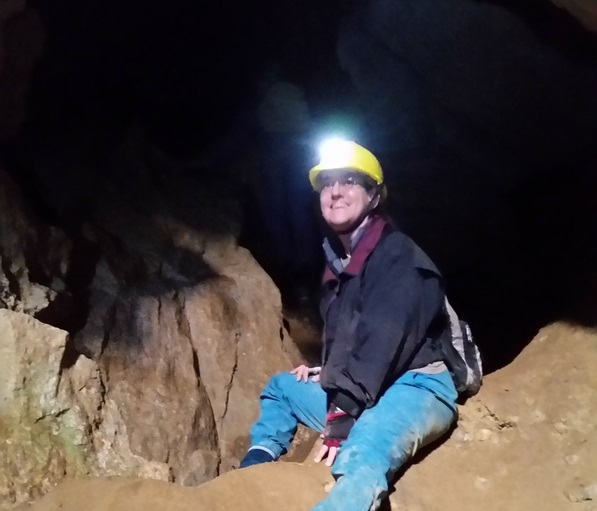
    The well-dressed caver.crop

    On Tuesday, March 21, six HMNs (including three members of this year’s training class) joined host Brian Lux and our guide, Daniel Greenawalt, on a caving adventure. Our destination was Church Mountain Cave, located off Runion’s Creek Road in Rockingham County.

    At the entranceAfter parking the cars, a short hike up a logging road and a section of trail led to the cave entrance, which is at the top of steep climb. The opening is wide, with a scramble down into a fairly large room. Because of the size of the opening, there is a lot of light coming into this room. Consequently, some of the rocks are covered with bright emerald-green mold, something you rarely see in wild caves.

    The part of the cave that we saw is pretty dry, which means the formations are not actively growing. Nonetheless, we saw a few, notably a large column—that is, a stalagmite and stalactite that have grown so long that they touch, making a single formation. This particular column appears to have settled at some point, leaving a three-inch gap about a foot below the ceiling.
    We also saw fossils embedded in the rock. The floor of the Shenandoah Valley features a thick layer of limestone, which is why there are so many caves here: surface water is slightly acidic from contact with carbon dioxide in the air and with organic material in the soil. This slightly acid water slowly dissolves the limestone, forming underground caverns. The fossils are there because the rock itself formed at the bottom of an ocean that was here before the collision of continents that created the Appalachian Mountains.

    In the big room.cropHaving explored the big room, some of us chose to follow Daniel down into the lower section of the cave. This part was also quite dry, which made easier going, since the mud which covers most of the floor is not so slippery. We eventually worked our way down to a small stream. The cave continues in several directions at this point, but we decided not to explore any further, as the passages got quite tight. Instead, we all turned out our lights for a few minutes in order to experience total darkness.
    At this point, we began the short climb back out of the cave. Some in our group had never before been in a “wild” cave, so this was a new experience. Thanks again to Daniel for being our guide, and to Brian for organizing!

    – Carl Droms, Cohort II, March 2017

    Photos by Peggy Plass, Cohort IV. At top is Kate Guenther. Kristina Oates and Daniel Greenawalt are at the cave entrance in the second photo and the third one is of the big room.

  • Tree ID Trip

    Tree ID Trip

    treeid-pp-5-pattin-crop2
    VDOF Forester Patti Nylander

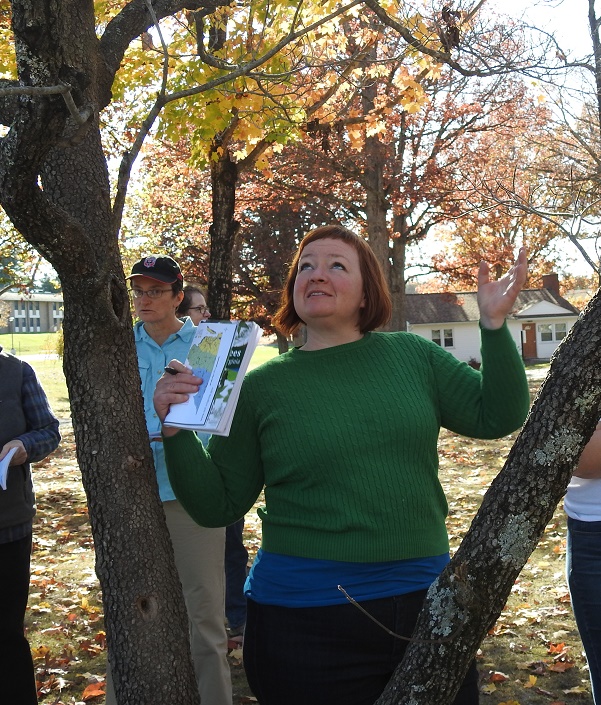
    On Sunday, November 13, Virginia Department of Forestry Senior Area Forester Patti Nylander hosted a tree identification trip for 13 members of this year’s Headwaters Master Naturalist basic training class. Trainees were joined by two current HMNs as Patti led a walk around the grounds of the Woodrow Wilson Rehabilitation Center in Fishersville, VA.

    While the field trip was intended as a “winter tree identification” outing, many of the beautiful trees at Woodrow Wilson still had their leaves, which made identification a little less challenging! Trainees had an opportunity to practice using keys from the Common Native Trees of Virginia text in determining the identity of trees like Scarlett and Black Oak and Virginia Pines.

    – Peggy Plass, Cohort IV


    Photos by Peggy Plass

  • HMNs at the Saw-whet Owl Banding Station 2016

    HMNs at the Saw-whet Owl Banding Station 2016

    owlbanding11-6-16-2-km-700

    Rockingham Bird Club members and university professors Clair Mellinger and Charles (Zig) Ziegenfus have been running a Northern Saw-whet Owl (Aegolius acadicus) banding station at the Highland Retreat Center near Bergton, VA, every fall for 15 years. They generously invite families and groups to watch and participate in their work.

    On any given night the number of owls caught is subject to the vagaries of the weather and migration patterns of these small raptors but Sunday, November 6 proved a great night for the banding station and HMNs who made the trip there. Over 20 owls were retrieved from the nets to be weighed, measured and banded.

    Clair Mellinger has been keeping a blogsite with daily reports on the station’s activity. His report for November 6 is here: https://highlandretreatowls.wordpress.com/2016/11/07/7-november-2016/

    Some notes on HMN trips to the banding station in 2014 are here.

    Photo above by Kim McCray, Cohort V, shows Kathy Whitten, Cohort V, taking notes while Clair examines a bird and Zig is weighing one.

    Thanks to Kim, Kathy and Ann Murray, Cohort II, for the photos below.

  • Fall Field Trips

    Fall Field Trips

    While the HMN Basic Training class was in full swing during its fall session, chapter members were given opportunities to join in on a wide variety of field trips. Thanks to Kate Guenther for her organizational skills that made this happen.

    Here is a sampling of where we went in October:


    mccormickfarm-10-16

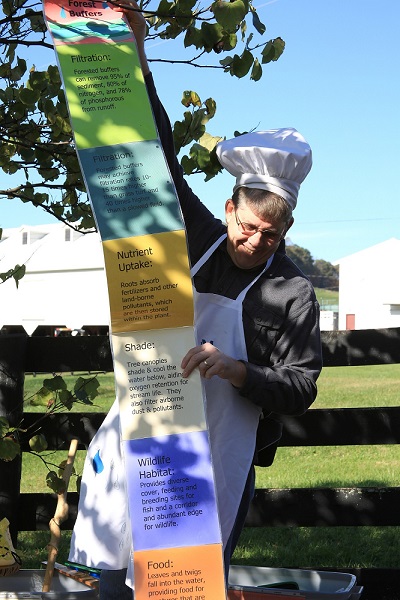
    Forestry Management at Historic McCormick Farm, October 29. Allen Baker, Cohort V, shown at left above, takes on the role of Water Chef in an activity led by Sandy Greene. The two cooked up a “soup” starting with fresh water then adding local ingredients in the way of some of the many types of pollutants that make their way into our waterways. Pouring the dirty water on a sponge offered a graphic demonstration on the function of riparian buffers and why they are so important. Allen assures us that “… the ‘pollutants’ we were using were safe stand-ins.” This was one of several activities available in the education boxes in the education shed at McCormick Farm which members can use when classes come to the farm.

    Retired forester Charlie Huppuch, in the above photo on right, leads an interpretive talk of forestry and riparian buffers on the Shenandoah Valley Agricultural Research and Extension Center trail at McCormick Farm. He discussed autumn olive and Ailanthus and other invasives, and how he is trying to preserve this old-growth section of trees. Pictured left to right: Charlie Huppuch, and cohort trainees, Rachel Kreiger, Kim McCray, Janet James, Allen Baker, Barbara Phillips, and Shelley Baker.
    Thanks to Deb Pugh, Cohort V, for the photos and Deb, Janet James and Allen Baker for reporting.


    benthicmonitoring10-16-16-300Macroinvertebrate Benthic Stream Monitoring, October 16. Through Friends of the Middle River, HMNs help sample, identify and count aquatic insects, snails, worms and other small creatures living on the rocky bottoms of different sections of the Middle River. The data is used to help determine the water quality and overall health of the stream.

    In the photo at left, Cohort V basic training class members Kathy McKenzie, Kim Atkins and Chris Shaw examine a netting from the Eastwood site.


    carbonheroes-gh-10-15-16Carbon: The Unsung Nutrient for Soil and Water, October 15. Conservationist Bobby Whitescarver discussed soils, riparian buffers and native grasses on his farm in Swoope to illustrate important farm management concepts for healthy ecosystems. Learn more from Bobby’s blog: Getting More on the Ground.
    Thanks to Ann Murray, Cohort II, for the photo and Ginny Hoffman, Cohort III, and Kate for input.


    cordage-10-12-16-2-cropMake Rope Cordage Out of Local Wild Plants, October 12. Kate Guenther, Cohort I, led this workshop out of her home near Churchville to “work with and experiment with local plants that can be used for cord making—dogbane, yucca, cattail, burdock, greenbrier, black walnut, grape and milkweed.”

    In the photo at left, Kate shows a plant from a wetland near her home to Janet James, Cohort III, and Cohort V trainees Sue Gier and Kim McCray.


    bbctour2-1-af-300Black Bear Composting Facility Tour, October 6. Black Bear founder and Chief Composting Officer Eric Walter led the group through his commercial scale composting process in Crimora. His company was instrumental in the diversion of four tons of kitchen wastes through the HMN-supported Market Compost Drop-off Program this year. More HERE.
    Photo credit Art Fovargue