Category: Field Trips

  • Black Bear Composting Tour

    Black Bear Composting Tour

    BBC.af.1.800

    On the afternoon of Thursday, June 9 Eric Walter of Black Bear Composting took a dozen of us associated with the Market Compost Drop-off project on a tour of his facility off highway 340 in Crimora. Started in October of 2011, the business currently occupies just a few of Eric’s 47 acres allowing most of the property to be a natural buffer.

    First steps in the composting process involve emptying the 65 gallon bins collected throughout the Black Bear Composting service area which includes Charlottesville, Waynesboro, Staunton, Harrisonburg and Shenandoah National Park. This day’s route happened to pick up from Shenandoah National Park. This step includes one of several efforts to pick out non-organic contaminants to the composting process. Common contaminants include non-compostable plastic bags and wrappers, plastic bottles and utensils.

    Green wastes are mixed with about four times their volume of equal parts dried leaves and wood chips. The leaves are delivered each fall from curbside collections in the Waynesboro area. Wood chips come from local landscapers. The water from bin washing is added to this mix which is arranged in long windrows and covered with a special black fabric which allows moisture to escape but sheds rain water. It is also very effective at keeping down odors and keeping out hungry wildlife.

    The freshly assembled piles must be turned five times in the next 15 days to assure a ready supply of oxygen for the busy microbes breaking down the organic wastes. After the frequent turning phase, the piles stay covered for another two months and are monitored to verify they are reaching temperatures of at least 130 ° F but not more than 170°, the range within which pathogens and weed seeds are effectively killed without killing off the helpful microbes. Samples are sent to the Virginia Department of Environmental Quality to test for Salmonella and a pathogenic roundworm egg.

    The piles then continue to cure uncovered for about four months after which they may be sifted through a 1/2 inch screen for the final end product. About 40% of the material from any one “finished” pile successfully makes it to this end stage with the remaining “overs” going back into the beginning of the composting process.

    A newer, less labor intensive method of composting has been undergoing a trial period at Black Bear Composting since late last fall. Large concrete pads are overlaid with a grid of 4-6″ perforated PVC piping connected to a blower similar to those used to blow up bounce houses. The PVC piping is covered with wood chips and/or “overs” on which the incoming green waste mixed with leaves and/or wood chips is piled and then capped with 8-12″ of wood chips and/or “overs.” The blower is rigged to a timer to fire up for 5 minutes out of every 15 minutes 24 hours a day, effectively aerating the pile without mechanical turning. This process brings the pile to the required temperatures faster and more evenly and is proving a time, space and labor saving alternative.

    Our tour ended with Eric helping us shovel up some finished compost for our home gardens.

    Many thanks to Eric for the inspiring tour and offering such a great service for our valley! Black Bear Composting is an impressively low-tech, productive and scenic operation fighting environmental degradation with each binful of compostable material diverted from the landfill.

    – Adrie Voors, Cohort II

    Reposted from the Climate Action Alliance of the Valley website which hosts the project’s webpage. Find lots of photos of our tour in the original posting HERE.

    Thanks to Kate Guenther, Art Fovargue and Carl Droms for their photos!

  • Fire and Mount Joy

    Fire and Mount Joy

    Adam.MtJoy
    Adam Christie, VDCR Steward, has a lot to offer the Natural Heritage Program and Master Naturalists.

    Adam Christie has big plans for the Mount Joy Pond Natural Area Preserve. Adam is the Virginia Department of Conservation and Recreation’s Natural Heritage Program’s Shenandoah Valley Region Steward and the Mount Joy Pond Preserve, near Raphine, VA, is one of nine preserves in his territory. He admits to it being his pet project. On Tuesday, November 10, Adam treated eight Headwaters Master Naturalists to an afternoon interpretive stroll along some freshly improved fireroads he has developed for this ecological sweet spot.

    With reminders of its recent history as a trash dump still pocking the landscape, Mount Joy Pond Natural Area Preserve is home to a large biologically sensitive sinkhole pond whose acidic, silty, loam soil supports the globally rare G1 S1* ranked Helenium virginicum Virginia sneezeweed. Adam orchestrated the removal of some five tons of trash from the area last year. This year’s project has him preparing for a springtime controlled burn covering roughly half of the 270 acre preserve with high hopes of bringing back the oak-hickory forest currently dominated by red maples and white pines. The burns target saplings of 4″ diameter and less with the maples and pines being especially vulnerable. There are some five different types of oaks in the area which stand to thrive after the burns.

    The controlled burns also have the potential of springing to life long-dormant seeds which may offer some surprise diversity. Another hoped-for effect is to increase the pond’s diminishing inundation period. Adam’s plans include the installation of a series of water-table monitoring wells which may help prove his working theory: decrease the densely packed young, fast-growing red maples and white pines sucking down the aquifer and the pond may return to its historically longer periods of holding water. Adam helped us envision the unique water-holding properties of sinkhole pond beds by roughly comparing them to Goretex: water can seep from the underground aquifer through the cobble and silt bedrock when the water table is high enough and as the water level retreats, the water stays in the pond.

    Evapotranspiration from forest foliage helps explain why sinkhole ponds tend to have the most water in the winter when the deciduous trees are bare. Despite the reality of area development and increased number of water wells also contributing to a lowered aquifer, removing the fastest growing, most dense growth around the pond could make it more pond-like.

    Adam has evidence that fires were an important component of historic natural disturbance regimes here, before the Forest Service began encouraging fire suppression. The fires created strong mature stands of oak trees which provided abundant wildlife food and required less water from the underground aquifer than the current forest growth.

    Our group was impressed with Adam’s enthusiasm and dedication to the health of our sensitive natural areas and grateful for his generously sharing his time and experience with us. We are looking forward to a followup visit to Mount Joy Pond Natural Area Preserve next spring to see the changes anticipated from the controlled burns. Adam has invited us back for this and to show us around the nearby Cowbane Prairie Natural Area Preserve  which underwent controlled burns last year.

    *G1 S1:  At high risk because of extremely limited and potentially declining numbers, extent and/or habitat, making it highly vulnerable to global extinction or extirpation in the state.

    FUN FACT: Maple leaves on a forest floor tend to stay flat and stack on one another trapping moisture which helps protect vulnerable red maples from fire. On the other hand, fallen oak leaves tend to curl as they dry making the leaves more conducive to spreading fire on a forest floor.

    – Adrie Voors, Cohort II


  • Dowells Draft and Chimney Hollow Ecology Hike

    Dowells Draft and Chimney Hollow Ecology Hike

    Goodyera pubescens, downy rattlesnake plantain
    Goodyera pubescens, downy rattlesnake plantain. Photo by Elaine Smith.

    The Headwaters Chapter 2015 Basic Training Class participated in a field trip along the Dowells Draft and Chimney Hollow trails in the George Washington National Forest, on July 29, led by “field naturalist and muddy boots plant ecologist” Eric Jones. He is the author of Wildflowers of Augusta County VA.

    Notes and photos contributed by Elaine Smith, Peggy Plass, and Byron Hukee.

    Wednesday, July 29 was a clear day for a nice, informative walk in the woods with Eric Jones. Bill and Selah Sprinkel, Byron Hukee, Kathy Byers, Peggy Plass, Elaine Smith and Judy Tammi participated.

    Plant list:

    Disturbed Area:

    • Milkweed
    • Teasel
    • Goldenrods
    • Queen Ann’s Lace
    • Wild carrot
    • Chicory
    • Crown vetch (doesn’t like shade)
    • Spotted knapweed
    • Bush honeysuckle
    • Poison Ivy (also prefers more sun than shade)
    Botanist Eric Jones. Photo by Elaine Smith
    Botanist Eric Jones. Photo by Elaine Smith.

    Forest Interior:

    • White Pine
    • Virginia Pine
    • Eastern Hemlock
    • Pignut Hickory
    • Sassafras (bird dispersed since no parent trees present. It was a major export crop for the colonists.)
    • Indian pipe (in all stages)
    • Nodding onion
    • Ebony spleenwort
    • Rattlesnake weed, not in bloom
    • Coral fungi, which is a decomposer
    • Rue leaves
    • Wintergreen
    • Black locust
    • Lichen, needs good air quality, doesn’t like acid rain
    • Pileated woodpecker holes, rectangular
    • Moss can break down cellulose
    • Bracken fern (linear growth makes it hard to eradicate)
    • Trailing arbutus
    • Mountain laurel
    • Red maple
    • Narrow-leaved Houstonia (Houstonia tenuifolia) (related to Bluets)
    • Teaberry
    • Partridgeberry in fruit stage
    • Rattlesnake plantain in bloom and were able to see the difference in the basal leaf venation
    • White and chestnut oak acorns sprout quickly. To make acorn flour, use white or chestnut oak which has less tannin than red and black oaks. Gypsy Moths are not hit as hard by Tannins as most of our native caterpillars. And it seems that they are able to use the tannins as a defense against a virus that has been introduced to control them.
    • Striped maple, or Mountain maple (unstriped)
    • Oak apple gall, wasp
    • Woodfern
    • Running cedar, lycopodium
    • Hepatica, round lobe
    • Christmas fern, sori only on some fronds
    • Wild yam
    • Turkey tail mushrooms
    • Gall on witchhazel. See Byron’s photo below. He suggests this site for more information.
    • Naked-Flowered Tick Trefoil (Desmodium nudiflorum)
    • Maple leaved viburnum
    • Chanterelles
    • Oyster mushrooms
    • Shagbark hickory, bat habitat
    • Red cap mushroom, Russula, have a beneficial relationship with pines
    • Yellow star grass
    • Heal all
    • Lactarius mushroom, give off their spores in a milky liquid
    • Smooth False Foxglove, Gerardia virginica
    • Wild cucumber
    • New York fern, tapers at both ends
    • American chestnut
    • Rhododendrons, Great Laurel growing next to stream
    • Ironwood
    • Chrysogonum virginianum, Green and Gold
  • Visit to the Center for Coldwaters Restoration

    Visit to the Center for Coldwaters Restoration

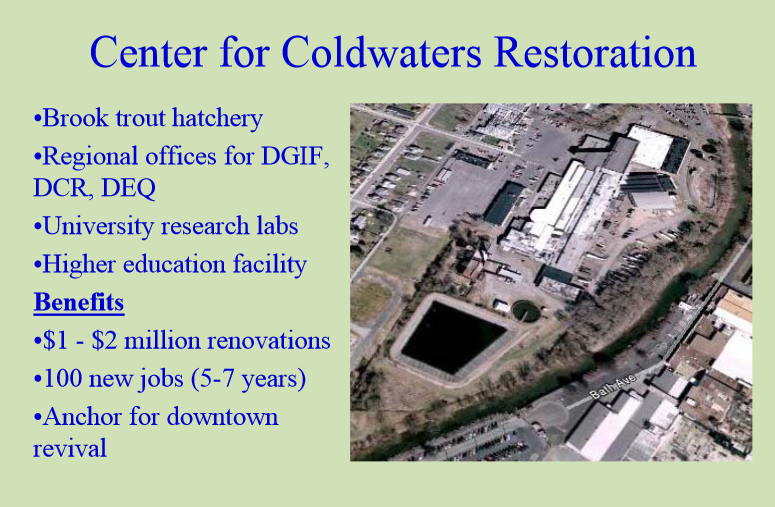
    CCRIn mid May, the Headwaters Master Naturalist training class was introduced to the Center for Coldwaters Restoration (CCR) exhibit show room for a sampling of what promises to be a world class facility in downtown Waynesboro. The Center for Coldwaters Restoration, an idea home-grown in Waynesboro, is all about the natural world (ecology) of the South River and making it a naturally healthy home to native aquatic life.  Since we know that we all live “downstream,” this is a far reaching endeavor that will have unlimited benefits for as far as the imagination can go.

    The history of the CCR goes back to the days of the law suits against Dupont for the toxic waste it contributed to the surrounding earth and water in Waynesboro.  Fishing in the South River continues to be problematic because of the mercury that continues to leach out of the stream bank soil making a less than desirable home for unstocked, wild trout that used to populate the stream. Fed by cold water springs the South River was, and should once again become, one of the natural treasures of the East Coast.

    CCR has joined with many partners to conceive of and build a facility that will incorporate four essential components located in one place. The South River as it runs through Waynesboro and a re-purposed industrial site in the City will be the basic foundations of:

    1. The Blue Ridge and Valley Interpretive Center and Aquarium – which will utilize the Virginia Museum of Natural History as a model. More here.

    2. University Research and Education Center – to establish a center for an artificial stream laboratory shared by universities and colleges in VA for the purpose of education and research of watersheds and their environments. More here.

    3. Campus for physically locating State and National agencies that share common missions, thereby eliminating duplication of facilities and increasing information exchange and accessibility among agencies studying natural resources.

    4. Hatchery – Brook Trout is our State fish and used to be wild in the South River. Now we can only hope that centers like CCR will repopulate our streams with genetically appropriate fish. To this end, the Center will be able to scientifically determine the environment and ecology that best sustain Brook Trout.  Be assured that partners such as Trout Unlimited, the Department of Conservation and Recreation, and the National Fish and Wildlife Fund will be enthusiastic about contributing to this component. The Science Team is dedicated to eliminating man made problems with South River and related streams.

    An unofficial component of this grand scheme is our Master Naturalist program.  There is a very fruitful place for us as interpreters in the galleries of the Center. After receiving specialized instruction, Master Naturalists can guide guests knowledgeably as well as provide Standards of Learning (SOL) information for students.  There will most likely be outside presentations as well.  AND…if we are willing to have specialized training, laboratory work at the Center may be available to Master Naturalists.

    It is hard to imagine a place richer in access to all levels of environmental study and research than CCR.  The design concept for the project is state-of-the-art beautiful.

    To read more about what is happening, please Google CCR, Waynesboro, VA.  To arrange for a tour of the exhibit center at 301 West Main St., Waynesboro, 540-942-6705 is the phone number of the Waynesboro Development Director who can put you in touch with the most available person for the tour. In the next couple of years, this institution will indeed be just that as well as a must visit for any visiting guests.

    – Sandi Rose, 2015 Training Class
  • Hone Quarry Walk with Chris Bowlen

    Hone Quarry Walk with Chris Bowlen

    Two members of the 2015 basic training class were joined by a few other chapter members for a wildflower-focused walk around the Hone Quarry Recreation Area with Headwaters Master Naturalist and botanist Chris Bowlen on Friday morning, May 8, 2015. RoxAnna Theiss took some notes about what was presented. Elaine Smith kept a list of findings below.

    HoneQuarry.5.8.15.300Chris spoke to us about the Spring Ephemeral strategy and ecology:  producing early spring greenery before the canopy closes with heavy leafing – storing that energy for later blooming.  A staged blooming cycle allows for the continual cycle of life – migrating insects, food for birds, a balance dependent upon each component.

    Interruptions in that balance are often delivered by non-native invasives such as garlic mustard plants that have a mycorrhizal fungi suppressant.  The relationship between plants and mycorrhizal fungi is critical to the well-being and continuation of many plants due to the symbiotic relationship.   The plant performs photosynthesis and other above-ground functions, and the fungi handle underground nutrition-gathering and protect the roots.

    Chris told stories of how many invasives were introduced by early colonists such as Bedstraw (cleavers).  In Europe, the dried, matted foliage of the plant was once used to stuff mattresses. Several of the bedstraws were used for this purpose, due to the fact that the clinging hairs cause the branches to stick together, which enables the mattress filling to maintain a uniform thickness.

    Evidence of the changing balance at Hone Quarry came from the ever decreasing stands of Jewelweed.  The loss of large predators has allowed an increase in the deer population that feed on the Jewelweed shoots before they can go to seed resulting in a decline in a plant that once blanketed the area.

    It was noted that very few of the original natives remain and much of what is considered “normal plant populations” came from somewhere else.  Change happens.

    Plants found on the walk:

    •    lettuce (so many it’s hard to id until later)
    •    sugar maple, has leafed out already
    •    shagbark hickory, still getting leaves
    •    hemlock (both eastern and Carolina are susceptible to woolly adelgid (Adelges tsugae))
    •    hickory, leaf stem covering
    •    bluets
    •    heart leaved aster (leaves)
    •    wild strawberries
    •    spicebush (Lindera benzoin)
    •    wine berry (non native)
    •    anemone (wood?)
    •    miterwort, bishop’s cap
    •    kidney leaved buttercup (Ranunculus)
    •    long spurred violet (white and violet)
    •    cinquefoil (Indian strawberry)
    •    plantain, both common (large round leaf) and English (long pointed leaf)
    •    lyre leaved sage
    •    fleabane daisy
    •    blackberry
    •    Virginia creeper
    •    poison ivy (much discussed)
    •    striped maple (in flower)
    •    sycamore
    •    witch hazel
    •    sweet cicely (Myrrhis odorata)
    •    blood root (past bloom, but many leaves remain)
    •    impatiens (jewel weed family)
    •    goldenrod (will bloom in fall)
    •    ebony spleenwort
    •    rue anemone
    •    wild grape
    •    Christmas fern
    •    cutleaf toothwort (past bloom, but many leaves remain)
    •    yellow violet
    •    wild geranium
    •    bedstraw/cleavers
    •    stinging nettle (lots of wildlife value!)
    •    sphagnum moss
    •    common blue violet
    •    Solomon’s seal
    •    wild ginger
    •    black cohosh
    •    partridge berry
    •    honeysuckle
    •    greenbrier
    •    burdock
    •    dogwood
    •    Japanese barberry
    •    hepatica (past bloom, but many leaves remain)
    •    perfoliated bellwort
    •    golden ragwort
    •    jewelweed (deer will eat tops before it can go to seed)
    •    lousewort leaves (?)
    •    Microstegium vimineum, stilt grass (dominant invasive)
    •    pipevine, Dutchman’s pipe (Aristolochia)
    •    coltsfoot (some gone to seed, like dandelions)
    •    early dogbane
    •    beech tree
    •    fringed polygala