Once again, we are being treated to the wealth of knowledge and generosity of local fungi experts Jack Wilson and Chris & Vicki Vacher on a walk/talk and more, on Sunday, September 12, starting at 9:30AM.
Jack shares this “draft plan” for our outing:
“To avoid hot weather, we should start at MoonDance Camp (Braley Pond Road) at 9:30AM.
We will be at 2000’ and that helps some with summer heat.
After a brief orientation, we would hike much of the route we did for the (February 2020) Lichen Hike, plus a look at the Calfpasture River.
We will do a scouting expedition a few days ahead of time to see what’s out.
I would suggest that we add Summer Pollinators to the agenda. The pollinator garden in front of the Wayside solar panels is in it’s third year and was developed with help from Master Naturalists. It would make an interesting stop, if we add pollinators as a topic.
After what is an easy 2 mile hike, we would head to Churchville and The Necessary. Lunch can be either bring-your-own or pre-ordered and waiting for us at The Necessary. The Necessary has a video kiosk for the inside portion of the program. The Necessary is an outlet for White’s Wayside and is also home to both Necessary Bees and Friends of Fungus.
No Pets, No Smoking, 10–12-person limit is our preference.
Hiking poles, long pants, creek hopping shoes and a camera with good macro features are suggested.”
“Jack Wilson, along with Chris & Vicki Vacher, are residents of the George Washington National Forest, likers of lichens, beekeepers and certified/state-approved mushroom foragers.
Jack is the proprietor of White’s Wayside Diner. When not busy with the above-mentioned activities, he is attempting to train Bella the Diner Dog to find morels.
Christopher is a licensed landscape contractor who has installed well over 10,000 plants, practices small-scale organic agriculture, and has worked on many conservation projects.
Vicki is a degreed horticulturist who enjoys creating landscapes with natural beauty that improve the environment and provide habitats for biodiversity.” – fromour February 2020 Headwaters Highlights HERE.
Thanks to Malcolm Cameron with our CE Committee for making this happen! He is our Chapter host for this trip and can be reached at malcolmgcameron [at] gmail.com
Sign up to attend in the current VMN VMS: Better Impact. You will be given directions to get to this outing once you’ve signed up. Sign up early. Space is limited!
Rain date is Saturday, September 18.
Read about our November 2017 Lichen Hike with Jack HERE.
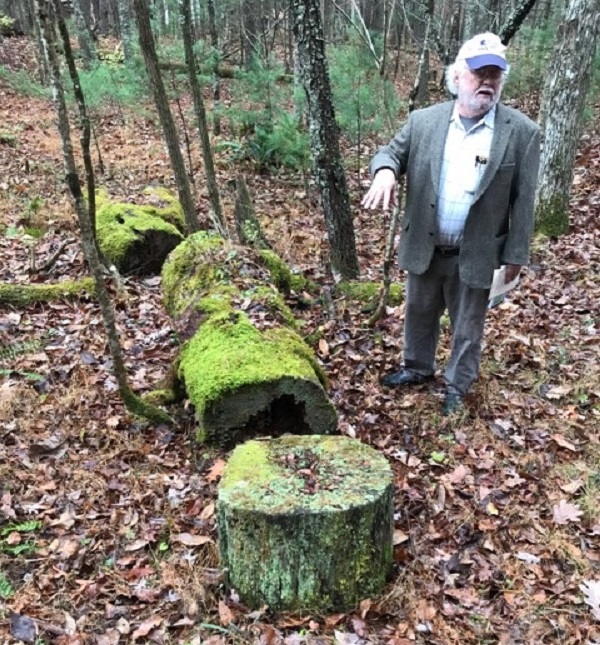
Photo above is of Jack and a lichen-covered log from our 2017 outing with him. Photo by Jerry Hopkins, Cohort I.
Precipitated by the chance meeting of our Headwaters Chapter’s president and the then president of the Southwestern Piedmont Chapter of the Virginia Master Naturalists at a leadership workshop last fall, members of our Chapter recently enjoyed a full weekend of activities in a distant part of Virginia new to many of us.
Some dozen HMNs and family members gathered at Virginia’s Fairy Stone State Park in Patrick County on Friday evening, June 21. We picked out our accommodations for the weekend ranging from tents and bunk beds in the group “lodge,” to a reserved cabin and RV spot. As it grew dark we were treated to a roaring campfire and tender tunes from a talented trio of HMNs: Burt Blessing, Dave Forrer and John Bauman. They deftly handled requests from our group. Janet James supplied us with the quintessential campfire treat: s’mores!
Morning found us carpooling for the 30-minute drive to the Virginia Museum of Natural History (VMNH) in Martinsville. There we were greeted by several members of the Southwestern Piedmont Chapter who hosted a full day of activities for us. Christy Deatherage is the current president of this local VMN chapter based out of the Museum; she is also the Education Manager for the VMNH. We were fortunate to have her as an experienced guide throughout our day. Divided into two groups, we enjoyed Museum tours, both public and behind the scenes in the morning. Scroll through the photo tiles below this article for more about this.
Dr. Elizabeth Moore at home surrounded by excavated bones and shells. Photo by Elizabeth Pass.
While we ate lunch, the museum’s recent curator of archaeology, Elizabeth Moore, gave a presentation about an excavation she was involved with in the Great Neck area of Virginia Beach in which her team unearthed remnants of a Native American encampment dating back 1500 years. As a “faunal” specialist, Dr. Moore particularly enjoys examining recovered bone and shell shards, since they give us insight into how people lived, what they ate, and what kinds of domestic animals they kept. Read more about the Great Neck excavation efforts from Stacy Parker of The Virginian-Pilot in this article dated December 1, 2015. A pdf version is here in case the online version isn’t available to you.
Dr. Moore is currently transitioning into the position of State Archaeologist in the Virginia Department of Historic Resources, Division of Archaeology.
After Dr. Moore’s talk, we all had the opportunity to help with some of the work that needs to be done “behind the scenes” at the Museum. Dr. Moore has a large number of bags of material that had been excavated from that site in Virginia Beach which we scrutinized for animal-type material, like pieces of bone, shell and fish scales. Other samples that had been collected from the site of an Occaneechi Indian village along the Roanoke River in Pittsylvania County were examined for miniature beads, though no beads were found in our samples.
Dr. Moore also has possession of a “significant archaeological faunal assemblage” saved from the landfill where it was headed before Dr. Moore received grant funding to study these 17-19th century bones and teeth from the Claremont Manor in Surry County. Before they can be studied, the individual pieces need to be cleaned. We were given instructions on how to do this, using toothbrushes, dental picks, and small amounts of water. More about Claremont Manor from the Surry County tourism website here.
A smaller number of us were also given the chance to work in the “wet room”: this is where a large sampling of animals including many reptiles and amphibians are kept in bottles of alcohol and formaldehyde. Our job was to identify the liquid in each bottle, and to top it up if necessary.
All in all, it was an interesting glimpse into what might be called the daily grind of science … a lot of work goes into making that great breakthrough!
Kathy Fell, a member and past president of the Southwestern Piedmont Chapter, was instrumental in organizing this day of activities for us. She met our chapter president Chris Bowlen at a VMN leadership workshop in Charlottesville last fall. Kathy invites all VMNs to help with museum work every Tuesday. Contact her at kathyfell [at] yahoo [dot] com
Garden walk at the home of Kathy Fell. Photo by Elizabeth Pass.
Saturday evening, we were all invited to a potluck dinner and social gathering at Kathy’s lovely and spacious home with other members of the Southwestern Piedmont Chapter. Kathy’s house is surrounded by vast gardens of wildlife-supporting plants accessed by stone walkways all of which she installed herself.
Sunday morning was free time. A few of us hiked to the park’s waterfall, while others went kayaking or headed for home.
In hopes of giving more members this fun and instructive opportunity, our chapter is considering a similar trip next year. Many thanks to Continuing Education Chair Margaret Speicher for her work preparing for this “retreat,” despite being unable to attend herself. All the more reason for a repeat!
– Carl Droms and Adrie Voors, Cohort II, June 2019 With thanks to Kathy Fell for her help with some of the VMNH details!
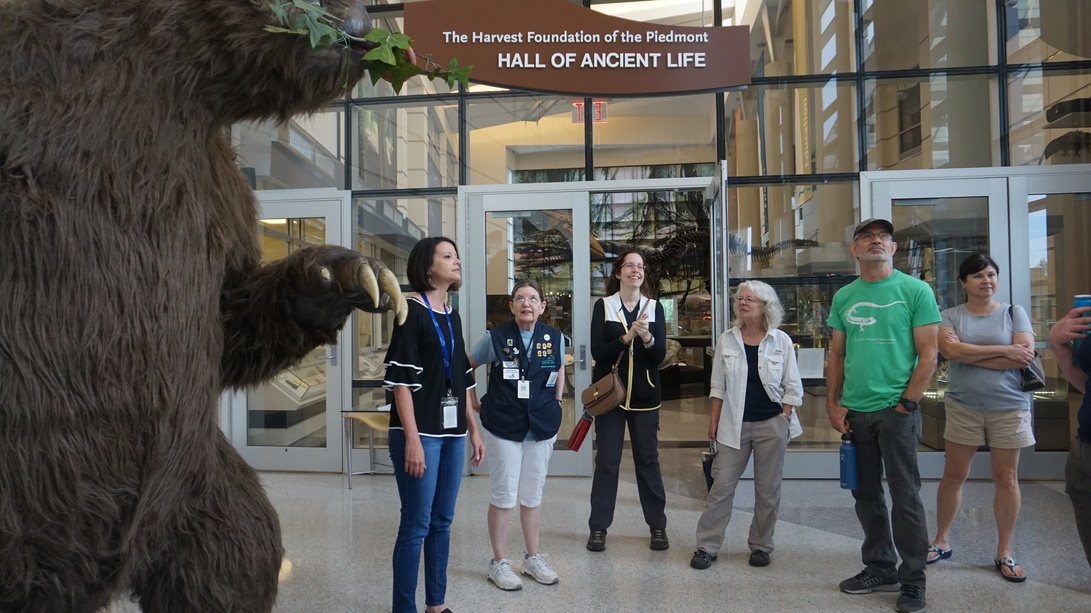
Photo at the very top is of Southwestern Piedmont Chapter members Christy Deatherage and Gael Chaney with some of our group between tours at the Virginia Museum of Natural History on Saturday, June 22. Photo credit: Carl Droms.
Click on a photo below to see it enlarged, find the full caption, and start a slide show.
Sending out smoke signals from our camp area in Fairy Stone State Park.
Friday night campfire.
Mary, Ivan Hiett, Jenna, and Janet sifting through sand, looking for tiny Native American glass beads. Photo by Elizabeth Pass.
Jenna led us in a game of “name that skull” at Fairy Stone State Park.
Burt, John, and Dave and their 3 guitars serenading us Friday night. Photo by Elizabeth Pass.
Dave paddling along the shore of Fairy Stone Lake on Sunday, June 23. Photo by John Bauman.
VMNH trophy room. Photo by Carl Droms.
Elizabeth and Dave check out the rock garden in front of the VMNH building. Photo by John Bauman.
VMNH’s dermestid beetle colony cleaning a specimen. Photo by Elizabeth Pass.
Chris and Christy in the Bone Room. Photo by Elizabeth Pass.
British Soldier Lichen at Kathy Fell’s home. Photo by John Bauman
Peggy, Christy, and Burt cleaning bones. Photo by Elizabeth Pass.
Fresh Water Bryozoans (Moss Animals) in Fairy Stone Lake. “Dave and I found these attached to tree limbs submerged in the lake while kayaking.” Photo by John Bauman.
A closer look at the Freshwater Bryozoans by John Bauman
Burt in the Wet Lab. Photo by Elizabeth Pass.
Adrie sniff testing for preservative type. Photo by Carl Droms.
Christy showing Peggy one of many trays of bird skins stored at the VMNH. Photo by Carl Droms.
Christy showing us one of the many drawers of bones. Photo by Elizabeth Pass.
Dave, Burt, and Sarah looking at a 500 million year-old stromatolite. Photo by Elizabeth Pass.
John Bauman paddling by rhododendrons at Fairy Stone Lake. Photo by David Forrer.
Chris, Peggy, Carl and Adrie followed a park trail to a waterfall on Sunday, June 23.
Virginia Museum of Natural History / Fairy Stone State Park Retreat June 21 to June 23, 2019
HMN Chapter President Chris Bowlen and Continuing Education Committee Chair Margaret Speicher have been making plans since early this year for a 1st Annual HMN Retreat to visit another part of the state. We will stay at a Virginia State Park and spend time with a VMN sponsor organization and another VMN Chapter.
Our weekend will begin with a Summer Solstice Celebration Friday night at the Fairy Stone State Park Campground. Come ready to relax, chat, and bring instruments.
OnSaturday we will carpool to the Virginia Museum of Natural History in Martinsville for an exciting day of volunteer and continuing education opportunities. Training is available for all activities and everyone will have the opportunity to rotate through the various offerings throughout the day.
Behind the scenes tour – What happens in the areas that the public doesn’t get to see…..you will find out !
Bone Cleaning – Over one hundred boxes remain to be washed, sorted, and catalogued under the guidance of museum staff. Where did these bones originate, you ask? Trash!
Sifting for Beads – Screened material from the Chesapeake and Virginia Beach area are likely to contain Native American beads.
Slide Scanning and Documentation – As to be expected in any museum of natural history, there are A LOT of data, and a lot of resources. We can thank the museum for our time there by helping with some of the administrative tasks that just keep coming. We can help by working on scanning and filing the many resources.
Wet Lab – Topping off alcohol in the lab’s specimen jars. This is a neat opportunity to investigate the hundreds of jars of bugs, reptiles, mollusks and other curious creatures.
Tour of the Museum Exhibits
Presentation by Dr. Elizabeth Moore, VMNH Curator of Archaeology – During lunch Dr. Moore will give us an up close and personal talk about one of their archaeological sites.
Chapters’ Projects Discussion – After lunch we will have an opportunity to sit down with members of the Southwestern Piedmont Chapter and discuss some of our ongoing projects and hear some of the great things they are doing in their area.
Saturday evening we will join members of the Southwestern Piedmont Chapter for a potluck dinner at the home of (former) Chapter President, Kathy Fell. She has a large kitchen and outdoor fire pit. Hone up your “stick cooking” skills and bring your pie iron to cook dinner over the fire. A “perfect potluck” link with the Southwestern Piedmont group can be found HERE. (Please note that this potluck signup link replaces the one published in our May newsletter). We ask everyone to contribute to the dinner. Please contact Margaret Speicher at margaret.speicher [at] gmail [dot] com with any dietary restrictions so that she can pass them along to Kathy.
Camping is available in either the group campsites or the rustic lodge (bunkhouse), you must contact Chris Bowlen at bowlenchris [at] comcast [dot] net to reserve your spot. The fee is $20. We currently have spaces available in the bunkhouse and group tent sites, first come first served. If you would prefer, you may contact Fairy Stone State Park to reserve a private campsite, they fill fast so check their website for availability.
This is sure to be a memorable weekend you don’t want to miss.
– Margaret Speicher, Continuing Education Chair
Top two photos are from the Virginia Museum of Natural History’s Facebook page.
April 22, Earth Day, with warm sunny weather, was an appropriate time for three Headwaters Master Naturalists and guests Mike Smith of the local PATC Chapter and Roger and Cynthia Barouti of Allegheny Highlands Master Naturalists to explore rare plants at four area shale barrens and a couple other locations.
Jay Shaner, a well- known wildflower expert from Staunton, led our trip through Allegheny, Botetourt, Bath and Augusta counties. Shale barrens, because of the dry, south-facing slopes and temperatures that often reach 140 degrees, harbor rare plants that have adapted to these harsh environments.
Our first stop was near Bessemer along Craig Creek in Botetourt County, just west of Rte. 220. This location has Virginia White-Haired Clematis, which is found in only seven counties in Virginia. The defining feature of these plants is the hairy white, bell-shaped blossoms, where other wild clematis have lavender blossoms with very little hair. We also saw the yellow Shale Barren Ragwort and Shale Barren Pussytoes, plus common wildflowers such as Bleeding Heart, Wild Pink and Rue Anenome.
On a second stop on the south side of Craig Creek, we were not able to find Clematis. After lunch we stopped along Rte. 42 opposite the Cowpasture River at a small shale barren where we saw Shale Barren Primrose, Shale Buckwheat and Plume Lilly.
The Baroutis knew of a couple sites on or near the Walton Tract in the George Washington National Forest south of Millboro Springs, so we stopped there. Plants found there included Walking Fern, which is fairly rare, Jack-in-the-Pulpit, Twin Leaf and both Red and Grandiflorum Trilliums. The Trilliums and Twin Leaf were very prolific in a rich, moist forest.
The next stop was along Rte. 633 west of Millboro where we saw the Millboro Leatherflower, a rare Clematis and also Wild Oats. This required a bit more walking along the road from the parking area, but was well worth it.
Our final stop was along the old Parkersburg Turnpike near the crest of Great North Mountain, on the east side of Deerfield Valley. Here we saw Clematis Albacoma ( also a rare type of white-haired clematis), Wood Vetch and Wild Pink.
All in our group agreed that this was by far the best way to spend Earth Day. Many thanks to Jay Shaner for taking a whole day to impart his vast knowledge of rare wildflowers in western Virginia.
– Malcolm Cameron, Cohort III, April 2019
Top photo is of Jay Shaner with trip participants by Malcolm. Photos below are by Malcolm and HMN Jean Stephens. Click on a photo to enlarge it and view the photos as a slide show.
Photo by Malcolm.
Aspleium rhizophyllum (Walking Fern). Photo by Jean.
Clematis coactilis (Virginia White Haired Leatherflower). Photo by Jean.
Dicentra eximia (Wild Bleeding Heart). Photo by Jean.
Clematis albicoma (White Haired Leatherflower). Photo by Jean.
Clematis viticaulis (Millboro Leatherflower). Photo by Jean.
Sunday, March 10 turned out to be a beautiful, warm, spring-like day for 14 Headwaters Master Naturalists and five guests who enjoyed a very informative outing to Maple Flats Ponds near Sherando with James Madison University Instructor in Biology Billy Flint. Billy’s hope was that we would see at least 6 to 8 species of salamanders and frogs. The ponds and surroundings surpassed his expectations by providing us a look at 10 species all together.
We explored three sinkhole ponds of various sizes and a couple of streams which drain or flow into them. These sinkhole ponds are unique to the western base of the Blue Ridge in our area and form when limestone dissolves locally beneath a mantle of colluvial soils which washed off the mountains. A layer of clay forms several feet below the surface of this area and creates a perched surface water table that reaches up into the sinkholes during the wet season.
A common Eastern Red-Backed Salamander beneath a log along a small stream was our first find. These may or may not have a red stripe on their back and are nocturnal like most salamanders. The ones without a red stripe are called ‘Lead Backs’. Like all salamanders, they’re carnivorous in every stage of their lives.
Billy explained how the three species of mole salamanders (all terrestrial as adults that stay mostly underground) found at Maple Flats have different breeding periods so that the competition for resources is minimized. They only enter the pond areas to breed and lay their eggs. Billy found an adult Spotted Salamander next to a small pond. These are fairly large at 4 to 7 inches and are black with distinctive yellow spots. They mate and lay eggs in February to March and have an elaborate, swimming ‘mating dance’. The other mole salamander species common to the Maple Flats area are the smaller Marbled Salamanders which mate and lay eggs in the fall, and the state endangered Tiger Salamanders that breed in January.
Shelley found a Spring Peeper frog hopping on the leaf litter as we were leaving this first small pond. Only the males call in the chorus we hear each year.
The second pond was much larger, but very heavily grown-in with greenbriers, making access challenging. This pond was currently larger than any of our group had ever seen it before. Billy waded into it and found a salamander larva which was probably a Marbled Salamander. A few Cricket Frogs were found on surrounding soggy ground. These are smaller than Peepers at just over an inch and have more warty skin.
Billy found and held up a large gelatinous mass of salamander eggs with small larvae of the Spotted Salamander.
Kids are usually better at finding things and Merrilee’s son Eli located a typically 5 inch Red Salamander under a rock away from the pond. These showy copper-red salamanders were named the Virginia State Amphibian by Virginia lawmakers last year. They are not to be confused with the Red Eft stage of the smaller Red-Spotted Newt.
A young Northern Dusky Salamander was also among the day’s finds. Billy noted that they’re mostly aquatic and lungless, breathing through their moist skin and mucous membranes. A young Four-Toed Salamander and an aquatic adult male Red-Spotted Newt rounded out our salamander discoveries. The Four-Toed Salamander is named for having only four toes on each back leg. Most salamanders have four toes on each of their front legs but five on the rear. At only 2-3 inches in length, we could not count the toes on Billy’s find but their distinctive white belly with black spots is a giveaway characteristic of this species. They lay their eggs in moss at the edge of the pond and the larvae can then easily wiggle into the water. The aquatic adult Red-Spotted Newts have lungs and are toxic to fish. They can spend up to six or seven years as juvenile, terrestrial Red-Spotted Newt Efts looking for suitable habitat and conditions to reach their reproductive form.
Ben described seeing a tadpole which Billy determined was most likely a Bullfrog considering the time of year. Bullfrogs actually mate in early summer, but their tadpoles often don’t complete metamorphosis until the following summer, and so will remain as tadpoles for a whole year.
We enjoyed about three hours exploring the ponds and all wished we had more time to see what other wonders could be found in these unique habitats.
We are extremely fortunate to have such a knowledgeable and enthusiastic herp guide in Billy Flint. Our sincerest thanks to him for taking the time to share his wealth of expertise and sharp eye for us to experience a bit of the fascinating world of amphibians associated with vernal pools and sinkhole ponds.
– Malcolm Cameron, Cohort III, March 2019
And many thanks to Malcolm for organizing this trip!
Thanks to Cheryl Shull, Eli Lianez, and Debbie Pugh for taking and sending in the great photos below! Click on any one to enlarge it and get a slide show. Uncredited photos are by Adrie.
Boot bleaching before entering the ecologically sensitive Maple Flats Ponds area. Photo credit: Debbie Pugh
Spring Peeper. Photo credit: Cheryl Shull
Spotted Salamander. Photo credit: Cheryl Shull
Billy with a Spotted Salamander.
Shelley and Eli checking out a find by Billy. Photo credit: Debbie Pugh
Four-Toed Salamander. Photo credit: Eli Lianez
John and Ben searching the pond.
Cricket Frog. Photo credit: Cheryl Shull
Eli with his Red Salamander find.
Red Salamander found and photographed by Eli Lianez. This is the Virginia State Amphibian.



 On Saturday we will carpool to the Virginia Museum of Natural History in Martinsville for an exciting day of volunteer and continuing education opportunities. Training is available for all activities and everyone will have the opportunity to rotate through the various offerings throughout the day.
 Sunday is on your own at the park. Contact Fairy Stone Park for information and availability for renting kayaks or canoes. You can also contact


 Kids are usually better at finding things and Merrilee’s son Eli located a typically 5 inch


