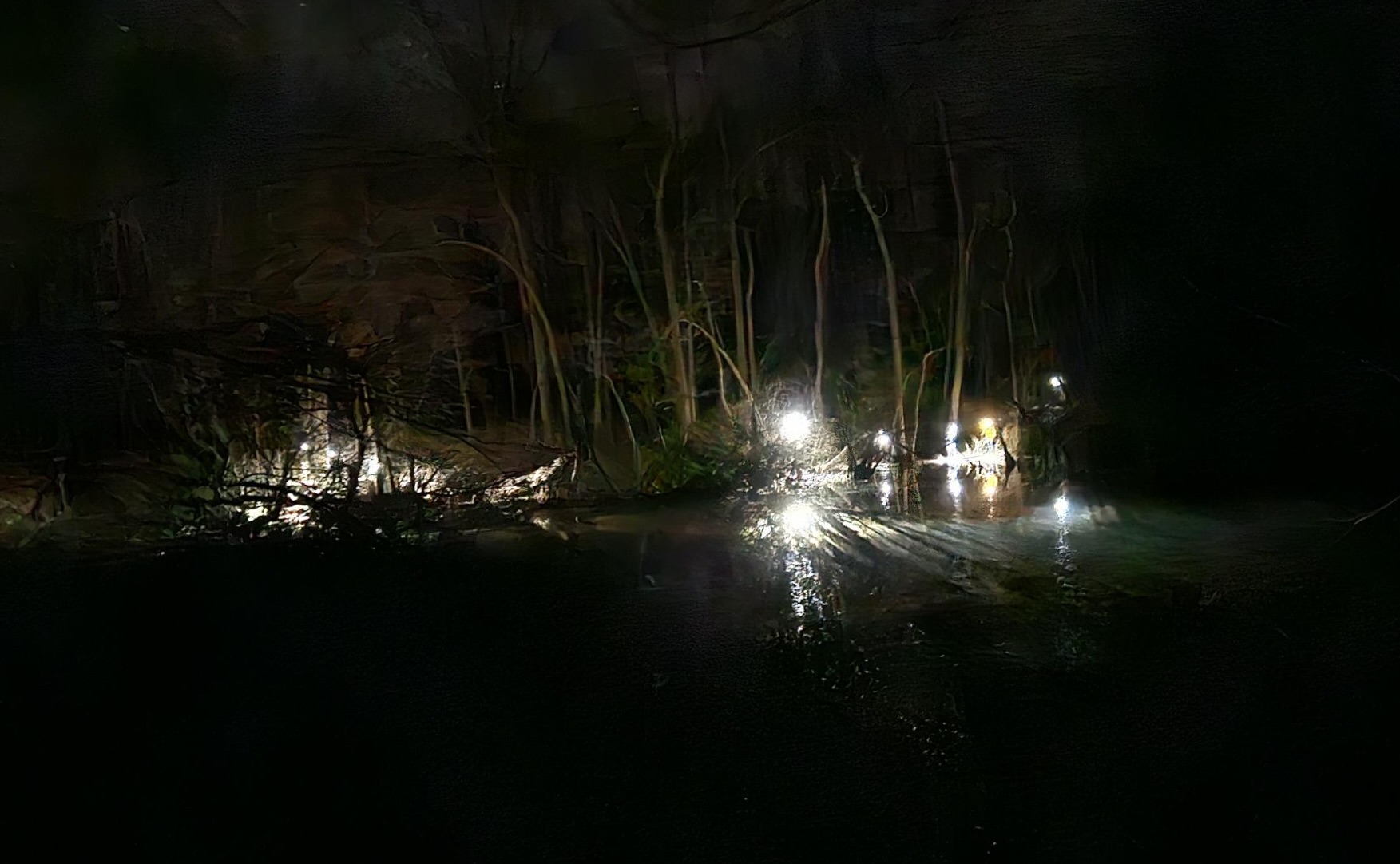
For more about how Virginia Master Naturalists are contributing to vernal pool monitoring and salamander conservation (as well as the work of local conservation photographer Steven David Johnson), see the feature in this month’s issue of Virginia Wildlife, a publication of the Virginia Department of Wildlife Resources.
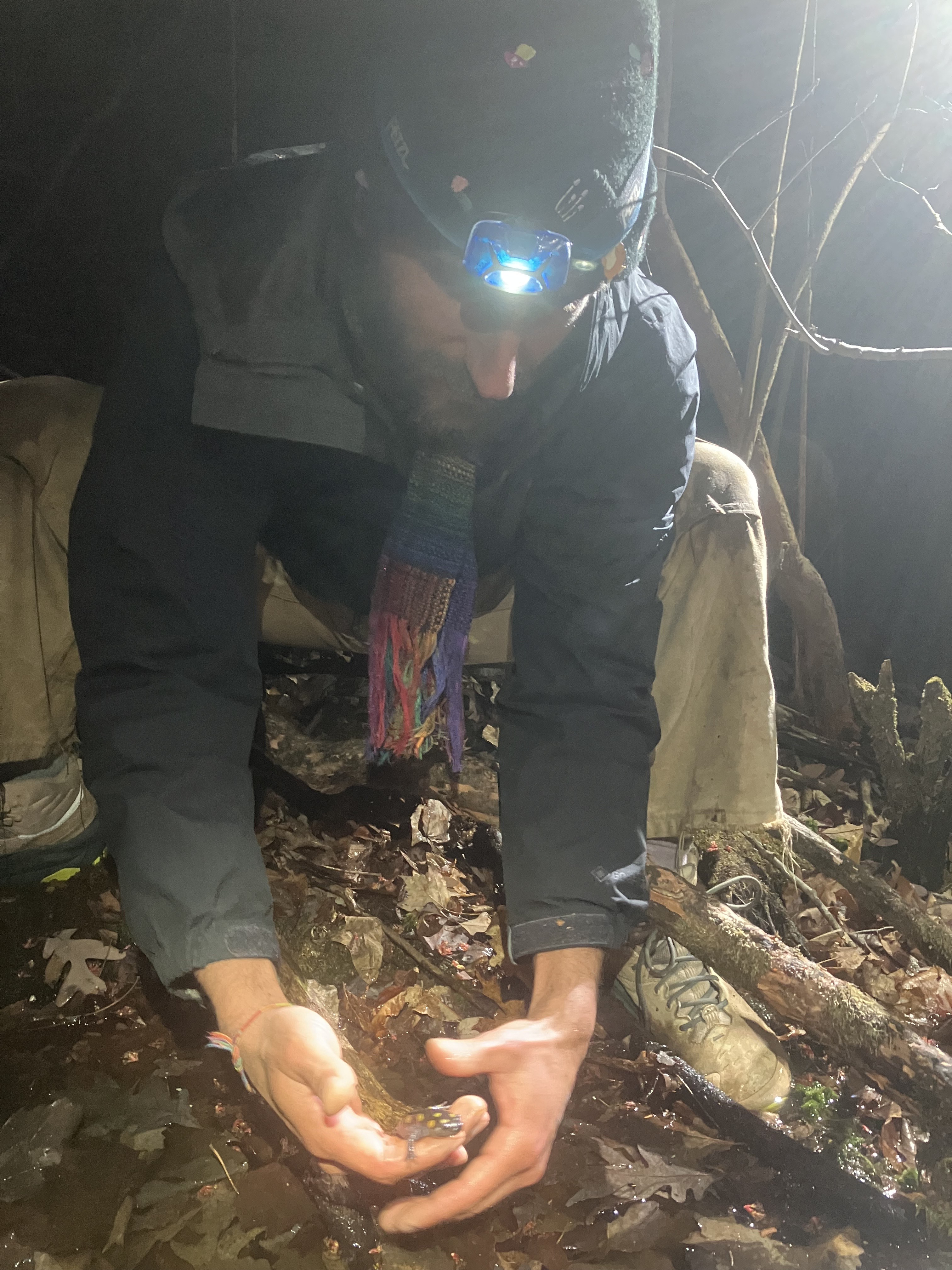
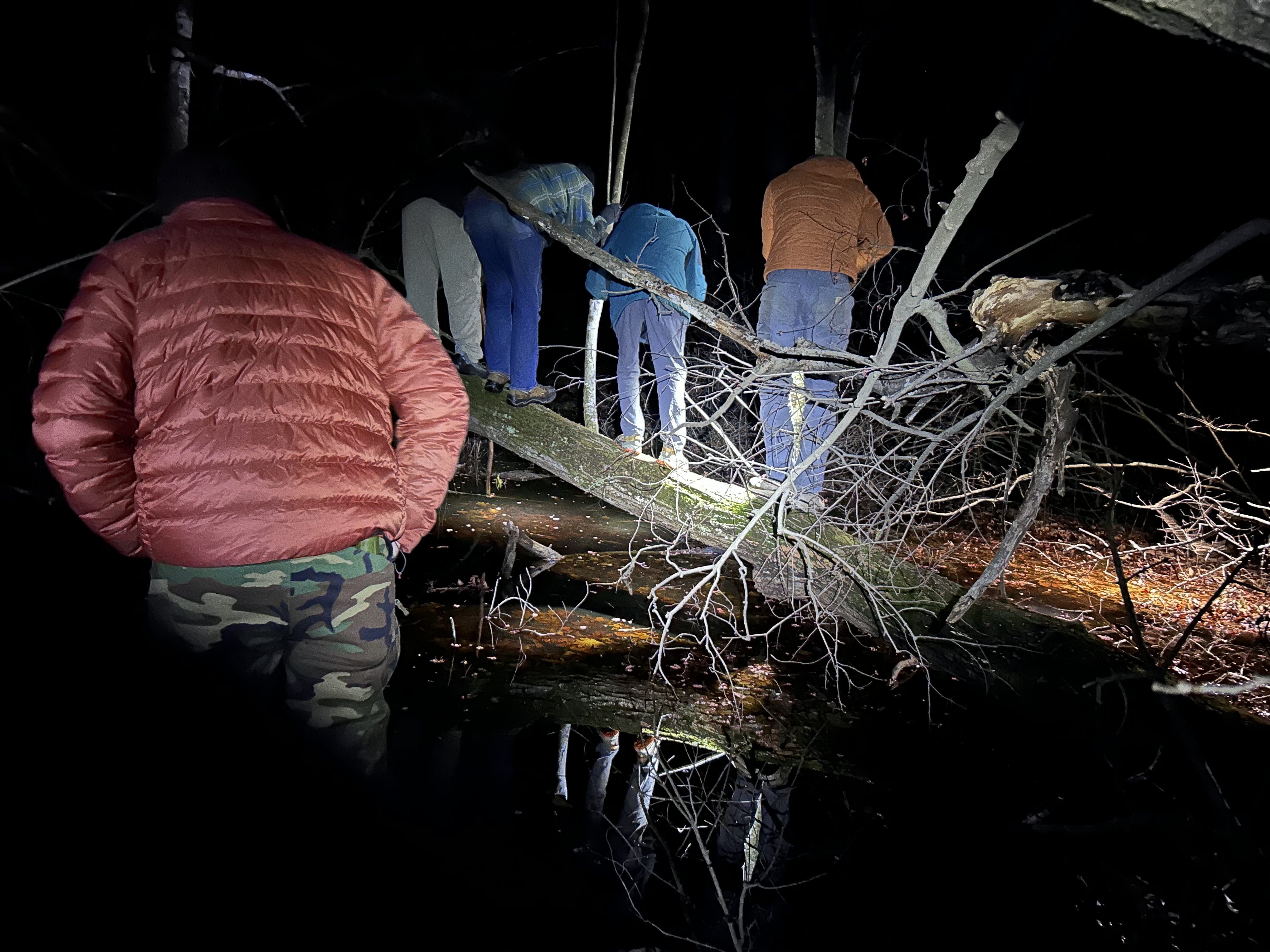
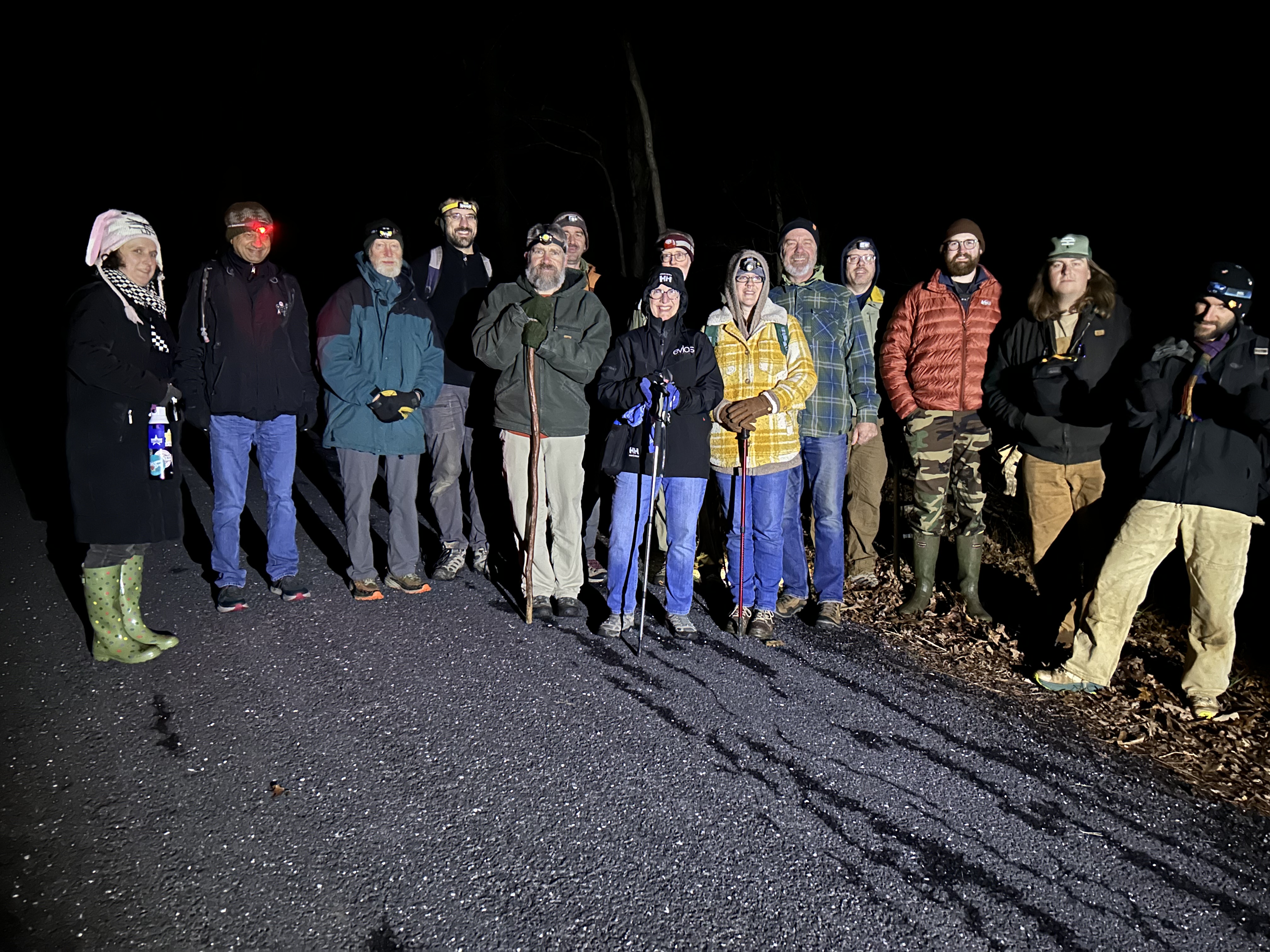
Walking carefully among the undergrowth and dodging greenbriers on a dark night on Thursday, March 12, Billy Flint, a JMU salamander ecologist, led 13 Headwaters Master Naturalists and three guests on a two-hour search around the perimeter of a private sinkhole pond. Their goal was to find spotted salamanders on the move or their egg masses during the annual mating time, usually mid-February to mid-March, depending on the weather and pond water levels.
Malcolm and Lynn Cameron hosted the outing on forested land they own in eastern Augusta County which has two sinkhole ponds amidst a mixed mesophytic forest along the eastern edge of the Blue Ridge. The land has a conservation easement held by the Virginia Outdoors Foundation because of the unique ecosystems within and around the ponds. The HMN group was exploring the largest pond in hope of at least finding spotted salamander egg masses and/or the salamanders themselves. The weather conditions were not optimal, which would require that it be raining. There had been about 0.7 inches of rain that morning during a cold frontal passage, but the sunshine and strong winds that afternoon had dried out a lot of the leaf litter. The pond had enough water due to rains over the previous month, but was still only up to about 8 to 10 inches below the full level. Although the temperature was in the mid-30s, we did find a few salamanders and at least one was laying eggs in the water. These salamanders are not affected by the cold, but a fairly heavy rain is needed to signal to them that it’s time to move out from under logs and rocks on higher, dryer ground and to head to a vernal pool. In this case the site was a sinkhole pond of about 1/2 acre. The fact that we did not see other egg masses probably meant that most of the salamanders in the area were waiting for heavier rains. Our group also found a dead Northern Water Snake, which was possibly killed by a raccoon or other predator.
These vernal ponds host numerous invertebrates in the late winter and early spring months thus providing plenty of food for salamanders. In late spring, summer and fall, the ponds usually dry up and the salamanders bury in the muddy ground beneath the leaf litter, logs and loose rocks. If their favorite vernal pool becomes consistently dry, they will move over dry ground to get to new locations.
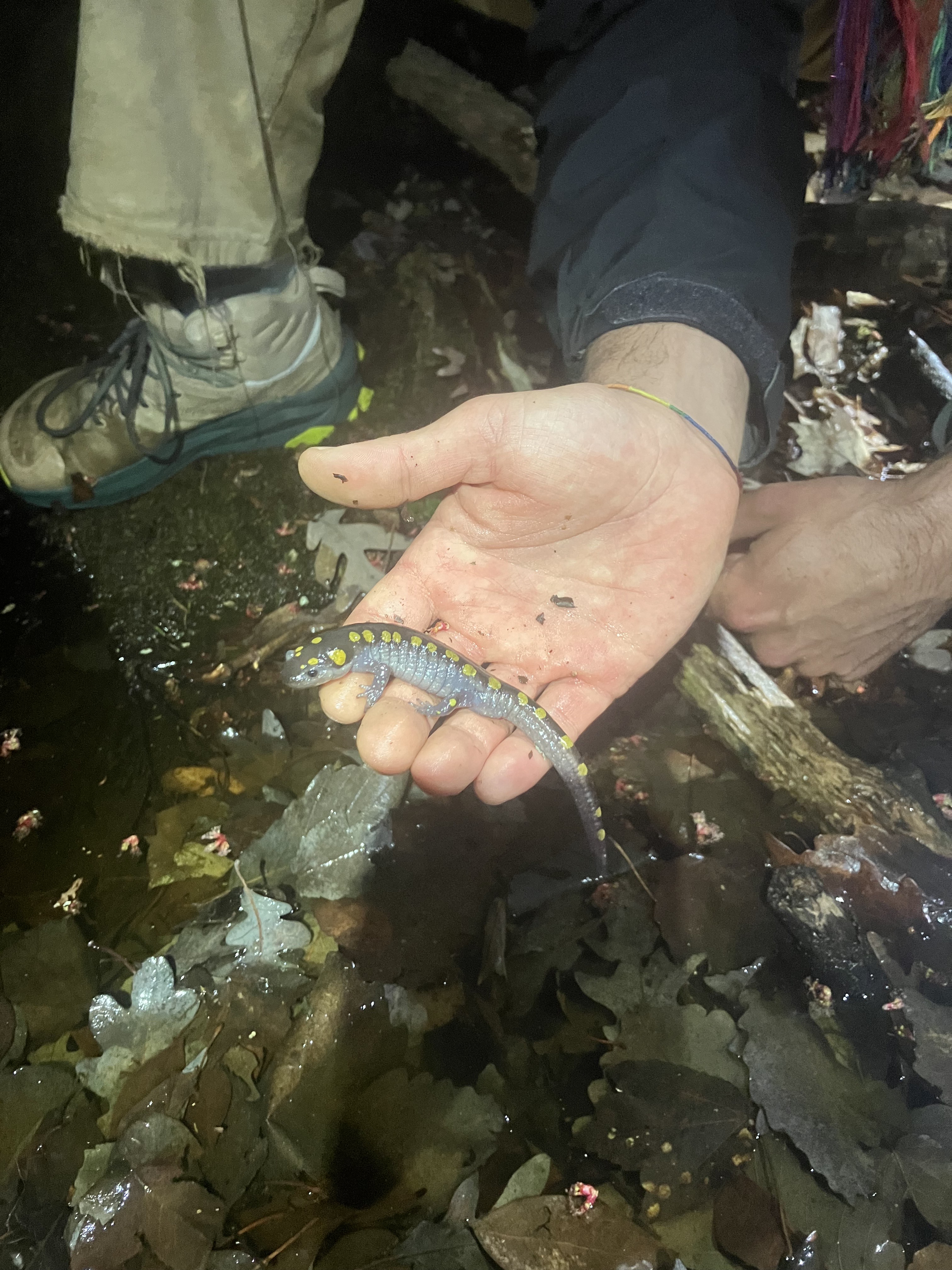
Even though they bury themselves in mud they do not have keratin on the ends of their toes to dig. They also have lungs but can absorb oxygen through their skin when spending time in the water. They spend their overwintering in a mud-encased torpor.
Spotted salamanders often return to the same body of water in which they were hatched, reach sexual maturity after five years and can live more than thirty years. They only travel to and from vernal pools when it’s actively raining, and only then to mate; the rest of the year they remain underground. They average 6-8 inches in length, as wide as your thumb, with females usually larger than males. Males deposit silvery spermatophores throughout the vernal pool or springs and females take them into their bodies through cloaca to fertilize the eggs. A female can lay up to 300 eggs per season in multiple clutches; eggs are gelatinous clusters often attached to twigs or detritus in vernal pools. If the pools dry out before the larvae are ready to hatch, the moist gelatinous casings protect them long enough to ensure that most of them survive.
We left for home about 10 p.m., but most of us could have easily stayed longer. I found that one advantage of a clear night was that being able to see known constellations in the sky helped to keep me oriented in the dark, even in a familiar place.
Story by Malcolm Cameron with assistance from Charlie Lovewell and Bill Howe


 Virginia Master Naturalists Headwaters Chapter