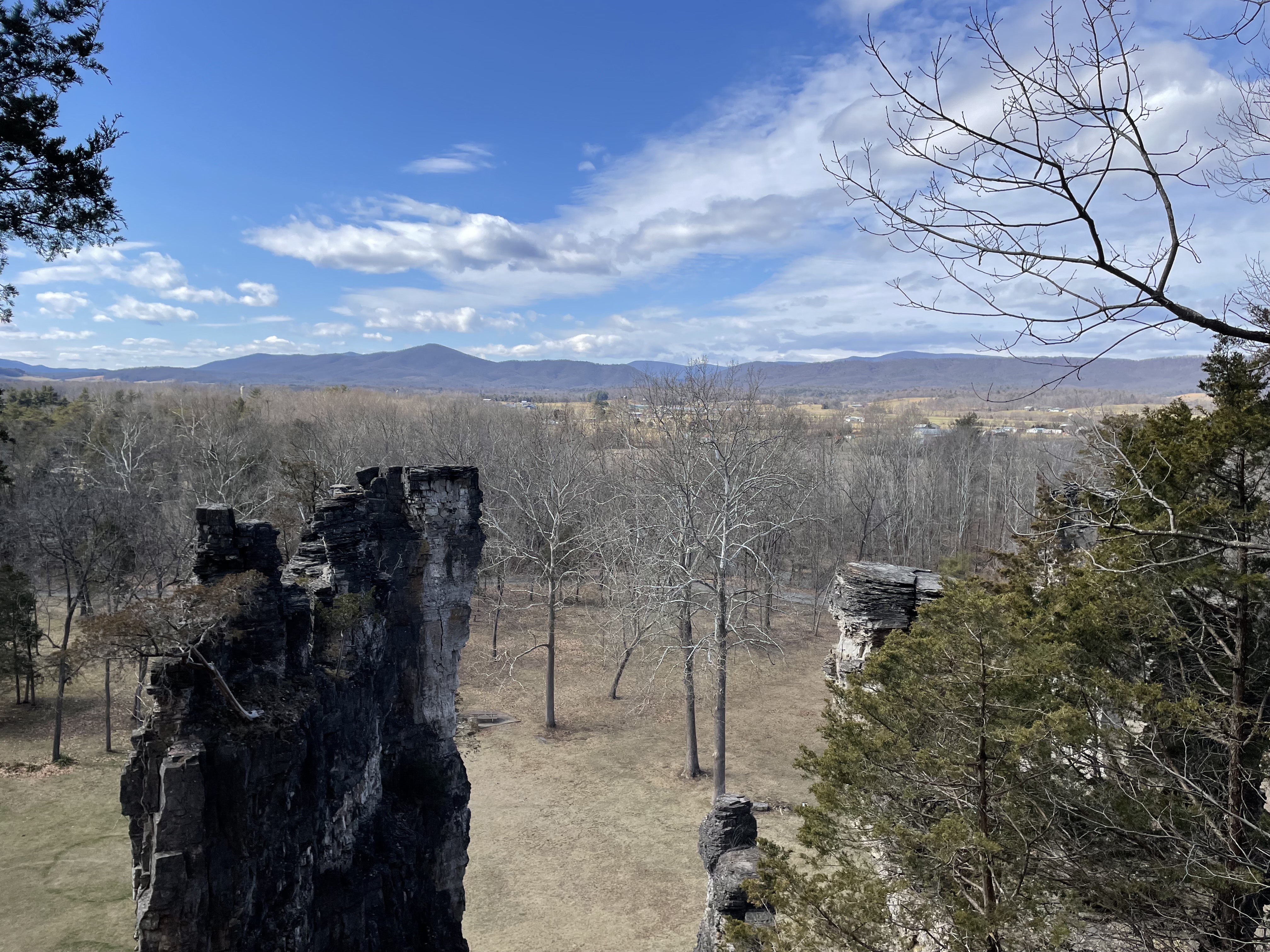
Looking west from the Chimneys Overlook Trail’s overlook. Photo by Sue Gier.
As Sue Geir reported at the annual meeting in January, a small group of HMN members has had discussions with Natural Chimneys Park staff about how the chapter might support invasive plant removal and other conservation efforts there.
On February 18, Sue Gier and Wick Fary joined Park manager Kelly Rourke and Jacob Edel, Invasive Management Specialist for Blue Ridge Prism, for a survey of the property in order to determine the number and extent of invasive species present. These ranged from the usual suspects like Ailanthus and shrub honeysuckles distributed throughout the park to Yellow Archangel gaining a foothold along the edge of a few trails, to intertwined thickets of Burning Bush, Multiflora rose and wood brier in the stream bottom covering perhaps an acre. We also observed some of the upland terrain that’s covered by mature tulip poplar and oak canopy with relatively little disturbance from non-native growth.
Current vegetation management activities seem to focus on hazard management and pedestrian and vehicular access. A small demonstration wildflower planting is the only example of conservation-themed management that was observed at the park, but there is interest on the part of management to increase the emphasis through targeted vegetation management and increased visitor awareness promoted by improved trails and signage.
Jacob has extensive experience as a technician applying vegetation control treatments in forest and urban settings and was able to compare the relative merits of various strategies for the conditions we observed. Having been working in Virginia for about a year now, he has recently completed pesticide applicator certification for forest settings and may be able to be of service to the chapter as our trainer and ‘applicator of record’ if we choose to involve ourselves directly in the process of applying herbicides.
Sue added that Jacob faced limitations in screening for many invasive plant species due to the time of year, which may necessitate a return visit. One such species, Garlic Mustard, is beginning to emerge, and it is crucial to manage this invasive plant, as it can significantly affect soil composition. Fortunately, now is an ideal time to remove it since it hasn’t flowered yet and can simply be tossed aside. Additionally, she observed a considerable amount of litter in the park, and recommends that during each visit, we bring a small trash bag to collect debris as we carry out other tasks. The more trash that accumulates, the more emboldened people may feel about neglecting their responsibility to clean up after themselves.
A full report will be prepared by Jacob prior to the board meeting scheduled to take place at the park on March 23rd. The document will provide a map indicating the locations and extent of each species of concern, and a calendar with the optimum timing for detection and control of each. The report will be invaluable to the chapter as we assess how we might best promote conservation and wildlife in the park, and determine the scope of activities that our membership can sustain. Likewise, Kelly and the Park staff will have a good reference for setting priorities and optimizing the value of any investments of time and money they make toward conservation.
Wick Fary and Sue Gier
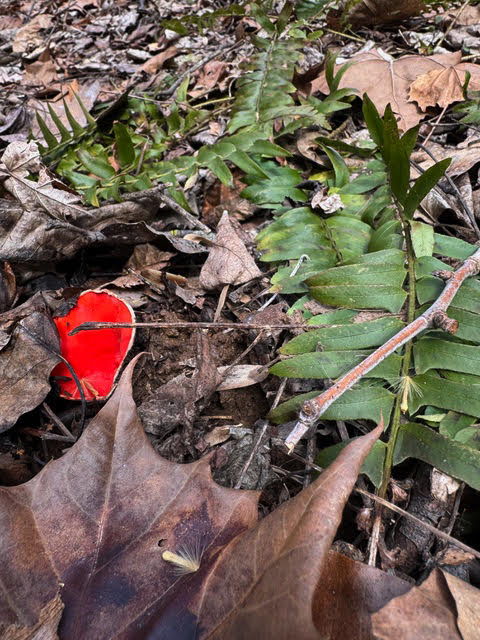
Early Sarcoscypha! Photo by Wick Fary.
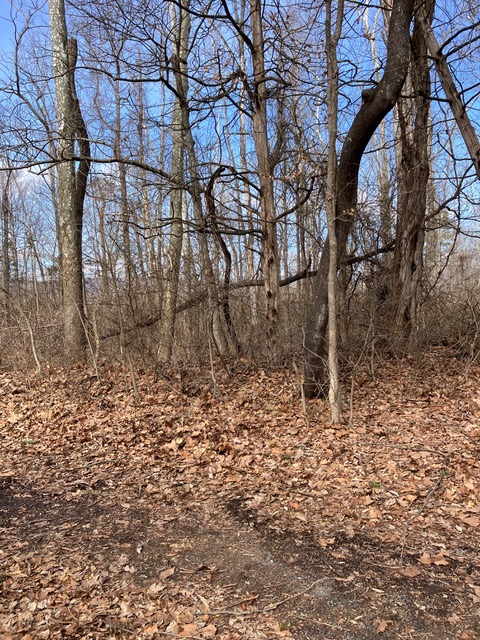
Mature Ailanthus is present in most areas of the park. Staff has recently removed those that pose a hazard in high-traffic areas. Photo by Kelly Rourke.


 Virginia Master Naturalists Headwaters Chapter