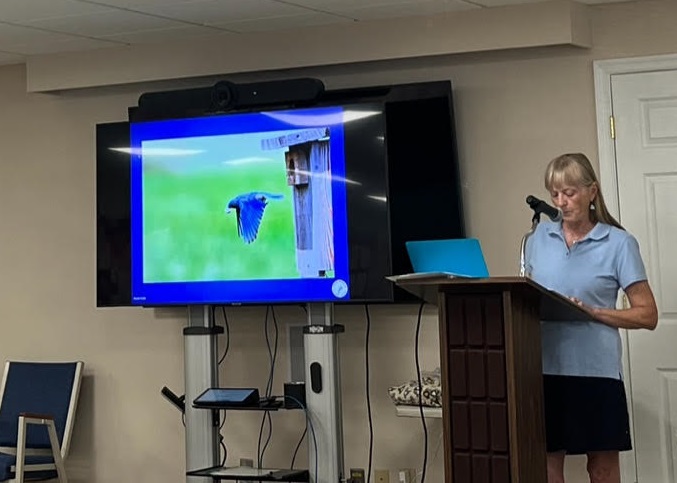
Welcome Back Bluebirds
Presented by Gail Fisher
August 13, 2023
Sunnyside Retirement Community
Since 1978 the North American Bluebird Society (NABS) has been helping people increase bluebird populations.
Bluebirds, a member of the thrush family, build nests in cavities but their beaks aren’t strong enough to dig the hole themselves so they use holes in trees. In our area we have Eastern Bluebirds all year. With increased land development, cavity nesting birds lost habitat so their populations declined. Another issue is the introduction from Europe of starlings and house sparrows (which are not in the sparrow family, but rather the house weaver family). They aggressively compete with bluebirds. They are invasive species and so are not protected by law. They can be trapped and killed, and their eggs can also be “addled.”
Most bluebird eggs are blue but occasionally are white. Eggs are laid one at a time over 3-7 days. Sixteen to 20 days after hatching they will fledge. The bluebird box should not be opened after day 12 because the birds may fall out. Fledglings stay in the area. They have brown spots on their chests. Bluebirds rely on insects. Sometimes mealworms can be used to supplement their diet but too many can impede the development of babies’ bones.

Nest box designs have evolved over time. Factsheets and plans for nest boxes are on the NABS and VA Bluebird Society websites. Location is important: open lawn, short grass with a nearby perch where pesticides are not used. Boxes should be installed by late winter since eggs are laid by late March. They should be placed about 100 yards apart. It is important to monitor nest boxes weekly during the season to ensure the health of the birds and provide data to the Virginia Bluebird Society. Predators and competitors include mice, feral cats, squirrels, raccoons, snakes, paper wasps, starlings and house sparrows. Baffles on the pole will keep snakes out. Noel guards also help keep out predators.
Other cavity nesters that might use a bluebird nest box include: tree swallows, chickadees, titmice, house wrens and nuthatches. Nest boxes can be winterized to provide a place for cavity nesters to stay warm in the winter.
Sunnyside Community has 5 monitored trail systems with 40 boxes. This past season there were 178 eggs laid, 118 hatched, and 97 fledged. Only 3 boxes didn’t have nests. After the presentation a trail tour was provided by Cindy.
Virginia Master Naturalists Headwaters Chapter members in attendance expressed interest in having a workshop to make nest boxes and learn the basics of monitoring. This may happen in February 2024. More information will be sent as plans are finalized.
Headwaters Master Naturalists in attendance: Ann Murray, Eunice Sill, Cindy Westley, Sharon and Jay Landis, Elaine Smith and guest, Bill Howe, Lynne Eggert, Vicki Langdon
– Elaine Smith and Cindy Westley, August 2023


 Virginia Master Naturalists Headwaters Chapter