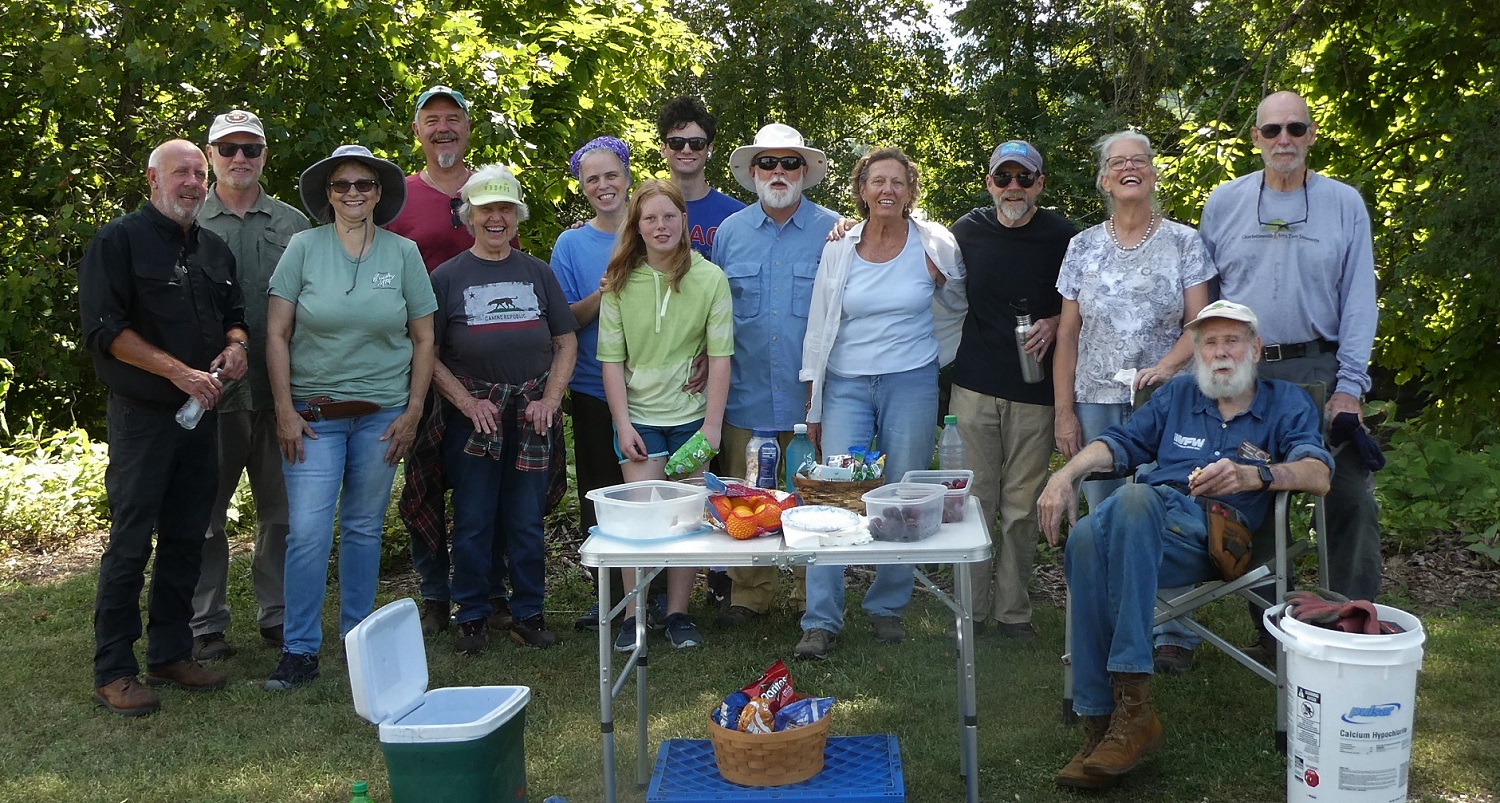
Photo by Diane Lepkowski, Cohort VII, September 22, 2023.
Stellar turnout to learn about bats
Peggy Plass, of the Headwaters MN Chapter, educated us on bats in general and on our local bats as we watched them coursing above the pond. Fun evening!
On Friday, September 22, Headwaters Master Naturalists partnered with Bat Conservation and Rescue of Virginia (BCRV) and the Edith J. Carrier Arboretum at James Madison University to offer a “bat watch” at the pond in the Arboretum. More than 80 people from the community came to talk about bats, and to watch them emerge and fly around the pond just after sunset.
Work that BCRV and HMN have done at the Arboretum over the summer has indicated that there are populations of Eastern Red Bats and Big Brown Bats at the Arboretum, and very likely some Tri-Colored Bats as well. Tri-Coloreds are endangered in Virginia, so knowing that they’re living in the middle of Harrisonburg is quite exciting! In addition to offering information about bats, HMN Peggy Plass talked with the participants about doing acoustic bat monitoring, and there was a bat monitor on hand for visitors to check out.
The turn out for the event was unexpectedly large, so much so that we’re planning to make this a more frequent event next year! We’re discussing with the Arboretum and the BCRV about doing a “bat watch” with Harrisonburg community members every other week through the late Spring to early Fall bat season. If you’re interested in being a volunteer to host these events, you can talk with Peggy Plass (president) or Pam Gray (Projects Committee Chair) for more information!
– Peggy Plass, HMN President, September 2023
Thanks to Steven David Johnson for sharing these lovely photos from the evening:
Staunton Tree Stewards took root (we’re here for all the puns) in 2020, when Shenandoah Green, a local environmental group, began the Staunton Legacy Tree Project. In three years, volunteers planted 3300 trees, and then began to transition to long-term care and management of those trees. Staunton Tree Stewards focuses on four areas within the 24401 zip code: where there is an environmental justice focus, such as historically redlined neighborhoods; heat islands; flood plains; and riparian buffers.
Our current projects include geolocating trees that volunteers planted and monitoring them on an ongoing basis; removing invasives such as tree-of-heaven and English ivy; and planting trees (though on a much smaller scale than previous years).
We have work days on the second Saturday of each month and either the third or fourth Tuesday, and welcome volunteers. If you’re comfortable with tech and want to get better at your tree ID, geolocating trees is a great way to do that (during the growing season, at least). During November, our work days will be planting trees. We also have a goal of organizing one educational walk per season. Anyone is welcome to join; we share events on Facebook and through our newsletter. We can also be reached at stauntontreestewards [at] gmail.com.
– Lora Steiner, Staunton Tree Stewards, September 2023
Depending on what you do, HMN Volunteer Service Project hours for these activities can be logged under:
Wildlife/ Plant Inventories and Monitoring: Staunton Tree Stewards – Geolocating
Invasive Species Management: Invasive Plants Removal, and/or
Habitat Restoration/Maintenance: Tree Planting and Maintenance
Dave Forrer leading a Meaningful Watershed Educational Experience activity at the EJC Arboretum, September 13, 2023. Photo by Katie Rankin.
HMNs Help Provide Environmental Education to City 4th Graders
The Edith J. Carrier Arboretum’s Katie Rankin and Harrisonburg Public Schools’ STEM Director Amy Sabarre (with a grant from DCR) put together a wonderful program for all of the City’s 4th grade classes. The watershed project was held at the arboretum on September 12 through 18, and there’s still one more day, October 10, to catch the last class.
More than 500 4th graders attended and visited each of these five different stations:
1) “Just Passing Through” – The kids, acting as raindrops during a storm, ran along a straight hose (which represented a straightened-out stream or ditch), a curvy hose , and a curvy hose with human “trees” and “shrubs” planted along the “stream.” Each time, the kids were timed – showing them how a stream in its natural state with curves and trees, slows down the water.
2) “Freddy the Fish” – Freddy, a fish cut out of a sponge, was living happily in a stream (actually a 2 gallon container) until he decided to explore the world downstream, where he encountered fertilizer, road salt, litter, acid rain, toxic waste, and oil dumped down a storm drain. Each time a pollutant was added to Freddy’s water, the kids shouted in unison “Oh no! Poor Freddy!!!” Freddy dies, but the kids took home valuable lessons about stream pollutants and how to reduce them.
3) Scavenger Hunt and Stormwater Discovery Walk – The kids were given a form on which to tally all wildlife and pollution they observed, and to describe various pond and stream features, including riparian buffers and stream improvement measures.
4) The Shenandoah Valley Soil & Water Conservation District had an “erosion box” and provided a demonstration of runoff across various surfaces. They also had a rain barrel and described how they can help reduce runoff.
5) The City’s STEM director led a STEM project that challenged students to design structures and landscapes that provided optimal runoff reduction.
The following HMNs participated as “Station Leaders”: Ann Murray, Anthony Adamovich, Rob Beaton, and Dave Forrer. JMU first-year Education students assisted at a couple of the stations. The activities were a lot of fun for the presenters, and the kids learned valuable environmental lessons from the experience – and yeah, they had a lot of fun too!
– David Forrer, Cohort VI, September 2023
Click on an image below to enlarge it and find a caption. Photos by Katie Rankin and Dave Forrer unless otherwise noted.
The information below is from Katie Rankin at the Edith J. Carrier Arboretum at James Madison University. She is asking for help from our volunteers. This would be a VERY fun way to rack up some volunteer hours under General Outreach and Education. Please note the link to a sign up sheet. – Pam Gray, Projects Committee Chair
Monday-Friday, Sept. 11-15 and Monday, Sept. 18
The programming will be daily from 9:45 to 1:05. We have 4 content stations planned, each rotation lasting 40 minutes. Students will also get a lunch period. 4 of our 6 schools have 4 classes, and 2 of them have 5. So on the days we’re hosting a school with 5 classes, we’ll add in that 5th group as shown below.
I’m hoping the Master Naturalists would be able to largely take in hand the leadership of station 1. We will have college students and some other volunteers on hand for providing support assistance to station leaders, so you won’t be alone!
Station 1 is a lot of fun in my opinion. It has 2 parts: “Just Passing Through” is a movement activity that we’ll do on the tiers of the lawn behind the pond in which students pretend that they are the raindrops of a storm, and we time them as they come barreling down the hill together toward the stream. We’ll have chart paper for producing a bar graph showing how fast the “water” flows following a simple straight gully, then if we introduce curves into the stream, and then if we introduce riparian plantings (some students become trees who tag the ‘raindrops’, which then have to circle the tree 5 times before proceeding downhill). We’ll have a microphone out for this, so you can be heard by the group.
The other part of station 1 is “Freddy the Fish”, which is a pollution demonstration in which you tell the sad tale of Freddy’s journey to the ocean that is riddled with a variety of pollution sources (erosion, road salt, litter, factory waste, motor oil). The more dramatic, the better, and there’s a script. My favorite part is getting the students to exclaim, “Oh no! Poor Fred!” after each pollution source.
I will train volunteers on how to do each activity, and we have all the supplies!
Here is the sign-up link for the leadership roles at this program: https://www.signupgenius.com/go/10C084FAFAD28A2FDC61-station People are very welcome to sign up for multiple slots (and it will be easier for all if they do!); I just didn’t want to ask someone for a multiple day 4-hour commitment!
In the sign-up, I’ve got these two activities split up since they will each need a leader.
Schedule for Each Day
9:45-10:25
10:25-11:05
11:05-11:45
11:45-12:25
12:25-1:05
Group A
2
4
LUNCH
1
3
Group B
2
1
LUNCH
3
4
Group C
3
2
4
LUNCH
1
Group D
1a, then 1b
2
LUNCH
4
3
Group E (Sept.11th and 15th)
1b, then 1a
3
2
LUNCH
4
Station 5 is lunch in the family garden, and the classroom teachers will take the lead on that. I’m hoping that the Soil and Water Conservation district will be willing and able to handle station 2 since those are sort of their natural programs. Ali Sloop from JMU stormwater compliance is prepared to do most of the scavenger hunt/walk through the arboretum (station 3), though she needs coverage on the 18th and I’m sure wouldn’t mind having someone to swap out with the other days. Station 4 is the STEM design challenge that has to be completed after students have at least seen the erosion box/rain barrel demonstration, but the school staff is handling the leading of that one.
I really appreciate your participation in this program! I’m sure there will be questions; please let me know what they are.
Waynesboro trees work group, August 12, 2023. Photo courtesy of Breyette Covington and CATS.
On Saturday, August 12, Headwaters Master Naturalists and Charlottesville Area Tree Stewards (CATS) joined forces in Waynesboro to replace beaver cages around planted trees along the Greenway. The shaded path and breeze down by the river and enthusiasm all around made for a perfect workday.
We assisted over 50 trees including river birch, willow oak, London plane trees, cherry, sycamore, and others.
This project was the brainchild of Breyette Covington (HMN class of 2017) who lives in Waynesboro and is also a Tree Steward. It has been a dream of hers to bring both groups together to support trees in her hometown. Breyette worked with Kathy Nepote from CATS and Stephen Black (Horticulturalist for the City of Waynesboro) to make this project become a reality.
Shout out to current HMN’s trainees Lyn Holt, Robert Beaton, Bill Howe and Eunice Sill for joining us! We were also joined by Diana and David Covington who proved to be valuable and joyful assistants.
This is the first collaboration between CATS and Headwaters Master Naturalists and we look forward to more adventures in the future!
– Breyette Covington, Cohort V, August 2018
Thanks to Eunice Sill, Cohort 8, and Breyette for the photos below. Click on one to get a better view and start a slideshow.