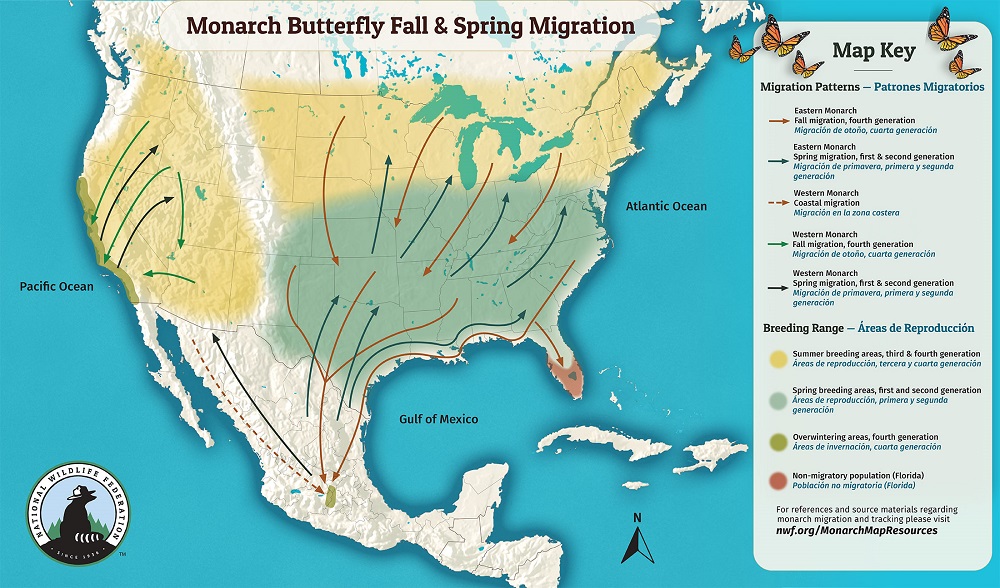
Thanks to Rob Beaton, Cohort 8, for sharing about this fascinating phenomenon!
The Eastern monarch butterfly migration is one of the most impressive natural events in the world. Every year, monarch butterflies (Danaus plexippus) undertake a long and arduous journey, traveling thousands of miles from their summer breeding grounds in the northeastern US and Canada to their wintering grounds in central Mexico. After hibernating, the monarchs mate and begin their journey north, following the same flyways and searching for milkweed to lay their eggs on. This journey is completed by the offspring of the generation that completed the journey southward and hibernate. The butterflies that make the journey north will continue the process of breeding, laying eggs, and completing the journey south and back north again. It typically takes two generations to reach the migration’s northern limit and then another two to return to Mexico. The Eastern monarchs begin their journey south in eastern Canada and the northeastern US, traveling 25 to 30 miles per day over a period of several months. They arrive at specific sites in the mountains of Central Mexico, where they form large clusters on the oyamel fir trees and hibernate until February or March. Then the amazing cycle begins again.
To prepare for their journey, monarch butterflies accumulate energy by feeding on nectar from flowers. They then rely on environmental cues, such as changes in temperature and day length, to guide them on their journey. The exact route taken by the monarchs can vary from year to year and between generations, depending on weather patterns and wind currents.
During their journey, the monarchs face many challenges, including extreme temperatures and weather events, habitat loss, and predation. Despite these challenges, the monarchs manage to complete their journey to their wintering grounds where they gather in large numbers and cluster together for warmth and protection.
Conservation efforts are underway to protect the habitat of the Eastern monarch butterfly, which has been declining in recent years. These efforts include planting milkweed, which is critical for the survival of monarch butterflies, and creating areas for monarchs to breed and feed. Experts estimate that the eastern monarch butterfly population size has been reduced by more than 80% since the 1990s. This decline is likely due to a combination of factors such as habitat loss, climate change, pesticide use, and disease. By supporting conservation efforts, we can help ensure that future generations will have the opportunity to witness the incredible journey of these majestic insects.
Sources:
https://www.worldwildlife.org/stories/the-great-monarch-migration
https://www.fs.usda.gov/wildflowers/pollinators/Monarch_Butterfly/migration/index.shtml
https://www.fws.gov/savethemonarch/
https://msutoday.msu.edu/news/2021/eastern-monarch-butterfly-disappearing
Graphic credit: https://monarchs.nwf.org/
– Rob Beaton, Cohort 8, August 2023


 Virginia Master Naturalists Headwaters Chapter