Category: Projects

  • Wildflower Walks 2016

    Wildflower Walks 2016

    Thanks to everyone who was part of the Shenandoah Mountain Wildflower Walks 2016! A great turn out with many lovely discoveries. Find some of them in Friends of Shenandoah Mountain’s facebook album: Wildflower Walks a Success!

    Mark your calendar for Shenandoah Mountain Wildflower Walks 2017: Saturday, April 29, 2017.


    trailing arbutus ES 2015

    Wildflower Walks on Shenandoah Mountain
    Saturday, April 30, 2016

    Please join the Headwaters Master Naturalists for our annual rediscovery of the springtime beauty in the forests of our backyard mountain.

    After a long winter, what better way to celebrate warmer days than to hit the trails in search of spring wild flowers. And really there is no better place to start your search than the trails of Shenandoah Mountain. Have you ever seen the fringe on the fringed polygala? Smelled the foul flower of wild ginger? Admired the slim stalks and blue beauty of the bluets? These are just a few of the wildflowers you might encounter on the naturalist-led walks hosted by the Headwaters Chapter of the Master Naturalists.

    Come out and see the spring wildflowers on Shenandoah Mountain in the George Washington and Jefferson National Forests!

    • Join one of three groups that will be accompanied by members of the Headwaters Master Naturalists for a walk in the forest. We will have the support of wildflower experts familiar with the trails and flowers.
    • Find and photograph the many different species of wildflowers.
    • Admire the flowers in place leaving them for others to enjoy and to fulfill their spot in the mountain ecosystem.
    • Upload photographs to our web album after the hike. See photo sharing options here.
    • Free! All welcome! Sign up required.

    register button

    To Participate:

    • Sign up by time and place through our Eventbrite site.
    • There will be a total of three options of places to visit starting at either 9:30 am or 1:00 pm on Saturday, April 30.
    • You will receive an email with the meeting place and directions after you sign up.
    • Anyone under 18 must be accompanied by a parent or guardian.
    • Wear walking shoes and bring water and your camera!

    Our Supporters:

    Wildflower Resources:

    Map of Trailheads:

    labelledtrails

    Click on map image to open Google map of trailhead locations.

    Top photo of Trailing-Arbutus by Frank Doherty from Wildflower Walks 2015

  • Starry Nights – Night Walk

    Starry Nights – Night Walk

    starrynightsarboretum1A friendly mix of three dozen night enthusiasts, including families and students, gathered at dusk at the Edith J. Carrier Arboretum at James Madison University on Friday, April 1, 2016, for a “night walk in the woods, star gazing, exploring our senses at night, animal adaptations, keeping the night dark.” HMN Chip Brown coordinated and led this night awareness adventure with help from four other HMNs and volunteers.

    The arboretum night walk was one of four consecutive evening programs planned by planetarium director Shanil Virani and English professor and author Paul Bogard for their third annual Starry Nights event to call attention to our increasing loss of the night sky due to light pollution.

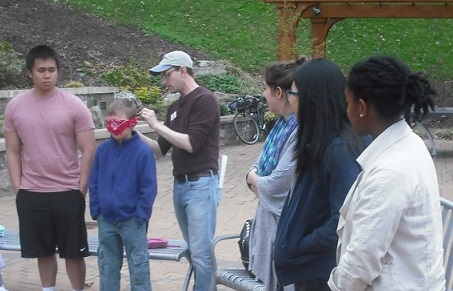
    Chip and HMN Rob Alexander showed their skills and experience with outdoor education as they led the group in a rousing game of bat and moth. Bandana-blinded designated bats and moths tried to find or evade each other by calling out “bat” and “moth.” Another game illustrated familial voice recognition common to many species.

    HMN Peggy Plass talked about frog calls, playing recordings of spring peepers and bullfrogs beside the arboretum pond as real bats put on an acrobatic show overhead.

    The group learned about ear adaptations to amplify sounds, how eyes adjust to night vision, and were treated to a story about dancing coyotes in the sky from Chip. HMN Adrie Voors helped Chip show off a street light shielding demo using a Mini Maglite, tablespoon and “boogie” bear lurking in the shadow of the unshielded light. Finally, HMN friend Art Fovargue was able to point out some celestial highlights despite the light pollution and clouds.

    Look out for Starry Nights version 4.0 in 2017!

    – Adrie Voors, Cohort II

    photos from the game of bat and moth

    street light shielding demo

  • McCormick Farm Tree Planting

    McCormick Farm Tree Planting

    McCormick2016PP1.crop
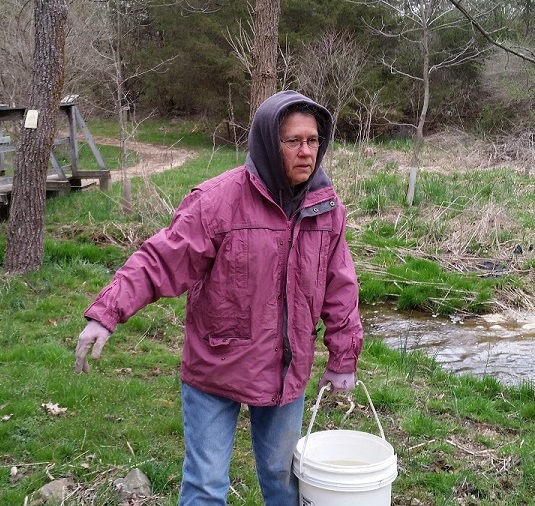
    Judy Tammi along Marl Creek.

    Even though the weather was decidedly un-Spring like, four Headwaters Master Naturalists celebrated the upcoming vernal equinox with planting trees at the McCormick Farm trail on Saturday, March 19. Ginny Joseph, Ann Murray, Peggy Plass and Judy Tammi joined Charlie Huppuch, retired district ranger in the U.S. Forest Service, for the Spring planting project.

    Volunteers worked under cloudy skies and drizzling rain which ultimately turned to hail and snow, planting dozens of young trees–including silky dogwoods, white oak, and mulberry–along the banks of Marl Creek at the farm. “I love imagining these little white oak trees still being here in 300 years, maybe remembering us and this day that we spent setting them out,” commented HMN Peggy Plass. Although freezing fingers and potentially slick roads resulted in a slightly premature end to the day’s work, most of the new trees slated for planting ended the day with their roots in the ground, joining the thriving community of trees and shrubs installed in previous years by the VMNs.

    – Peggy Plass, Cohort IV, March 2016

    photos by Peggy Plass

  • It’s a Wrap!  …. The Great Backy

    It’s a Wrap! …. The Great Backy

    greatbackyNot all of the figures and data are in but as of February 25th, checklists that have been submitted surpassed 158,000 and 5,500 species were reported, topping 50% of the world’s birds from more than 130 countries.  The collective spirit of such an event provides an impressive weekend of tallying birds around the world. The US submitted 128,000+, Canada 13,000+ and India placed third with 7,200+!!!!

    As I reviewed the local data, I was impressed by Bell’s Lane being ranked 11th in Hotspots in Virginia!!!!  The private pond on Bell’s Lane, one of the few ponds not completely covered with ice, gave us a good variety of waterfowl and helped push the species count to 40. And then, my curiosity was piqued with all of the participants both in Staunton and Augusta County and not knowing a lot of the names. I wish we could bring them into the fold of the bird club, field trips, master naturalists, etc.  Any ideas?

    It was a fun weekend and the snow on Monday added an extra layer of fun for me. While the snow was falling, I took a beautiful walk throughout my neighborhood and over to the Virginia School for the Deaf and the Blind (VSDB) soccer field and picked up a few more species for my list of Great Backyard Bird Count birds. A great ending to the Great Backy!

    Looking forward to spring and spring bird counts!!!

    Penny Warren, Cohort I
    President, Augusta Bird Club

  • Christmas Bird Count 2015

    Christmas Bird Count 2015

    ChristmasBirdFor me, I am like a kid waiting for Christmas morning when it comes to the annual Christmas Bird Count. The anticipation with getting up early… 4ish or so to go owling, wondering what will we see, record number birds, record bird sightings, etc. … all of it is wrapped up in excitement!!! Although not all of the data is in for the 2015 Augusta Christmas Bird Count, e.g. number of hours, mileage, etc., and the Waynesboro count isn’t until the first weekend in January, we do have the basic Augusta information showing a total of 77 species and five additional species for the count week. One of the count week species was a tragic statistic and that being our one and only Fox Sparrow was a window strike at one of my friend’s house!  …. not something I look forward to hearing!

    I always look at YuLee Larner‘s handwritten records for a quick comparison of Allen Larner’s list of birds and YuLee’s data to see high and low numbers as well as species seen and not seen in any given year. As I was going through the list, one record jumped  out at me…… 255 Evening Grosbeaks (EVGR) on Dec. 31, 1977!!

    Evening Grosbeck. Photo credit: Daniel Arndt through Flickr Creative Commons licensed under CC BY 2.0.
    Evening Grosbeak. Photo credit: Daniel Arndt, Flickr Creative Commons CC BY 2.0.

    The grosbeaks piqued my interest and with a little research on line I found an interesting article from BirdSource that provides CBC data showing changes in EVGR numbers between 1960 and 1998 along with an animated map of distribution between 1988 and 1998. Several speculations or possibilities about the decline were noted. EVGRs may not be moving as far south during winter due to warmer temperatures.  Second, decline of food availability due to changes in Canadian forestry practices and lastly, numbers in the East may be stabilizing in the north woods east of the Great Lakes. EVGRs did not occur east of the Great Lakes prior to late nineteenth century.

    All I know or can imagine is what an exciting CBC that must have been in 1977!  As always … something new and/or old grabs my attention and leaves me waiting with great enthusiasm for the next CBC. However, in the interim, we have the annual ‘Great Backy‘ to anticipate. Dates for this event are February 12-15th …. more on that later!

    Happy New Year!!

    – Penny Warren, Cohort I
    President, Augusta Bird Club
    Master Naturalist, Headwaters Chapter