Birds of the ‘Burg completed its second season of bird walks at Hillandale Park in Harrisonburg. The walks were held the first Saturday of each month, April through October and were led by Kathy Byers, HMN Cohort IV; Ralph Grove, Sierra Club; and Anne Neilsen and Bill Benish, both with the Rockingham Bird Club.
The walks began last year with youth and beginning birders being our focus. Participation was generally a handful of people with not a great many children attending. While the numbers of attendees were a bit disappointing, everyone in our group felt the experience was valuable. We decided to continue in 2016.
Attendance was a bit more consistent this year April through October. While the number of children attending remained low this season, those that did come out made up for it in enthusiasm and great binocular skills! Each month was a nice mix of returning and new folks, advanced and beginning birders, and birds from robins to warblers.
The Birds of the ‘Burg team did a great job of using their individual skills to add to the success of the walks. Kathy Byers usually began with a mini-lesson about birds and focused her attention on any children attending. Ralph Grove managed our sign-in sheets and welcoming folks. Anne Neilsen shared her wealth of knowledge about birds and plants along the way. And Bill Benish was “Master of the Spotting Scope,” giving everyone wonderful close-up views of birds in the park.
The group has agreed to continue the walks next year and is already looking forward to April!
On August 19, 2016, Chris Bowlen and Kathy Byers, two members of Headwaters Team 1 for the RareQuest project, launched an adventurous kayaking trip to find a rare species of goldenrod in Page County, VA. The team was anxious for success as one rare bird and another plant species had eluded the team earlier in the year.
River Rock Goldenrod was known to prefer rocky areas along the river. On previous trips, the steep, trail-less and heavily overgrown hillside had proven challenging and less than optimal for locating the plant. Chris and Kathy volunteered to attempt using kayaks to access the area. The trip would require shuttling vehicles, paddling five miles just to reach the designated area, and the inherent challenge of riffles and rapids along the way. Kathy’s slight apprehensions were eased by Chris’ extensive river experience and wild flower expertise. And who could say “no” to spending a summer day on the river?
The morning was spent counting turtles, identifying birds and following Chris’ lead through the faster moving areas of the river. Sixteen turtles, several wood ducks and one capsized kayak later, the designated area was reached. The two team members donned boots and gaiters and began searching for Solidago rupestris. After discounting a few close relatives, one group of goldenrod drew hopeful, detailed examination. It was decided that the plant did possess the identifying characteristics of the target species and a short celebratory happy dance, complete with boots and gaiters ensued. Several pictures were taken for documentation, kayaks were loaded on to the truck and the tired paddlers headed for home. With the possibility of success, the planning and effort of the trip now seemed even more worthwhile. A few days later, the plant identification was confirmed by Christopher Ludwig, chief biologist of the project. Solidago rupestris would remain on the list of plants found in Virginia and Headwaters Team 1 would look forward to their next assignment.
Bur oak along the banks of the South Fork of the Shenandoah River. Photo credit Chip Brown.
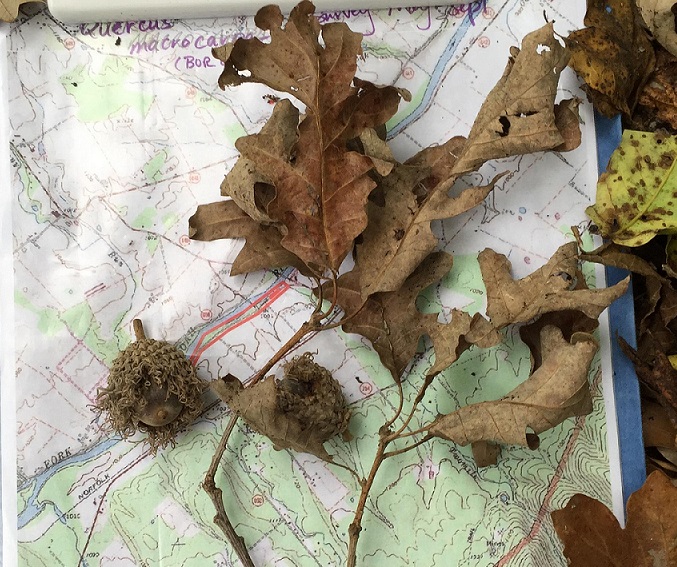
Headwaters Master Naturalist RareQuest Team 2 (Ginny Hoffman, Elaine Smith, and Chip Brown) conducted their final outing for the season on September 25th to search for Quercus macrocarpa (bur oak) in Rockingham county.
To get an idea of what they were looking for Elaine suggested they make a stop at a known specimen found in downtown Elkton, VA. Indeed, this tree was magnificent. A recent measuring records a circumference of 229 inches and a height of 96 feet. That’s a diameter of just over 6 feet! There are several bur oaks at the site and each were producing the giant and unique acorns characteristic of this white oak species. This tree is listed on the “Remarkable trees” website that highlights great trees in Virginia here.
According to the Flora of Virginia, the bur oak is mostly restricted to the mountain valleys west of the Blue Ridge mountains, particularly along the banks of the Shenandoah River. But the bur oak is a common tree elsewhere in the Eastern United States, especially in the mid-western prairie states. It is well adapted to fires and does well when planted in suburban and urban areas which may account some for its widespread status.
With their search image for the bur oak established, the three continued on to the area where wild specimens of the tree were last observed in 1991, along the South Fork of the Shenandoah River outside of Elkton. Sure enough, at least three bur oaks still survive at the site. The original observation in 1991 stated “One medium-sized tree and several small specimens nearby. Healthy, but no sign of fruit.” On the current visit, there were three medium to large trees, the largest of which measured at least 3 feet in diameter; not as large as the “remarkable” tree in Elkton, but impressive none-the-less. And, while no young trees or sapling were observed, several acorns were scattered beneath two of the three trees.
For this team, the RareQuest season was a success: they were able to verify two of the three historical observations they were assigned. More than that, they had several great adventures in places they might not have otherwise explored.
For more information about the RareQuest Project, see the Virginia Master Naturalist website here.
– Chip Brown, Cohort II, September 2016
Photos below by Elaine Smith.
Leaf and acorn specimen of Quercus macrocarpa (bur oak)
RareQuest Team 2: Chip Brown, Elaine Smith, Ginny Hoffman
Bridgewater College Department of Biology and the Wildlife Center of Virginia need help researching the best method for long-term storage of acorns. We are currently developing the protocol to test different collection, drying and storage methods to preserve the nutritional quality of acorns to be used as a food source for wild captive animals.
What is this? A local acorn research project.
Who is needed? Maybe YOU!
What will the protocol be? Details are still being determined, but it will be something like this:
access a solitary oak tree that is producing acorns
positively identify an acorn-producing oak tree to the species level,
gather acorns as they fall,
do a “float test” to eliminate “bad” acorns
weigh the acorns
deliver acorns within 1-2 days to the lab at Bridgewater College or another pre-determined spot
When will collection start? Fall of 2016
Interested? If you think you might want to participate, shoot an email to Kate Guenther at goatherderkate [at] yahoo [dot] com. When we soon have a more exact idea of what the process for your volunteering will be, we will be in touch with you again to see if you want to help.
A few answers to possible questions
Why solitary oaks? We need to make sure that each batch sample is from the exact same tree. The best way to do this is to find oaks that are far enough from other oaks that the acorns on the ground could co-mingle.
Hasn’t this research already been done? Believe it or not, there is research from the foraging community about how to process and store acorn for human consumption—via the indigenous traditions—but these processes store acorns as meal (a very lengthy, labor-intensive process). The other research is from the foresters who collect and store acorns for seedling propagation and tree farms. But this protocol only stores acorns fairly short-term and does not address nutritional data.
Our research study will determine how to optimize nutritional quality of the nut with the least amount of labor for the longest time possible.
Why long-term storage? Good acorn mast years are variable. Some years are boom, some are bust. At the Wildlife Center, we need to train baby bears to eat the native foods they will eat once they return to the wild as adults. We need to be able to provide them acorns while in captivity whether it is a boom OR a bust year. Storage addresses the “bust” years.
RareQuest, a partnership between the Virginia Department of Conservation and Recreation’s Natural Heritage Program and the Virginia Master Naturalists, is an adventure in the making. The Natural Heritage Program maintains a database of over 9,000 species rare in Virginia. By using the volunteers of the Master Naturalist program, the status of these species can be assessed more efficiently.The Headwaters Chapter has two teams of volunteers working with the RareQuest project who have been using their mobile devices to collect and track observations in the field.
The species that the two Headwaters Master Naturalist teams are searching for include:
Headwaters Team 1: Kathy Byers, Eric Jones, Andy Sale, Frances Sale, Chris Bowlen Lanius ludovicianus – Loggerhead shrike Arabis patens – Spreading rock cress Eleocharis compressa – Flat stem spike rush Solidago rupestris – Rock golden rod
Headwaters Team 2: Elaine Smith, Ginny Hoffman, Chip Brown Clematis viticaulis – Millboro leatherflower, grape clematis Filipendula rubra – Queen of the prairie Quercus macrocarpa – Bur oak
Biologists at the Natural Heritage Program provide historical records of the locations of rare plant and animal species to each group who then go into the field to verify that the target species is present.
While some of the sites are on public lands, other locations are found on private property and permission to access the land is required. Some land owners give permission freely while others have been reluctant to allow volunteers on their property. Property owners are not required to allow access and if these plants or animals are found on their property, there are no obligations to protect or conserve the population or habitat.
The Headwaters Team 2 made their first site visit on private property in early June looking for the Millboro leatherflower (Clematis viticaulis). According to the Flora of Virginia, this rare plant is endemic to Virginia and only found on shale barrens of Rockbridge and Bath Counties. The terrain was extremely challenging at the site where the clematis was last observed. After scrambling along the steep hillside, the team observed the maturing fruit (achenes) of the plant, but realized that they may have been too late in the season to see the plant in full flower. They continued their search along the hillside and as they were circling back, nearing a point where they started, Ginny spotted a single plant with a flower on it! Though the flower was still present, it was very mature and delicate, the petals barely hanging on to the base. It was an exciting find and one that made the wet feet and scramble on the hillside worth it.
With the success of their first outing, the team was eager to explore the second site. Based on an observation from 1989 on private property in Augusta County, the team planned their second outing, hopeful that they would find the rare plant, queen of the prairie (Filipendula rubra). Upon arrival at the site and to the surprise of the team, the land owner, who acquired the property after the original observation, called and wanted to meet the team. He was curious of the exact location and species of the search. He was appreciative of our work and interested in our findings.
The site included a swampy forest and open wetland that was soaked from the significant rain of May and June. Alder, cedar, green brier, roses, and sedges with extremely rough edges, poked and scraped the searchers. Despite their efforts and to the disappointment of the team, no specimen of the plant was observed. The reason the plant is no longer found at this site at this time is difficult to tell. Perhaps changes to habitat in the last 25 years, perhaps it is lurking in the background only to emerge when the conditions are right.
Headwaters Team 2 will continue their work with RareQuest later in the summer when they search for the bur oak (Quercus macrocarpa). No matter what they find at their final site for the season, the team has been able to explore some unique and inaccessible habitats and in the process learned more about a few of the rare species of Virginia.

 Birds of the ‘Burg completed its second season of bird walks at Hillandale Park in Harrisonburg. The walks were held the first Saturday of each month, April through October and were led by Kathy Byers, HMN Cohort IV; Ralph Grove, Sierra Club; and Anne Neilsen and Bill Benish, both with the Rockingham Bird Club.


 On August 19, 2016, Chris Bowlen and Kathy Byers, two members of Headwaters Team 1 for the RareQuest project, launched an adventurous kayaking trip to find a rare species of goldenrod in Page County, VA. The team was anxious for success as one rare bird and another plant species had eluded the team earlier in the year.
 capsized kayak later, the designated area was reached. The two team members donned boots and gaiters and began searching for Solidago rupestris. After discounting a few close relatives, one group of goldenrod drew hopeful, detailed examination. It was decided that the plant did possess the identifying characteristics of the target species and a short celebratory happy dance, complete with boots and gaiters ensued. Several pictures were taken for documentation, kayaks were loaded on to the truck and the tired paddlers headed for home. With the possibility of success, the planning and effort of the trip now seemed even more worthwhile. A few days later, the plant identification was confirmed by Christopher Ludwig, chief biologist of the project. Solidago rupestris would remain on the list of plants found in Virginia and Headwaters Team 1 would look forward to their next assignment.