Category: Projects

  • Volunteer with Save Lucy the Bat

    Volunteer with Save Lucy the Bat

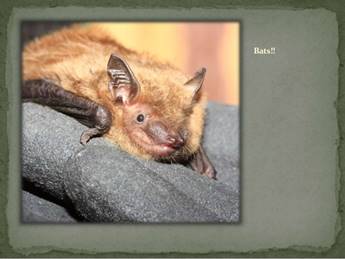
    image001There is a new volunteer opportunity and bat expert resource that moved to Augusta County!  Recently, Leslie Sturges has relocated her non-profit organization— Save Lucy the Bat— from northern Virginia to Mt. Solon.

    This is a non-profit organization dedicated to raising awareness of white-nose syndrome and its devastating impact on North American bats.  And because they are new to our area, Leslie is looking for volunteers. Save Lucy the Bat has a long history of working with master naturalists in the NOVA area. A typical year includes presenting an average of 50 live bat programs to school and scouting groups as well as adult groups like animal control officers, medical professionals, master naturalists.

    The organization is building a new bat house and flight cage, which should be ready next month just in advance of the spring rehabilitation for orphaned bat pups and injured adults.

    Interested in looking into volunteering? There are four areas where volunteering is needed. From the website:

    Education: The Save Lucy Campaign welcomes adult volunteers. We need people who can help with weekday and weekend educational events. We also need the assistance of creative people to help us develop outreach programs and opportunities and coordinate offsite youth volunteer projects.

    Bat Care: We also welcome volunteers who can help with bat care; potential caretakers must be 18 or older and have pre-exposure rabies vaccination. Persons seeking internships are encouraged to contact us, however internships are unpaid and are NOT full time. There are opportunities to explore behavior, environmental enrichment, and social interaction among captive bats. Right now, Leslie has about 20 bats in her care— everything from big brown bats, to tricolor bats, freetail bats, red bats and a little brown bat.

    Administration: We are seeking help with administrative functions such as board directors, fundraising, grant writing, record keeping and website maintenance.

    Building DevelopmentFolks will be needed to help paint and move into the new facility once it is ready in March, 2017!

    Save Lucy the Bat volunteer hours can be logged under one of the following Projects Listings on the VMN-VMS:

    • E – Outreach Wildlife Education with Rehabilitation Organizations
    • S – Build Wild Animal Housing for Wildlife Rehabilitators
    • S – Wild Animal Care with Permitted Rehabilitators

    To get started contact Leslie Sturges at: lsturges [at] savelucythebat.org

    More info? Look here:

    – Kate Guenther, Cohort I, February 2017

    benicetobats
    Click above for the complete graphic created by the Save Lucy Campaign.
  • Citizen Frog Science

    Citizen Frog Science

    For a few years now, I have been citizen scienc-ing it up in my front yard marsh monitoring the types of frogs that are there, what time of year they croak and how loudly. Sometimes the frogs are VERY loud. At times I have literally had the urge to put my hands over my ears. That is ridiculous.

    Here is my marsh:

    kates-marsh

    It’s the spring peepers that are so deafening. A good problem to have, I guess. After one of the VMN monthly webinar trainings encouraging frog citizen science, I signed up with FrogWatch USA.

    I’ve gotten pretty good at identifying the frogs in my pond—by call— because I do the monitoring at night when you can’t see anything. It takes me about 15 minutes per week to monitor and enter the data on-line and I do that every week from Feb 1- Aug 31.

    I learned a lot about the local frogs by researching which species were possibly living in my area, and making some charts about when the frogs might be heard. FrogWatch gives you a lot of training, but I also used the DGIF Frogs and Toads of Virginia Guide and CD ($10, a steal) to train my ear to recognize the different frog calls.  Here’s what I learned could be out there in my pond:

    possiblefrogs

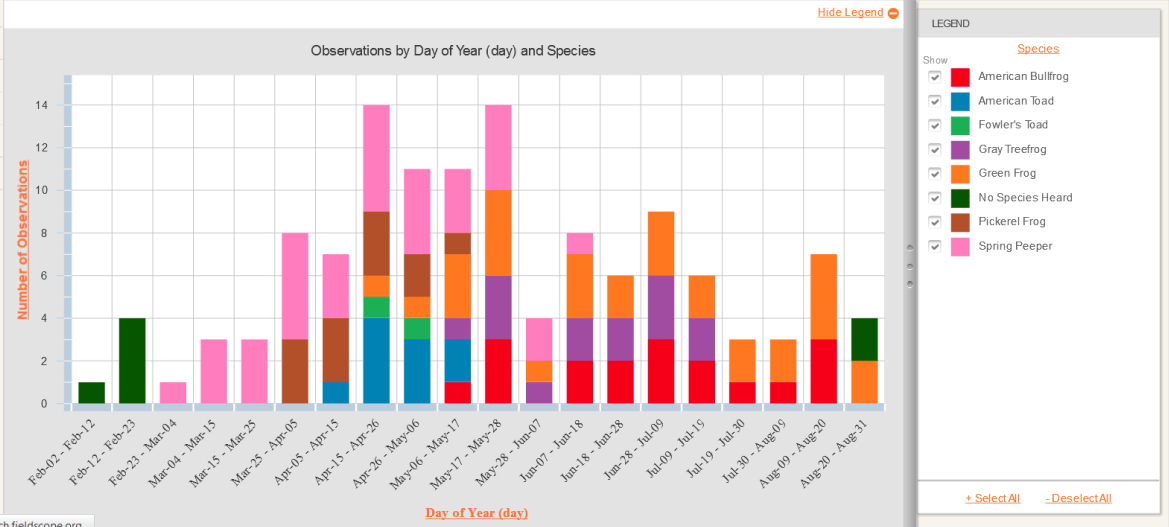
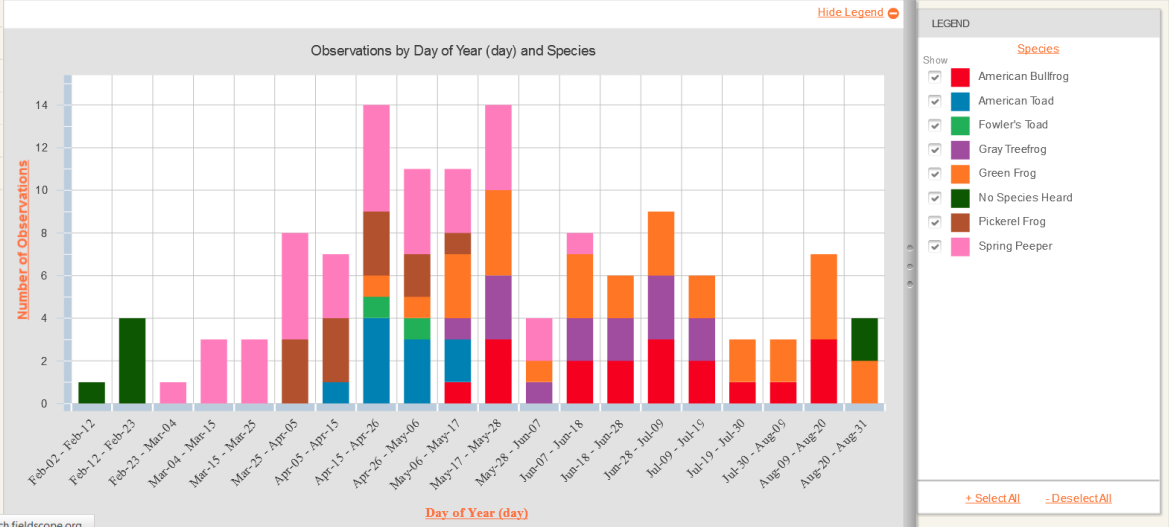
    Now, want to see what I’ve actually heard? At FrogWatch, you can plot and map your or other people’s data extensively. In this way, the accumulated data across the USA can be a research tool for anyone. In addition to just reporting, “Yes, I heard a Green Frog” we also track what the temperature, precipitation and wind speed is at the time we hear the frog. We follow a detailed, 3 minute listening protocol. Below is a chart of the 7 species in my marsh I have heard over the last 3 years. I could do other graphing based on the other data points.

    graph-crop-700
    Click for a bigger version of the graph

    I have yet to hear a wood frog, northern cricket frog or an upland chorus frog at my site—these guys are more likely to be found in ephemeral pools, I believe— but every year I am hopeful!

    Now, let me also say there is another different frog citizen science project called the North American Amphibian Monitoring Program.  The VMN webinar I linked to at the end of this article gives more info about that program as well as about FrogWatch USA.

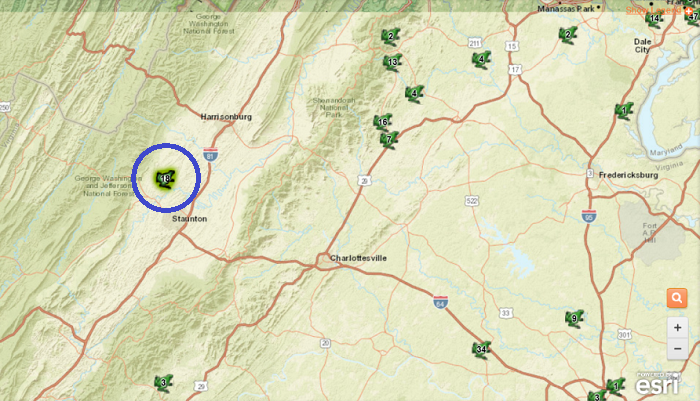
    So, check them both out, and see which group you want to get involved with. And you will want to get involved, won’t you? Because, look at the following map! See that graphic of a single frog located just above Staunton?

    Squint.

    See it?  That’s me! Notice how there are no other frogs near me, which makes me a lonely frog?

    frogmonitors-700-circle

    Any place near you that you have heard frogs can become a reporting site! You can participate as much or as little as you like, and after you get some initial set-up and training, the time commitment is really negligible.

    Amphibians are our “canaries in the coalmine.”  So adding to the data on science on how they are faring in our world is a beneficial science.

    kate2016I’d be glad to talk about the project with anyone who is interested or curious.

    – Kate Guenther, Cohort I, February 2017
    More info:

    Frogwatch: https://www.aza.org/become-a-frogwatch-volunteer

    North American Amphibian Monitoring Program: https://www.pwrc.usgs.gov/naamp/

    DGIF Frogs and Toads of Virginia (Guide and CD) :https://www.dgif.virginia.gov/wildlife/virginia-is-for-frogs/

    VMN Webinar Join the Virginia Frog and Toad Calling Survey  with Michelle Prysby and Travis Land—from January 15, 2015: http://www.virginiamasternaturalist.org/continuing-education.html

    frogs      Green Frog at Wildlife Center of VA                               American Toad in my bathtub

    Why was the American Toad in my bathtub? Because I wanted to get a good picture of him, and aside from peeing in my hand as I carried him in the house, he really didn’t seem to mind. Within 5 minutes, he was back out in the yard, catching bugs for dinner.

  • Nature’s Notebook

    Nature’s Notebook

    naturesnotebooksnipMy New Year’s resolution is to actively observe and record seasonal changes in local plants and animals.  I will be joining over 15,000 other citizen scientists and professional naturalists participating in the USA National Phenology Network’s (USA-NPN) Nature’s Notebook project.

    Nature’s Notebook participation is an enjoyable project, good for a variety of skill levels, and approved for HMN volunteer hours. But what is most exciting to me is how USA-NPN along with its government and academic partners and sponsors interpret and use our data.  They are professionally and actively analyzing plant and animal phenology data sets to conduct and release scientific studies on long-term changes in the natural world. For example, USA-NPN data was included in a recently released study which shows Spring is advancing in 3 of every 4 National Parks.

    And in 2015, the University of Wisconsin-Madison released study results using USA-NPN data.  Their article states that early springs and “false springs” will likely continue into the future due to climate change.

    It is easy to sign up and get started with Nature’s Notebook. Participants select from a list of plants and animals to monitor. We are encouraged to observe and record at our convenience, with a suggested three minutes or more observation period on three days a week. I will be monitoring three plants in my yard as well as ten animals, including honeybees, bumblebees and the woodchuck that lives under my shed. Observations are entered easily online by computer or mobile app.  The observations and some metadata on collection are uploaded via each participant’s Nature’s Notebook Observation Deck.

    Nature’s Notebook offers thorough online training and an assortment of features that keep the data collection fun and interesting. There are virtual badges to earn, new features and challenges to explore, and frequent news to read on how the program is making a difference toward understanding seasonal longer-term changes in the natural world.

    stephanieinplantUSA-NPN and its sponsors also host a variety of specialized data collection campaigns.  I will be participating in the cloned lilac campaign, a source for data used in the UW-Madison early springs study linked above. Other campaigns include Shady Invaders, about invasive shrubs; and cloned dogwood monitoring.
    For a project that you can do in your own backyard and that makes a difference in scientific understanding, I recommend phenology monitoring with the fun, well managed, and easily accessible Nature’s Notebook.

    – Stephanie Gardner, January 2017

    In the photo above right, Stephanie is peering through love-lies-bleeding (Amaranthus caudatus) flowers at the Smithsonian gardens in Washington, DC.

  • VBWT Adopt-A-Trail Update

    VBWT Adopt-A-Trail Update

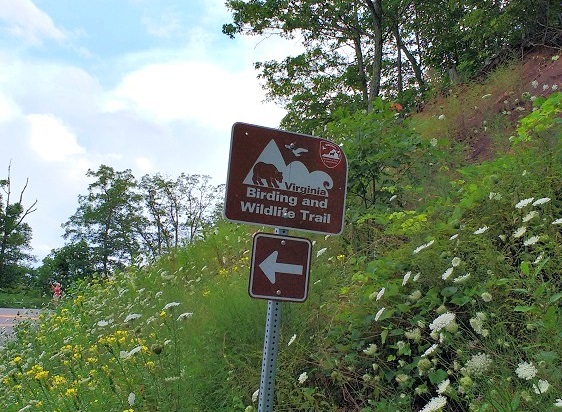
    vabwt-signswitzerlake-pic-cropAdapted from an email sent to Adopt-A-Trail Project coordinators by VDGIF’s Virginia Birding & Wildlife Trail Project organizer Jessica Ruthenberg on December 22, 2016:

    Due dates for checklists by season:
    Project coordinator, Sandy Greene, compiles and sends these in to Jessica.
    Winter: March 31
    Spring: June 30
    Summer: September 30
    Fall: December 31

    Only checklists for sites that are visited for the first time or are re-visited and have new findings about the site itself or the site/ manager contact, need to be sent in. Re-visits are primarily intended for birding and wildlife observation which are entered into eBird and our Wildlife Mapping project on iNaturalist.

    Site contacts should be contacted once per year.

    Winter in Virginia is a great time to observe over-wintering waterfowl, seabirds, and some song-birds and we would love to have observations of these species captured in eBird. Many of the VBWT sites on eBird lack winter observations. You may find that some sites are closed or inaccessible during winter. If this is the case for your site, we do not expect you to visit it.

    If you haven’t yet successfully been able to get in touch with your site contact, this may be a good time of year to try again as winter tends to  be a slower season for many of the site contacts. If the contact information is out-of-date on our website and you’ve been struggling to determine an appropriate new contact, please keep up the detective work by calling main offices for that site and asking around. Getting these contacts updated and having owners/ managers respond to the checklist questions is very helpful information for us. We recognize in many cases that getting ahold of these folks is the most challenging part of the project, so we appreciate your persistence!

    Adopt-A-Trail Project chapter coordinators are being asked to complete a Year-end Report Survey by January 31, 2017. The survey hopes to assess how well the project is going for the VMN chapters involved.

    Find Wildlife is a new interactive map version of the VBWT guide and website.  The Find Wildlife application does not replace the current VBWT section of DGIF’s website. It is intended to complement the website and offer a new way to navigate the VBWT.

    Department of Game and Inland Fisheries website has been undergoing an update, including the Virginia Wildlife and Birding Trail section of the website. Check them out.

    The project’s training powerpoint slides have been updated and are available in pdf form on the Adopt-A-Trail Project page on the Virginia Master Naturalists’ website here. These training slides serve as the procedure for the project.

    I have just completed reviewing and compiling information from all of the checklists submitted in 2016 (over 150 checklists!). We received back a ton of helpful information!

    As of December 2016, here are some project stats:

    • 13 (almost 50%) VMN chapters have committed to the project
    • 11 committed VMN chapters have already started the project and have been actively participating
    • 16 VBWT loops (about 25% of VBWT’s loops) have been adopted by VMN chapters
    • 13 loops were monitored and reported on by VMNs in 2016
    • 141 individual VBWT sites (over 20% of VBWT sites) have been monitored and reported on by VMNS in 2016! Way to go!

    We are very excited about the potential of this project and anticipate that Adopt-A-Trail will continue to evolve and grow over time. Thanks for taking the journey with us!

    Jessica Ruthenberg
    Watchable Wildlife Biologist
    Virginia Department of Game & Inland Fisheries
    jessica.ruthenberg [at] dgif.virginia.gov

  • Market Compost Drop-off Project Update

    Market Compost Drop-off Project Update

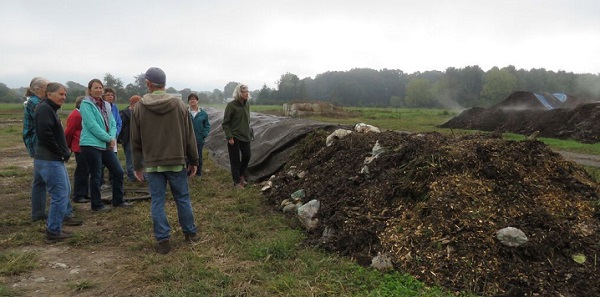
    bbctour2-3-af-crop-600


    By the close of the last official Market Compost Drop-off on Saturday, October 29th, 8195 pounds of household organic waste had been collected and recorded from some 1045 contributions over 31 weekly collections at the Harrisonburg Farmers Market. These four tons of nitrogen-heavy organics are happily on their way to becoming finished compost at the Black Bear Composting facility in Crimora. Although the last official Market station collection is over, Black Bear collection bins will continue to be available for organics deposits near the Market’s Turner Pavilion through the end of the year.

    The project coordinator, Adrie Voors, Cohort II, and her co-coordinator Art Fovargue were joined by HMNs Art Vasy, Stephanie Gardner, Kate Guenther and Carl Droms in devoting numerous hours to staffing the Market station. They were rewarded with many thoughtful conversations with program participants and expressions of gratitude for offering this option. There is no sense in sending these valuable resources to a faraway landfill when they can be composted locally.

    Late September brought the sad news from Black Bear Composting’s founder and chief composting officer Eric Walter that his business is scheduled to close at the end of the year after five years of slow growth. Despite a consistent demand for the finished compost, an insufficient organics waste stream aimed at the facility prevents it from being financially viable. Current Virginia state policy favors large landfills over smaller, local efforts at sustainability. Black Bear’s closure puts any future of a Market Compost Drop-off program for next year in jeopardy but options are still being explored.

    Over the course of the seven-month project, the Market Compost Drop-off program hosted other events including two tours of the Black Bear Composting facility, and four vermicomposting demonstrations at the Market with Bridgewater College Physics professor Deva O’Neil with some help from her students. Additionally, access to Black Bear’s commercial scale compost service allowed for the organization of two “zero waste” stations at the Shenandoah Valley Century on September 11. This annual bicycle event feeds 300 riders at parks in Harrisonburg and Bridgewater. Using compostable serving-ware, recycling granola wrappers and energy gel pouches through Terracycle, plus other recycling efforts for plastic bags and shrink wrap, paper, hard plastics, cardboard, and metals left very little for the landfill. Finally a culminating event for the program was a public forum on “Talkin’ Trash” with Harrisonburg -area waste managers attended by close to 60 concerned citizens interested in hearing about local waste handling and the status of recycling and composting programs.

    – Adrie Voors, Cohort II, November 2016

    Top photo is by Art Fovargue at the second Black Bear Composting facility tour on October 6th.