Category: Projects

  • RareQuest Outings

    RareQuest Outings

    Chris.Kathy.Gary.MagnoliaSwamp.pp.700

    On June 15, HMNs Kathy Byers, Chris Bowlen and Peggy Plass joined a trio of botanists with the Virginia Department of Conservation and Recreation for a trip to Magnolia Swamp in Augusta County. The primary target of their search was the Queen of the Prairie (Filipendula rubra), a beautiful wildflower last seen on the property about 25 years ago. The team also looked for other plants which are not usually found in Augusta County, but which had been sighted at Magnolia Swamp in the past.

    The site is well named—extremely swampy. “Yeah, there were probably only 5 or 6 times when my boot came really close to getting sucked off into the mud,” quipped Kathy Byers. The mucky terrain crisscrossed with trailing vines and seemingly endless patches of Johnny in the Pulpit (Arisaema triphyllum) was well worth the effort required to navigate the swamp though. Multiple small patches of swamp pink (Hellonias bullata) were located and plotted on the RareQuest Collection Map. Other finds included Grass of Parnassus (Parnassia palustris). Both plants were on the state botanists’ list of species (rare for that area) which they hoped to find at Magnolia Swamp!

    Queen of the Prairie.6.15.17.MagnoliaSwamp.pp.420
    Queen of the Prairie

    The best find of the day, however, was made by HMN Chris Bowlen, who located Filipendula rubra in an isolated corner of the property after fighting her way through mud, brush, and lots of bugs. VDCR botanists were delighted to find that the Queen was still resident in Magnolia Swamp. Keep in mind that none of these plants were in bloom at the time the team was at the site—so recognizing them involved careful scrutiny of a set of leaves growing among endless other green leafy things. An impressive feat!

    After the success at Magnolia Swamp, another Headwaters RareQuest team (this time including project coordinator Chip Brown along with Chris Bowlen and Peggy Plass) headed to a RareQuest site in Page County on June 25 to look for lowland loosestrife (Lysimachia hybrida). This site was soon dubbed “greenbriar swamp” by the team, who had to contend with nearly constant snagging of clothes and skin by the thorny plant.

    lowland loosestrifehopeful.pagecounty.6.25.17.pp.300
    Lowland Loosestrife-? See update below.

    The prickly terrain, coupled with the extravagant and multifaceted songs of what was apparently a very large group of roosters living on the adjacent property made for an exciting morning outing! Once again, Chris Bowlen was able to identify a small patch of what the team hopes is Lysimachia hybrida. With photos sent off to the state RareQuest coordinator for hopeful validation, HMNs will plan to make another visit in early July (when there’s a better chance that the plant will be flowering), hoping to obtain data needed to confirm the sighting.*

    More RareQuest outings are planned for later this summer. If you have an interest in being part of the project (this summer or next year) contact Chip Brown for more info!

    – Peggy Plass, Cohort IV, July 2017

    More about RareQuest from the Virginia Master Naturalists’ website HERE.

    All photos by Peggy Plass.

    Top photo is of Chris and Kathy (just behind Chris) looking for plants at Magnolia Swamp. Gary Fleming from VDCR is with the camera. 


    *Update August 2017, from Elaine Smith, Cohort IV: 

    yellowloosestrifeWe were informed by the state RareQuest coordinator that the June 25 find in Page County was not the loosestrife, but another, more common plant, Rhexia virginica, a meadow beauty.

    On July 22, Chip, Chris, Jan Worthy and I went back and found it! We logged our find into the Rarequest app.

    Find Elaine’s photos from the trip posted to a flickr album HERE. Photo at right of the target plant, lowland yellow loosestrfe, is taken from one of Elaine’s photos.
  • HMN Wildflower Walks 2017

    HMN Wildflower Walks 2017

    NRG.4.29.17.3.am.crop

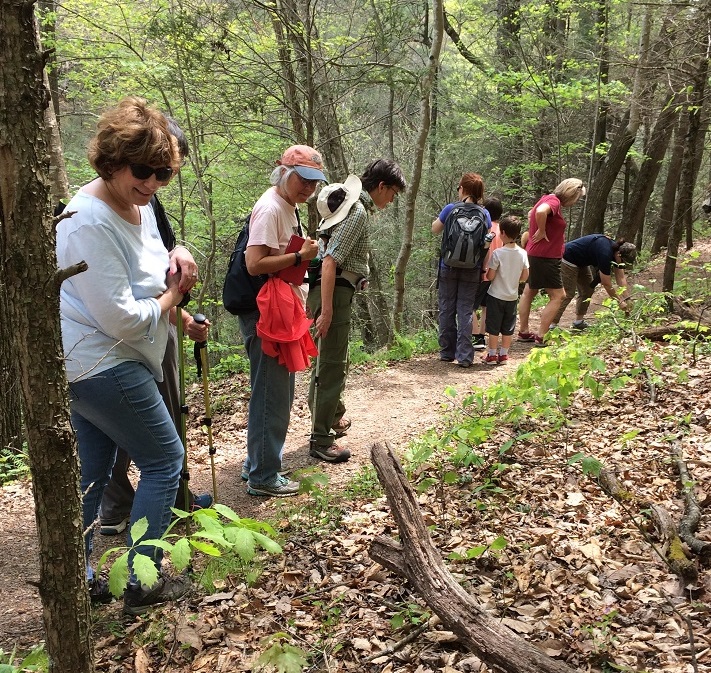
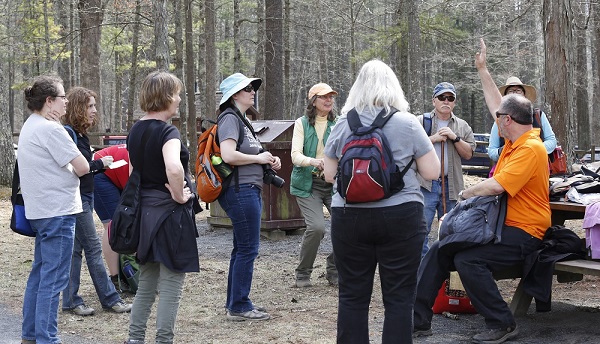
    On Saturday, April 29th, the Headwaters Master Naturalists led three wildflower walks on trails on Shenandoah Mountain. Nearly 50 participants and 15 master naturalists hit the trails in search of spring wild flowers. Highlights from the three trails include:

    Spring.beauties.crop.400Dowell’s Draft Trail (moved from Braley’s Pond due to fish stocking at the pond):

    Trailing Arbutus
    Hepatica
    Rattlesnake plantain
    Birdsfoot violet
    Spring Beauty (photo at right by Carl Droms)

    More photos from the Dowell’s Draft walk by Carl Droms below.


    pinks.HQ.lc.300Hone Quarry Trail:

    Early Saxifrage
    Dwarf Iris
    Wake Robin Trillium
    Pinks – easily confused with Phlox (photo at right by Lynn Cameron)

    More photos from the Hone Quarry walk by Lynn Cameron HERE and below.


    NRG.4.29.17.2.am

    North River Gorge Trail:

    Spur Violet
    Wood Anemone (photo at right by Ann Murray)
    Pink Lady’s Slipper
    Large Whorled Pogonia
    Virginia Heartleaf

    Photos from the North River Gorge walk by Peggy Plass HERE. Photo at top by Ann Murray at the North River Gorge walk plus more from her below.


    Thanks to everyone who helped make this year’s walks successful!


  • Stream Temperature Study

    Stream Temperature Study

    BCsite1.4.5.17.2

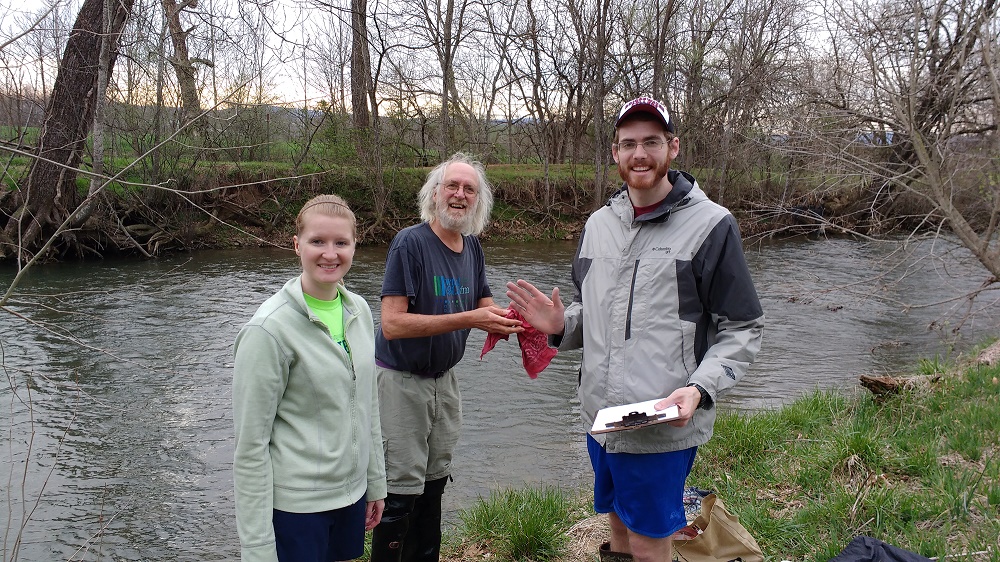
    In late March and early April, HMN trainees Morgan and Ben Martindell and members Adrie Voors and Carl Droms were among a group of 49 who volunteered to deploy temperature loggers for Trout Unlimited’s Upper Shenandoah Stream Temperature Study. The group included several other members of the trainee class.

    The first step in the process was to attend a training session at JMU organized by the study leaders, Jake Lemon and Seth Coffman, where we were told about the study: its purpose and scope, and the protocols to be followed. At the end, we were issued our supplies, which included the temperature loggers, as well as several 24″ long pieces of rebar.

    As you may have guessed, the purpose of the study is to monitor the temperature in several streams in the Shenandoah River drainage. As global air temperature rises, the effect on stream temperatures will be different at different locations. For example, a stream fed by an underground source will not warm up as much on a warm day as one fed mostly by surface water. Trout Unlimited’s interest in this comes from the fact that trout thrive in cold water streams, but do poorly if the temperature gets too high.

    templogger.350Our little group was given four locations on Beaver Creek near the village of Spring Creek in southwestern Rockingham County. After locating a site using the GPS coordinates we had been given, one of us waded into about the middle of the stream and pounded one of the pieces of rebar into the stream bed until only about 5″ protruded above ground. The temperature loggers (see photo at right) are encased in PVC pipe with holes that allow water in, with one set of holes reserved for sliding the whole thing over the rebar. Hose clamps tightened around the rebar above and below the logger keeps it in place.
    We were instructed to locate the loggers near the given sites, with a couple of other considerations: they should be shaded during the day if possible, and they should be located in a spot that will remain underwater even during the driest part of the summer.

    Our first attempt a placing a logger was complicated by the fact that there had been a torrential rain a few days before, which meant that the stream was much too fast and deep to be able to pound in the rebar (ever tried swinging a hammer under water?) Thus, we were forced to wait a few days for the water to recede. However, in the end we were able to place three of our four loggers without much difficulty. The fourth location was on private property whose owner politely declined to allow us onto his land.

    The loggers will sit in the streams until September, when we will go to retrieve them. We’re keeping our fingers crossed that we can find the locations again, and that the loggers will still be where we put them!

    – Carl Droms, Cohort II, April 2017

    Top photo is of Morgan Martindell, Carl Droms and Ben Martindell at Beaver Creek Site Number 1 on April 5th taken by Adrie Voors. 

  • Cohort V Adopt-A-Trail Project Initiation

    Cohort V Adopt-A-Trail Project Initiation

    Buckhorn Inn MN Field trip (1).600

    On Saturday, March 25th, the current Headwaters Master Naturalist Training Class met at Buckhorn Inn for a scouting field trip of part of the Virginia Department of Game and Inland Fisheries Forest Trails Loop of the Virginia Birding and Wildlife Trail, which they are adopting as their class project.

    We had a chance to look around Buckhorn Inn with the owner, and learn a little of its history over 200 years as a wayside inn, gambling hall and Civil War hospital. Lynn Cameron, of Friends of Shenandoah Mountain, spoke to us on their proposal for Scenic Area designation, embedded wilderness, and multiple use, supported by many diverse stakeholders. She highlighted Shenandoah Mountain as a world biodiversity hotspot, the largest roadless area east of the Mississippi, the only dark skies designated on the east coast. She also clarified that all the current management activities and access stay the same with scenic area designation, although mining and drilling would not be permitted. We carpooled west…

    Group in Braley Pond.600

    Our first site visit was Braley Pond, where we undertook a short Bioblitz, with each person assigned a particular aspect of interest, from mosses to raptors to people and amenities. We were also all tuned in to herpetofauna, as prompted by DGIF, for inclusion in the iNaturalist Virginia Wildlife Mapping Project. Rainbow trout had recently been stocked at Braley, so there were lots of happy anglers there, armed with powerbait. Braley Pond site was the first to be adopted, by new HMN Barbara Phillips.

    We moved on to Ramsey’s Draft, where we split into three groups to honor the wilderness requirements of no more than 10 people in a group. Kate Guenther took a group on one trail to explore Bird Language. Lynn Cameron’s group was on a wildflower hunt (lots of hepatica blooming), and my group fished up macroinvertebrates (stonefly, hellgrammite, mayflies) while looking for brook trout, and attempting to “match the hatch” of caddisflies with a tied fly. No bait is allowed at Ramsey’s Draft for the native brook trout. Ramsey’s Draft has been adopted by Dave Wendelken.

    Last stop, at the top of Shenandoah Mountain, Confederate Breastworks Trail, a jaunt on the trail, with a sound map, a toast of water pure to public lands and service, a little trash picked up, and return to Buckhorn. The observation bioblitz formed the background canvas for the first monitoring of the Forest Trails Loop of the Birding and Wildlife Trail, with six of the seven sites adopted through the class so far. And this trip was a delightful day of getting to know each other better!

    Monitoring the Birding and Wildlife Trails (North River Loop, and now Forest Trails Loop), gives us an excellent opportunity to really get to know our public lands, to share the experience with others on regular monitoring trips, to get better at ID and using eBird and iNaturalist to contribute to citizen science online.

    This is the assembly of life that took a billion years to evolve… Biodiversity is the key to the maintenance of the world as we know it… it is the property that makes resilience possible…it holds the world steady… it can be eroded away fragment by fragment. – E.O. Wilson

    – Sandy Greene, Cohort I, March 2017

    All photos by Deb Pugh, Cohort V

    Photo at top is of Jan Worthy on the porch of Buckhorn Inn. Second photo above is of group gathered at Braley Pond.

  • Purcell Hops Pull

    Purcell Hops Pull

    purcell2-24-7

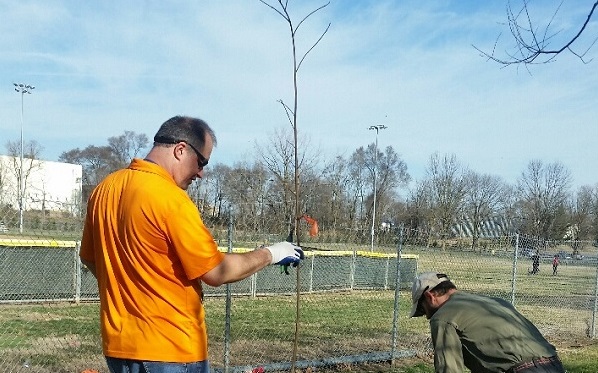
    Early in 2017 Harrisonburg’s Stream Health Coordinator Trey Jarrels invited HMNs to help save tree seedlings along Blacks Run in Purcell Park. Planted last year by representatives of The Nature Conservancy, the trees are part of a ten year joint project begun in 2008 to improve the health of Blacks Run whose waters find their way to the Chesapeake Bay. The online Nuevas Raíces has a nice overview of the project here.

    Since being planted, the Blacks Run riparian area has become overrun with Japanese hops among other invasives. The hop vines had literally pulled the seedlings down to the ground. On Friday, February 24 eight HMNs and a friend worked with Trey and two Nature Conservancy representatives to come to their rescue. Now dry and brittle the vines were fairly easily pulled off and away from the struggling seedlings. The hop vines’ seeds are set so their control will require ongoing attention. We provided the freed tree seedlings with added support from wooden stakes and landscape tape ties.

    The banks of Blacks Run in Purcell Park receive frequent doses of unwelcome litter as each rain event brings run off from large swaths of surrounding impermeable surfaces. We collected some of this as we made our way along the western edge of the park. We ended the morning by pulling up empty tree tubes from previous plantings which also often turn into litter after heavy rains.

    huja1More about Japanese hops from the National Park Service here. “The vines grow rapidly during the summer, climbing up and over everything in their path and can form dense mats several feet deep, blocking light to plants underneath. Hop vines also twine around shrubs and trees causing them to break or fall over. It is invasive in riparian and floodplain habitats where it displaces native vegetation, prevents the emergence of new plants, and kills newly planted trees installed for streamside habitat restoration. Hop can quickly cover small trees hiding them from view… ” Yup! We also discovered the effectiveness of the prickles covering the vines helping them grip and causing abrasions to uncovered skin.

    -Adrie Voors, Cohort II, February 2017

    Purcell Park is a unique urban stream restoration that has been very beneficial to the city of Harrisonburg.  With your work and environmental stewardship throughout the city we hope we can continue to create and maintain our project areas.  Thanks again for your assistance … -Harrisonburg Stream Health Coordinator Trey Jarrels

    More photos of our “winter” morning in the Park: