UPDATE: FOMR (Friends of the Middle River) has had to scrap our first set of dates for benthic monitoring at our 9 sites due to persistent flood conditions. We are uncertain as to when and if we will be able to do this volunteer activity this fall, but if we can, it will be ASAP in October. Keep and eye on the “upcoming events” on our website for new dates or let us know you are interested and we’ll make sure you get an email.
Friends of the Middle River is planning to monitor our benthic sites in late September and early October. We always welcome any volunteers who want to pitch in and pick and count critters or just see what we do and how we go about assessing stream health. (The species and quantity of certain aquatic insects indicate stream health).
This is always a fluid process (no pun intended) since we are dependent on the weather (peak hurricane season coming up), stream flows, and the schedules of our certified monitors.
It usually takes 1.5 to 2 hours to monitor a site. You don’t have to get wet, but dress appropriately, bring a camp chair, sun screen, insect repellent. If you have questions or want to help, send an email to info [at] friendsofthemiddleriver.org
Schedule as of September 5, 2018:
Date
Time
Site
Leader
Meet at
Sep. 16
1 pm
Cline Lane
Ann Cline
DGIF office, Verona
Sep. 21
9 am
River Ridge
Sherry Stanley and Sarah Jordan
the first house on the right in River Ridge off Limestone Rd., Verona
“The Virginia Big Tree Program maintains a register of the 5 (now 3) largest specimens of over 300 native, non-native, and naturalized tree species. The register includes information about each tree’s size, location, and unique characteristics. Each tree must be re-certified every 10 years to maintain its status in the register.” – VA Big Tree Program
Coordinated by Eric Wiseman, Associate Professor of Urban Forestry, Department of Forest Resources and Environmental Conservation, Virginia Tech, many of these trees were last measured in 2008 (or earlier) and require re-measuring this year. Two of these trees are in the HMN service area: a paperbark maple on the Bridgewater College campus and a Japanese zelkova in Staunton.
Breyette Lorntz, Cohort V, recently became involved in the re-measuring effort for the VA Big Tree Program. Thanks to Breyette for sending photos and this background on August 11, 2018:
I was trained yesterday to measure trees for the VA Big Tree Program. I met with Jon Rockett to measure the Japanese zelkova in downtown Staunton. Jon had previously measured the tree at Bridgewater, earlier this month when I was out of town.
Check out the listings, locations, current status and rankings of the these trees HERE.
More from Eric Wiseman including details of the re-certification process and links to maps and more HERE
Top photo is of Big Tree measurers Jon Rockett and Breyette.
Thanks to Breyette for the photos!
Location of Staunton’s “Big Tree” up for re-measuring this year.
Leaves on Staunton’s Japanese zelcova “Big Tree.”
Staunton’s Japanese zelcova on the Big Tree registry in 2008. Will it get to stay?
Just after sunset on July 1, HMNs Peggy Plass and Emily Fugate met at Lake Shenandoah to kick off our latest project—Acoustic Bat Monitoring! Our chapter purchased a handheld bat monitor earlier this summer, and Sunday night marked the first time that it was used to collect data in the field. This spring, the state office of Virginia Master Naturalist hosted a webinar with information about bat monitoring projects being done in two other chapters around the state. Headwaters will now be participating in one of these, filing data from weekly monitoring trips with BatAMP (the Bat Acoustic Monitoring Portal). In Sunday’s outing at Lake Shenandoah, Peggy and Emily recorded more than 100 bat calls from 3 different species—lasiurus cinereus (Hoary bats), lasiurus borealis (Eastern Red bats), and lasionycteris noctivagans (Silver-haired bats). They also got quite a lot of mosquito bites.
The project is just getting started, and we’re definitely still working out the kinks. If you’re interested in being part of this, here’s some basic information to help you decide. The protocol involves monitoring at a site at least once every two weeks (we’re hoping for weekly visits) for about an hour. Monitoring has to start no earlier than 15 minutes after sunset. Those who are considering the project should definitely watch the webinar from the Virginia Master Naturalist state office from this spring—it can be found here. You might also want to check out BatAMP for more information on how the data will be used. You can find that here.
The bat monitor itself is pretty easy to use, but requires a little bit of training, which we’ll of course provide. Right now, we only own one monitor, and it requires an Android device to be usable in the field. Only one person in a pair (or group) needs to have a compatible device, though. We’re feeling pretty committed to continuing to monitor at Lake Shenandoah, but are also very open to considering other sites, should there be other HMNs who want to work on this at other places. Spots on the Virginia Birding and Wildlife Trail loops that are in our area might be good choices.
If you’re interested in getting involved in this project, or just learning more about it, feel free to contact the project coordinator, Peggy Plass. You can reach her at plassms [at] gmail.com
– Peggy Plass, Cohort IV, Projects Committee Chair, July 2018
Photo at right is a screenshot of the monitor display from Peggy and Emily’s July 1st Lake Shenandoah monitoring indicating the call of an Eastern Red Bat.
It’s that time of year! The Headwaters Master Naturalists join the likes of the Edith J. Carrier Arboretum at JMU, Wild Virginia, and the Shenandoah National Park in offering guided Wildflower Walks to the public. With just a short season for these ephemeral beauties, the more opportunities to get out to experience their magic, the better.
This is the sixth year for the Headwaters Chapter’s Shenandoah Mountain Wildflower Walks. HMN Chip Brown coordinated the first event (which was officially rained out) as part of his Cohort II basic training class project in 2013. He has been heading them up ever since.
Lynn Cameron, with the Friends of Shenandoah Mountain, has been integral to each event, leading walks and providing support, advice and outreach. Stirring up appreciation and love for the tremendous assets provided by the mountain at our doorstep is an important goal of this effort for all involved.
More about the HMN Wildflower Walks on Shenandoah Mountain including a link for the free registration HERE.
Other area-wide Wildflower Walks
Edith J. Carrier Arboretum Director Jan Mahon leads a series of weekly Wednesday morning wildflower walks through the arboretum at James Madison University in April and May. Details here.
Wild Virginia‘s mid-April wildflower walk at the Hone Quarry Recreation Area filled up fast. It is led by local wildflower enthusiast Michael Seth. More here.
Wild Virginia will host a May 5 wildflower walk along the Shenandoah Mountain trail and in Ramsey’s Draft Wilderness. Details and registration here.
The Shenandoah National Park will celebrate wildflowers in early May with a host of activities including a youth art contest. Their May 5-6 wildflower weekend schedule is full of walks and programs including a botanical art workshop instructed by HMN Betty Gatewood. Find the full line up and descriptions here.
Headwaters Master Naturalist Byron Hukee took advantage of a unique opportunity to help scientists further our knowledge of the endangered California Condor. Many thanks to him for sharing his experience here.
My affinity for the California condor (Gymnogyps californianus) began in 2008 after moving back to Utah when I retired from the US Air Force. During a hike at Zion National Park, I saw and photographed two very large birds soaring high near the top of a canyon wall that turned out to be California condors. On a subsequent visit, I was fortunate enough to watch a condor glide out of the mist on a snowy day and perch on a dead tree near Angels Landing. I have always loved the recreational opportunities afforded there, especially visiting the five national parks found in Utah. Heading that list is Zion in the southern part of the state. I first visited Zion in 1977 when my wife and I took our young family on a tour of several western national parks while on leave from my military assignment in the Phoenix, AZ area. Sadly, our first visit to Zion was after the condor had already disappeared from that area.
It was soon apparent that without human intervention, California condors very likely would become extinct. With only 21 estimated wild condors remaining, a limited captive breeding program was begun in 1982 using eggs and chicks removed from the wild, and a single captured adult condor. During 1986 and early 1987, the nine remaining wild condors were captured to establish a more viable captive breeding program, and since mature female condors produce but one egg every two years, this process was going to take some time.
In 1987, the capture of the last 21 remaining California condors in the wild was completed. The first captive-reared birds were released in southern California in 1992. This was followed by the reintroduction of birds in Arizona at Vermilion Cliffs north of the Grand Canyon in 1996. Numerous releases at this site have followed and it is these birds that have found their way north to the Virgin River canyons of Zion NP. I have visited Zion NP numerous times since then and have been fortunate enough to see and photograph condors soaring above the canyon floor of Zion on many of these trips.
Fast forward to June 2017 when I was contacted by my good friends Christina Gebhard and Brian Schmidt both of whom work in the Bird Division of the National Museum of Natural History (USNM) on the Mall in Washington D.C. The USNM bird collection is the world’s third largest with about 640,000 specimens representing about 80% of the approximately 9,600 known species of birds. The reason for their contact was to see whether I wanted to serve as a volunteer on their team that would inventory and begin the initial processing of the preserved remains of more than 200 condors that had been previously held in cold storage at three different sites in the southwest US. Of course I quickly agreed to participate. The addition of these condor specimens would increase their California condor specimen count by about 400%.
The data working station manned by Byron Hukee in the lab during California condor processing
My main duty during this week was to assist Christina Gebhard, Museum Specialist, in the enormous task of organizing all the birds received in multiple coolers from these three different places. We pulled them all out of the huge walk-in freezers at the Smithsonian Institution Museum Support Center (MSC) to sort and thaw. Once the birds were inventoried a unique preparation number tag was affixed to the specimen. These numbers correspond to numbers in a preparation book that I maintained for each team by writing down all the data as the specimens were prepared.
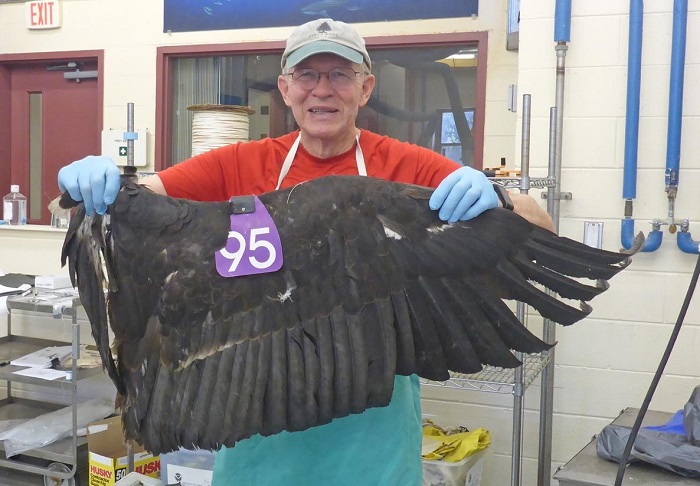
Byron shows the size of one of the California condor specimens being readied for processing
The condors ranged from eggs that did not hatch to mature adult birds and all had been necropsied. (A necropsy is an autopsy on an animal.) The condition of the adult birds varied from pristine to severely decomposed, some with detached or missing body parts due to the necropsy process or predation post mortem. A preliminary determination was then made as to which type of specimen preparation method would be best suited for each individual condor.
Museum bird specimen preparation types include the following:
Boneless skin “shmoo” or flat skin – used when a specimen is unique and plumage as well as separate skeletal elements need saving
Spread wing – a wing may be removed and preserved separately as a spread wing for better study of feathers
Complete skeleton – if the bird is too decomposed for the skin and feathers to be preserved, as is the case with some salvaged specimens, the skeleton alone may be preserved. All feathers and tissue are removed, and the remaining dried tissue is removed from skeletons by using dermestid beetle larvae.
Partial skeleton – same process as a complete skeleton but using only the bones remaining from an incomplete specimen.
Fluid Preserved – whole or partial birds fixed in formalin and stored in ethanol. Most young birds and chicks were preserved this way.
Live mount – not usually done unless an exhibit needs one.
Notes:
Feathers were saved in a “feather bag” (large slide-lock bag) from specimens for isotope work etc. Even the large bags provided were not large enough to hold the 24 inch primary feathers!
Genetic material saved – muscle tissue preserved in vials and then frozen in liquid nitrogen
Once the processing began, many members of the division of Birds, including curators and fellows came to help with this huge task. I provided each processing team with the required labels depending on the method of specimen preparation, tissue tubes to save genetic material, feather bags or anything else needed to make the processing go smoothly.
The highlight of my week was that I prepared a spread wing, partial skeleton of a California condor that will be kept in the USNM bird collection in perpetuity with my name in the collection book as preparer.
The collection data for the California condor processed by Byron Hukee
During my three days working with the professionals of the USNM Bird Division, I gained an appreciation for the work required to actually produce a specimen suitable for research. I also gained insight as to the need for such museum specimens, most of which are never seen by the general public. Although all the condors I worked with were preserved remains of those birds that died since the beginning of the captive breeding program in 1982, I understand that other species are collected from living bird populations. Although some would say that it is inhumane to kill living birds for the purpose of a museum collection, this statement sums it up: “The carnage caused by domestic cats, glass windows, automobiles, and communications towers is far greater than the comparatively tiny numbers of birds collected by scientists each year (Banks 1979, Churcher and Lawton 1989, Klem 1990b).” – Kevin Winker, Journal of Field Ornithology, June 2000
I later assimilated all the known information from multiple studbook sources maintained by the condor projects in the US detailing the specifics relating to each individual condor specimen into one spreadsheet. It was a great help to the division of birds to have all the information in one place when the specimens were cataloged in the database.
– Byron Hukee, Cohort IV, January 2018
Top photo: The California condor has a wingspan of 3 meters and weighs 12 kilograms making it the largest in span and second only to the trumpeter swan in weight.
All photos and captions provided by Byron Hukee.
More here: (Click on a photo below to see its entire caption, and turn the set of photos into a slide show.)
A California condor with tag #99 rests on a dead tree branch near Angel’s Landing in Zion National Park
Brian Schmidt, a museum specialist in the Division of Birds at NMNH gives Byron some OJT (on the job training)
Byron shows the size of one of the California condor specimens being readied for processing
One of the ornithologist professionals holds a condor’s wings at full spread
Byron gets his hands dirty as he collects tissue samples from a California condor
The contents of an adult California condor contained smoothly polished glass and stones and the letter R
The box containing tissue samples is carefully lowered into the tank containing liquid nitrogen
Christina Gebhard, a museum specialist in the Division of Birds at NMNH, shows condor with tag #38
Three fetal condors that failed to hatch will be preserved in alcohol
It takes a group of ornithology professionals to measure the span of a California condor


 The bat monitor itself is pretty easy to use, but requires a little bit of training, which we’ll of course provide. Right now, we only own one monitor, and it requires an Android device to be usable in the field. Only one person in a pair (or group) needs to have a compatible device, though. We’re feeling pretty committed to continuing to monitor at Lake Shenandoah, but are also very open to considering other sites, should there be other HMNs who want to work on this at other places. Spots on the Virginia Birding and Wildlife Trail loops that are in our area might be good choices.