Category: Projects

  • ‘Tis the Season…for Deer Heads!

    ‘Tis the Season…for Deer Heads!

    DeerCWD600

    Photo: by Adrie Voors, Cohort II
    At the Verona VDGIF office, Kate (left), teases out lymph nodes from a deer head. Chelsey Faller works on the back left, while Chelsey’s technician, Erin DeGuntis works on the right.


    Fall is for white-tailed deer hunting, and since 2009 Virginia has seen a slow, steady spread of chronic wasting disease (CWD) among its deer population. The Virginia Department of Game and Inland Fisheries (DGIF) monitors this threat by testing the deer killed within two CWD containment/management areas covering a total of seven counties. While Frederick and Shenandoah counties have previously been the only ones with identified cases, in the fall of 2018 a deer killed in Culpeper county surprisingly tested positive for CWD. Not contiguous with the previous area, the Culpeper county case led to the establishment of the second management area covering Culpeper, Madison, and Orange counties.

    For the past few years, HMNs have been invited to help collect samples from these deer to be sent to outside labs for testing. Kate Guenther, Cohort I, and I have spent some time at the Verona DGIF office this fall helping to process some of the hundreds of deer heads collected at processing facilities in the CWD management areas. Guided by DGIF wildlife disease biologist Chelsey Faller, we’ve learned how to locate and extract the retropharyngeal lymph nodes from the throat area. CWD’s rather elusive causative agent, a prion, has been found to accumulate in the poles of these fairly accessible lymph nodes so they serve as a convenient means of testing. So far there is no reliable test for CWD in live deer. Our duties also include filling out data cards, labeling and filling sampling envelopes and vials, and aging the deer by their teeth.

    There are often other DGIF staff members around helping with the workload and we’ve enjoyed learning from them about DGIF related issues. (Did you know both porcupines and armadillos are now found in Virginia? Though not yet widespread, porcupines are migrating in from the north and armadillos from the west.)

    Kate and I are both eagerly awaiting the results of this season’s monitoring efforts, which will get posted to the DGIF website. DGIF wildlife veterinarian Megan Kirchgessner says the spread of CWD through Virginia’s white-tailed deer population is fully predictable and DGIF containment efforts can only hope to slow it. Though this season is winding down, consider getting involved in this HMN approved project in 2020!

    by Adrie Voors, Cohort II
  • Adopt-A-Highway Adventures

    Adopt-A-Highway Adventures

    HMN.AAH.fall2019

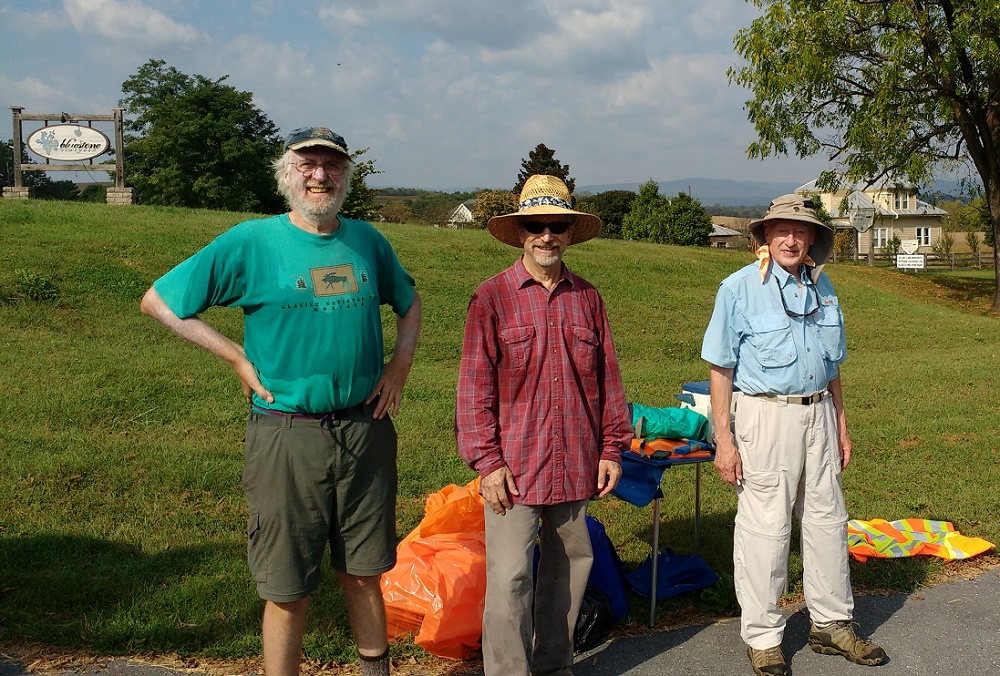
    Hardy and hot HMNs in the heat of … October! Carl Droms, David Forrer, Jerry Hopkins.


    Wednesday, October 2 was unseasonably hot! Nevertheless, a handful of hardy HMNs managed to cover over two-thirds of our designated Adopt-a-highway roadway on Spring Creek Rd in Bridgewater to collect over six bags of trash and a bag of aluminum cans in record time. Thanks to Jerry Hopkins, Chris Bowlen, David Forrer and Carl Droms for this good work!

    Our home base for the twice-annual pickups is Bluestone Vineyards, who have always been very supportive of our efforts. With all the recent concern about the expanding territory of the invasive spotted lanternfly, Jerry engaged the General Manager and head winemaker, Lee Hartman, in an interesting conversation about how his business is reacting to this latest threat to his livelihood. He described some of the proactive steps he’s been taking to limit exposure of his vineyards to this pest including methodically eliminating its host tree, Ailanthus altissima, the infamous tree of heaven. Frederick County and the City of Winchester are currently under a spotted lanternfly quarantine, hoping to slow its spread.

    Mark your calendars for our next Adopt-a-highway trash pick up on Spring Creek Rd on Wednesday, April 1, 2020.

    AAHpic2
    Photo: by Adrie Voors
    Chris Bowlen and Carl Droms picking trash along the road above the vineyards.

    HMN.AAH.foundpillowcase
    Photo: by Adrie Voors
    Somehow this pillowcase got separated from its pillow found on opposite sides of the road during the trash pickup. It did not clean up well enough to be reused as a pillowcase around here but will surely find a repurpose.

    HMN.AAH.TurkeyStatue
    Photo: by Adrie Voors
    My favorite find wasn’t until the following week finishing up the last stretch of our roadway. This handsome bird seemed thrilled to be rescued from the ditch and to accompany me on the rest of our litter collecting walk. It had no doubt run away from home knowing Thanksgiving is approaching!

    By Adrie Voors

  • Look at Our Beautiful Compost Drop-off Art!

    Look at Our Beautiful Compost Drop-off Art!

    Headwaters Master Naturalists were well-represented at the “Artwork Dedication & Celebration of Composting” event held during the Saturday Harrisonburg Farmers Market on August 17. Compost Drop-off project coordinator Adrie Voors assembled some local composting “champions” to help dedicate a new painting created by local artist Erin Murray for the Compost Drop-off collection area near the Market’s Turner Pavilion. Made possible through grant funding from the Arts Council of the Valley, the painting offers a whimsical look at the “No Waste World” of wildlife.

    Artist Erin Murray stands next to her creation! A print of the original painting on sheet aluminum, which is visible in the background to the left in the photo above, is on permanent display at the Compost Drop-off site in downtown Harrisonburg. HMN Dave Forrer, Cohort VI, donated his woodworking skills to build the cedar log frame post for the print. Be sure to drop by to see this wonderful addition to the Compost Drop-off site for yourself!

    Shelley Baker, Cohort V, picks out compost critters to show event attendees.

    Read and see more photos about the project on the Climate Action Alliance of the Valley (CAAV) website. CAAV is one of the supporting groups of the project, lending use of their treasury and website.

    by Adrie Voors
    Photos by Carl Droms

  • Processing Pollinators!

    Processing Pollinators!


    Left: A pollinator trap for collecting bees. Right: Washing the bees; one of the steps in processing them for identification.
    Photo by Peggy Plass (left) and Elizabeth Pass (right)

    One of the many benefits of working on projects through Virginia Working Landscapes is the excellent education and training opportunities which they also provide. Through the years, several Headwaters Master Naturalists have worked as volunteers for VWL’s pollinator project, collecting field data in support of a survey of local bumblebees. The field portion of the project involves tromping through beautiful fields to retrieve bees who have been drowned in blue vein traps (see photo above left), storing them in alcohol, and returning them to the researchers at Blandy Farm who painstakingly examine and count all of these little animals. The fact that the work is designed to provide a much needed (and previously unavailable) census of bees in the state, and to allow tracking of changes in that population, has always made me feel better about the fact that some individual bees die in the traps.

    In addition to the work of collecting and monitoring the traps during the summer season, however, volunteers also have the opportunity to participate in the processing of the bees. This is a place where you can let your inner citizen scientist truly run rampant, becoming part of the process of preparing the bees for identification (and learning how to do some of that identification yourself!).

    I once heard a young girl (who had accompanied her mom to one of the bee processing sessions) describe the work as “bee salon,” a fairly apt description Processing the bees begins with opening up the bags (collected during the summer from the blue vein traps) and straining out the alcohol used to store them (see photo above right). Sometimes there are a lot of other bugs in the traps. For example, in one collection this summer, I removed probably 300 june beetles from my blue vein trap. If there are a lot of such non-bee insects in a collection, it’s good to pick those out before beginning the first round of washing.

    In the next step, the remaining bees are emptied into a large jar, covered with water and just a drop of dishwashing solution. Some enthusiastic shaking (think washing machine agitation on gentle cycle) ensues. The next step involves rinsing to remove the soap and any other icky parts that might have been remaining. The bees are then poured out into a large kitchen strainer, and head to the drying station.


    Drying the bees under a strainer.
    Photo by Peggy Plass

    The strainer containing the insects is inverted onto a paper towel, making sure that everyone is securely “trapped” underneath the “dome” of the strainer, with no legs or wings caught underneath or sticking outside. Then, holding the strainer securely with one hand, one fires up a blow dryer. Bees start blowing around the inside of the strainer in a little whirlwind, and when they all seem to be pretty dry (always hard to tell exactly when that is, but usually when they’re all floating around pretty freely, no clumping), they get moved to the pinning station.


    Sorting bumblebees from other bees and insects.
    Photo by Elizabeth Pass

    Here’s where things get really fun. The study supported by VWL is focused only on bumblebees, but the researchers at Blandy want to hang on to non-bumble bees as well (for possible future examination). So, after the bees are clean and dry, the next step is to sort the bumbles from the other bees (see photo above).  Non-bumblebees are returned to a whirl pack and stored for future examination. Through the years, I’ve gotten pretty good at recognizing which insects are bumbles and which are not (it’s not as easy as you might think!), but there are always professional researchers around to help. The remaining bumbles are pinned in boxes, ready for identification and counting by researchers.


    Sorted and pinned bumblebees, ready to go to the scientists.
    Photo by Peggy Plass

    The researchers at Blandy are amazing folks who generously share their considerable expertise with volunteers interested in learning how to identify the bumblebees. There are a lot of different bees in our area, and the differences in their appearance are subtle, so I admit I’m not very good at this part, but I’ve enjoyed being made aware of what to look for. Being able to be part of the research experience in this way is just one of the many benefits of volunteering with VWL. Watch for reminders next Spring about the opportunities opening for VWL volunteering in 2020!

    by Peggy Plass

  • Vernal Pools Monitoring Project Training

    Vernal Pools Monitoring Project Training

    vernalpooltraining.cd.600

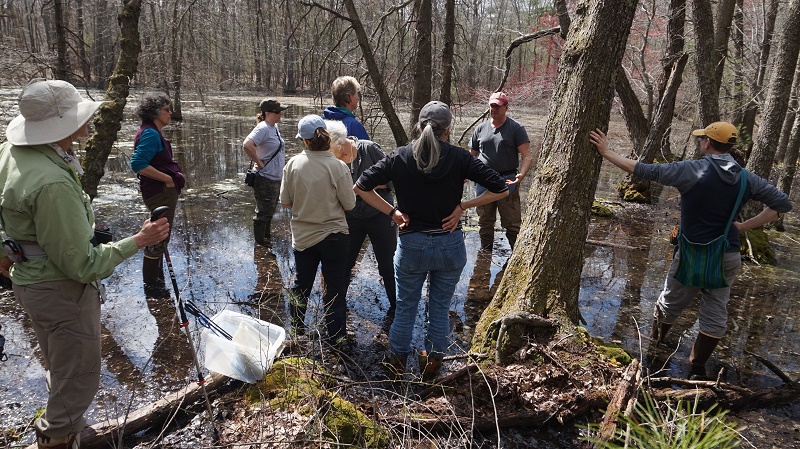
    Our chapter is starting a new Citizen Science project to locate and monitor vernal pools in our region. In support of this, we had a training session on Saturday, April 6 that started at McKinney Science Center at Bridgewater College and ended at Deep Run Ponds Natural Area Preserve. Dr. Anne Wright, director of Life Sciences Outreach at Virginia Commonwealth University and Susan Watson, Fish and Wildlife Information Services Biologist with the Virginia Department of Game and Inland Fisheries office in Henrico were our presenters.

    Vernal pools are “seasonal wetlands”: they begin to fill with water in  late fall, then dry up in the summer. Because they’re not permanent, fish can’t live in them. This is important for many species of amphibians, since fish would eat their eggs and larvae. In fact, there are six salamander species and two frog species in Virginia which are obligate vernal pool dwellers in the early part of their life cycle, and a number of other species which use them if they’re available.

    After the classroom presentations, we all made our way to Deep Run Ponds near Port Republic. Gavin Lawson, professor of biology at Bridgewater College, joined us there and described the ongoing research he does with his students at this protected area known  or its sinkhole ponds. We were able to locate and examine egg masses for a couple of salamander species, as well as some adult critters that had found their way into the traps Dr. Lawson places as part of his research project.

    The Vernal Pools Monitoring Project is scheduled to get underway this coming fall.

    – Carl Droms, Cohort II, April 2019

    Top photo at Deep Run Ponds by Carl Droms. Photos below by Carl, and Shelley Baker. Click on a photo below to enlarge it and see the others as a slide show.