Photo: by fieldandforestfriends.com
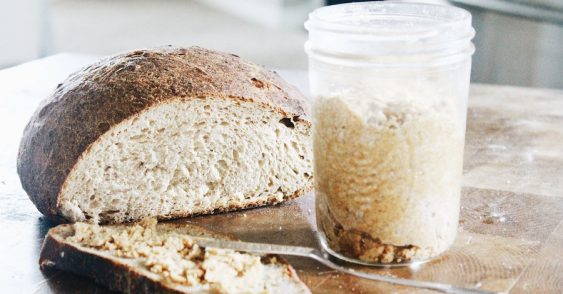
Wild yeast sourdough bread with starter
Rob Dunn Lab Group, formerly known as Your Wild Life, citizen science projects are appealing for volunteers who like to dabble in the science of the small! Overseen by Dr. Holly Menninger, Director of Public Science and Dr. Rob Dunn’s Public Science Lab in the Applied Ecology Department at NC State University, the research team enlists volunteers to collect samples of microbes from our bodies and homes. A list of previous and current projects can be found here: http://robdunnlab.com/projects/.
This team has an outstanding ability to make applied ecology accessible and fun for a variety of audiences. Their research findings and resulting publications are increasing scientific knowledge about the biodiversity of the worldwide humanmade environment.
Adrie Voors and I previously participated in some Your Wild Life projects as Headwaters Virginia Master Naturalist volunteers. Here’s a link to a story about swabbing the insides of our showerheads for The Showerhead Microbiome Project https://headwatersmn.org/2017/10/31/our-wild-life/ Another initiative involved swabbing doorframes. Results of those and other Your Wild Life experiments appear in the team’s ongoing research publications as well as Dr. Dunn’s 2018 book, Never Home Alone: From Microbes to Millipedes, Camel Crickets, and Honeybees, the Natural History of Where We Live.
When the Rob Dunn Lab announced another study on the microbiology of sourdough bread starters, a simple multiday project that corresponded in timing with COVID-19 pandemic quarantining, I was eager to enlist. http://robdunnlab.com/projects/wildsourdough/ The Wild Sourdough project is managed by scientist Lauren Nichols at NC State.
On April 15, 2020, I read the experiment’s protocol and left tap water standing out in a glass overnight to remove chlorine.

Photo: by Stephanie Gardner
Starter setup
The next day, it was time to mix the first starter, one with the bleached white all-purpose flour that I had on hand. You can use any type of flour for the Wild Sourdough Project, so long as it isn’t self-rising.

Photo: by Stephanie Gardner
Starters getting started
My cheap flour starter quickly turned into a smelly liquid goo, although smelly isn’t necessarily bad with Your Wild Life Projects and it is indicative of the early microbial growth in a sourdough starter. However, after five days of feeding, I realized that refreshing the starter with water straight from the tap was likely killing the microbes. I switched on April 21st to a new starter fed only with dechlorinated water.
On April 26th, I invested in some whole wheat flour and began a second starter with it.

Photo: by Stephanie Gardner
Starters prior to baking
Participants keep an eye on our starters for consistent rising and falling and for the production of a liquid called hooch on the top of the starters. These are indications that the sourdough microbes are active. More active starters received more frequent refreshing.
The protocol calls for sniffing the starter and characterizing the odor, removing and discarding a tablespoon full of the goo, and refeeding at 12 to 24-hour intervals for fourteen times. Both starters went through an early stage of smelling like vinegar. Given that other participants were reporting much worse odors on the project’s active social media page, https://www.facebook.com/groups/520212195329302/ this didn’t seem so bad. Both of my starters later smelled like latex paint and finally stabilized with a nice sourdough bread odor.
Unlike past experiments, there are no samples to take and mail for the Wild Sourdough Project. At the time of the 15th refreshing, participants transfer a standard amount of starter to another jar, feed it a specified mixture of flour and water, and measure its height and growth over a period of hours.
The bleached white flour starter began at 1.3 inches and rose to a total of only 1.5 inches over six hours. The microbial element was there but not really working. Happily, failed starters are also of interest to Nichols and the team. They will analyze the reported smells and growth along with datasets from all over the world to determine how geography and flour type is impacting the biodiversity of sourdough.
The whole wheat starter did better in the final experiment. It started with a 1.4-inch baseline and rose to a 2.5 inches high tide mark overnight.
The Wild Sourdough project webpage provides a webform for submitting final results. Unfortunately, I selected an incorrect dropdown menu choice when reporting my second set of results. The system assigned a number to each specimen, so I wrote the team and reported my error with it. I was pleasantly surprised to receive a personal email from Nichols within the day, stating that she would correct the dataset and that she hoped I would soon be baking some good bread.
The experiment was now over, but the Wild Sourdough team provides a simple sourdough bread recipe for those who want to try baking. Not able to leave well enough alone, I searched out and tried a more complex recipe for whole wheat sourdough bread. My loaves filled the house with the tantalizing aroma of sourdough bread but didn’t rise, and so were baking flops.

Photo: by Stephanie Gardner
Baking fail
Despite the post-experiment baking failure, participation in the Wild Sourdough initiative was enjoyable and should be beneficial to scientific inquiry. It is the simplest of several projects that the Rob Dunn Lab has conducted on the wild microbes in sourdough bread. Working from home during social distancing gave me opportunities to regularly refresh the starters, and the project itself brought a sense of unity with citizen scientists all over the world.
After interpreting the submitted data, the Wild Sourdough team will share it with participants. I know from previous projects that waiting for personalized results can be a long process, but the findings are interesting, and they make a real difference in the understanding of household biodiversity. Despite the post-experiment baking failure, participation in the Wild Sourdough initiative was enjoyable and should be beneficial to scientific inquiry. It is the simplest of several projects that the Rob Dunn Lab has conducted on the wild microbes in sourdough bread. Working from home during social distancing gave me opportunities to regularly refresh the starters, and the project itself brought a sense of unity with citizen scientists all over the world.
After interpreting the submitted data, the Wild Sourdough team will share it with participants. I know from previous projects that waiting for personalized results can be a long process, but the findings are interesting, and they make a real difference in the understanding of household biodiversity.
by Stephanie Gardner