On Thursday, June 17th 2021, members of the Headwaters Master Naturalists chapter volunteered at The Save Lucy Campaign facility in Mount Solon. The Save Lucy Campaign is a non-profit organization dedicated to raising awareness of white-nose syndrome in bats and rehabbing injured bats along with education to the public regarding all things bats.
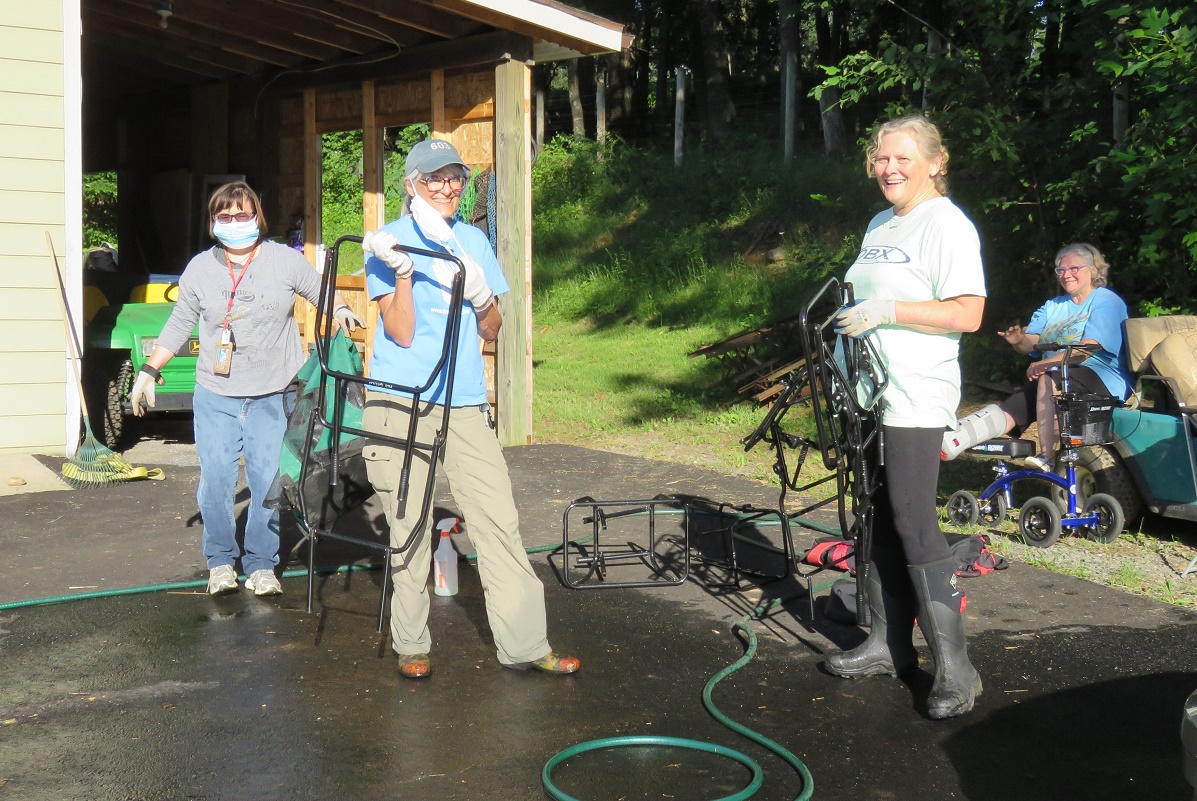
The volunteers helped add shade material to the flight cages as well as clean crates used to house and transport bats. Other time was spent doing some general cleaning and weeding at the facility so that it was ready for an upcoming media interview.
Leslie Sturges, founder of The Save Lucy Campaign as well as local bat rehabber, gave the members a tour of the facility and showed off some of the education bats that are used.
For more information about The Save Lucy Campaign, visit their website at www.savelucythebat.org or find them on Facebook.
– Jeanine Botkin, Cohort VII, June 2021
Photo at top: cleaning crates, l to r: Stephanie, Peggy, Jeanine, Leslie. Photo by Art Fovargue, Cohort VII
Click on any photo below to start a slide show.
Art. Photo by Jeanine Botkin.
“Curly”, the Big brown bat (Eptesicus fuscus). Photo by Jeanine Botkin.
The flight cage, after we put up the “ivy” shade material. Photo by Art Fovargue.
Peggy. Photo by Jeanine Botkin.
Stephanie. Photo by Jeanine Botkin.
Education bat, a Tricolored bat (Perimyotis subflavus). Leslie said she did not have a name as of yet, but the group seemed to coalesce around “Piccolo” as she was tiny. Photo by Jeanine Botkin.
Friends of the Middle River will hold its annual trash cleanup of the River likely between August 16-22, 2021.
Volunteers pickup trash by walking in the River pulling a canoe behind them which acts as a barge for the trash collected. A team consists of between 2 to 10 persons per team who clean a mile or two of the River. Other volunteers sometimes act as land crews and help unload, sort and inventory the trash. Then the trash is transferred to a dumpster. We typically utilize about 100 volunteers.
We’ll have different teams at different times on different sections of river. HMN members could form their own team, or people can volunteer as individuals and be put onto a team that fits your availability.
Volunteers do not have to be members of Friends of the Middle River. To get involved, email Kate to be contacted shortly after July 7 when we start to organize volunteers into teams.
Send your email to fomr.guenther [at] gmail.com and
1) Put “River Cleanup” in the subject line 2) If you want to join as a member to FOMR, you can do that on our webpage, http://www.friendsofhemiddleriver.org. Otherwise, we will NOT assume you want to become an FOMR member, just that you are interested in this one volunteer opportunity. 3) Please give us the email address you want to be contacted on and a phone number.
Cleanups are messy, sweaty and very satisfying volunteer opportunities. Volunteers should be able to walk unassisted on uneven rocks and muddy river bottoms in water that is up to thigh deep.
Thank you for considering!
– Kate Guenther, Cohort I Watershed Administrator, Friends of the Middle River
Photo at top shows HMN Ginny Hoffman, Cohort III, at a river cleanup in 2019. Photo courtesy of Friends of the Middle River.
After 1 year, 6 months and 26 days, the Community Compost Drop-off tent returned to the Harrisonburg Farmers Market. However, the drop-off bins and the collection of compostable food waste and other organic products never disappeared. The project’s loyal customers continued to bring their deposits to the bin location near Warren St by the Turner pavilion in Harrisonburg. In fact, over that time span about 43 tons of compostables have been collected; more than any equivalent period in the past.
The next visit to a Saturday Farmers Market will be on June 5, when the tent will be set up next to Master Gardeners. Synergy will be at the forefront as the gardeners will have composting and vermiculture presentations at 9:00am and 10:00am respectively.
This project, started by Adrie Voors (Cohort II) in 2016, helps keep it out of the landfill, reduces methane additions to the atmosphere and provides important nutrients to our soil. Remember, you can get hours for your Master Naturalist certification by volunteering for this project.
– Art Fovargue, Cohort VII,May 2021
The photo at top, above, shows Art at the Compost Drop-off table at the Harrisonburg Farmers Market on Saturday, May 22. Photo by Adrie.
HMN Penny Warren was one of a five member team, the Rockfish Gap Hawk Watchers, which participated in a day-long annual bird watching eventon May 10, 2021.
Penny’s fellow team member, Ezra Staengl, describes their day here:
On May 10, the Rockfish Gap Hawk Watchers team (Vic Laubach, Baxter Beamer, Ezra Staengl, Penny Warren, and Rich Wood, pictured above L to R) conducted our 9th annual Raptorthon to raise funds for Hawk Migration Association of North America (HMANA) and our local Rockfish Gap Hawk Watch. The first bird of the day was an Eastern Whip-poor-will singing at 5am as we descended into Highland County, followed by more in the pre-dawn hours.
Just after sunrise, we arrived at the road to Paddy Knob; a gravel road with only the name ‘public road 55’ to identify it. Cold mist stung our skin upon exiting the car while Least Flycatchers sang their short “chi-bek!” song from every direction. A Veery’s melodious descending song echoed off the mountainside. Warblers were everywhere, including Blackburnian, Black-throated Blue, Black-throated Green, Black-and-white, and American Redstart. Farther up the mountain it was foggier, with less bird song, but Chestnut-sided and Canada Warblers were singing. At the top, we heard two Ruffed Grouse drumming, a sound so low it registered more as a rhythmic popping feeling than an actual sound. We also heard three Mourning Warblers, an important target bird at Paddy Knob.
Later on, we met up with John Spahr in the Blue Grass Valley. John monitors many raptor nest boxes and kindly offered to show us some nesting birds. We walked up a nearby hill whereupon he inserted a camera inside a box as we viewed a female Eastern Screech-Owl with chicks on a small screen. Then we headed up Wimer Mountain Road to Bramble Hill, one of the best places in the state to see breeding Golden-winged Warblers. Here, John showed us an occupied American Kestrel nest box with 5 eggs. He proceeded to capture the female, and then we helped band her on a leg. Seeing a kestrel up close in the hand was an exciting experience for all of us!
We soon heard several Golden-winged Warblers, and located one foraging in a low shrub by the road. Every so often it would sing its loud buzzy song and then promptly go back to foraging. Soon, a second singing Golden-winged Warbler was heard nearby. We then said goodbye to John and continued on our adventure. Another highlight of the day occurred at a small pond off Laurel Fork Road. We pulled over because we noticed a couple Least Sandpipers from the car, but closer inspection revealed there were actually 38, as well as two Spotted Sandpipers, a Solitary Sandpiper, and a Lesser Yellowlegs! We also found 3 Greater Yellowlegs earlier at a different pond. Highland County is a land of mountains, and has little to offer shorebirds. These birds were surely migrating, and the overnight storms likely forced them down onto the small farm ponds where we encountered them.
We ended our day around 7:30 pm, by which time most of us were thoroughly exhausted. Overall, we birded in five counties (Highland, Bath, Augusta, Rockingham, and Pocahontas) and two states (VA and WV). We saw or heard 110 bird species, including 8 raptors (Screech-owl, Kestrel, Osprey, Bald Eagle, Broad-winged Hawk, Red-tailed Hawk, and Black and Turkey Vultures), 7 shorebirds, 5 swallows, 19 warblers, and 9 sparrows. Most importantly, we had a fun, memorable experience while raising a record number of donations, amounting to over $2,240. Thank you so much to everyone who donated!
– Ezra Staengl, Raptorathon team member, May 2021
Thanks to Penny for arranging for this webpost!
Below is a Golden-winged Warbler in Highland County found during the event. The photograph is by team member Baxter Beamer.
Find more photos of the May 10, 2021, Raptorthon on the Rockfish Gap Hawk Watch facebook page HERE.
This past summer I had the greatest honor to work with the Shenandoah National Park Bear Techs (Biological Science Technicians – Wildlife) and American Conservation Experience Wildlife Management Interns under the management of the SNP Biologist, Rolf Gubler.
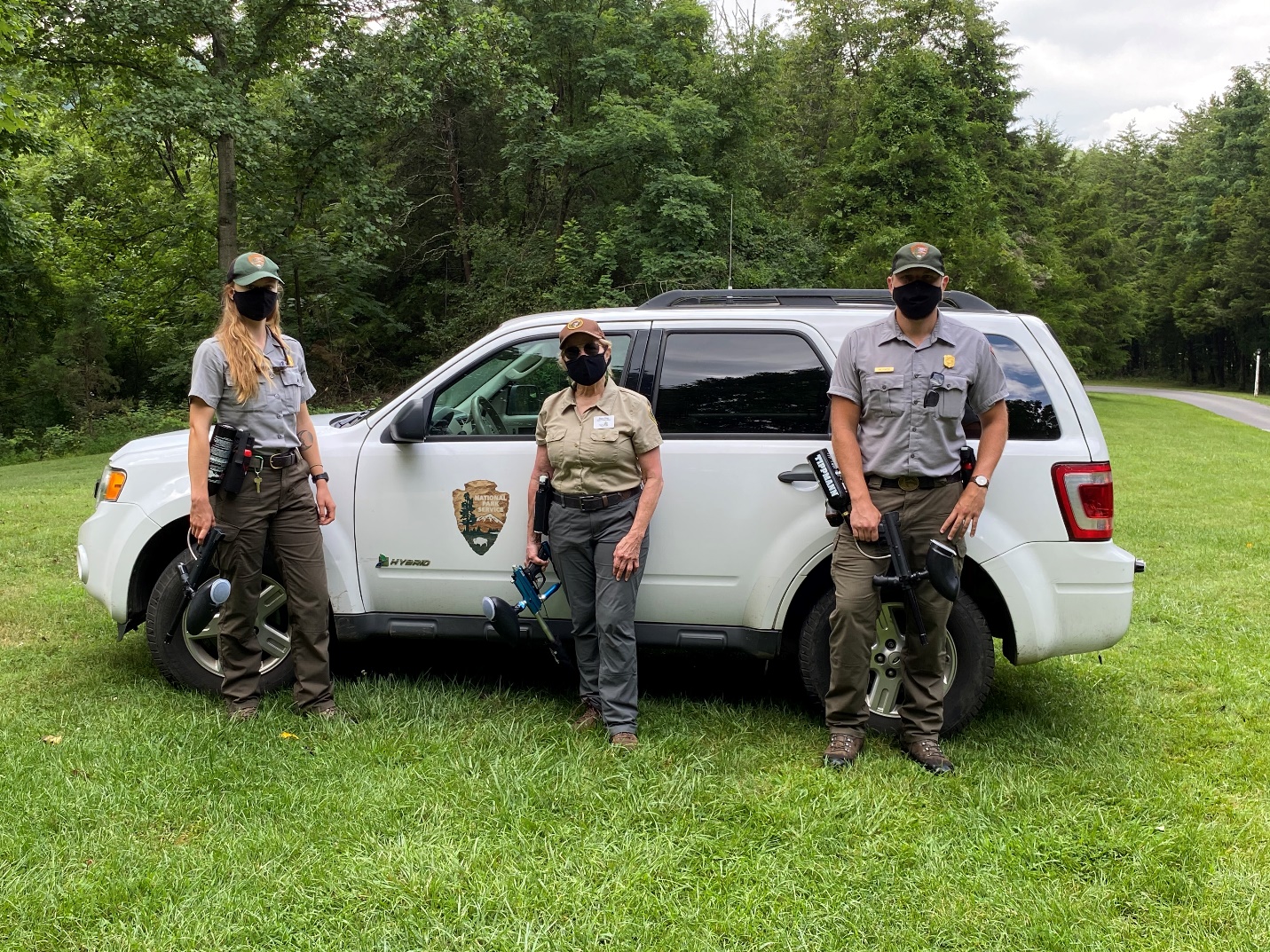
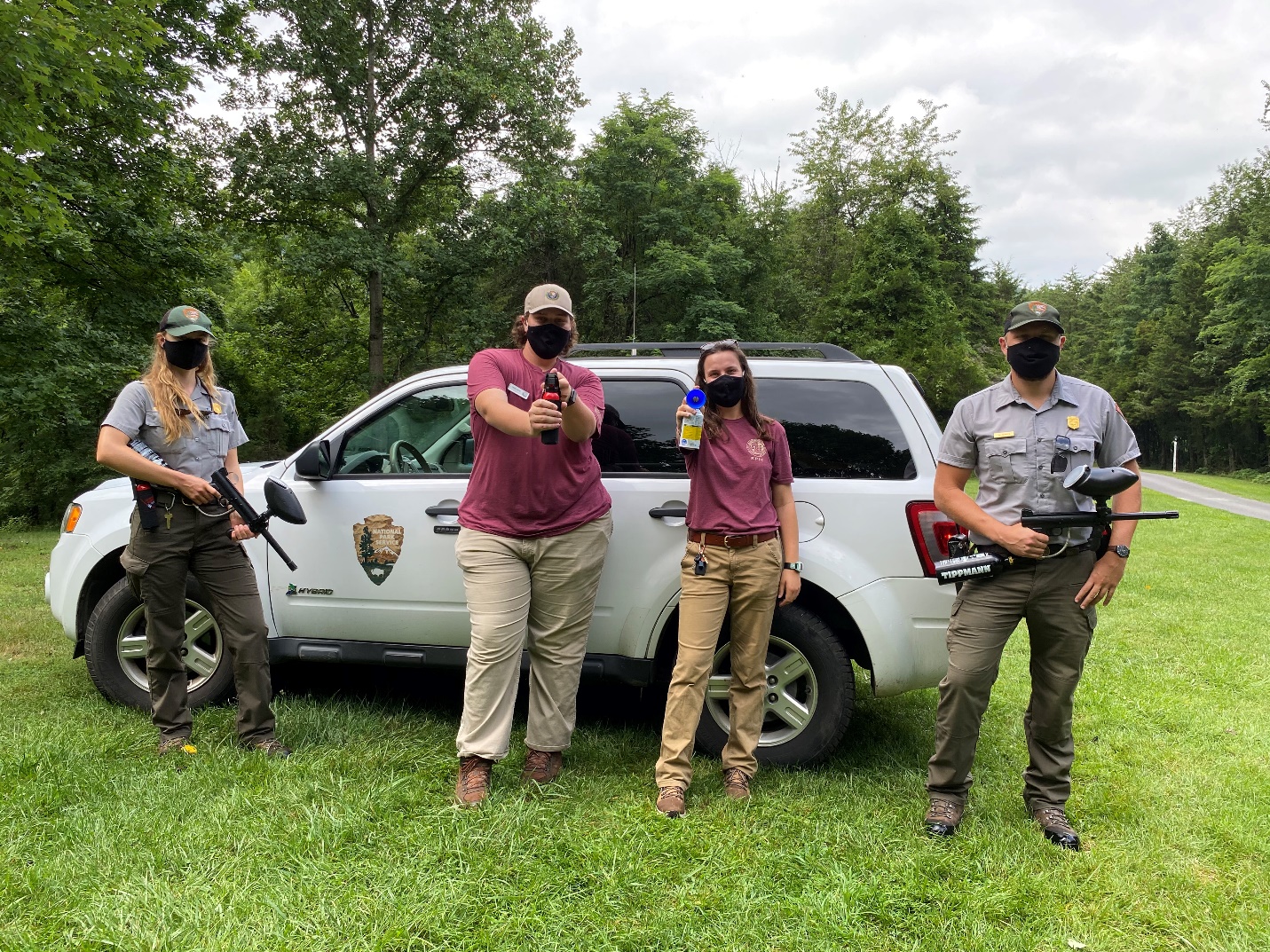
The purpose of this program includes assessing nuisance black bear and white-tailed deer behavior in developed areas and keeping people and animals safe. Other duties may include assisting with wildlife monitoring, integrated pest management, forest pest management, and peregrine falcon restorationwork. Every season, the Bear/Wildlife Mitigation Team works to separate people from wildlife by hazing or relocating bears and other animals. When bears become too comfortable around people, they can become aggressive. Our team uses non-lethal aversive behavioral conditioning tactics such as yelling, air horns, paintball guns, bean bag rounds and cracker shells to chase bears out of developed areas such as campgrounds, picnic areas or alongside Skyline Drive. This reduces the likelihood that they will become conditioned to human food or garbage. The goal of aversive conditioning is to re-establish the natural fear of humans in wildlife, which ultimately minimizes human-wildlife conflicts.
While bears are the primary interest of the team, we are called to handle any and all critters in the park. On my first day we removed a copperhead snake from a picnic area. I’ve chased bears, assisted in conducting opportunistic Chronic Wasting Disease (CWD) testing of road-killed deer (severing a deer head for testing), helped remove and relocate a raccoon from a wayside office, and helped set raccoon traps and black bear culvert traps.
We’ve been handed a hummingbird with a broken wing, rescued an injured turkey poult, deactivated a yellow jacket nest at a campsite, stood watch to prevent a bear from getting into a grease pit at Skyland, pulled dead wildlife out of the road and relocated problem bears.
The Bear Tech Program also provides education to park attendees and employees on Bear Safety and Bear/Human Contact Mitigation. A very important part of our work is monitoring the campgrounds and picnic areas for food and micro-trash. As we sweep these areas, we are constantly in contact with park attendees, educating them on why we are picking up this trash and asking them to support our efforts to protect the bears from human conflict and keep their areas clean and their food properly stored. If we find unattended coolers/food, we impound these items into bear-proof storage units or within the ranger huts.
Often there are SARS (Search & Rescue Services) events requiring the help of the Bear Tech Team. As a volunteer on the team, I’ve provided response services to assist in the carry-out of a wounded hiker on a litter (transport stretcher). This event required 17 people and five hours to transport a patient 1.5 miles down the trail after dark. It was an amazing experience to work with one of the highest rated search and rescue teams in the national parks. There are few days in the park during the busiest times when the SARS team can take a day off.
Fortunately, I was asked to return for the 2021 park season. My first day back we chased off a sub-adult bear from a picnic ground and helped the SARS Team rescue a 13 y/o girl who had fallen over Dark Hollow Falls.
I’m looking forward to the rest of the season which will go through the end of October. This work is hard, fun, educational and extremely rewarding, and more than anything, I get to experience the awe and wonder that Shenandoah National Park bestows upon me and every visitor fortunate enough to experience this amazing treasure.
– Pam Gray, Cohort VI, May 2021
Photo at top: Left to right: Jenifer Mallinoff, Bear Tech, Pam Gray Bear Tech VIP Volunteer, Kai Schafer, Bear Tech – holding paintball guns used in aversive behavioral conditioning for black bears
Photo below: Left to right: Jenifer Mallinoff-Bear Tech, Reese Taylor & Laurel Glover both American Conservation Experience Wildlife Management Interns, Kai Schafer- Bear Tech – holding paintball guns, air horns and bear spray used in aversive behavioral conditioning for black bears
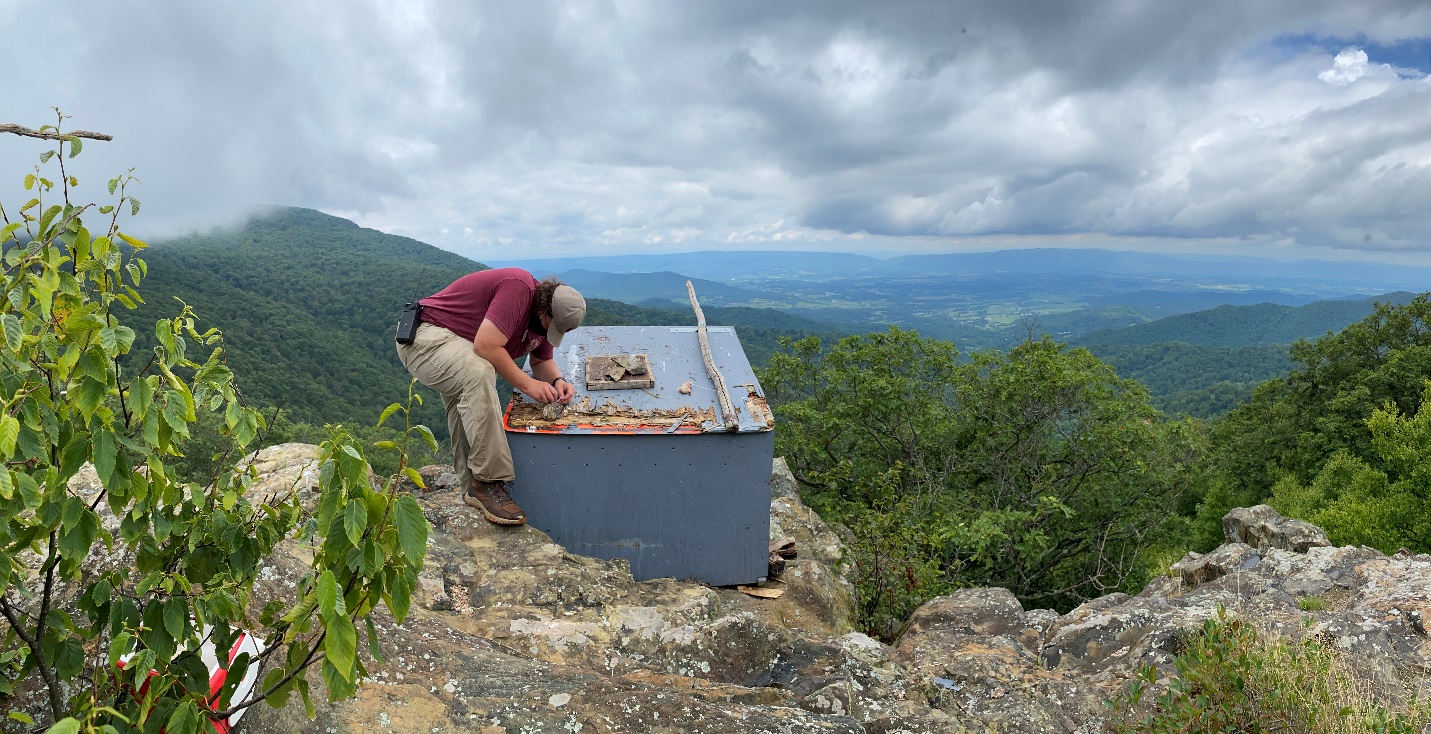
Above photo: Reese Taylor, American Conservation Experience Wildlife Management Intern perched atop Franklin Cliffs at the PEFA hack box preparing food for the peregrine falcons under care in the SNP Peregrine Falcon Restoration Project
More about being “Bear Wise” from the Virginia Department of Wildlife Resources HERE.