Category: Projects

  • Christmas Bird Count 2021

    Christmas Bird Count 2021

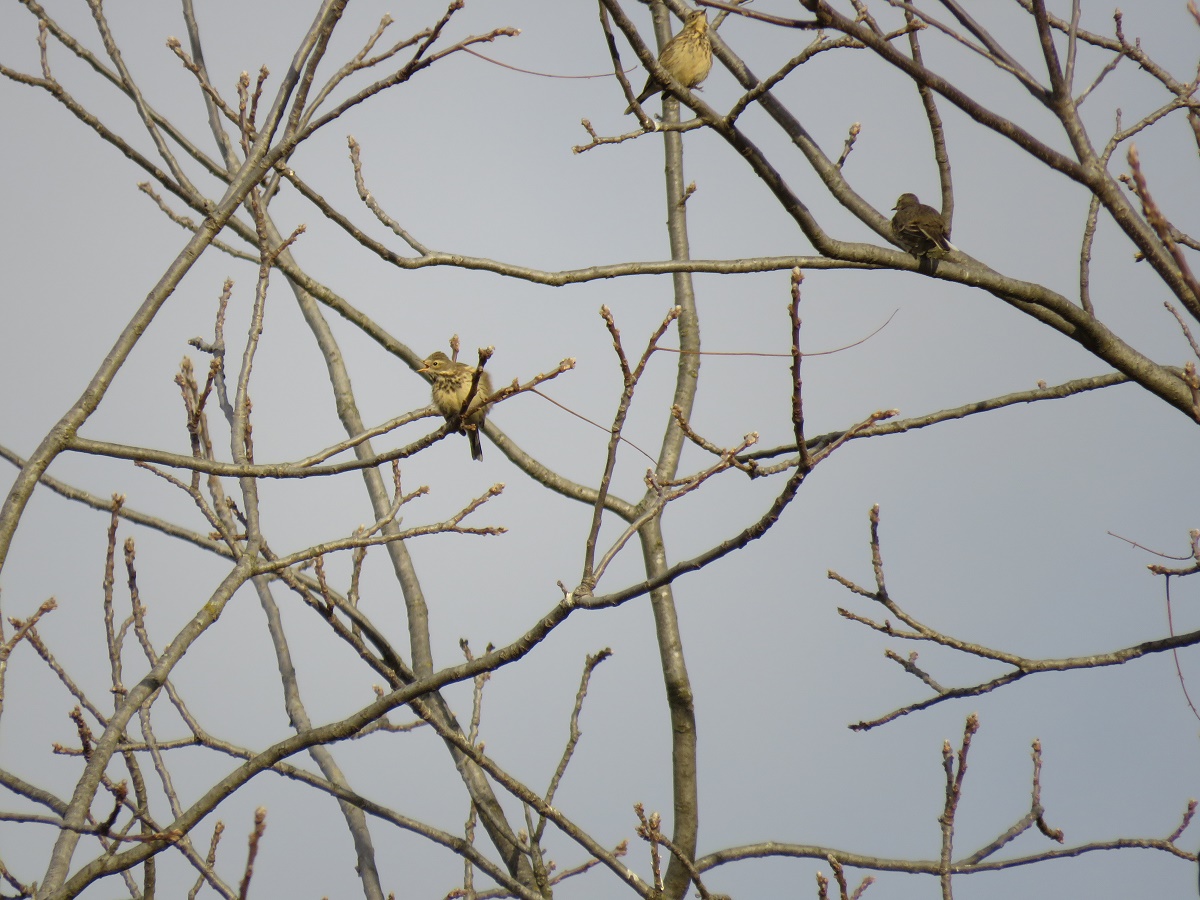
    American Pipits, December 17, 2021

    Reports from Art Fovargue and Zack Perdue, both in Cohort VII, about their day of birding for the 2021 Christmas Bird Count.

    On Friday, December 17, the Rockingham Bird Club held its annual Christmas Bird Count (CBC). The Club’s count circle, one of nearly 2000 in the United States, has a 7.5 mile radius with its center in Ottobine. The circle, in turn, is broken into six sectors in which different groups concentrated their birding. Art Fovargue, Cohort VII, and his wife (mostly his wife), Kathy, headed up Sector 6 for the usual leader Kathy Byers, Cohort IV, who was traveling this year. Sector 6, the western portion of the circle, includes Briery Branch (& reservoir), Union Springs, and much of the county between Ottobine and Rawley Springs.

    One of the most notable differences from past CBC’s was the mild temperatures, allowing one not to have to dive into their vehicle every few minutes for more hot chocolate. We spent about 6 hours driving and stopping along the many roads in the sector. In the end we tallied 35 species, but rather than about numbers, a lot of the enjoyment is discovering the unexpected.  Like the 24 American Pipits, which are normally sighted foraging in farmers’ fields, we found high in a tree along Fulton School Rd. Also, the 60 plus Turkey Vultures, normally seen soaring in the sky or roosting on tree branches, we discovered scattered across a field, almost as if they were looking for bugs to eat.

    After lunch we were joined by Adrie Voors, Cohort II, to hike various trails in the National Forest. Although things had quieted down by then, we did manage to add some new little forest birds to the list, and more Carolina Wrens. Although we never actually saw a Carolina Wren, we did hear one at almost every stop.  It was almost as if he/she was in the trunk and every time we pulled over announced tweet-I’m-here, tweet-I’m-here, …!

    For more information on the CBC, organized by the National Audubon Society, and the local participation, visit this description from the Harrisonburg Citizen.

    Art Fovargue, Cohort VII, December 2021

    Photos by Art

    immature Red-shouldered Hawk along Waggys Creek Rd, December 17, 2021

    Zack surveyed an area also coordinated by the Rockingham Bird Club:

    December 17 was unseasonably warm, but this seemed to have little effect on the number of birds seen. I went out with Bob Eggleston, a retired local ophthalmologist, who has been doing the bird counts continuously in this area since 1968: this was my first. We covered a wedge of a circle whose center is near Paul State forest and extends into northwest Augusta and southwestern Rockingham County. 

    We started a little after eight in Bridgewater and drove eastward toward Centerville. Bob has an encyclopedic knowledge of byways and the best locations to spot various birds. There was a surprisingly high number of white-crowned sparrows (22), making these the most numerous sparrow species after the predictably ubiquitous house sparrows (32). We saw a total of forty rock doves, divided between two crowded agricultural buildings. We saw three red-tailed hawks, one Cooper’s hawk and seven kestrels. A highlight for me was to spot a bald eagle rebuilding its nest south of Bridgewater. We were disappointed not to see any non-mallard ducks. With patience we did manage to spy a Wilson’s snipe hiding in the grass keeping company with some mallards.

    In all, we logged 38 species, the most numerous being the 113 European starlings, with single examples of great blue heron, Cooper’s hawk, bald eagle, the snipe, belted kingfisher, red-headed woodpecker, brown creeper and dark-eyed junco (I think they were all at my feeder, outside the circle).

    I found the experience to be fun, relaxing, and edifying. We are fortunate to have such a group of knowledgeable birders as we enjoy locally.

    – Zack Perdue, Cohort VII, December 2021
    122nd Christmas Bird Count: Map of Active Circles

  • Kestrel Nest Box Monitoring

    Kestrel Nest Box Monitoring

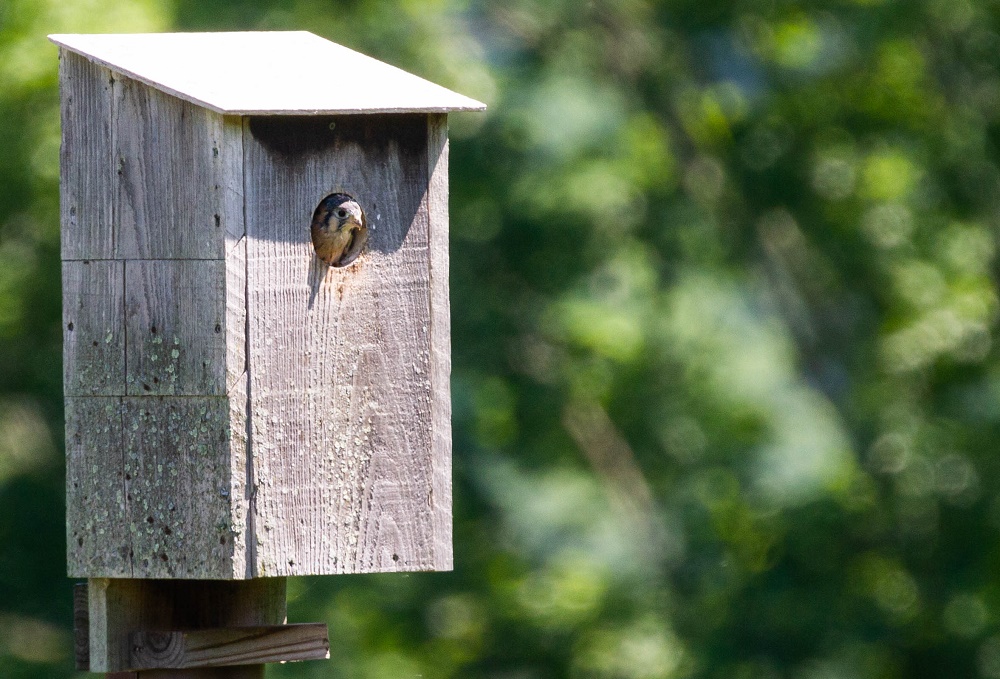
    A kestrel nestling peers out of a nest box last spring at Bramble Hill in Highland County.
    Photo by Diane Lepkowski, Cohort VII. All rights reserved. 

    We still have to get through winter, but it’s not too early to be thinking of spring projects! The Kestrel Nest Box Monitoring Project administered by Lance and Jill Morrow out of Timberville in Rockingham County will be needing more helping hands come spring.

    Ben Spory, Cohort VI, has been involved with this project for a few years now and explains some of what you can expect to do if you are able to help:

    As far as help goes it is probably most needed to help check boxes from spring to mid summer for adult kestrels and then chicks. The vast majority of nest boxes are mounted 10-12 feet up on telephone poles. There is a lot of clambering through ditches and climbing up an extension ladder. We use a drill to open the boxes and hand down chicks to be banded which can be a bit precarious if you aren’t comfortable working from a ladder; some level of balance and dexterity are definitely a must.

    We also work with barn owls and check a lot of old silos which can also involve climbing in and out of some tight/uncomfortable spaces.

    It should also be noted that we don’t use gloves while handling the birds, to help prevent injuring the animals, so any volunteers should be prepared for at least a mild mauling from time to time. Disclaimers aside it’s a lot of fun and allows for an opportunity to help in the conservation of the species and gather useful scientific data.

    Ben Spory, Cohort VI, November 2021
    Contact Ben at 540-660-4377 or bspory [at] gmail.com to get involved!

    Meanwhile, if you have some woodworking skills and time to offer over the winter, Lance and Jill are in need of more nest boxes for both kestrels and bluebirds, using blueprints that they provide. If you can help, contact Lance at 540-896-6553 or saltlick2003 [at] gmail.com.

  • Stop the sale of invasive plants

    Stop the sale of invasive plants


    HMN David Forrer, Cohort VI, on a collaborative effort to curb invasive plants in Virginia:

    All of us HMNs are painfully aware of the many invasive plants that are taking over landscapes and forests around us. In addition to the stiltgrass, garlic mustard, and other invasives we see and do battle with in the forest, I spend a couple hours every week, along with half a dozen other volunteers, removing invasive plants at the Edith J. Carrier Arboretum. There are times when I feel that we may never work ourselves out of a job because of all the invasives that are planted around the arboretum. In the national forests, I’d pretty much given up hope.

    However, I was recently given a ray of hope. Several weeks ago, I attended a virtual presentation (via the Lewis Ginter Botanical Garden talk series) about invasive plants by Beth Mizell, with the group PRISM (Partnership for Regional Invasive Species Management). During the presentation, Beth informed us of a Virginia House of Delegates Resolution that could result in curtailing the sale of invasive plants. But they need our input. Here is her response to my request for more details:

    HMNs Betty Forrest, Chris Bowlen and Jerry Hopkins, along with Bea Woody, pulled wavyleaf grass from the Shenandoah National Park in June 2014. More here about that work.

    HJ 527 is a VA House Resolution mandating the formation of a work group representing conservation groups, private landowners, and the nursery industry. The work group is led by the Department of Conservation and Recreation and Department of Agriculture and Consumer Services to develop specific recommendations aimed at reducing invasive plants for sale in Virginia. You can read the resolution language at the website below:
    https://lis.virginia.gov/cgi-bin/legp604.exe?212+ful+HJ527ER

    It is too soon to tell what the specific work group recommendations will be and if these recommendations will be taken up by the legislative bodies in Virginia. Public comment is an important part of this process either in person at the meetings or by email. You may send any comments to the workgroup agency leads, Nathan Burrell and Larry Nichols, at the following email addresses.
    larry.nichols [at] vdacs.virginia.gov
    nathan.burrell [at] dcr.virginia.gov

    Not only does the work group need to hear how invasive plants impact you, they need to hear specific recommendations from the public about getting invasive plants banned and promoting native plants. Here are some suggestions:

    • Amend the noxious weed law to clarify or remove commercial viability, so more plants can be classified as noxious weeds and banned for sale in VA and work with those impacted to phase out invasive plants popularly used in landscaping
    • Form a statewide biodiversity task force
    • Fully fund the Virginia Invasive Species Management Plan
    • Fund Dept Conservation and Recreation to update Virginia Invasive Plant List on a regular basis with a defined science-based process
    • Prohibit state agencies from selling or planting anything on the Virginia Invasive Plant List; use native plants wherever possible

    You can also recommend that the state set aside funds to assist private landowners with invasive eradication efforts.

    Best,
    Beth Mizell, Blue Ridge PRISM
    info [at] blueridgeprism.org | http://www.blueridgeprism.org

    David Forrer, Cohort VI, November 2021


    Note that the meetings for the work group led by DCR and the Department of Agriculture and Consumer Services are concluding by November 30, 2021, but the report will likely not get submitted until early 2022. Meanwhile, letting policymakers know your views is impactful.


    The photo at the top of this post shows HMNs Burt Blessing and Dave Forrer on the right with fellow arboretum volunteers Karen Craun and Craig Chandler on the left. The truck bed is full of invasive stiltgrass they have removed. More about their work HERE. Photo courtesy of the Edith J Carrier Arboretum.


    DCR’s Virginia Invasive Plant Species List is HERE.

  • Stream Studies at Starry Meadows

    Stream Studies at Starry Meadows

    Sharon Landis, a recent HMN basic training graduate in Cohort VII (aka Cohort Zoom), shares here about the environmental education work that she and her husband and fellow Cohort VII member Jay Landis have been doing on their property in Rockingham County.

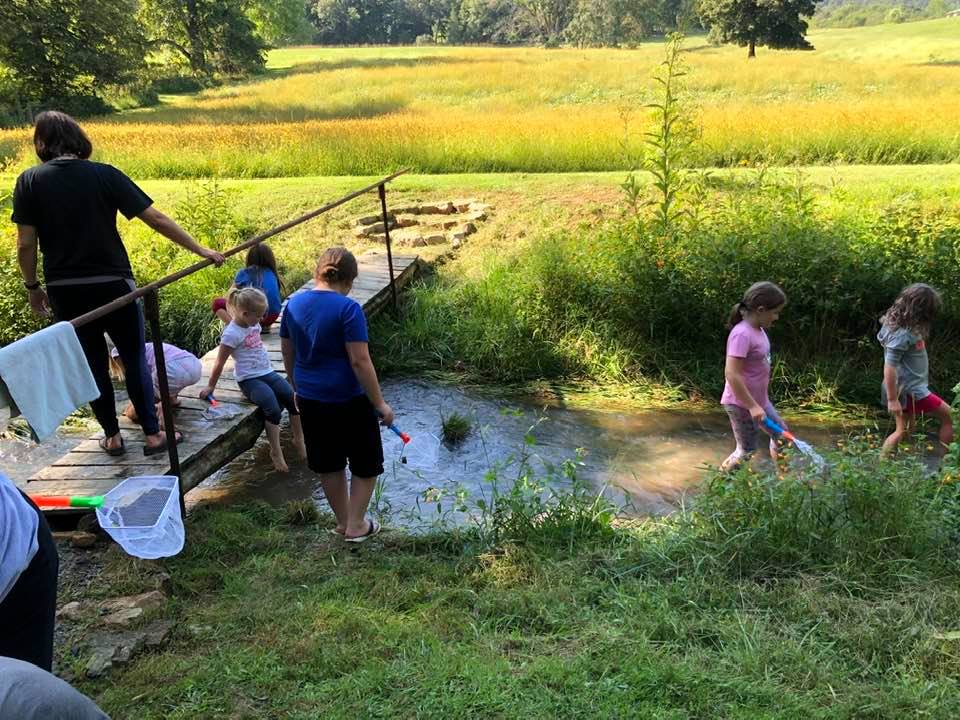
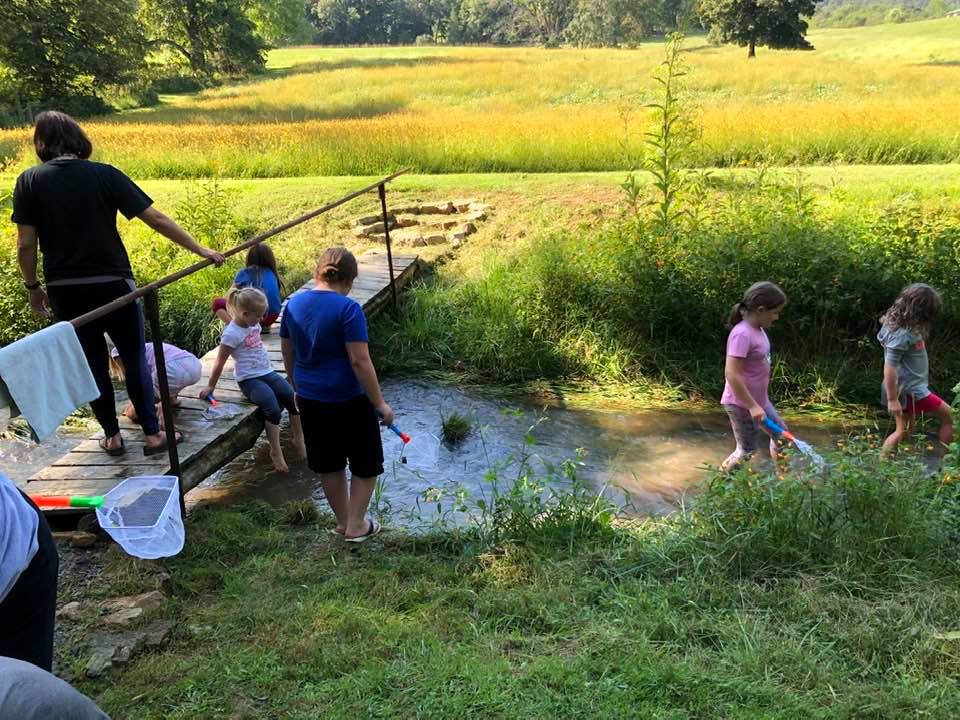
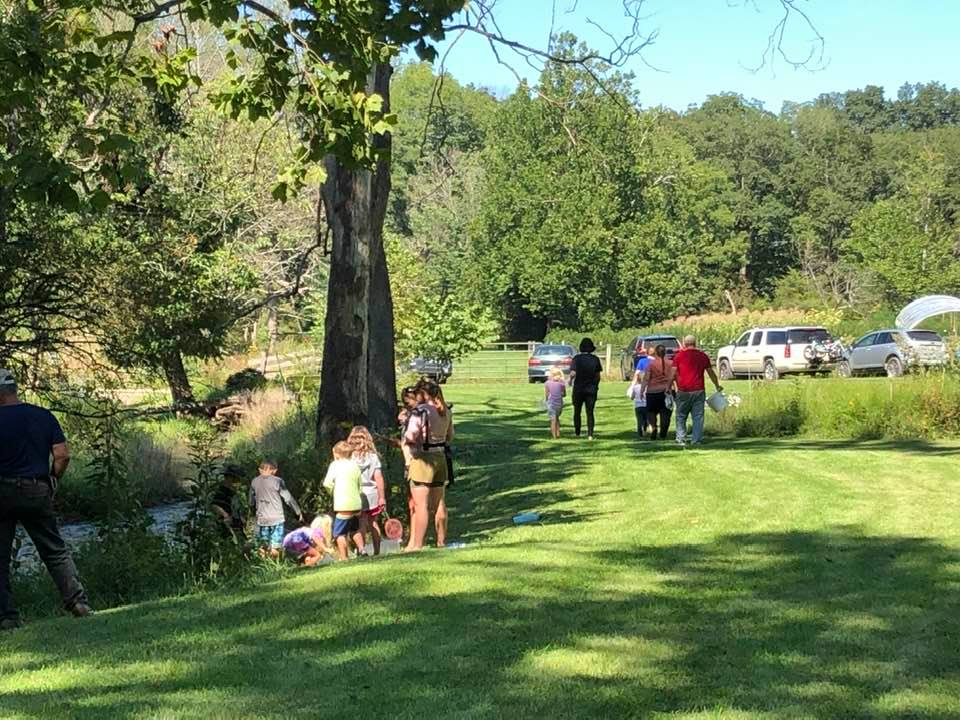
    Since moving to Virginia in 2016, Jay and I have been offering Stream Studies to local homeschool groups at our farm, Starry Meadows in Linville. Since the section of Brock Creek running through our farm is short, and our space limited, we didn’t contact public schools. This year we added nature walks to our offerings, but the Stream Studies were by far the most popular. In August and September, we hosted six, 3-hour Stream Studies with a total of 62 children and their parents, and two Nature Walks with 7 children and their parents.

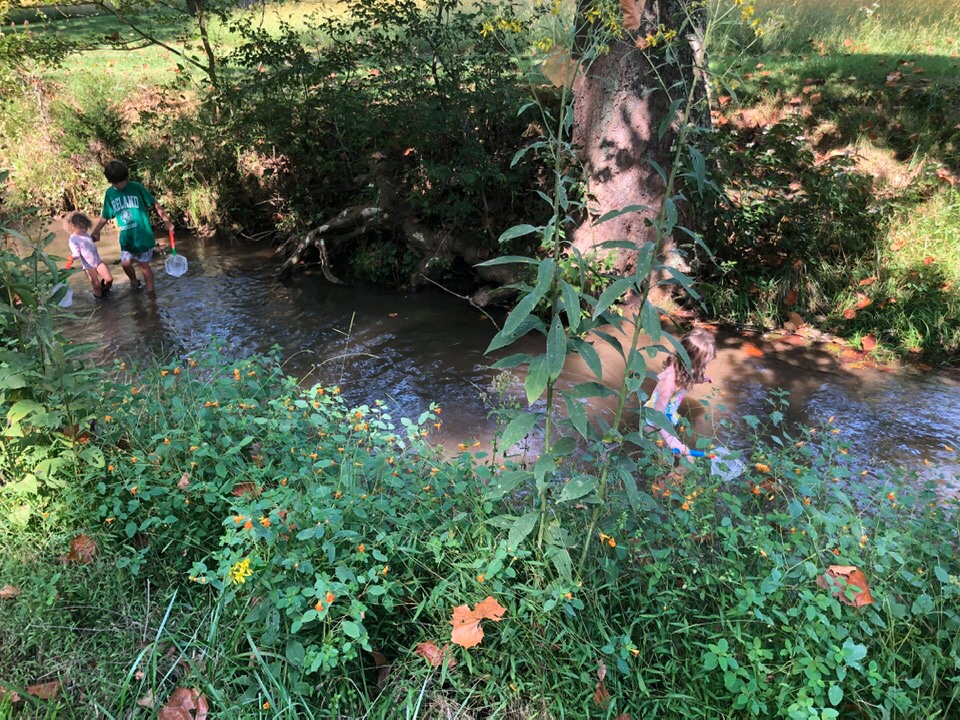
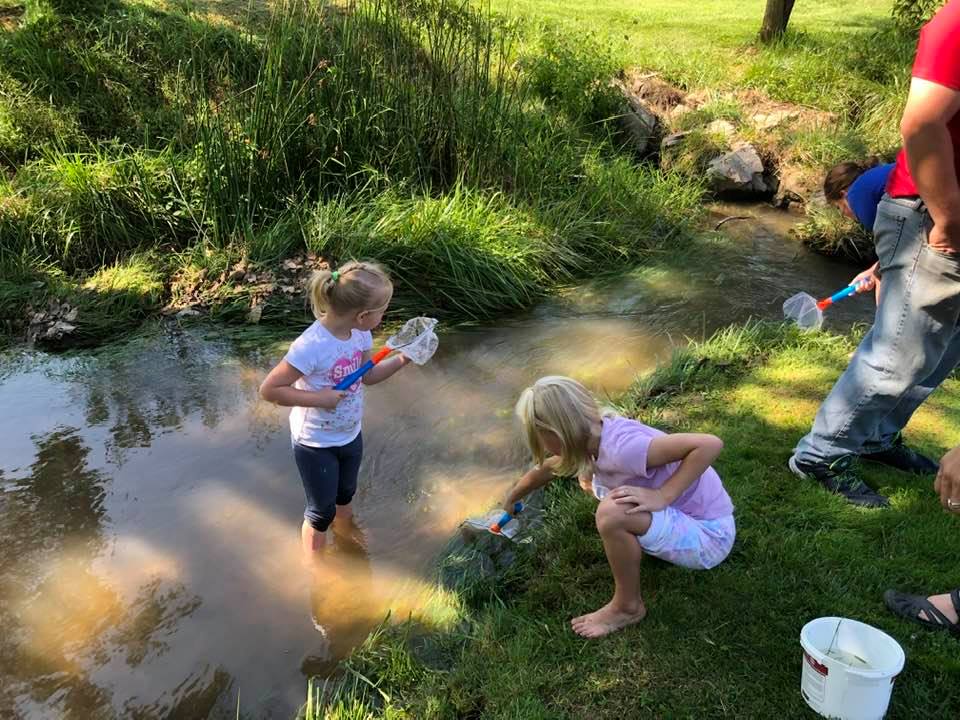
    For the Stream Studies, we gathered each group by the stream, gave a teaching intro and talked about the data sheet we handed out. The data sheet included weather and how it affects a stream, water clarity, fast or slow current, stream bank health, and how Brock Creek flows northeast to join Turley Creek, then crosses R259 to flow into the North Fork of the Shenandoah River. We talked about erosion, and what creatures they might find in the stream. Sharon instructed them on safety, poison ivy and snakes, plus the proper way to handle salamanders if they catch one. We divided the children into four groups; Jay handed out bins and while Sharon instructed the kids to work from the top to the bottom of the stream: observe and capture surface insects, then scoop water without stirring up the bottom, next lift rocks and scoop underneath being careful to put rocks back where you got them. Lastly, scoop deep into the mud at the bottom, let the mud wash out and see what remains in the net. We handed out clipboards and a paper on macroinvertebrates so they could ID what they find.

    Sharon gave special instructions for pebbly areas of the creek bed to search for Caddisfly larva. The kids looked for composite pebbles and put them in separate bins to see if the pebbles moved. This was the highlight of every group – finding caddisfly larvae in their casings. Salamanders and crayfish were also a group favorite.

    As the kids worked the water, we moved among the groups helping the kids with IDing, assisting where needed, and exclaiming over their bins full of water striders, minnows, crayfish, and various macroinvertebrates. There is nothing quite like the whoops of happy kids finding a new discovery, or the joy on their faces as they come running to show us the contents of their nets or bins.

    After two hours of scooping, digging, observing creatures in the creek, we gathered the whole group together to talk about what was found, tally our catches, and ask questions that stimulate discussion. One group had the delight and horror of watching a fishing spider eat another water bug in one of their bins, which led to a good discussion of the food chain. Together we decided that due to critters caught Brock Creek is very healthy! Caddisfly larvae, Stonefly nymphs, snails and Dobsonfly larvae can only thrive in unpolluted water environments. At the end, we offered extra resources for kids that want to learn more and invited children to help us release the captured creatures back into the creek.

    Jay and I are thinking of expanding to groups of kids that may not have such opportunities, possibly schools with small classroom sizes, or the local Boys and Girls Clubs. If we do work well with the Boys and Girls Clubs, we might ask for other naturalists to help us lead field trips/nature walks to public areas as Augusta Springs Wetlands, or birding in local parks.

    Sharon Landis, Cohort VII, October 2021

    Photo at the top of this post shows Stream Studies participants examining Brock Creek. Middle photo shows Jay – farmer naturalist helping ID. Small photo just above on the right is of Sharon and Jay at Buffalo Mountain, Willis, VA.

    All photos on this post are by Sharon Landis.

    Click on a photo below to see it better and start a slide show.

  • HMNs Participate in Middle River Cleanup

    HMNs Participate in Middle River Cleanup

    Most every August, the Friends of the Middle River (FOMR) organize a week of trash removal from different segments of the Middle River as it runs through Augusta County. Members of the Headwaters Chapter of the Virginia Master Naturalists are always invited to participate and earn volunteer service credit hours under the activity: “Trash Cleanups: Waterway Cleanup.” You can learn much more about FOMR’s river cleanups HERE.

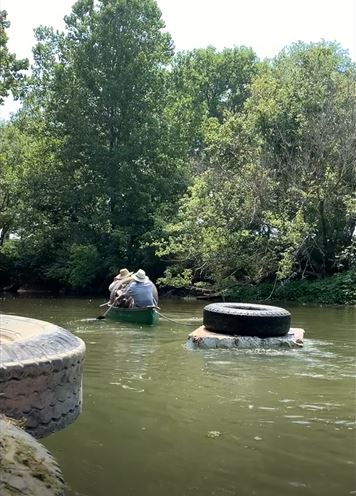
    This year twelve teams went out from August 21-29 encountering river conditions conducive to finding tons of trash including many dozens of tires.

    Below are some photos from and personal insights of the week’s effort from a few of the HMN participants.


    Team River Pickers
    from Jeanine Botkin, Cohort VII

    Team River Pickers went out on Saturday, August 21.

    In this photo (above) are Marion Bittinger, John Peterson, and Pam Bull after cleaning the river between the bridge at Windswept Lane and a farm on Bailey Road (2 miles of river).

    Team River Muckers
    from John Bauman, Cohort VI

    We had a seven-person team called “River Muckers,” and boy, were we ever mucked up when all was said and done. We spent 4 1/2 hours on the river on August the 24th and pulled a total of 30 tires out. Yes, 30 tires, three tubes, several bags of small trash, and a foam sofa mattress that took about 98% of the strength of three of us to get it up over the boat gunnels. About a mile and a half down the river, we came across a large piece of styrofoam that was so big it would have taken up half of a canoe had we loaded it, so we hooked it to a tow line and towed it down the river. Near the end, when all the boats were near maximum, and a big tire was mucked out of the river, we put it on top of the styrofoam and towed it to the take-out. It was a most rewarding day of floating the river, sighting some wildlife that we don’t normally see, and best of all, sharing the day with others who value our natural resources and care enough to protect them 🙂


    Team Shenandoah Campers
    from Carl Droms, Cohort II

    Team Shenandoah Campers went out on Wednesday, August 25.

    In the above photo, Team Shenandoah Campers are from R to L: Randy, Carl, Adrie, Greg and Mary with big on-land support from Antonio, Stanley, Dave and Team Leader Josh.

    Five (in-the-water) members of Team Shenandoah Campers put in along Walnut Grove Dr and got busy scanning the river for trash. It didn’t take long. Less than 500 feet from our starting point, we encountered two pickup truck cargo boxes that appeared to have been dumped off the Limestone Rd bridge. Rather than haul them along with us, we brought them back to the starting point. After that, things quieted down considerably. We found the usual complement of tires, bottles and cans, fishing line, toys and baby diapers, and a couple of cinder blocks. The water was low enough that we spent a good bit of our time dragging the boats over the cobbles. By the time we got to Bald Rock, not even halfway to the Shenandoah Valley Campground, our intended endpoint, it was past our estimated finish time, so we decided to call it quits. We were met there by a land-based crew that had wrestled a discarded sofa bed up the bank. Besides the good feeling of having left the river cleaner than we found it, it was the perfect place to spend an otherwise hot and steamy late August day.


    Some final “estimated” numbers from Friends of the Middle River’s Watershed Administrator Kate Guenther, Cohort I, on the week’s work: “It looks like we had 91 volunteers, cleaned 25 miles, filled a 20 cubic yard dumpster and also had 136 tires removed from the river!”