Category: Projects

  • Ridge and Valley Native Plants Guide

    Ridge and Valley Native Plants Guide

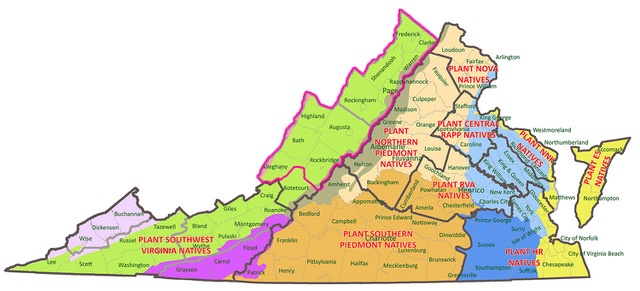
    Map of Virginia’s regional plant guides with the notable exception for our area. Image courtesy of Anna Maria Johnson.

    New HMN Project

    Anna Maria Johnson is excited to announce a new approved project that you can participate in for volunteer hours. Anna Maria is the coordinator of a group of plant-loving people who are working to create a Ridge and Valley Native Plants Guide. The Guide will be similar to other plant guides that have been published in different regions throughout the state. You can learn more about these regional plant guides as well as the corresponding marketing campaign to promote native plants as better options for home landscaping and ecological restoration at the website: www.plantvirginianatives.org.

    The first regional guide in this series came about as part of the government-funded Coastal Zone Management program, but it was so popular that other regions decided to follow suit and design similar books featuring their own native plants. Virginia Witmer, who works for the Department of Environmental Quality, has been instrumental in helping all the regional campaigns to educate the public about the value of using native plants. She has been in conversation with Anna Maria for the past year about how to bring the project to the Ridge and Valley region of Virginia.

    A collection of plant guides for other regions of Virginia. Photo courtesy of Anna Maria Johnson.

    The Plant Virginia Natives Initiative brings together non-profits, businesses, and local government organizations to collaborate on ways to “increase the knowledge and use of the beautiful array of plants native to our Commonwealth.” The Ridge and Valley Native Plants guide is the most recent project in the Plant Virginia Natives Initiative and will comprise the following 11 counties: Frederick, Clarke, Warren, Shenandoah, Page, Rockingham, Augusta, Highland, Bath, Rockbridge, and Alleghany.

    If you are interested in getting involved with making and marketing this Guide, please contact Anna Maria Johnson for more information at annamar [at] mac.com or by phone at 540-383-2325. Many different skill sets will be needed to make this project a success including native plant knowledge, photography, graphic design, writing, editing, fact-checking, sales, marketing, distributing, and accounting. No previous experience is required, although basic knowledge of our local native plants will be advantageous.

    The timeline for this project is as follows:

    • Summer: create the initial plant lists and layout the first draft using InDesign
    • Fall: fact-checking, peer review of content, editing, and improving the design
    • Winter: get the book professionally printed
    • Spring: distribute, market, and sell the book as widely as possible through tabling events, partner organizations, and online; outreach to the public, plant nurseries, garden clubs, and more

    Anna Maria Johnson, Cohort VII, June 2022
  • Virginia Working Landscapes

    Virginia Working Landscapes

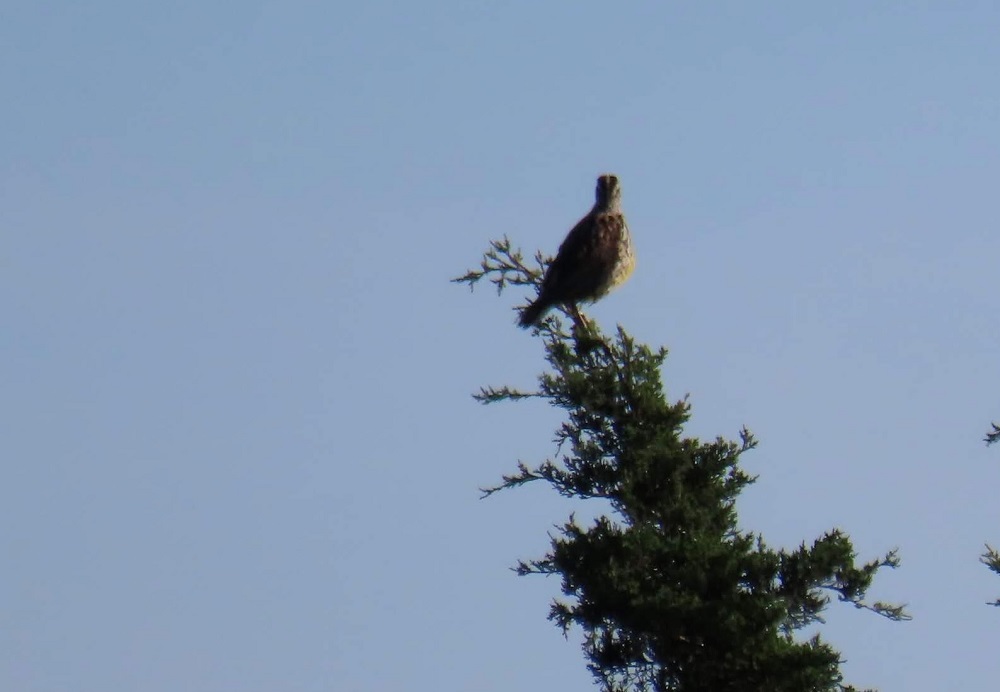
    Eastern Meadowlark photographed during a VWL grassland bird survey at Crusher Run Farm in Rockingham County. Photo by Zack Perdue.

    Thanks to Zack Perdue, Cohort VII, who joined the Virginia Working Landscapes project this year, for sharing this report with us!

    Virginia Working Landscapes or VWL is a program sponsored by the Smithsonian since 2010 to work with owners of rural properties to investigate the effects of various land-use practices on species of interest, including pollinators, grassland birds and native plants. Teams consisting of experienced researchers and conservation biologists, in tandem with support from a robust flock of citizen scientist volunteers, obtain permission from private landowners to conduct surveys on their properties in order to observe and record changes in species diversity and population sizes over time.

    This year I became involved in VWL’s grassland bird survey. Grassland birds have experienced greater declines than any other group of birds (e.g. forest, wetland, shorebirds) in the past 50 years. Since the vast majority of remaining grassland is privately owned, often in the form of agricultural hayfields or pastureland, it is essential to work with owners to find ways to reverse habitat loss. Enrolling in the Smithsonian volunteer program is a bit involved, including an FBI background check. However, once this is completed, the experience is entirely positive and worthwhile. There was even a bonus birdwatching outing led by Dr. Amy Johnson, whose ability to identify birds by sound is extraordinary. Seventy species were identified in about three hours at a farm in Fauquier County that has implemented a suite of conservation practices over the past decade.

    The VWL program aims to recruit as many Virginia landowners as possible. I believe this is the first year that we had participation from someone in Rockingham county, namely Dolly and Bibb Frazier, who own Crusher Run Farm near Port Republic. During our training we were told that most landowners were happy to have us and tended to be hospitable. What an understatement! Dolly and Bibb greeted us at seven in the morning, oriented us to the layout of the farm, and provided post-survey refreshments of home-baked coffee cake and coffee. We also received a tour of the farm, which turned out to be an exemplar showcase for enlightened agricultural practice with riparian buffers and a habitat for butterflies planted with the help of Chris Anderson, a lepidopterist and County Coordinator for the Alliance for the Shenandoah Valley. The Fraziers have also erected a large number of birdhouses on their property and have become very expert on bird habitats by working with Dr. Charles Ziegenfus, who has been a driving force in biodiversity conservation in the Shenandoah Valley for decades.

    Our team consists of Alex Brubaker, a graduate of the University of Virginia, with a strong interest in ornithology; Justin Proctor, who works for the Smithsonian and is coordinator of the Piedmont Grassland Bird Initiative; and myself. We met at about 7 AM to survey three predetermined circular spaces for ten minutes each, registering birds that were actively involved with the habitat. Birds simply flying overhead, such as roughly a dozen herons, were noted, but not included in the count. We were particularly focused on birds whose numbers have declined precipitously, such as Northern Bobwhites, Bobolinks and Eastern Meadowlarks. Our count included Eastern Meadowlarks, Field Sparrows and Grasshopper Sparrows. Although we didn’t spot any bobwhite or bobolinks, the habitat is ripe for both. We are to have two further sessions in the coming weeks. One of the aims is to determine the time of nesting, egg-laying and fledging for ground-nesting birds. This will give the landowners more detailed information on how to better accommodate these birds with their agricultural practices during the critical nesting period.

    The landowner/producer network associated with Virginia Working Landscapes and the Piedmont Grassland Bird Initiative continues to grow. If you are interested in grassland birds, building back biodiversity on your landscape, and/or getting involved as a citizen scientist, please feel free to reach out to Justin Proctor at ProctorCJ [at] si.edu.

    – Zack Perdue, Cohort VII, May 2022

    This orchard oriole is from a bird walk in Northern VA. It’s not exactly a grassland bird, but the tree was in a field.
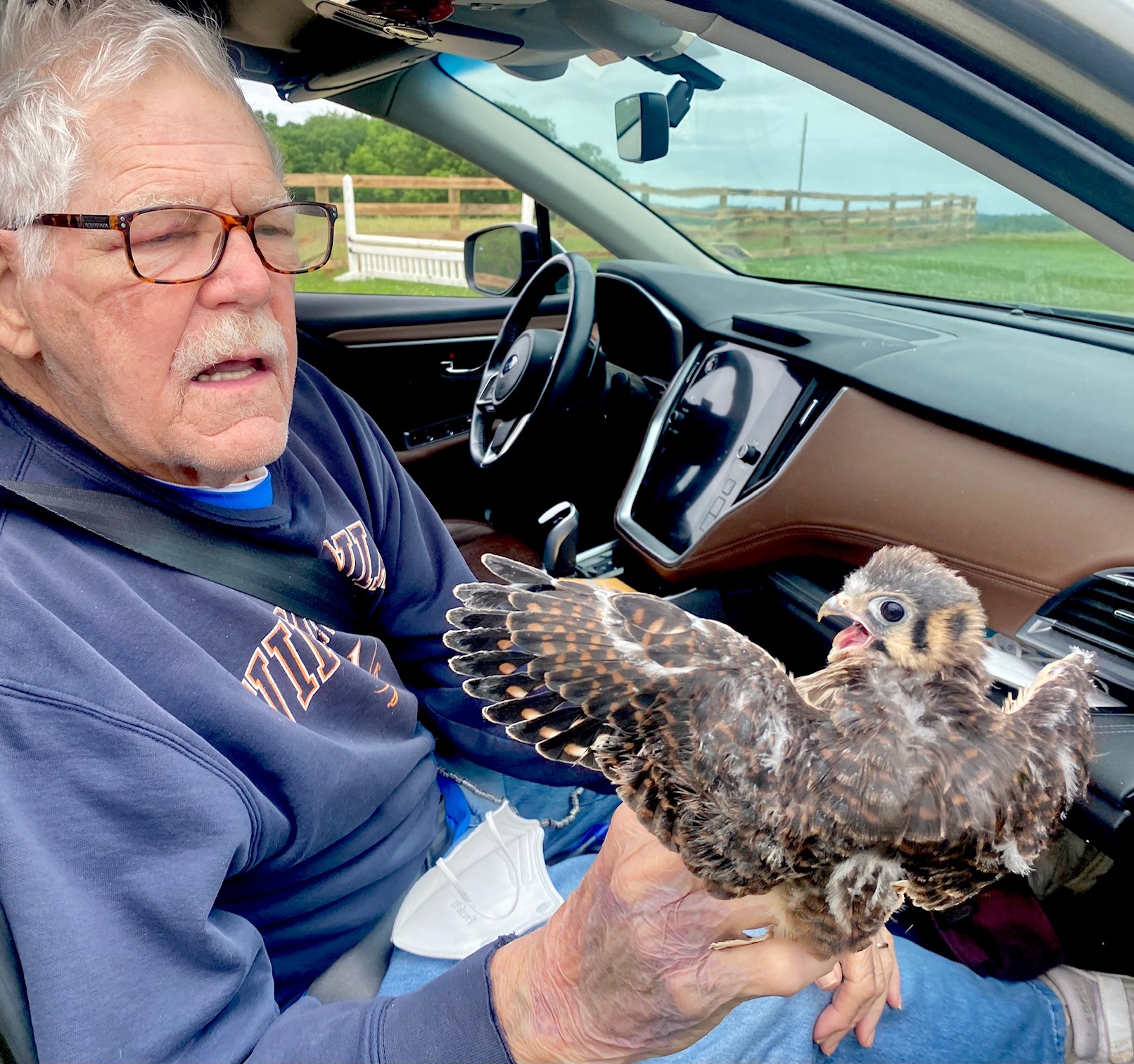
    Dolly sent me this wonderful picture of Dr. Ziegenfus banding a kestrel at her farm.
  • Volunteers Planting Riparian Buffer

    Volunteers Planting Riparian Buffer

    Along Hawksbill Greenway in Luray, Virginia

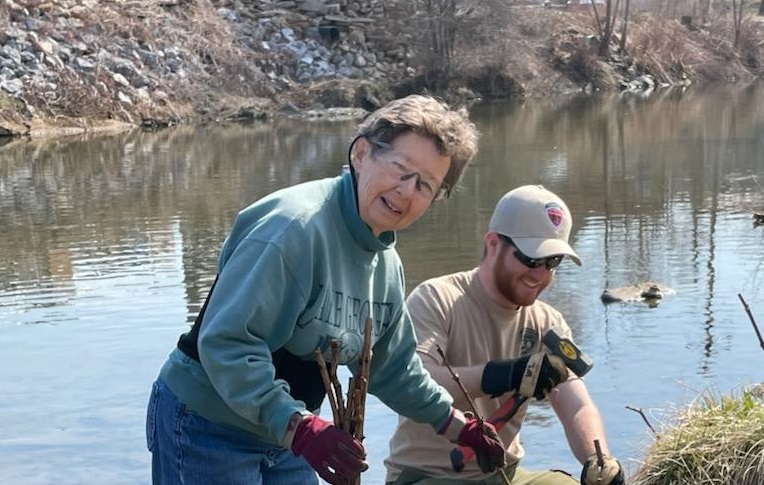
    Karen Milne helps VDOF forester Zack plant live stakes along Hawksbill Creek, March 2022.

    “The Luray-Hawksbill Greenway combines a lush habitat for birds, butterflies, trout, and other wildlife along with urban amenities. …

    The young trees and rough grass located here are part of our Riparian Buffer. This planting of a sixteen-acre plot along the Hawksbill Creek was done with a grant awarded to the Page County Tree Board in December 1999.

    Various church groups, Hill & Valley Garden Club, Boy & Girl Scouts, Tree Board members, high school students, and community volunteers have planted more than 2,500 seedlings over a period of several years.

    Varieties of Oak, Maple, and Ash as well as Locust, Bald Cypress, River Birch, Red Osier Dogwood, Persimmon, Redbud, and shrubs are growing up to become a forest buffer in this area.

    The buffer is part of Virginia’s Conservation Reserve Enhancement Program. Because of this program agreement, grasses and weeds in the restricted area cannot be mowed from April 15 through August 15.

    Riparian buffers are the single most effective protection for our water resources in the entire Chesapeake Bay Watershed. These buffers are one-hundred foot wide strips of grass, shrubs and trees along the banks of rivers and streams. The Riparian Buffer along the Hawksbill provides a transition zone between the water and the cattle pasture. It filters out phosphorus and nitrogen from fertilizer and animal waste and traps 80-85% of these chemicals which formerly entered the stream during moderate to heavy rainfalls.

    The habitat offered by riparian buffers is home to a multitude of plants and animal species, including those rarely found outside this narrow band of land influenced by the creek. This buffer also serves as a wildlife travel corridor.

    When this forested riparian buffer matures it will benefit aquatic habitat by improving the quality of the water through shading, filtering and moderating stream flow. Shade in the summer maintains cooler, more even temperatures. This allows the water to hold more oxygen and will reduce stress on the fish and other aquatic creatures. This riparian buffer has contributed significantly to the transformation of this creek into a ‘Class A’ trout stream.”  – This information is taken from the Luray Hawksbill Greenway Booklet.

    As part of this effort, March Saturday workdays were planned this year to add trees and shrubs to the streamside, as well as clean around tree tubes previously planted. Volunteer participation has included three Virginia Master Naturalists (one from Shenandoah Chapter and two from Headwaters Chapter), members of the Hawksbill Greenway Foundation and a Boy Scout troop.  

    On March 5th we had a total of 13 people: 11 volunteers and 2 Virginia Department of Forestry staff.  We planted approximately 900 live stakes. Live stake species included: Elderberry, Ninebark, Arrowwood Viburnum, Gray Dogwood, Silky Dogwood, Red Osier Dogwood, Silky Willow, Hazel Alder, and Buttonbush.

    On March 19th, Anna Maria Johnson and Karen Milne from Headwaters Chapter participated in the riparian buffer restoration with other volunteers. Two more weekends are planned for additional plantings. The overall project includes just over 3700 live stakes along 5224′ of bank and 624 sheltered hardwood seedlings covering 3.5 acres (sheltered seedlings were planted last spring). 

    This was a rewarding and fun experience. The Greenway is a beautiful site for both people to enjoy as well as providing a natural restored habitat for wildlife. I would encourage other Master Naturalists to join us for future such efforts. For further information and to volunteer contact: cain.harbison@dof.virginia.gov Additionally, find the original Eventbrite signup here.

    – Karen Milne, Cohort VII, March 2022

    Photos courtesy of Karen.

  • Marl Creek Trail Tree Planting

    Marl Creek Trail Tree Planting

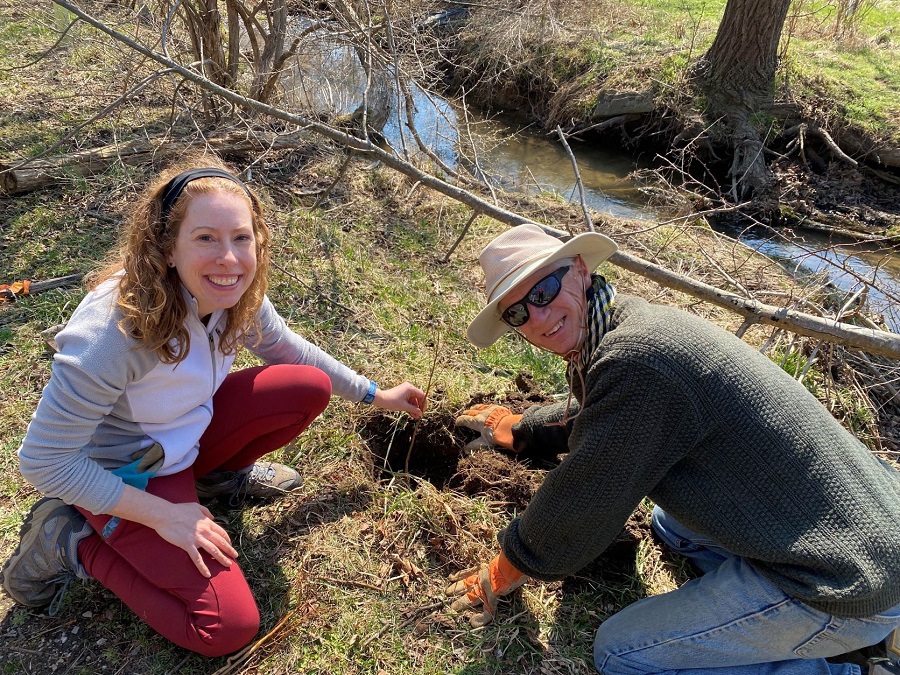
    Andrea Dono and Tom Engle plant a seedling along Marl Creek on March 5th. Photo by Sandy Greene.

    On Saturday, March 5th, Master Naturalists met retired USFS Forester Charlie Huppuch at McCormick Farm in Raphine to plant bare root tree seedlings along the Marl Creek trail. Several master naturalists were joined by former Headwaters Chapter Advisor Paul Bugas to find the perfect spots for silky dogwood, persimmon, and other trees, in addition to cleaning up the trail marker signs.

    We were delighted to see bluebells starting to peek out from the ground and numerous skunk cabbage at the end of their growth cycle. The crew worked for about four hours and then enjoyed a leisurely lunch break by the water.

    Originally the farm was home to Cyrus McCormick who invented the reaper in 1831 and transformed agriculture. It is now the Shenandoah Valley Agricultural Research and Extension Center, part of Virginia Tech University. Years back, a group of naturalists asked that a riparian buffer be created along the creek to prevent erosion, maintain stream health, and use native plantings to facilitate thriving flora and fauna at this site. The site is open daily and offers historic buildings to visit, Marl Creek with a children’s learning trail marker system and lovely spots for a picnic.

    Andrea Dono, Cohort V, March 2022

    Thanks to Sandy Greene and Andrea for these photos from the March 5, 2022, Marl Creek tree planting day!

    Sandy and Tom. Photo by Andrea.

  • McCormick Farm Tree Planting 2022

    McCormick Farm Tree Planting 2022

    Enhancing the Marl Creek Trail Riparian Buffer

    Volunteer Opportunity

    Saturday, March 5, 2022 | 10:00 AM – 2:00 PM

    McCormick Farm, 128 Cyrus McCormick Circle, Raphine, VA 24472


    Planting trees and maintaining the Marl Creek Trail at McCormick Farm (Shenandoah Valley Agriculture Research and Extension Center) in Raphine, has been an annual project since our chapter began. Working with Retired USFS Forester (and the trail’s designer) Charlie Huppuch, we are restoring many native trees, shrubs, and perennial species to the riparian buffer trail.

    On Saturday, March 5th, we will meet Charlie at the trailhead, right across from the mill, ready to plant bare root tree seedlings along the trail. Tools provided, but bring your own special spade, if you like. We may also be doing a little trail maintenance. You can earn an hour of HMN CE in addition to the volunteer opportunity this activity offers.

    Wear gloves and boots, dress for the weather, and bring your water bottle. 
    HMN contact is Sandy Greene at greenes104@aol.com or 540-487-1224. Sign up on Better Impact or by calling Sandy. Also call Sandy if you plan to help but the weather ends up being sketchy that day. 

    The 2/3 mile Marl Creek Trail is free and open to the public every day. Beginning at the historic mill and passing by the millpond and along the stream, it is popular with birders, hikers, and travelers. Come walk it yourself!  

    Directions
    Take the Raphine – Steele’s Tavern exit off I-81 on the border between Augusta and Rockbridge Counties. It’s less than a mile to McCormick Farm, with plenty of parking and restrooms open in the log cabin from April to October.

    – Sandy Greene, Cohort I

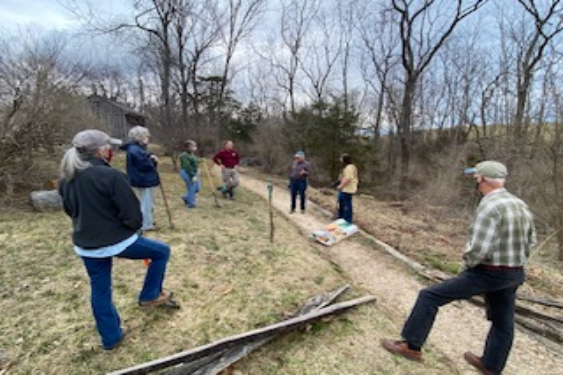
    Photo at top shows HMNs Peggy Plass, Cyane Lowden, Ann Murray, and Tom Engle, with Caroline Fitzgerald, Student Society of American Forester’s representative, Forester Charlie Huppuch, and Extension Forester Adam Downing, on 3/12/2021. They planted 50 native trees along the Marl Creek Trail. Photo by Sandy Greene.