Category: Projects

  • Collect Acorns for the VDOF

    Collect Acorns for the VDOF

    It’s that time of year again! The Virginia Department of Forestry is requesting acorns from around the state. HMNs can log volunteer service hours for this under “Habitat Restoration/Maintenance – Acorn Collection for Virginia Tree Nurseries (DOF)” in Better Impact.

    From the Virginia Department of Forestry News Release, September 8, 2022:

    Every year, Virginians from all over the state collect and donate acorns and other seeds that VDOF staff
    plant at the Augusta Nursery, where more than a dozen hardwood tree species get their start.
    Successful seedlings are later sold to Virginia landowners, typically to reforest open lands. Trees that
    begin from homegrown acorns, nuts and seeds are much more likely to thrive in Virginia’s climate.
    Collection guidelines remain primarily the same as last year, with some minor adjustments to the
    deadline and species list. Please drop off acorns at any VDOF office location by Oct. 14.

    This year, VDOF’s collection priorities are:
    • Black Oak
    • Black Walnut
    • Chestnut Oak
    • Chinese Chestnut
    • Northern Red Oak
    • Pin Oak
    • Shumard Oak
    • Southern Red Oak
    • Swamp Chestnut Oak
    • Swamp White Oak
    • Water Oak
    • White Oak
    • Willow Oak

    “We are happy to report record-setting seedling production numbers at VDOF’s Augusta Nursery this
    year,” said State Forester Rob Farrell. “Thanks to additional funding provided by the General Assembly,
    and collection efforts by everyone across the Commonwealth last fall, we will soon have approximately
    3.7 million conifer, and 2.7 million hardwood seedlings available for purchase. This represents an
    increase of 63 percent, or almost 2.5 million seedlings. Please support these encouraging trends by
    collecting acorns and donating them so we can collectively grow the forests of tomorrow.”

    “Each fall, Virginia is covered with acorns and folks wonder what to do with them,” said Assistant
    Forestry Manager at the Augusta Nursery Josh McLaughlin. “Collecting acorns and donating them to
    VDOF is a huge help to us, presents a great activity for environmentalists of all ages and provides the
    perfect opportunity to learn more about Virginia trees. Our acorn crop varies from year to year, and you
    can help us ensure representation from all over the state.”

    Drop-off details and locations:
    Please drop off your collected acorns and nuts at any VDOF office location by Oct. 14.
    HMNs can drop off at the Augusta Center, 90 Forestry Center Lane, Crimora, VA 24431

    Keep these tips in mind:
    • Safety first. Stay away from roadways.
    • Do not collect on private property without permission.
    • Collection from yards, sidewalks, driveways, etc., is recommended, to ensure collection of a
    single species. (Forest collection makes it difficult to determine the tree of origin and may lead
    to mixing of acorn species.)
    • Do not collect damaged, cracked or dried out acorns/nuts.
    • Avoid sticks, leaves, gravel and debris, but acorn caps are okay. (When the caps remove easily it
    means the acorns are ready for harvest.)
    • Place in a breathable bag, such as paper (best), burlap or cloth. Do NOT use plastic bags.
    • Use a separate bag for each species.
    • Label the bag with the collection date and species if known (e.g.; willow oak). If you’re not sure,
    include a few leaves from the tree to aid nursery staff with identification.
    • Don’t allow acorns to freeze, heat up or dry out.
    • Place in a cool area until you’re ready to drop them off at VDOF.

    For more information about acorn collection, or help identifying tree species, contact the Augusta
    Nursery at (540) 363-7000 or visit the VDOF website.

    The full News Release is here.

  • JMU Tree Inventory Updates, Summer 2022

    JMU Tree Inventory Updates, Summer 2022

    Note the Tree Inventory Volunteer Days in September: 1, 6, 8, 9, 14, 20, 22. More details here and in Better Impact!

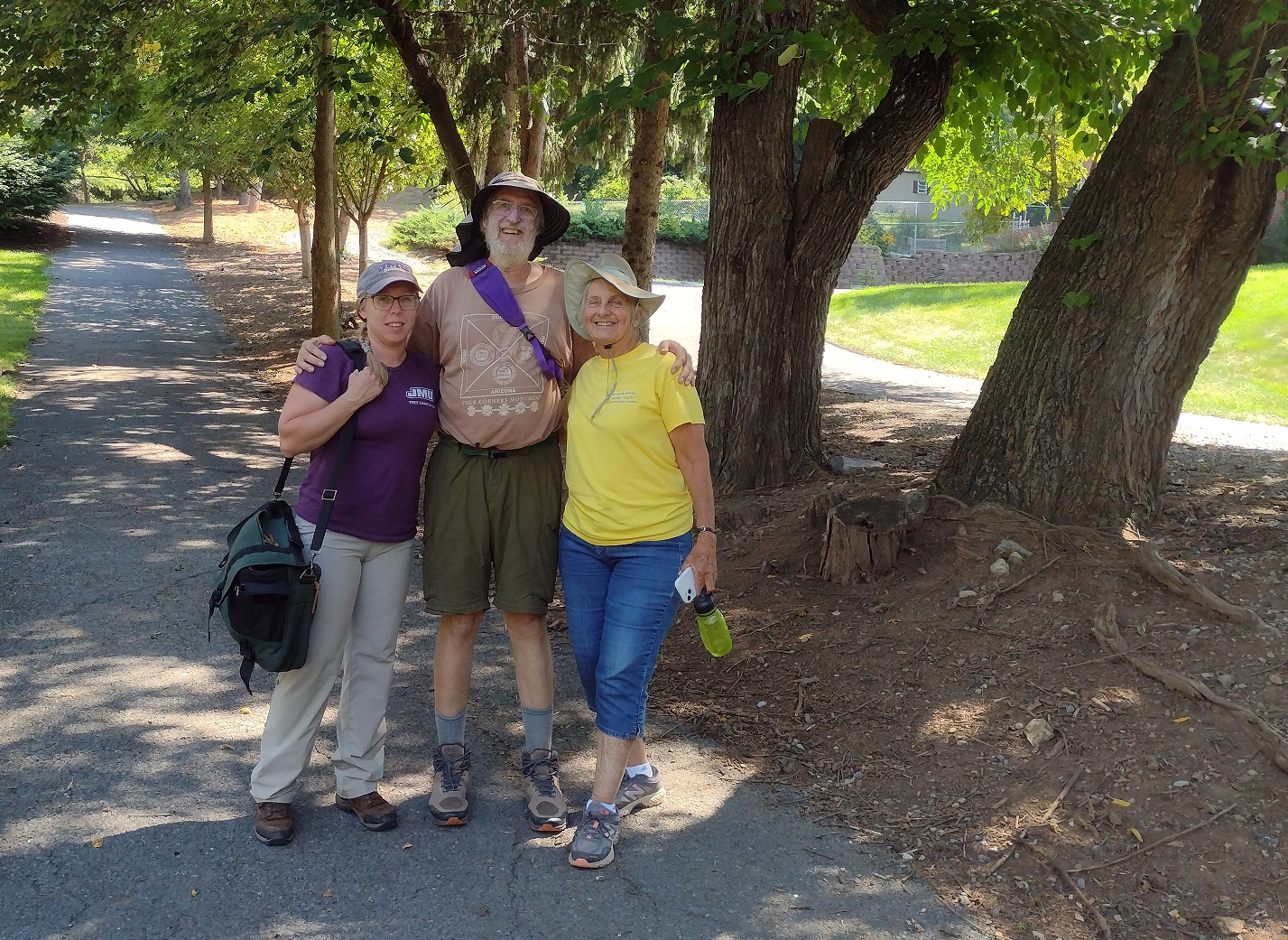
    Ali, Carl Droms and Ann Murray under two giant white mulberry trees freshly inventoried into the ArcGIS Collectors App, August 9, 2022.

    To date eight HMN volunteers have spent 70 hours logging trees into a GIS field data collection app and have added a total of 733 trees to JMU’s Campus Tree Inventory Map. Information such as: Species name, height of the tree, diameter at breast height or DBH, health, maintenance recommendations, photographs and more have been added to an extensive database that is publicly accessible and will be utilized by the university to calculate existing tree canopy cover in order to establish a goal for improving the tree canopy cover on campus. The tree inventory data will also be used for research and education by faculty and students and to begin the process of evaluating the many benefits urban trees provide to the campus and to the local community.

    – Ali Sloop, JMU Stormwater Compliance Specialist, August 26, 2022

    Photos below by Ali except the one of her shirt which was taken by Adrie.


    JMU Stormwater Compliance Specialist Ali Sloop and Ann Murray, Cohort II, work on the JMU campus tree inventory project, July 28, 2022. Photo by Dave Forrer, Cohort VI.

    Since Headwaters Master Naturalist volunteers started assisting James Madison University about a month ago with its campus tree inventory, a total of 477 trees have been geolocated.

    Five HMN volunteers have spent a total of 32 hours on campus adding data to the ArcGIS Collector app JMU staff uses for the tree inventory. HMNs measured each tree’s height, diameter at breast height, identified species, noted health and structure of the tree and logged photographs. This data will prove very useful as JMU works to increase the urban tree canopy on campus, preserve existing canopy on campus and manage the urban forests on campus.

    – Ali Sloop, JMU Stormwater Compliance Specialist, July 28, 2022

  • Bat Count

    Bat Count

    Bat counters at Carolyn Ford’s farm in Staunton, July 27. Photo by Zack Perdue.

    Leslie Sturges, president of Bat Conservation & Rescue of Virginia, organized a bat count on the evening of July 27 at the farm of Carolyn Ford, just within Staunton city limits. We had excellent attendance and weather, with a total of about 17 participants, including three from our Headwaters Master Naturalist chapter.

    We began with a brief survey of the barn whose floor held an abundance of bat droppings, promising an impressive turnout of bats. It in fact houses a sizable number of female big brown bats (Eptesicus fuscus) in a bat maternity colony. Leslie gave a roughly 15 minute presentation as we waited for it to darken sufficiently for the bats to emerge. We then stationed ourselves at strategic points around the barn to watch as they shot out of various openings, silhouetted against the evening sky.

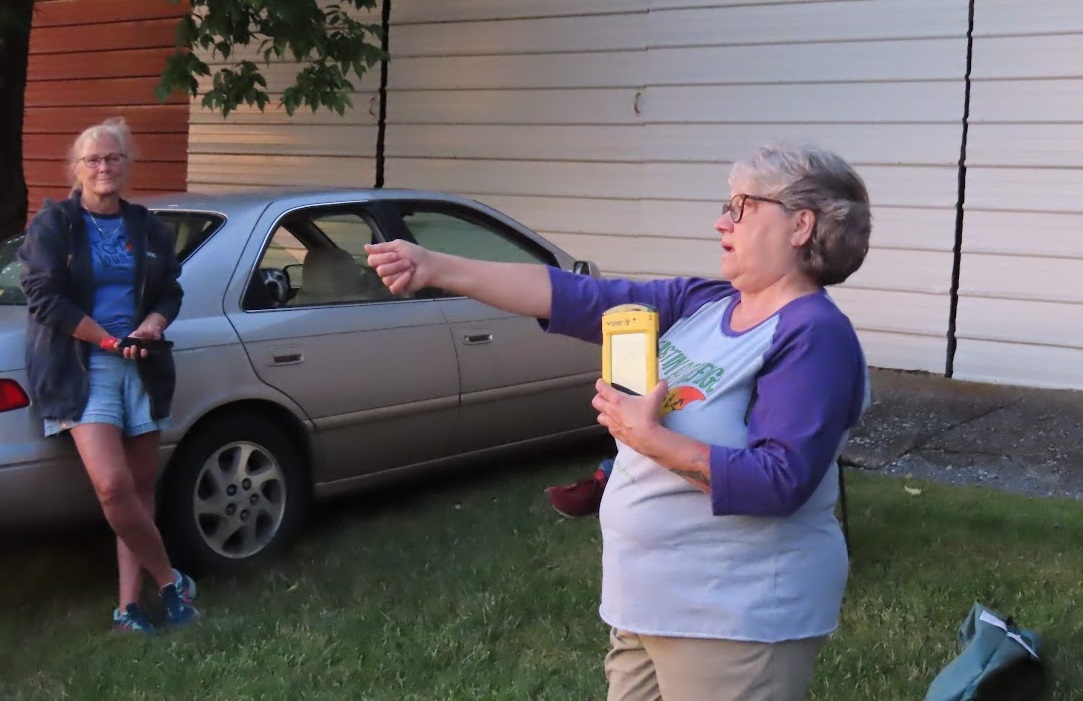
    We got to use various electronic devices to render audible the ultrasonic emissions of the bats. I received a handheld device called a ‘Baton,’ which reduces the frequency by a factor of 10 such that an inaudible 30 kilohertz sound is easily audible even to aging ears at about 3 kilohertz. Leslie also used a more sophisticated device called an Echometer Touch.

    Although big brown bats weigh only about 18 grams, they nonetheless have wingspans of about 13 inches and are an impressive sight as they flit overhead. We learned that they tend to fly over groups of people because we exhale CO2, which attracts insects. Thanks to the Baton, we were alerted to the pulses of sound they produce as they exit the barn and hunt for prey. When Leslie tallied the counts from each group of observers, the final count was a little over fifty, twenty more than had been observed in the spring.

    These bats are impressive insectivores, capable of consuming up to 1000 insects per hour. Aided by the listening devices, we got to witness them diving to capture flying insects. The big brown bat has been largely spared white nose syndrome, and is one of the most abundant bat species in North America. They have complex social lives, with relationships based on factors other than kinship. They can apparently interact with bats from adjoining colonies as well.

    Leslie maintains a website, virginiabats.org, which goes into detail about the desirability of increasing bat populations and strategies to achieve this, with good summaries of their various programs. She is a remarkable living resource, having devoted herself to this cause for the past twenty-one years. She is hoping to have further similar events in the coming months. I’m looking forward to further participation.

    – Zack Perdue, Cohort VII, July 2022

    Rich Sturges with HMNs Ann Murray and Kate Mahanes awaiting bat emergence. “The bats started to emerge about 8:40, and we counted for about an hour, until it was too dark to see them.” – Zack. Photo by Leslie Sturges.
  • Volunteering at JMU in June

    Volunteering at JMU in June

    Sue Gier, Cohort V, working on tree documentations with JMU’s Stormwater Compliance Specialist Ali Sloop. Photo by Cindy Westley.

    HMNs participate in new JMU stewardship projects

    James Madison University holds a designation as a Tree Campus. They have a committee for oversight of activities. Annually they must host service projects, have a tree care plan, and celebrate Arbor Day. One of their goals for this year is to increase the tree canopy coverage on the campus. Out of the estimated 8,000 trees on campus, about 6,000 have been geolocated and only half of the 6,000 have been identified to species. Recently Ali Sloop, Stormwater Compliance Specialist at JMU, reached out to Headwaters Master Naturalists for help with two projects.

    On June 22 and 23, five Master Naturalists helped to identify and document trees on a section of the campus in order to help determine the baseline canopy. Ali provided training. We used special equipment and our smartphones to identify the location, height, girth, structure, species, and health of the tree in a JMU app.

    The second project, on June 28-30, was to inventory the stream buffers on campus and identify invasive species. There are about three miles of above ground streams that run through or near the campus. The riparian buffers serve to filter stormwater runoff, provide wildlife habitat and offer educational opportunities. Volunteers were given training to note species found in three areas in the iNaturalist app. Over 600 plants were identified. Observations can be found in the iNaturalist app under the “JMU Stream Buffers” project.

    See below for other opportunities to participate. Ali is a knowledgeable and patient guide. Technology allows for more accurate data collection and I now feel more confident with the use of apps. It was great to be part of projects that support JMU’s sustainable practices.

    – Cindy Westley, HMN transferee, June 2022

    HMNs Dave Forrer and Kathy Byers help inventory trees on JMU campus, June 22, 2022. Photo by Cindy Westley.

    JMU Campus Tree Data and Inventory Workdays

    Multiple Dates:
    July 6,15, 25 and 26
    August 1, 2, 3, 4, 9,10,12,18,19, 23, and 24

    September 1, 6, 8, 9, 14, 20, 22

    Time: 8:30 am – 12 noon

    Update from Ali starting in September: There is also a new parking permit system that has gone into effect on campus. I will need each volunteer’s make, model, license plate number and color of their vehicle to submit that info to JMU’s Parking Services new license plate recognition technology via an online form. I will need the vehicle information a week in advance of when volunteers will be parking on campus to give Parking Services time to approve the permit request.

    Phone number: (540) 421-1105                                Email: witmanad [at] jmu.edu

    Equipment needed: Smartphone with ArcGIS Collector app downloaded

    Master Naturalists will join Ali Sloop, Stormwater Compliance Specialist with JMU Facilities Management, to geolocate, identify and photo document urban trees on campus. As part of JMU’s Arbor Day Tree Campus USA designation, the university is working to gather data on all the trees on campus in order to set a canopy coverage goal and more effectively manage the urban forest. Data collected will include: location, height, diameter at breast height (DBH), structure, species, health, condition and photo documentation. Training on the tree inventory protocol and logging of data will be provided. A specific log-in will be assigned to each volunteer in order for each person to contribute to the overall campus inventory database.   

    Volunteers will need a smartphone that can download the app (Collector) that is used to collect the information. If you are interested in volunteering, but do not have a smartphone or are unable to download the Collector app, please contact Ali for alternative ways to help. Volunteers should wear sturdy closed-toe shoes, and preferred sun and insect protection.

    Ali Sloop will need to know at least a week in advance which volunteers will be attending so that she can coordinate getting log-ins for the Collector app for each person. 

    Be sure to sign up for this great opportunity in Better Impact!!!!

    – Pam Gray, Project Committee Chair

  • HMNs Present at Arboretum

    HMNs Present at Arboretum

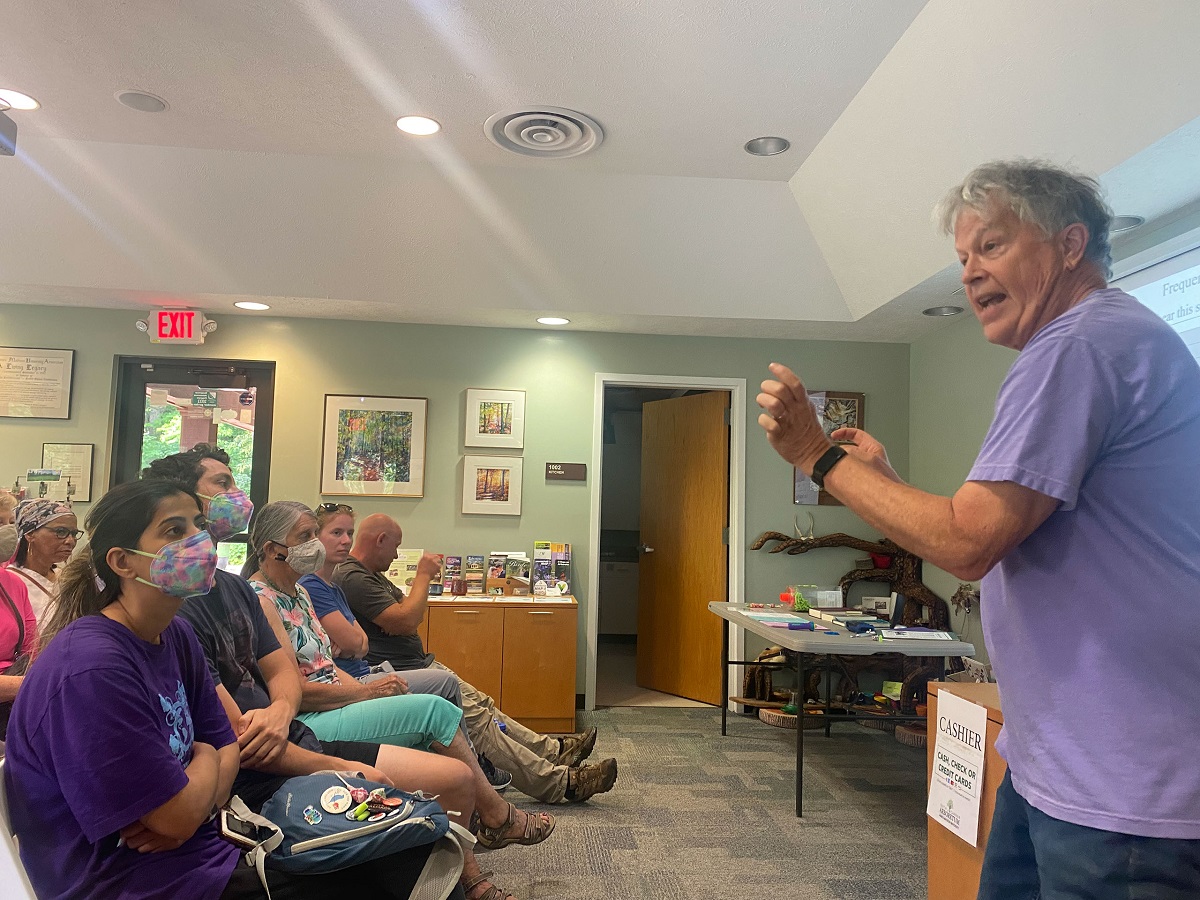
    Lincoln Gray, JMU neuroscientist and HMN, presents to a packed audience at the JMU Arboretum visitors’ center, June 22, 2022. Photo by Brittany Clem-Hott.
    Snakes have no external ears but “hear” through vibrations entering their middle ear via their jawbone.

    The Brown Bag Lunch series at the Edith J. Carrier Arboretum at James Madison University featured two programs in June presented by Headwaters Master Naturalists. The first, on June 22, was “What Humans Hear in Nature & Vice Versa” presented by Lincoln Gray, who is professor of Communication Sciences and Disorders at JMU. The focus of his talk was a comparison of the hearing anatomy of various species, and how each is adapted to its needs and environment. As might be expected, the sensitivity to sounds of different frequencies varies quite a lot between species. For example, among mammals, cats have the “best” hearing, in that they can hear the widest range of frequencies, whereas pigeons are masters at hearing low frequency sounds; it’s believed that a pigeon perched on the Gateway Arch in St. Louis can hear the rumble of the waves from the Atlantic and the Pacific!

    Art staffing the Market Compost Drop-off table last year.

    The second talk, on June 29, was entitled “Composting YOUR Way,” presented by HMNs Art Fovargue, Chris Bowlen, and Dave Forrer. Beginning with an explanation of the biology of composting, they went on to discuss some strategies for making your backyard compost pile more efficient. Most important is getting the right mix of nitrogen (“greens”), carbon (“browns”), oxygen, and water. As alternatives to backyard composting, they mentioned worm composting, which can be done indoors, and taking your organic waste to the Harrisonburg Compost Dropoff, from which it goes to Black Bear Composting, a commercial-scale composting operation in Crimora. Besides producing compost for your garden, all these methods help to keep organic waste out of landfills, thus reducing the production of methane, among the most powerful of greenhouse gases.

    – Carl Droms, Cohort II, June 2022

    Thanks to Brittany Clem-Hott, Marketing and PR Specialist for the Arboretum, for these photos! From left to right: Art, Chris and Dave, June 29, 2022.