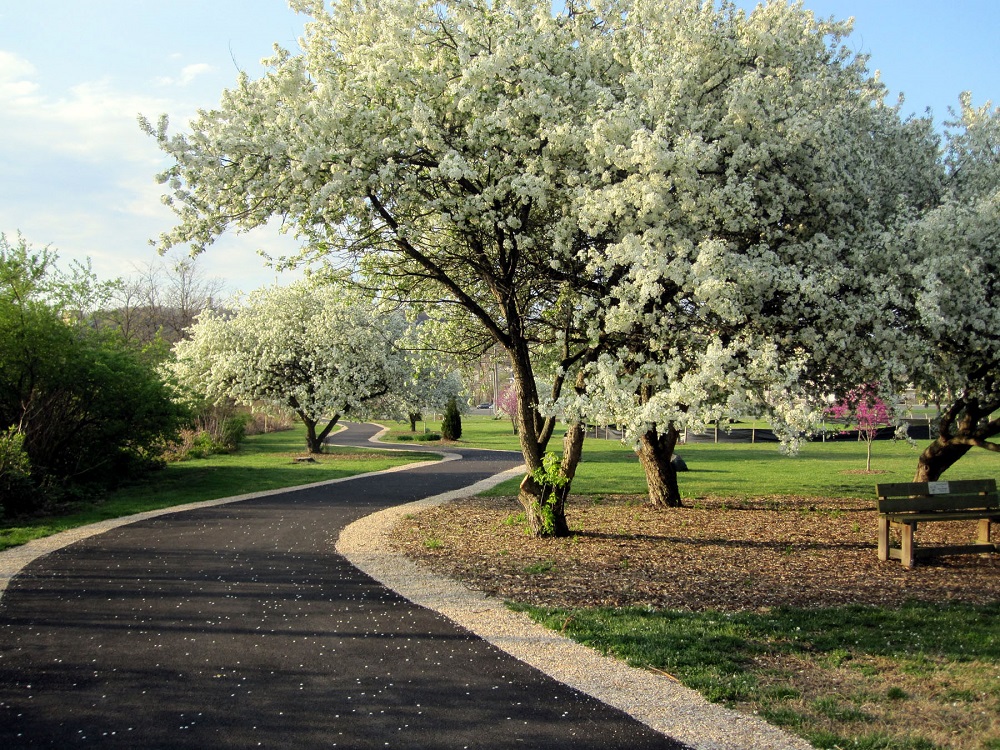
“Greenway in blossom,” courtesy of the Waynesboro Parks and Recreation Department website.
An exciting new Master Naturalist project centered around trees is starting in 2023 in Waynesboro! Headwaters Chapter members will work in current and planned public spaces like Ridgeview Park, The Greenway, Basic Park, and Coyner Springs Park. We will assist with management of invasive vines and trees, management of beaver cages around trees, pruning, and may also assist with planting and mulching.
The first planned project is to enlarge beaver cages around 74 planted trees along The Greenway, which runs alongside the South River. These cages were installed around 5-10 years ago and many are in urgent need of replacement. There is also ample opportunity to remove invasive vines along this beautiful paved trail.
This project was created with support and encouragement from Waynesboro Parks and Recreation and the Charlottesville Area Tree Stewards. Contact Breyette Lorntz Covington, project lead, if you’re interested in joining this effort. (breyette.covington [at] gmail.com)
– Breyette Lorntz Covington, Cohort V, January 2023
It’s that time of year when HMN board members put together our Annual Report for the VMN state program coordinators. Among our lists of activities and volunteered hours over 2022, this project stands out for the combined 162 hours put in by two HMN volunteers. Thanks to Jean and Lincoln for providing this unique and valuable service!
Two Headwaters Master Naturalists, Lincoln Gray and Jean Stephens, work with a National Park Service professional to treat Ash trees for Emerald Ash Borer (EAB) and Hemlock trees for Hemlock Wooly Adelgids (HWA) in Shenandoah National Park. They are also assisted by two master naturalists from other chapters. Both treatments involve injections of insecticides (into the tree for EAB, soil for HWA).
Volunteers on this project were required to complete 20 hours of training and pass the Virginia Department of Agriculture and Consumer Services’ exam to become a Certified Pesticide Applicator Technician.
The Shenandoah National Park Trust has also purchased some very small, but expensive, Laricobius nigrinus beetles from Virginia Tech that eat HWAs. The beetles are released in areas of the park which are near streams (where the insecticide cannot be used) or in hard to reach locations. HMNs have been involved in the release and monitoring of the beetles. HMNs also help monitor the health of ash and hemlock throughout the Park. Such monitoring indicates a significant difference between treated and untreated trees. The work is significant because without this integrative forest health management project, some predict that many or most of the ash and hemlock in the National Park will die, a major change in the landscape and biodiversity.
– Lincoln Gray, Cohort VI, and HMN Jean Stephens, December 2022
Photo on left above shows Lincoln working with a park forester in June 2021. Photo courtesy of Lincoln. | Photo on right is of the tiny Hemlock Wooly Adelgid-eating Laricobius beetles. “They are the tiny black dots on the excelsior.” Photo by Jean Stephens.
Bald Eagle and Common Ravens vying for carcass scraps near Briery Branch, December 17, 2022. Photo credit: Art Fovargue.
On Saturday, December 17 the Rockingham Bird Club (RBC) conducted its annual Christmas Bird Count (CBC). The CBC was started in 1900 by Frank Chapman as an alternative to hunting birds. It is the longest running citizen science survey in the world. Locally the count has been happening since 1954.
My participation, with my wife (the true birder), was again in what is known as Sector 6 of the count circle. To see the count circle, click here, and zoom into our area. Sector 6 starts just west of Ottobine, Clover Hill and Lilly and extends to Briery Branch, Briery Branch dam, and Union Springs. We started our recording at dawn in the Ottobine Elementary School parking lot. In addition to some songbirds, we saw two Bald Eagles and seven Common Ravens fly over. Shortly thereafter we found their destination when we saw them working on a deer or cattle carcass near Briery Branch. From there we went up past the dam and hiked some of the trails hoping to get some good forest birds. However, it was quite quiet, which we attributed the everything still being enshrouded in ice from the storm two days previous. Although it wasn’t as warm as last year’s CBC when the temperature reached into the 60°Fs, long underwear and hot chocolate kept us going.
By the end of the day, we had logged 33 species and 494 total birds (seen or heard). European Starling was the high count for any species, as it often is, at 120. Sadly, it is part of our landscape. On the other hand, we saw lots of fun birds such as the Yellow-bellied Sapsucker plying a tree I could almost touch, the Yellow-rumped Warbler along Waggy’s Creek, and the near 50 Dark-eyed Juncos along the roads in the higher elevation. (We wondered where they were since they’re not at our feeder!).
Overall, in the count circle, a preliminary review shows that 75 species, and 10,428 total birds were observed. If you are interested in final details, check out upcoming RBC newsletters here.
HMN-Led Presentation and Possible Future CE Opportunity for HMNs
I led a small and informal stargazing session on Thursday, October 27, at Starry Meadows, a farm near Linville owned by Sharon and Jay Landis, participants in the most recent Headwaters class. They have been hosting numerous bird walks there, but had expressed an interest in taking advantage of their dark skies for astronomy outings. I intentionally limited the number of participants and did not post it on Better Impact, since I thought there might be technical and logistical problems on this first attempt. Although all went well, it took some time to find a suitable spot, not blocked by trees or buildings.
We had a great time using binoculars and my conventional refracting telescope, but the images obtained by my EvScope, essentially a telescopic camera that can take very long exposures, seemed to create the most excitement. It has the particular advantage of being able to connect with smartphones and tablets, such that up to ten participants can view astronomical images forming over seconds to minutes. At top is an image of the Lagoon Nebula, a star-forming region in the constellation Sagittarius, with a cluster of recently-formed stars to the upper left.
We are hoping to schedule such sessions with members of the Master Naturalist group in the future, with continuing education credit. We are also hoping to do some outreach to youth groups in the area.
Headwaters Chapter VMN – Update on JMU Tree Campus Inventory Project
Over the last five months, eight Headwaters Chapter master naturalists (and one Charlottesville Area Tree Steward in training) have worked together with James Madison University staff to geolocate approximately 1,667 campus trees. This work has pushed the new total of campus trees to over 8,000! Master naturalist volunteers have been instrumental in identifying each tree and collecting important tree data for each of those 1,667 individuals. Data collected includes each tree’s height, diameter, health, structure, species common name, native or non-native status, maintenance recommendations and identifying photographs.
JMU Facilities Management staff would like to thank the dedicated volunteers that braved the varying degrees of weather, thorns, insects and the ever-present poison ivy to assist with this tree inventory. Volunteers logged approximately 112 hours observing and recording data via the ArcGIS Collector app. The tree inventory data will be used by JMU’s staff, faculty and students for a wide variety of projects, analysis and research in order to improve upon the management and conservation of the urban forests and trees on campus.
A big THANK YOU to Ann Murray, who was this year’s tree inventory MVP. Ann dedicated over 40 hours of her time collecting tree data for the inventory. Thank you to each of the tree inventory volunteers who also committed their time assisting with the data collection and sharing their own unique expertise: Adrie Voors, Breyette Covington, Carl Droms, Cindy Westley, Dave Forrer, Kathy Byers, Sue Gier and Scott McNally (Charlottesville Tree Stewards). A behind the scenes thank you to Pam Gray for all her work in adding the inventory dates to the volunteer system and emailing new dates out so you all could sign up. The saying, “teamwork makes the dreamwork” has never been truer than for this project.
We hope to have you all back on campus in the spring for continued tree inventory work, but in the meantime, take a crack at learning to identify those evergreen trees in your community or contact Ali Sloop (witmanad [at] jmu.edu) and learn with her on a campus winter tree walk.
– Ali Sloop, JMU Stormwater Compliance Specialist, October 2022
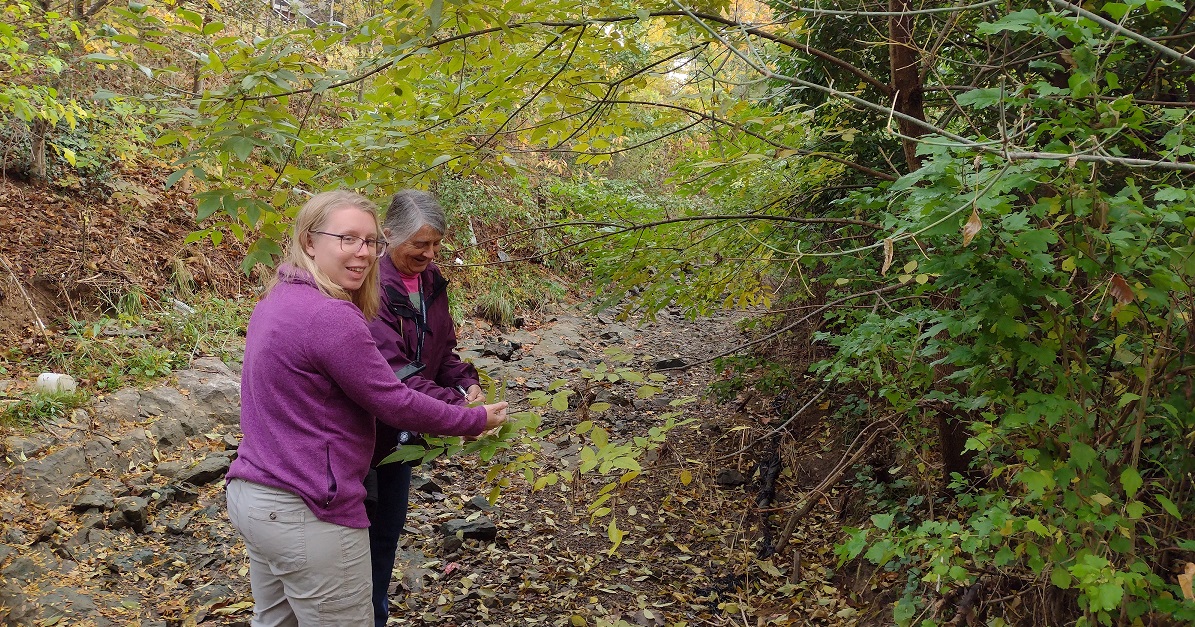
Photo at top shows Ali and Ann collecting data along the Sibert Creek riparian buffer on JMU’s campus, October 17, 2022.