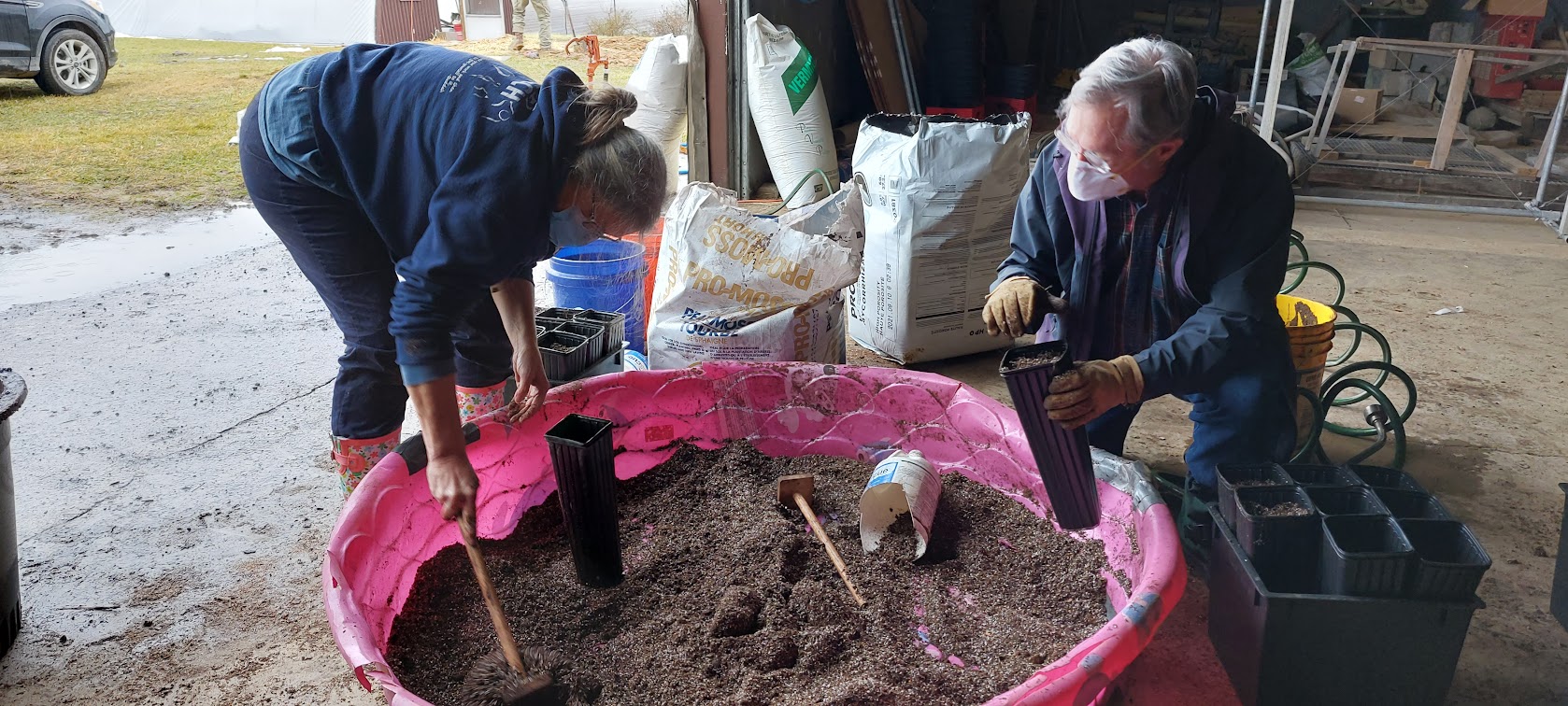
HMNsTina and Zack filling pots for chestnut seeds, February 4, 2022.
Master Naturalists Volunteer with the American Chestnut Foundation
On February 3 and 4, Headwaters Master Naturalist volunteers joined up with Rivanna Chapter VMNs and members of The American Chestnut Foundation (TACF) to sow chestnuts at the Virginia Department of Forestry’s Center in Crimora. The TACF organizers were happily surprised with the total number of volunteers that came: 20 on the 3rd and 15 on the 4th. Representing Headwaters were Karen Milne, John Bauman, Peggy Plass, Tom Engle, Tina Dove, Zack Perdue, Dave Forrer, and Cindy Westley (who has just transferred from the Rivanna Chapter to Headwaters- Welcome, Cindy!). A number of other HMNs had signed up for the 5th (Saturday), but due to the large turnout on Thursday and Friday, there was no work left for Saturday. Thanks (and regrets) to those who signed up for Saturday!
We planted over 1,600 chestnuts (seeds) in containers in those two days. Specifically, our work included mixing soil (in a child’s swimming pool), filling 4”x 4”x 18” deep containers with the potting mix, and sowing one chestnut in each container. While we were working, the organizers, John Scrivani, Tom Saielli, and Tom Wild – with TACF, spent some time educating us about what it is their organization is doing. And it’s very impressive.
We sowed roughly 600 pure American chestnuts, 100 Chinese chestnuts, and 900 hybrids. The seedlings will start off in the greenhouse at the DOF center. Rather than being sold and/or planted in forests, these trees will be used for research: selecting for resistance, testing for effective fungicides, and for further cross-breeding.
The American Chestnut Foundation will be asking for assistance with these trees and with other future projects. TACF’s Virginia Chapter President, John Scrivani, emailed the following message:
Our Chapter needs a group of Citizen Scientists dedicated to the restoration of this iconic tree.
Some citizen science activities you can engage in include:
Tree Hunters – You can start by downloading the TreeSnap app and following the links to the AppStore or GooglePlay. On this webpage, you can manage your account and apply to join groups. Our group is named “Virginia TACF”. Here is a YouTube video that may help you get started. Let me know if you would like suggestions on where to search. This may include collecting leaf samples for genotyping.
Greenhouse Work – work in our greenhouse to assist in raising our seedlings, conduct small stem assays, and collect data
Field Plantings – direct sow or plant seedlings in our American germplasm conservation orchards or breeding orchards
Orchard Work – work in our orchards to maintain and cull trees, perform field inoculations, make and record scientific observations
Pollinators – collect pollen and control pollinate female flowers to create families trees
Harvesters – collect chestnuts for our orchards and in the wild to grow new trees
Restoration planters – assisting with possible restoration plantings and field trials
I will keep you informed of opportunities and possible training sessions (Zoom or in-person). Much of our work is seasonal, but coming up in the next couple of months are some greenhouse work and orchard maintenance, followed by orchard plantings. When the leaves come out, tree hunting! Followed by pollinating, and so on.
– John Scrivani, President, Virginia Chapter, The American Chestnut Foundation
We’ll keep you apprised of any future CE and volunteer opportunities with TACF.
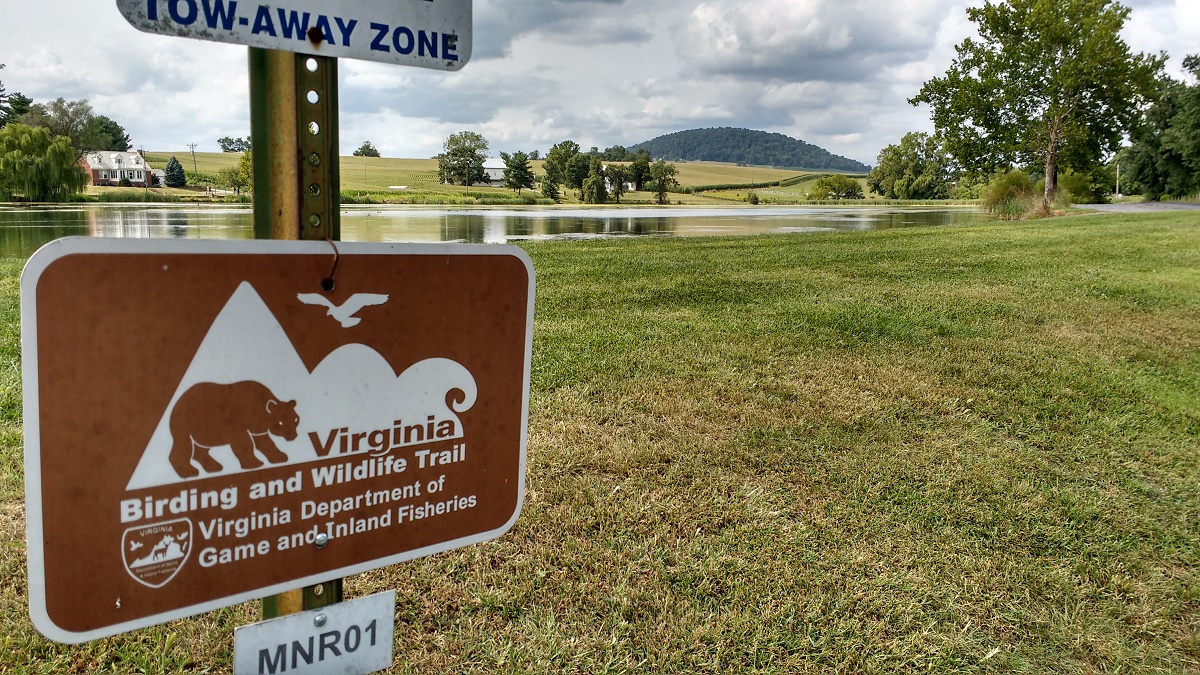
August 2018 photo of the Bird and Wildlife Trail sign at Silver Lake. Since then the Virginia Department of Game and Inland Fisheries has been renamed the VA Department of Wildlife Resources and the Birding and Wildlife Trail program has dropped the “ing” in Birding to become the Bird and Wildlife Trail.
A big “Thank You” to all HMN BWT volunteers and an appeal for new monitors for 2022
From project coordinatorSandy Greene
Our chapter responded to the request to adopt all three the Bird and Wildlife Trails in Augusta and Rockingham Counties, and YOU rose to the site monitoring challenge. YOU found your places, explored and learned more about what grew and moved there, took other visitors, picked up trash, mended trails, photographed and sent in love notes about them to Cheryl and Sandy. We in turn compiled your notes and photos and reported to the Virginia Department of Wildlife Resources (DWR), and the North River Ranger District of the George Washington/Jefferson National Forest.
Thank you for your commitment, your diligence and study, and your creativity as we searched for the most beneficial way to highlight and care for these special natural areas. Your visits were more important than you may have thought, when looked at in composite:
We began including eBird data in our reports, which prompted the DWR to add eBird hotspot links on their website to each of the Bird and Wildlife Trail sites.
These sites have been the logical destinations for Wildflower Walks for many years, for Wildflowers and Warblers, Dragonfly study, Butterfly and bird counts, and a Frog-Calling Workshop. Advertising to the public, and becoming more confident about hosting and leading events has elevated the beauty, ecological value and comfortable accessibility of our public lands.
Having reports on file at our agencies insures more accurate website information.
Learning to navigate to our sites, knowing where to park, where the trails really go, where and when the wildflowers are blooming, and birds are migrating, has enriched our Master Naturalist skills, events and training.
Monitoring has prompted us to learn to use eBird and iNaturalist – even as we struggle with our phones and connectivity. We’re at least on the learning curve.
Thank you for becoming the students, stewards and advocates for your sites.
We are excited about the direct and real-time reporting changes coming this year to the Bird and Wildlife Trail programs through CitSci. At the chapter level, we will also change to an annual commitment for monitors. If you love your sites, wonderful! Sign back up. If you’re worn out, or need a break, that’s ok too. We sure do understand!
If you would like to become a monitor for a particular site (or sites) for this year, call or text one of us. We will be actively recruiting for all of our sites soon. All of us will need some orientation to CitSci, to the new online format for reporting. We are also recruiting experts in using eBird and iNaturalist, and will be hosting virtual training and supporting every monitors’ skills in these programs. The VMN already has wonderful training videos ready for us.
We have so enjoyed partnering and learning with you in this project! – Sandy and Cheryl
Here is a listing of all our sites with the names of HMNs who have helped monitor them over the past six years. Pick a site (or two or more) and contact Sandy or Cheryl to sign up for this year: 2022!
Bird and Wildlife Trail Monitoring Project Background and Update for Headwaters Master Naturalists 2022
From project coordinator Sandy Greene
What’s Not To Like?
It’s an approved project statewide, with our HMN chapter an early adopter of our three loops in Augusta and Rockingham Counties. The goals of the 2004 project, the first statewide program of its kind in the U.S., “celebrates our diverse natural habitat, with 400 species of birds, 250 species of fish, 150 species of terrestrial and marine mammals, 150 species of amphibians and reptiles and a wide variety of aquatic and terrestrial invertebrates”. Then-Governor Mark Warner introduced the project by saying it “will truly open the door to the Commonwealth’s exquisite natural wonders.”
Our overall charge: “to update, maintain and improve the Virginia Birding and Wildlife Trail”
Monitoring one or more sites on the VA Bird and Wildlife Trail is a Covid-proof project, with plenty of volunteer hours possible, but only a suggested minimum 10 minute visit each quarter.
It’s one click to report your volunteer hours on Better Impact.
Even if you are already a monitor, and you want to stay with your site, you can sign up for a year at a time, so you can do different sites each year.
You can go out when it suits you within each seasonal quarter.
We will provide the training and patient support (as we are learning ourselves!) for learning how to use eBird and iNaturalist, and the new CitSci reporting tool.
One Website has all the info we need:
The VMN Website has all the Scoop, the training videos, and all the links. Here is the path:
It’s easy to discover Virginia’s wild side with The Virginia Bird and Wildlife Trail (VBWT), an organized network of outdoor sites highlighting the best places to see birds and wildlife in the Commonwealth. Walk a nature trail, paddle a river, or enjoy a scenic overlook to experience Virginia’s wealth of natural diversity, ranging from brown pelicans and bottlenose dolphins along our Atlantic Coast to bald eagles and black bear in the Appalachian Mountains. With 400 species of birds, 150 species of mammals, 150 species of amphibians and reptiles, 250 species of fish, plus hundreds of butterfly, dragonfly, and other invertebrate species, you’ll soon see why Virginia is a premier destination for birding and wildlife viewing.
As of January 2022, you can also find theblog post by Meg Raynes about her visits to the Lost Shoe and North River Loops. This is the first of her posts about all of Virginia’s BWT sites.
If you click on Mountain Region, and then North River Loop:
North River Loop Description
Heading west out of the Shenandoah Valley into the Allegheny Mountains reveals the towering white pines and hemlocks of the George Washington and Jefferson National Forest. As the mountains rise to meet West Virginia, the visitor encounters a series of reservoirs created from several tributaries of the Shenandoah River, where the North River eventually ends. These small lakes add to the diversity of habitats found along the loop and make for excellent wildlife watching. Traveling these quiet back roads could expose wild turkey, ruffed grouse, and perhaps black bear as they cross roads or come to lakes for a drink. The hills host numerous nesting wood warblers in spring while fall brings raptors cruising south along the ridgelines high above the Shenandoah Valley. The numerous small lakes require extra special attention during migration when a number of unusual species of waterfowl may appear.
COVID-19 & the VBWT: Be Safe While OutdoorsDWR encourages you to be safe while outdoors. Before heading out, first check with individual sites on the Virginia Bird & Wildlife Trail for any COVID-19 policies or closures. This information is typically posted on a site’s own website. Remember to maintain CDC social distancing guidelines while enjoying the outdoors.
Description
Elevation: 1968 ft.
Todd Lake Recreation Area has a few more facilities than most of the sites along this loop, making it an ideal spot to pitch a tent or park the trailer. The park has a bathhouse and a beach where visitors can take a refreshing dip in the lake or just relax on the beach and watch the clouds pass by overhead. Wildlife viewing opportunities abound around the lake, which hosts a variety of waterfowl and wading birds. Be on the look out for great blue heron, wood duck, blue-winged teal, spotted sandpiper and belted kingfisher. Bald eagle and osprey may also drop in from time to time. The neighboring woodland is worth searching for Appalachian songbirds such as eastern wood-pewee, blue-headed and red-eyed vireos, wood thrush and the exquisite scarlet tanager. Check the lakeshore for dragonflies, especially eastern amberwing, widow skimmer and common green darner. Butterflies are more widespread and may include pipevine and eastern tiger swallowtails, silver-spotted skipper, red-spotted purple and great spangled fritillary.
Directions
Location: Leading Ridge Rd, West Augusta, VA 24485
Coordinates: 38.3653900, -79.2086799
From Harrisonburg, VA: Travel south on State Route (SR) 42 passing through the town of Bridgewater. Continue for 3.2 miles to the intersection of SR 42 and 809/747 (at sharp left-hand turn). Turn right onto SR 809/747 and continue for 3.4 miles to a four-way stop sign in the town of Mt. Solon. Continue straight on SR 747 (Freemason Run Road) for 2.3 miles to a three-way stop sign. Continue straight on SR 747 (Freemason Run Road) for 1.0 miles to the intersection with SR 730 (Stokesville Road). Continue straight on SR 730 (Stokesville Road) for 1.3 miles to the intersection with SR 730 (North River Road. Continue straight on Route SR 718 (Stokesville Road) for 1.1 miles to the intersection of FR 95 and FR 101. Turn left onto FR 95 and travel 3.1 miles to Todd Lake Recreation Area on the right.
How About That? On the real eBird site, all the observation data is live and searchable.
Now you go click on a site that interests you! Then sign up to monitor, and really go there!
Extra Credit for a Snow Day
If you are ready to sign up to monitor for 2022, then you can also click on CitSci.org for an advanced taste of our new reporting model. There are two video links at the original VMN website to start off our training. But don’t worry, all in due time!
We are a global citizen science support platform. We streamline citizen science so you can focus on designing and implementing projects for greater impact.
On CitSci, thousands of people engage in science through projects created by folks just like you. New projects are created all the time. Many gain insight and inspiration from your work and others. Have an idea for a new citizen science project? At CitSci, you’ll find tools to support your entire research process, from creating projects to managing participants; building custom data sheets; collecting data; sharing and analyzing data; and gathering feedback. We don’t just host citizen science projects; we transform citizen science into action.
– Sandy Greene, Cohort I, Bird and Wildlife Trails Monitoring project coordinator, January 2022
Take a Sampler Tour of our Bird and Wildlife Trail sites here:
Click on the image for part 1 of this slide show. Part 2 is HERE. Part 3 is HERE.
It is split into three parts to accommodate Google slides file limit.
Thanks to Sandy Greene for creating this slide show!
Project history and overview from the VMN website:
About the Project
Virginia Birding and Wildlife Trail signs mark trail sites.
The Adopt-A-Trail (AAT) project is a way for the Virginia Master Naturalists to partner with the Virginia Department of Wildlife Resources to update, maintain and improve the Virginia Bird and Wildlife Trail (VBWT). The VBWT is a statewide driving trail composed of 65 loops connecting the best sites in Virginia for watching birds and other wildlife. It was established in three phases between 1999 -2004, with the goal of increasing awareness, appreciation and conservation of Virginia’s wildlife and native habitats. When it was completed in 2004, it was the first statewide trail of its kind in the country! All sites are marked with signage and a guide to the trail is available in print and electronically on DWR’s website at http://www.dwr.virginia.gov/vbwt/.
The last major update to the trail guide was completed in 2007, which means it is time for another update, but with 637 trail sites located throughout the Commonwealth, DWR could sure use some help! DWR is inviting chapters of Virginia Master Naturalists to “adopt” loops of the VBWT through the Adopt-A-Trail project.
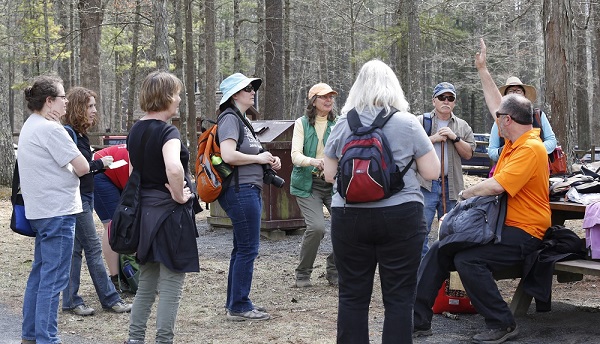
Sandy initiates Cohort V to the VA Adopt-a-Trail Project, March 2017, at Braley Pond.Photo by Deb Pugh, Cohort V.
Sandy Greene on Being Good Enough!
An appeal for Bird & Wildlife Trail site monitors for 2022
From the first project I took on at Headwaters Master Naturalists, I have been capitalizing on everyone else’s good energy and ideas: piggybacking on water monitoring projects, adding on to school field trips, grafting on to park plantings. This was our chapter project strategy in the beginning. My job was to establish our first chapter project list, write up the project proposals and hustle them. It wasn’t very well organized, but it was good enough!
In my first new project attempt, I tried to turn wildflower watching into a competitive tournament – not a big success. I also called off one year’s hikes because of an “iffy” weather forecast. It didn’t rain at all, and I had to hide out the whole day. Fortunately, Chip stepped up to do a fabulous job of our signature wildflower walks for years thereafter. And we sent lovely photographs and invitations of our wildflowers to elected officials and the media, sometimes even put up posters. Last year, our gamble on the Mothers Day Warblers and Wildflowers day for the public paid off. So, good enough!
Sandy with Ginny Hoffman, Cohort III, at the beginnings of the pollinator garden at Natural Chimneys, April 2015.
Then I tried a chapter project in support of dwindling monarch populations, and somehow we had four energetic teams of “Matty Nats” establishing pollinator waystations on public lands, and maintaining them for three years. We even had a bus tour to go visit all of them. They were fabulous, with original interpretive signs. Two of these waystations still exist. And many more pollinator gardens sprang up, including Harrisonburg’s Pollinator Trail, with HMN’s helping. Good enough!
Sometimes, projects had active HMN participation and the blessing of the Project Committee, but just needed a project description and coordinator name in order to fit into our website for recording those hours. I didn’t do anything except type and post on the website. But that was good enough.
When I began to do Outreach, I signed up to participate in all the local fairs and events, and created some crowd-friendly (I thought) displays. Were they all successful? Not so much. Like the fake scat display. The Do-It-Yourself Biodiversity display? I loved it! But not great in cooler weather or wind. The puppets? Too popular, as they somehow walked away, with the Identiflyer cards. That was mysterious. But still friendly and welcoming enough, with many wonderful HMN volunteers.
Finally, along came the request from VMN and the Virginia Department of Wildlife Resources (then Game and Inland Fisheries). Could we adopt our Bird and Wildlife Trails, and monitor them every quarter? All Master Naturalist Chapters were encouraged to do this, but we have three loops, and 26 sites. Maybe we could try one loop? The biggest one, North River, with 10 sites. A good enough start, with eager site volunteers, if we just had a coordinator name. Could I do just a good enough job? I would try.
Did I call monitors to remind them to go out to their sites? Nope, but I enjoyed every chat and e-mail from monitors, and kept lots of notes. Did I get my reports in exactly on time? No. But when I did send them, they were accurate and full of monitor details. Did I visit every site that monitors missed? Yes, but not right away. Did I learn how to use eBird? Yes, finally. Now I search eBird before I go out to visit sites, so I know what species to look for. Did I learn how to use iNaturalist? Yes, and I have sent one whole post. I learn so much when I explore the website. Good enough, but just barely.
And then along came Cheryl, who took on a second and a third loop of the Bird and Wildlife Trail, and who elevated our mission. She took wonderful photos and hustled new monitors. We strategized, joined the local bird clubs, met with the North River Ranger District staff. Suddenly, together, we could do a really good job.
Now we are undertaking the switch to direct, real-time monitor’s reports, as well as recruiting for a year at a time for each site. We talked on the phone this week about filling out the 26 initial CitSci forms before the spring quarter, calling and thanking each monitor, signing (or re-signing) up people for this year. We agreed to try to do a good enough job, but to be kind to ourselves and our monitors.
I hope these confessions give you the confidence to sign up as a monitor, or even to coordinate a loop. If you have worried that you wouldn’t be able to do a good enough job, or that other people must already know about eBird, or that you wouldn’t want to get stuck forever with a site, don’t fret. Just call! You are good enough, and we need your help!
– Sandy Greene, Cohort I, January 2022 540-487-1224 greenes104 [at] aol.com
Help plant chestnut seeds in a greenhouse at the Augusta Forestry Center in Crimora, any of Thursday, February 3- Saturday, February 5. Tom Saielli of the American Chestnut Foundation sends an appeal for volunteers here:
Hello Chestnut Enthusiasts (veterans and new folks alike)!
If anyone is interested and available, we are sowing ~2,000+ American and hybrid chestnut seeds in containers at our new greenhouse at the Augusta Forestry Center, Crimora, VA (directions below). We will be working over three days. –Potting seeds is rewarding work that anyone can do and enjoy.
Note: We will maintain all COVID safety protocols (masks, safe distance, and we ask that participants be fully vaccinated). The bulk of the work will be inside of an enclosed greenhouse.
Dates:
Thursday, February 3rd through Saturday, February 5th starting at 9:00 AM each day (although, if you can’t make it by 9:00, just come when you can).
The purpose:
The seeds represent the American Chestnut Foundation chapters and the Virginia Department of Forestry’s advanced backcrosses, used for seed orchards and research. This work allows us to advance breeding program goals in the region.
Directions:
Augusta Forestry Center 90 Forestry Center Lane Crimora, VA 24431
GPS: 38.171309, -78.853842
Head down the driveway and take the first left, then cut back on the gravel road to your right, you’ll see the greenhouse next to a big warehouse.
Don’t forget to bring water, lunch & snacks. Dress for the weather and bring work gloves if you prefer.
That’s it. Hope to see many of you there!
Please let me know if you plan to make it.
Thanks!
Tom
Thomas McNeill Saielli Mid-Atlantic Regional Science Coordinator The American Chestnut Foundation 900 Natural Resources Dr Charlottesville, VA 22903 Tel: 828-450-9100
If you have any questions, please email or text Dave Forrer, who is the HMN liaison for this activity: 540-271-2539 or davidforrer07 [at] gmail.com
Although the work will take place indoors, it might be chilly, so bring layers. And work gloves just in case. The work will be performed Thursday Feb. 3 through Saturday Feb. 5 starting at 9:00 each day. If you can’t get there at 9:00, just come when you can. They are happy to get any help, for any amount of time, during the day. They haven’t set a finish-time, so it’s probably not a good idea to show up at 4:00, expecting to work till 5:00 unless you call or text first. – Dave
Sign up in the HMN volunteer management system, Better Impact.
Update from Dave 2/2/2022: Contacts with the American Chestnut Foundation have informed me that this event is open to anyone. In other words, you can invite your friends and family! The work (planting chestnuts in containers) will be done indoors; however, it could be muddy around the greenhouse, so wear appropriate shoes. Covid precautions will be maintained; so only vaccinated people can participate. Also, please remember to bring a mask. And don’t forget water and a lunch (unless you’re only volunteering for part of a day).
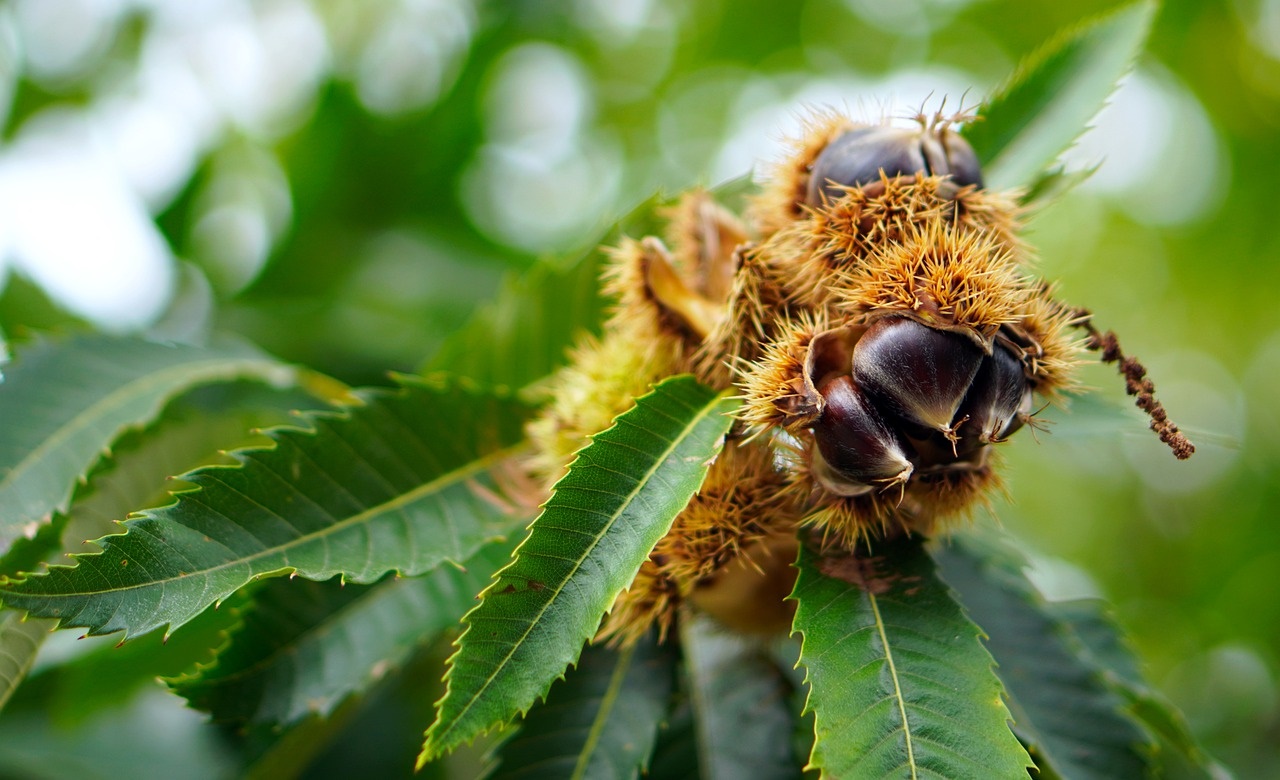
Photo at top is of chestnut leaves and seeds courtesy of Pixabay.com.