HMN Lisa Klein reports here on her May 1, 2021, garlic mustard pull along the Shenandoah Mountain Trail near the Confederate Breastworks in the George Washington National Forest:
There is a ton of garlic mustard up on Shenandoah Mountain. Lynn Cameron had seen a couple of patches, but by the time we went up to pull, there was a wide swath of the stuff in several places. There is quite a bit down by the restrooms and in the woods along the guard rail and parking lot. We pulled in two areas about a mile in.
We dragged out two black plastic trash bags of the stuff. I have heard from other master naturalists that there are places, like Reddish Knob, that are completely overrun by this invasive. I think that if we can get out on Shenandoah and really work at it, we can keep it from taking over. It will take multiple forays and more than just this year.
It was very satisfying to remove two patches of this troublesome plant. If any master naturalist has time, please consider doing some garlic mustard removal on Shenandoah. I will be advertising some additional volunteer group activities up there soon!
– Lisa Klein, Cohort VI,May 2021
Photos by Lisa
Photo at top above: Lisa’s friend, Ann, helping bag the garlic mustard. “We took out two bags full.“
The photo above shows a patch beforegarlic mustard removal… and the one below is afterremoval.
Spend Time with Mother Nature on Shenandoah Mountain
Friends of Shenandoah Mountain and Headwaters Master Naturalists are joining forces to encourage members of the public to discover the springtime treasures found on Shenandoah Mountain. Over past years, we’ve hosted Wildflower Walks on Shenandoah Mountain. This year, it will look a little different.
On Saturday, May 8 from 10AM to 2PM, three sites along the Virginia Department of Wildlife Resources’ Bird and Wildlife Trail will be prepared for visitors with nature experts and activities to help them explore these areas.
Virginia Bird and Wildlife Trail Sites Visit as many of these sites as you like:
Hone Quarry – Meet at Picnic Area, walk along native trout stream, view birds and wildflowers, tadpoles, hemlock forest, wheelchair accessible (more info and directions). Watch for potholes in paved Forest Service access road.
Braley Pond – Meet at Picnic Area, take 1/2 mile hike around beautiful pond, view birds, wildflowers, salamanders and tadpoles (more info and directions)
Shenandoah Mountain Crest on Rt. 250 – Scenic view of Highland County, walking tour of Confederate Breast Works with interpretive signs, birds, history of Ramseys Draft Wilderness and Shenandoah Mountain (more info and directions)
More information about this event on the Friends of Shenandoah Mountain website HERE.
From Sandy Greene who has been helping to organize this event:
“As COVID vaccinations increase and restrictions begin to be lifted, Headwaters Chapter is planning a socially distanced twist on the previous successful Wildflower Walks on Shenandoah Mountain, with thanks to Chip for organizing those in partnership with Friends of Shenandoah Mountain for so many years. We are also blending our monitoring commitment to the Bird and Wildlife Trails, by featuring three sites that have restroom and parking capacity: Hone Quarry, Braley Pond, and Shenandoah Mountain at the Confederate Breastworks.
Public visitors will be encouraged to explore on their own, supported by a team of four volunteers at each site. (These teams include a “Greeter/Coordinator,” “Scout,” “Kid Activator” and “Expert.”) Volunteers come first from current Bird and Wildlife Trail monitors, and other Master Naturalists with ties to these sites and loops, as well as US Forest Service Biologists, who have also participated in Wildflower Walks in the past. These teams have already come together, but we welcome HMN participants and visitors. We will be keeping lists of wildflowers and birds, especially warblers, and will encourage the posting of those sightings and photographs to eBird and iNaturalist.”
Greeter/Coordinators:
Braley Pond: Sandy Greene
Hone Quarry: Cheryl Shull
Shenandoah Mountain: Lynn Cameron
HMNs who do not have active volunteer roles in this event are still welcome and encouraged to come by these sites to participate and/or lend a hand to make this a fun and rewarding experience for everyone attending! No registration needed!
This event has been approved for up to 1.5 hours of CE credit for HMNs who attend. Note: Log CE hours for this activity into “Continuing Education activity” and not “VOL: Warblers & Wildflowers.”
The Spotted Lantern Fly (SLF) is the latest in a long list of non-native insects that are making their way through Virginia. Introduced into Eastern Pennsylvania from Asia, the Spotted Lantern Fly has moved easily into western PA and south into Maryland and Virginia. Most recently, small populations have been found locally in Shenandoah and Augusta Counties. SLF has the potential to become a serious pest causing damage to fruit trees and gardens of all types.
Virginia Cooperative Extension has been operating a volunteer trapping program for the SLF to determine how this pest is spreading through the state. Headwaters Chapter participated in this project last year with one trap location in Rockingham and one in Augusta. We would like to increase the number of traps placed in both counties this year and would really appreciate more volunteers. The primary requirement is having access to a Tree of Heaven that is greater than 5” in diameter. You need to check the traps periodically and enter your data in an app, loaded on to your phone or home computer, provided by the VA Cooperative Extension.
Learn more about this latest insect introduction by signing up for and watching the Webinar: Update on the Spotted Lanternfly in Virginia. It airs Tuesday, March 30, 2021and lasts an hour from 1:00-2:00 EST. Virginia Working Landscapes has created this 1 hour presentation with Q & A for the last 15 min of the program. This webinar qualifies for 1 CE credit. (Scroll down to find a recording of this webinar.)
If you are interested in signing up and/or have more questions, contact Chris Bowlen chris.bowlen [at] gmail.com. 540-289-6801.
– Chris Bowlen
More about the Spotted Lanternfly from the Virginia Cooperative Extension HERE.
Click on the image above to find the archived webinar presented live on March 30, 2021 by Kyle Rhodes of the VA Dept of Agriculture and Consumer Services, hosted by Virginia Working Landscapes.
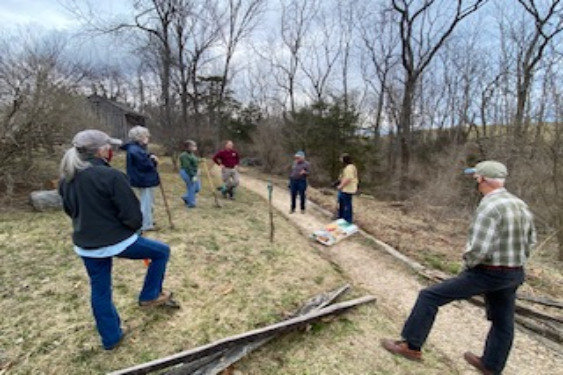
HMNs Peggy Plass, Cyane Lowden, Ann Murray, Tom Engle, and Sandy Greene, with Caroline Fitzgerald, Student Society of American Forester’s representative, Forester Charlie Huppuch, and Extension Forester Adam Downing. We planted 50 native trees along the Marl Creek Trail on 3/12/2021. Photo by Sandy Greene.
Planting trees and maintaining the Marl Creek Trail at McCormick Farm (Shenandoah Valley Agriculture Research and Extension Center) in Raphine, has been an annual project since our chapter began. Working with Retired USFS Forester (and the trail’s designer) Charlie Huppuch, we are restoring many native trees, shrubs, and perennial species to the riparian buffer trail. Last year, our chapter also contributed to the fund to replace the interpretive signs, which were over 15 years old and sun-damaged. The new signs are really beautiful, and tell the stories of riparian ecology and stream health.
The 2/3 mile Marl Creek Trail is free and open to the public every day. Beginning at the historic mill and passing by the millpond and along the stream, it is popular with birders, hikers, and travelers. Come walk it yourself!
Directions Take the Raphine – Steele’s Tavern exit off I-81 on the border between Augusta and Rockbridge Counties. It’s less than a mile to McCormick Farm, with plenty of parking and restrooms open in the log cabin from April to October. During Covid, the museum and mill are only open by appointment, but you are still welcome to walk around them.
On Saturday, February 20, several HMNers were treated to a Zoom introduction to the CoCoRaHS organization by the Augusta/Rockingham coordinator, Tommy Le Beau. Despite a slight snag at the beginning (this was Elaine’s first time as Zoom host) it was an enjoyable presentation. Karen Milne, Peggy Plass, and John Bauman Zoomed in. Jean Stephens had internet issues and so wasn’t able to stay.
Tommy is passionate about the weather and it certainly showed. He says about himself: “I have been interested in meteorology since I was 11. In 2015 I volunteered with CoCoRaHS. Then, in 2016 I joined Skywarn as a weather spotter and the American Meteorological Society in 2018. In 2019 I became the CoCoRaHS County Coordinator for Augusta County.”
CoCoRaHS (Community Collaborative Rain, Hail, & Snow Network) is a grassroots volunteer network of backyard weather observers of all ages and backgrounds working together to measure and map precipitation (rain, hail, and snow) in their local communities. Their work is vitally important, especially considering the impacts of climate change. Volunteers across the country take and report daily measurements, using the 4-inch, high capacity gauge available through the CoCoRaHS website.
A dense network of volunteers is needed, and that is why Tommy came to us. Rockingham County only has a few volunteers, so any HMNers who want to join would be welcome!This is an approved citizen science project, and the training (including the hour Zoom introduction, Meeting # 83694296549, Password 620160) counts as continuing education. There are also webinars available through CoCoRaHS.
The data collected by volunteers is used by numerous agencies, including the National Weather Service, USDA, NOAA, farmers, and planners. Tommy pointed out that reporting zeros can be extremely important. Data collection only takes a few minutes a day and is preferably done in the morning. A commitment of at least one season is ideal.