Category: Projects

  • Skills Project News

    Skills Project News

    CeremonialTagging
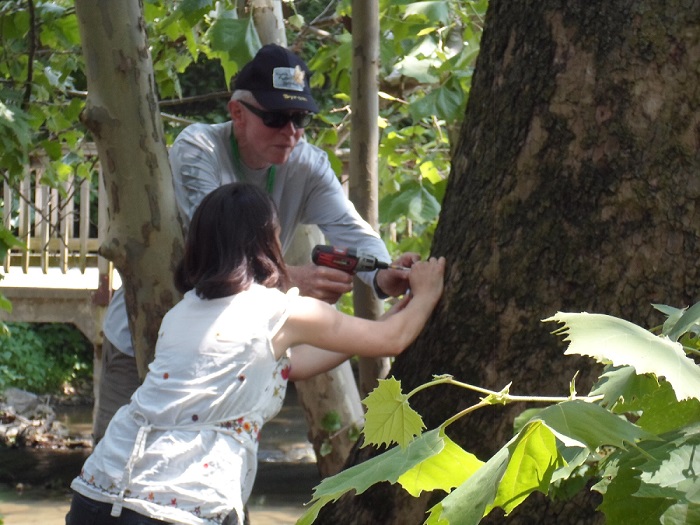
    Byron and Anna Maria’s ceremonial placing of an ID tag on a sycamore tree.

    On a hot afternoon in early June, the 2015 training class for the Headwaters Master Naturalist chapter celebrated both the end of their first semester of study and the completion of their Spring skills project with a reception at Cooks Creek Arboretum in Bridgewater, Virginia. The twelve members of this year’s training class had undertaken to identify the various species of trees found in the small but lovely park. Visitors to the Arboretum can now find identifying markers on exemplar trees representing every species found there.  Identifying markers were supplied by Plants Map, a Northern Virginia company which manufactures interactive plant tags for private gardens and public nature preserves such as Cooks Creek.

    PlantsTagTulipTree
    Tagged tulip tree along Cooks Creek.

    Visitors and fellow students looked on as training class members Byron Hukee and Anna Maria Johnson ceremonially attached the final marker to the towering American Sycamore which grows on the banks of Cooks Creek near the entrance to the park.  Guests were then treated to tea and spectacular ginger scones (baked by Training Class coordinator Roxanna Theiss), and guided walks through the park to view the markers and the many interesting plants which reside there.  Each marker contains a QR code, which links to the Plants Map site, and provides information about the species of tree and about the park itself (including GPS coordinates of the labeled plants).  In addition to tagging the trees in the Arboretum, the class also installed a marker for the Pollinator Garden found there—part of this year’s Monarchs and More! focus project designed to encourage the provision and protection of habitat for Monarchs and other Virginia pollinators.

    Finduson PlantsMap.150Chapter members and friends are encouraged to make a visit to see the work of the 2015 class and enjoy this gem of a park in Bridgewater!

    Peggy Plass, 2015 Basic Training Class

  • Cooks Creek Arboretum on Plants Map

    Cooks Creek Arboretum on Plants Map

    Sample Plants Map tag. Click here for the Cooks Creek Arboretum Plants Map website.
    Sample Plants Map tag. Click here for the HMN Cooks Creek Arboretum Plants Map website.

    This spring, the Trainee Class has been busy with their project to identify the tree species and create and install labels for them within Cooks Creek Arboretum.  The Arboretum is approximately 8.84 acres and part of the Bridgewater town park system.  Chapter members may be familiar with it because it is also a location of one of the Pollinator Waystations.  Planted trees, a walking path, Cooks Creek, wetlands, and a variety of birds and wildlife make this park a pleasant destination for a walk, picnic and wildlife observation.

    It is the goal of the trainees to provide accurate on-site tree identification and information about these resources to educate and inform the public who utilize this area.  Under the guidance of Adam Downing, Senior Extension Agent with the Virginia Cooperative Finduson PlantsMap.150Extension office, the trainees are identifying major tree species and will be installing signage from Plants Map (plantsmaps.com), a Virginia based company.  Besides name identification, the signs include digital QR codes that lead the user to more information about the species and GPS based identification online.  As the Tree ID Team shared, ”Our hope is that visitors will appreciate knowing what trees they are looking at and something about each of them.”

    The trainees are working with the town of Bridgewater to ensure all stakeholders are involved and excited about the project specifically and to enhance the education and recreation value of this location more broadly. This project has given the class experience in creating project proposals, tree identification, outreach to partners, understanding risk management, and most importantly, working as a team.

    Please join us on June 11, 2015, at Cooks Creek Arboretum when we install the final labels and celebrate a great first term.

    Lacey Dean, Brian Lux, Byron Hukee, Bill Sprinkel, Kathy Byers, 2015 Basic Training Class

    In the spring of 2015, the Virginia Master Naturalist (VMN) state program arranged with Plants Map to produce tags with the VMN logo in place of the Plants Map logo. “…we thought this would be a great way to market our program while providing some great educational resources to the community.” – Alycia Crall, Virginia Master Naturalist Program Coordinator. Bill Sprinkel contributed to an article about this for VMN’s July 2015 eNewletter, The Pollinator: Linking Up with PlantsMap.

    Thanks to Carl Droms for providing these photos!


    The Bridgewater Current covered this project, along with the Pollinator Waystation installed by HMN at the Cooks Creek Arboretum, in their July 2015 issue here. Thanks to Elaine for finding this and sending it in!

  • Living the Frog Life at the Wildlife Center

    Living the Frog Life at the Wildlife Center

    This was written by HMN and Wildlife Center of Virginia (WCV) Front-Desk Coordinator Kate Guenther and published on the Wildlife Center’s website on May 8, 2015. It is reprinted here with Kate’s permission. The WCV pond was part of our Headwaters Master Naturalists’ 2013/2014 Focus Project, coordinated by Kate, to create wildlife habitat around the Wildlife Center. This article demonstrates our success!

    KFtadpoles2015After we installed the pond in front of the Wildlife Center last year, new neighbors are moving in! Varieties of frogs are checking the place out, and some are definitely calling 1800 South Delphine “home.”

    In recent weeks, more than 100 tadpoles have been seen sunning themselves in the warm afternoon waters of the pond’s edge. Who are the parents? It’s hard to say because a Green Frog, a Pickerel Frog, and a Gray Treefrog have all been seen in the vicinity! And, earlier this spring, director of outreach Amanda rescued an American Toad out of Maggie the Peregrine Falcon’s enclosure and relocated it to the front garden, before Maggie could claim it as a snack.

    Fish and frogs in this pond are an essential component of the ecosystem for keeping the mosquito population in check and for controlling the algae that develops in the pond.

    The Wildlife Center does not frequently admit amphibian patients. Since 2011, we have admitted 25 frogs and toads as patients:

    Green frog in our pond.

    • 10 American Toads, Anaxyrus americanus
    • 4 Bullfrogs, Lithobates catesbeianus
    • 8 Green Frogs, Lithobates clamitans
    • 2 Gray Treefrogs, Hyla versicolor
    • 1 California Treefrog, Pseudacris cadaverina

    These patients have come to us for a variety of reasons, including dog and cat attacks, lawn mower encounters, entrapment in pools, and other unknown causes.

    If you are interested in learning more about frogs and toads, the Virginia Department of Game and Inland Fisheries puts out a wonderful booklet and CD set to help you identify frogs by sight and by their nighttime calls. Identifying frogs by their calls is easier than identifying birds calls because 1) there are far fewer species to be familiar with and 2) the calls are very unique.  Also, visual and auditory identification is available through the Virginia Herpetological Society’s website.

    KFgray treefrog (3)If you have frogs in your area and want to help scientists learn more about these fascinating species, you can do citizen science volunteering through a couple of different frog programs: FrogWatch USA or the North American Amphibian Monitoring Protocol.

    I started volunteering with FrogWatch this year. I have a marsh in front of my house, so I can report what I’m hearing by monitoring twice a week for five minutes. Of the 11 species that are in this part of the state, I’ve already heard four this spring!

    Take your passion for nature deeper by participating in citizen science — let your inner scientist emerge!

    –Kate
    Front-desk coordinator

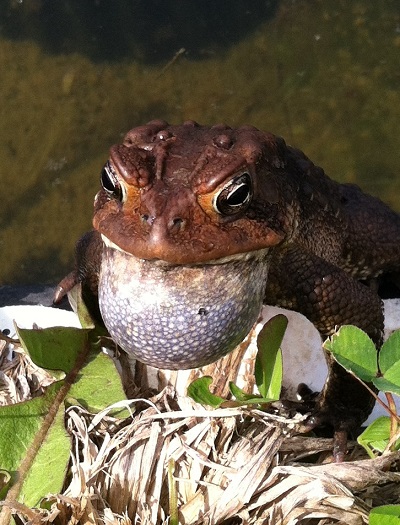
    american toad.400This handsome American toad was photographed by HMN Frank Deckert at the Springdale Water Gardens last May 2014. Both Frank and Springdale Water Gardens were instrumental in building the WCV pond as part of HMN’s 2013/14 Focus Project.


    Photos of the HMN Wildlife Gardens at WCV in May 2015 taken by Kate and Adrie:

  • Wildflower Walks Appreciation

    Wildflower Walks Appreciation

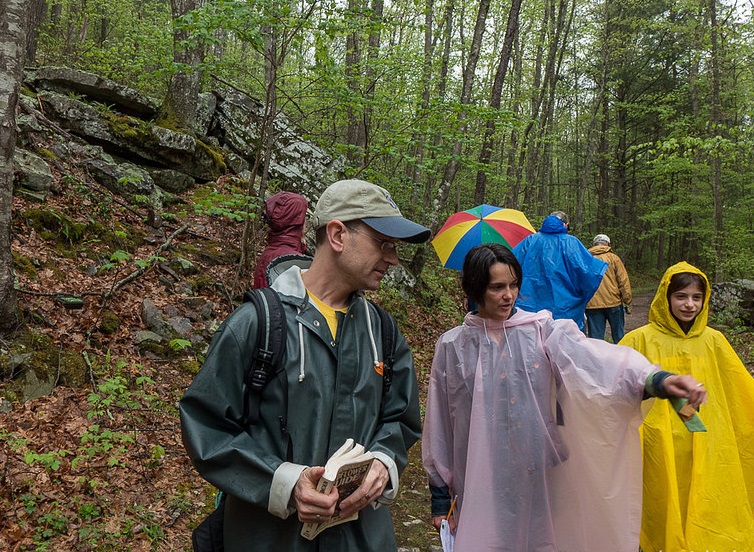
    Thanks to all the volunteers and participants who braved the cool and wet weather to join us on Shenandoah Mountain for our Wildflower Walks 2015!

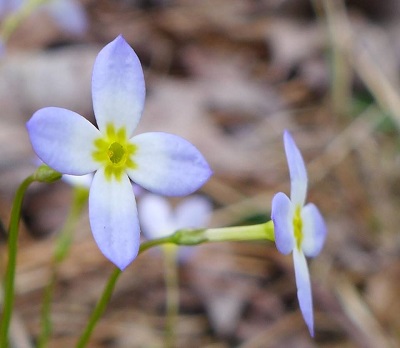
    Bluets Photo by Frank Doherty
    Bluets on Wolf Ridge Trail
    Photo by Frank Doherty

    Over 40 people registered and just under 40 appeared at the scheduled time and trails on Saturday, April 25.

    We’ve made a tally and lists of the wildflowers (and other plants) found at each of the four walk sites. Find it here:
    2015 Plant Biodiversity Dash Lists

    North River Gorge: 45 species
    Wolf Ridge Trail: 47 species
    Braley Pond: 41 species
    Hone Quarry participants came up with a very comprehensive list of 101 species!

    Thanks to all those who have been posting their lovely photos to our facebook photo album and Flickr group page!

    View some of the day’s photos on facebook HERE and Flickr HERE.

    See photo sharing options here.

    Save the date: Shenandoah Mountain Wildflower Walks 2016 will take place on Saturday, April 30, 2016.


  • Wildflower Walks and Diversity Dash 2015

    Wildflower Walks and Diversity Dash 2015

    wildflowers.april2015.ws

    Two walks at 10 AM, two walks at 1 PM …. free!

    Find one perfect for you and sign up to attend HERE!

    Experience first hand some of the incredible biodiversity Shenandoah Mountain has to offer!