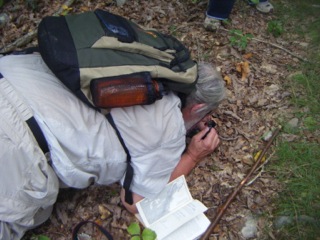
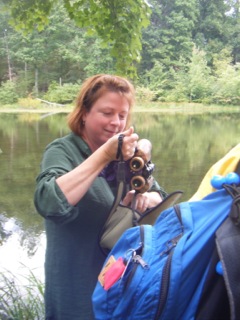
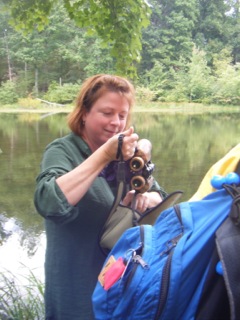
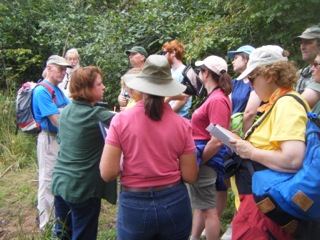
We had a dozen happy explorers at Maple Flats on Sunday afternoon, September 7, including two new guests and two family members of a Master Naturalist. We had our dragonfly experience at the first false pond, and hiked past the second one (nearly dry at this time). Edie Kretsch introduced us to dragonfly behaviors and sounds, and we saw several species of the 55 possible ones that live there. (Some of them live nowhere else!) Several females were laying eggs in the water, there was a mating pair that nearly crashed into us. Lovely pale blue, deep red, clear-winged and golden dragonflies and several different damselflies. Edie used an iPad to help with identification and close ups.
Eric Jones led a relaxed and informative hike, focusing on the fall flora around us, along with some history and lore of the sinkhole ponds. This was a great refresher on tree identification, fall wildflowers, and some ancient plants – lichens and fungi. Eric also showed us some of the natural sinkhole ponds, and gave us more detailed directions for getting to Green Pond and Spring Pond, deeper into the forest. Bikes would be great for this! The variety of ponds and species found in them, their seasonal fluctuations and life cycles would make for endless observation and exploration. Since so much research has been done on these, some understanding of this area might help us if we were to work on the ponds behind Grottoes for a focus project.
Tom and Jenna Benzing (Janet James’ family) were frog magnets – finding at least four different species, another aspect of the sinkhole ponds.
This trip was an important entree into the areas of the George Washington/Jefferson National Forest along the Coal Road, and we Master Naturalists gained some confidence about more exploring there!
The Headwaters Chapter of the Virginia Master Naturalists is inviting the public to join them in exploring the special sinkhole pond ecology of the Maple Flats Ponds in the George Washington/Jefferson National Forest near Stuarts Draft on Sunday afternoon, September 7 from 2:00 – 4:00 PM.
Home to rare and endangered plants and animals, these Shenandoah Valley sinkhole ponds are at least 15,000 years old, dating from the end of the Pleistocene epoch.
Asclepias tuberosa, butterfly weed
We’ll have two educational experience stations with some easy hiking in between by which to gently explore this unique geological and ecological treasure:
Plant life and history with Dr. Eric Jones,
Botanist and Ecologist from Mary Baldwin College, Headwaters Master Naturalist, and author of the online resource: Wildflowers of Augusta County, VA.
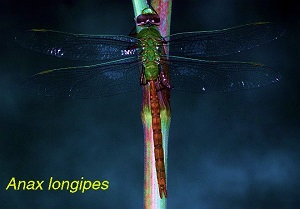
This dragonfly is only found in 3 places in Virginia, one of them is Maple Flats.
Dragonflies 101 with Edie Kretsch,
Entomologist and Master Naturalist, formerly at Douthat State Park, and now with the Virginia Department of Game and Inland Fisheries.
An introduction to dragonfly natural history and behavior, identification and monitoring. Maple Flats sinkhole ponds are home to 55 species of Odonata dragonflies and damselflies, many rare and endangered.
Bring binoculars if you have them!
The Maple Flats Ponds are about 45 miles from Harrisonburg, 25 miles from Staunton and 12 miles from downtown Waynesboro. Click on the image at left to find Google map directions to Maple Flats Ponds. You will access the Ponds from Forest Road 42, the Coal Road. You’ll see a semi-circular parking area on the right marked with big boulders. If that’s full, go ¼ mile further to the next parking pullout.
Parking is limited … please consider carpooling. You may meet at 1:30 at the Park & Ride at Shenandoah Village on Rt. 340, Waynesboro exit.
A light rain won’t cancel this event.
Event coordinator and contact: Sandy Greene: 540-487-1224, greenes104[at]aol[dot]com
Virginia Master Naturalists can earn two hours continuing education credit at this event!
Sign up through VMN VMS or give Sandy a call if you plan to attend. … Or use the contact form below. Any of these options will constitute “registration” or “signing up” for this event. 🙂
Although a bit south of the targeted area of observation, I have enjoyed participating in the Cricket Crawl for the past three years and have received nice feedback from the projects’ collectors to whom I sent data. I learned of the Cricket Crawl through our Headwaters chapter, where it is an official volunteer project!
The purpose of the project is to conduct a cricket and katydid census by recording the calls that observers hear within a one-minute interval on a specified August night. This citizen science project achieves area wide monitoring and records annual night insect behavior over time and in various regional habitats.
Participants learn the calls of eight target crickets and katydids species. The project website, provides pictures of these insects and fun downloadable sound clips for learning their calls.
After time spent learning the calls, it is counting time! On the specified August night, this year, August 22, observers take out their flash lights, stop watches and notepads to record which of the eight target species they heard calling during a one minute time frame. They then send in their collected data by telephone, email or website.
This year I heard the Field Cricket, Japanese Burrowing Cricket, Jumping Bush Cricket, Fork-tailed Katydid and Oblong-winged Katydid. I missed hearing my favorite caller this year, the Greater Angelwing, which makes a sound like a rapidly bouncing ball.
Excitement builds each year near the count date as the Cricket Crawl organizers send emails with details on how to record and transmit the count data. The project has a fun Facebook page (https://www.facebook.com/CricketCrawlDCBaltimore) with lots of great cricket and katydid photographs all year as well as images from the organized cricket count events that occur in Northern Virginia during August.
Participants are later provided with results of the data. This year 550 observations were received!
I recommend the Cricket Crawl as an engaging and simple volunteer project. It has been great fun to be able to recognize cricket and katydid calls on summer nights and it was satisfying to volunteer in the annual cricket census. My mother helped me record while visiting one year and we both enjoyed this easy naturalist activity that can be done in one’s own backyard with minimal training and supplies already on hand.
– Stephanie Gardner, August 2014
A couple of added notes from Stephanie should you have trouble distinguishing the different cricket calls: I’ve had to move a few times from the spot where I had planned to listen to another spot where the individual calls were more distinguishable. In the field behind my house, they all blended into one big sound!
Another thing that happened was that the Cricket Crawl project site said that people with older ears may not be able to hear some of the katydid species due to their pitch. The year that Mom helped me, she was not able to hear all the katydid calls. We still had a great time though.
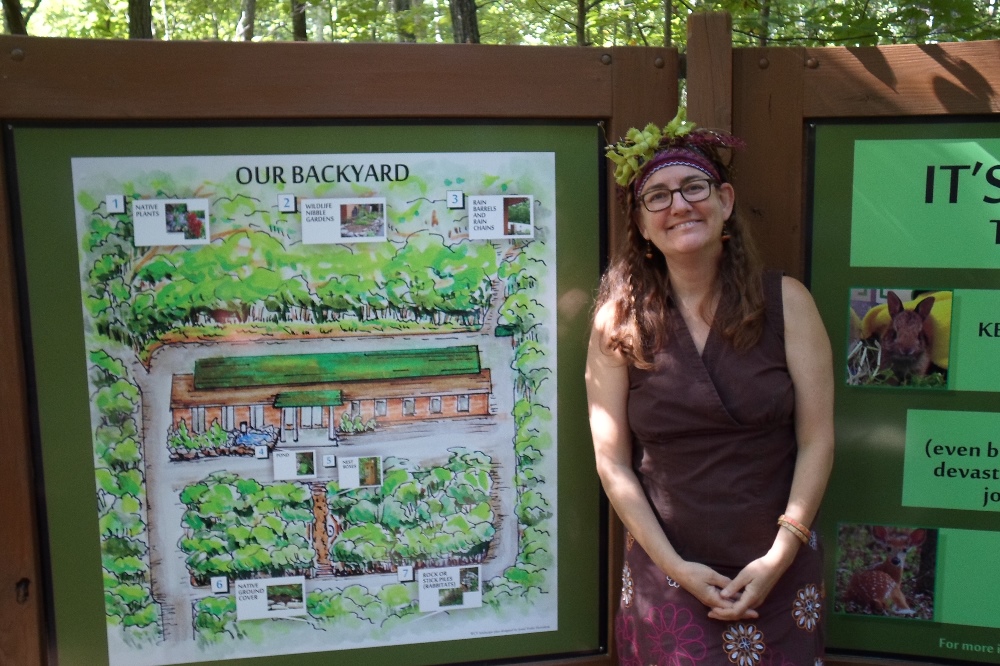
On Saturday, August 16, the Headwaters Master Naturalists (HMN) celebrated the culmination of a year’s efforts in transforming landscaping around the Wildlife Center of Virginia into wildlife-friendly habitat … including informative signage and demonstration nest boxes on the path leading to this nationally renowned wildlife hospital in Waynesboro.
The Wildlife Habitat Garden ribbon cutting event was attended by the many volunteers involved in this project and Boy Scout Troop 30 of the Stonewall Jackson Area Council which donated and installed a new American flag for the Center’s flagpole.
HMN and Wildlife Center Front Desk Coordinator Kate Guenther master minded and oversaw the many details of this first annual 2013/2014 Focus Project for the Headwaters Chapter. Chapter focus projects strive to use the broad array of member talents in a cohesive year long effort that ultimately meets the Master Naturalists’ goal of helping to conserve Virginia natural resources.
From Kate:
Over the course of a year, 32 of us made this project happen. Thank you to all those who gave of their time, supplies, money and expertise. Financially, the Wildlife Center contributed $1581, HMN chapter contributed $200, donors contributed $3320. The total value of the project was $5100.
Click above for the virtual tour by Kate and Sandy!
Ribbon cutting guests were treated to Kate’s outdoor presentation on What the Wildlife Eat. The Wildlife Center patients’ diets are supplemented with plants gathered from the surrounding woods, as described here for the fawns, and they now have the additional possibility of getting herbs planted for them in the raised beds of the new gardens.
HMN Sandy Greene had the honors of cutting the hospital gauze ribbon stretched across the path leading to the hospital while Frank Deckert masterfully emceed, honoring all of the individuals involved.This was followed by the flag ceremony with the boy scouts raising up a new flag onto the Gardens’ flagpole. Wildlife Center Outreach Coordinator Raina Krasner led an interested group around the Center’s compound to meet its many wildlife ambassadors.
Inside the Center, guests enjoyed a hardy spread of food and drink organized by Sandy.
Click here for more on Certified Wildlife Habitats.
Virginia Tech’s Department of Horticulture offers detailed information about Backyard Wildlife Habitats as published by the Virginia Cooperative Extension.
Next years’ Focus Project will be organized around efforts to plant milkweed and other plants supportive of the imperiled Monarchs!
See below for photos of the August 16, 2014, Wildlife Habitat dedication event. Thanks to Josie Kinkade for her camera work! Find a year’s worth of project progress photos through Smug Mug here.
Gretchen,RoxAnna, Jewel and Pat in the food room.
Kate’s talk.
VMN Program Coordinator Alycia Crall!
Sandy cuts the ribbon!
Frank presents the Tiara.
Frank honors Kate with honored with a tiara and wand.
Scouts hoist up the new flag.
New signage was collaboartive effort. Artwork by Jewel Hertzler!
Raina gives us a tour of the Center’s animal ambassadors.
Members of the Headwaters Chapter are involved with three different water monitoring projects, each using different methods and organizational collaborations, but with the common goal of protecting our area water resources. Headwaters Chapter Adviser and Fisheries Biologist Paul Bugas and the Virginia Department of Game and Inland Fisheries play supportive roles in all these efforts.
“Pretty stunning that so many Headwaters Master Naturalists have taken over routes for the Friends of the Shenandoah River water monitoring. Twice a month, for the past 20 years, volunteers take water samples from every tributary on the Shenandoah, which are then taken on ice by volunteer couriers to the lab (Department of Environmental Quality approved) at Shenandoah University.
RoxAnna takes samples from six sites around the Dayton/ Bridgewater area, Judy Tammi = Middle River and Moffett Creek, Sue Eckroth is Mill Creek, Cub Run, and Naked Creek. Ginny Hoffman has North River in three different spots. They are joining 20+ local volunteers from above Waynesboro all the way down the watershed, to assess multiple variables, including several types of nitrogen, phosphorus, turbidity, temperature, dissolved oxygen, and local conditions.
Data like this can identify successes or problems in land use practices, and help guide decisions for better Shenandoah stewardship.” – Sandy Greene
Online benthic monitoring training from VA Save Our Streams
Whit Morriss, chair of the Riparian Stewardship Committee of the Friends of the Middle River, coordinates a three times yearly benthic monitoring program spanning nine sites along the Middle River in Augusta County. Following protocols developed by Virginia Save Our Streams, each monitoring event involves collecting a sample of a site’s aquatic macroinvertebrates for identifying and counting. Plugging the numbers into a scorecard allows the results to be turned into a single number from 0 to 12 with the higher numbers reflecting an overall healthier aquatic environment.
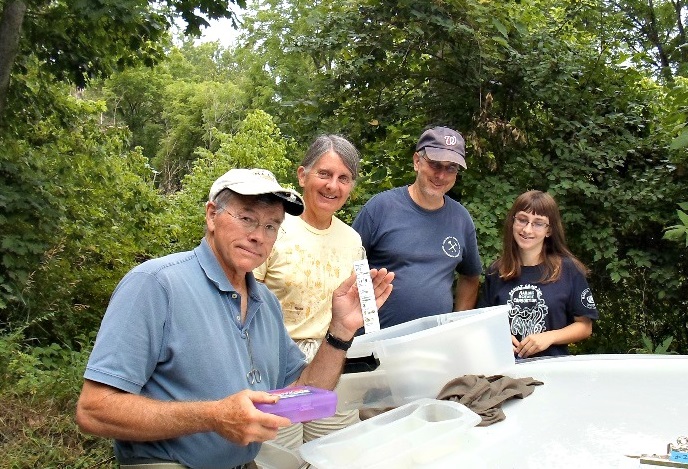
See the photo gallery below for a look at a typical benthic monitoring event, as worked by HMN volunteers Ann Murray and Adrie on July 20, 2014. This site sampling at Cline Lane, off Laurel Hill Rd. near Verona, saw high numbers of common netspinning caddisfly larvae which are fairly tolerant of water quality impairment. The final scoring tallied an 8 out of 12, considered a “gray zone,” meaning the “ecological condition cannot be determined at this time.” Click here for a scoring history of this site.
The most recent water monitoring efforts in our area are being organized by Trout Unlimited in response to the potential for the development of unconventional shale gas resources in our surrounding forests. Based on similar programs in Pennsylvania, which has seen the extensive use of hydraulic fracturing techniques to extract natural gas, this program hopes to establish baseline data and ensure continuous monitoring for changes should gas drilling expand into this part of Virginia.
With all day training sessions held in Harrisonburg on March 22, 2014, and in Charlottesville on June 21, 2014, HMN volunteers Sue Eckroth and Adrie joined other Master Naturalists and interested citizens in attending one of these sessions. Instructed in the methods and equipped with the tools to perform monthly evaluations of local streams at risk from the growing gas industry, Sue and Adrie are working on finding suitable sites in the Rawley Springs area to monitor for turbidity, conductivity, pH, and barium and strontium, among other parameters.
From the July 20, 2014, benthic monitoring of a Middle River site on Cline Lane with Friends of the Middle River:
Ann and Whit preparing the field table.
Sampling containers ready for sorting the aquatic critters.
Whit and Kaylee collecting our sample. Chris watches the timer.
 We had a dozen happy explorers at Maple Flats on Sunday afternoon, September 7, including two new guests and two family members of a Master Naturalist. We had our dragonfly experience at the first false pond, and hiked past the second one (nearly dry at this time). Edie Kretsch introduced us to dragonfly behaviors and sounds, and we saw several species of the 55 possible ones that live there. (Some of them live nowhere else!) Several females were laying eggs in the water, there was a mating pair that nearly crashed into us. Lovely pale blue, deep red, clear-winged and golden dragonflies and several different damselflies. Edie used an iPad to help with identification and close ups.