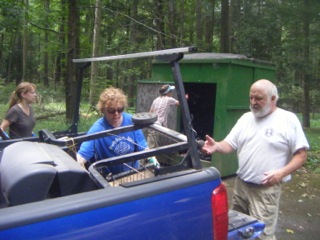
Headwaters’ second cleanup in the George Washington National Forest was again a huge success. Several members – Adrie, Sandy, Gretchen, Ann, Judy, RoxAnna, and Tom – met at Todd Lake about 8:30 a.m. on July 14. Rangers had provided large trash bags and the weather was splendid for outside work and activities.
There are about a dozen “dispersed campsites” located along the Forest Service road between Elkhorn Lake and the Camp Todd historical site. Although these campsites have no tables, toilets, or other facilities, they get frequent use during spring, summer, and fall. Several campsites are actually a network of multiple camping areas located along the stream that flows into North River and eventually into the South Fork of the Shenandoah River. We also picked up trash along several miles of road between Elkhorn and Camp Todd.
A unique find of the day: grass-haired guy.
Since we had conducted a cleanup of the same area during the summer of 2013, our band hoped for a light trash run. However, rangers had assured us that heavy use of the area guaranteed us plenty to do – unfortunately the rangers were right. If anything, we collected more trash than last year, filling a pickup with huge contractor bags of cans, bottles, propane cylinders, broken camp equipment, children’s toys, and much more. Among the large items that didn’t fit in bags were a homemade porta-potty and a gutted gas grill.
After depositing the trash in the Forest Service dumpster at Todd Lake, we enjoyed lunch at the almost deserted picnic area and talked about upcoming events and environmental issues facing the Central Valley. Also discussed was how best to convey a message of “pack-it-in, pack-it-out” and good stewardship to the folks that use the treasure we know as the George Washington National Forest. Because of the obvious need to keep the area and our waterways clean, the board agreed with the Volunteer Service Projects Committee that this cleanup will be an annual event.
– Tom Long, July 2014
A gutted gas grill was among the truck full of trash.Gretchen and Adrie enjoy a tailgate ride from Tom.
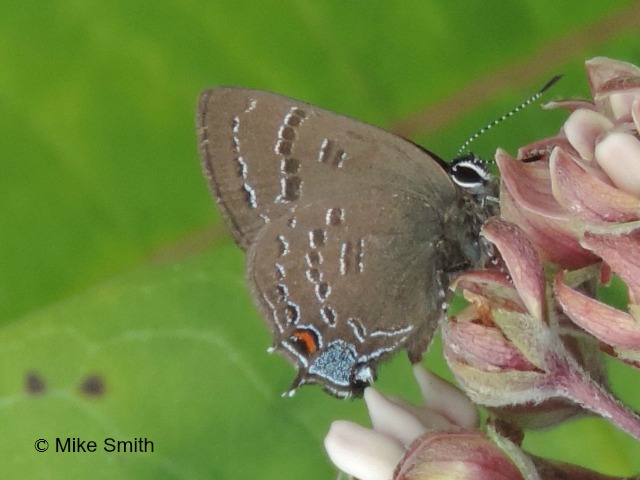
Banded hairstreak on milkweed seen on the Island Ford count July 5.
Imagine you are a butterfly. You love the hottest days with the most humidity so your wings can be warmed as you spend your days looking to mate before you forever fly away. Butterfly Counters have to contend with those hot humid days to see the most butterflies. And as cool morning air changes to sunny hot, the number of butterflies you will see suddenly increases.
The North American Butterfly Association sponsors an annual July 4 Butterfly Count. Locally, it has been administered by Mike Smith of Elkton. He compiles all the group totals and reports the results to the Association. Mike is a member of the Rockingham Bird Club and he and other Bird Club members make up the core of volunteers who participate. Also this year, three members of the Headwaters Master Naturalists, Chris Bowlen, Betty Forrest and Jerry Hopkins, joined the Counters on July 5 to enjoy the heat and humidity for the 15th annual Rockingham County – Island Ford area Butterfly Count. Then on July 13, a Shenandoah National Park Butterfly Count was done with Betty Gatewood joining Betty Forrest and Jerry Hopkins to represent Headwaters.
The July 4 Butterfly Count is similar to the annual, and perhaps better known, Christmas Bird Count. While the actual counting of species may not be exactly July 4 or on Christmas Day, it is as close to the date as weekends, weather or schedules allow.
The Island Ford count on July 5 started at 8:30 am on a cool day with the temperature below 70 degrees, which is the ideal minimum temperature that butterflies become most active. As the butterflies were not as active at this temperature, this part of the count is where you walk into the fields and use the “kick-up” method of getting those butterflies that may be on grasses or flowers to start to fly. You aren’t actually kicking any butterfly, you are just walking through the field, and your activity of moving the vegetation causes them to fly. The day had 100% sun with a low temperature of 63 and a high of 83.
So, what are the results? The Island Ford Count had 36 different species of butterflies and 727 individual butterflies.
The Shenandoah National Park Count encompasses an area with a 15 mile radius. There were many groups participating in such a large area and not all groups have finalized and reported their count. But this day was a ‘butterfly day.’ It was so hot and humid that it took two hands to push open your car door to cut through the humidity. Final numbers should be good.
Do you really need extensive experience in identifying butterflies to participate in the count? No experience needed! Mike pairs you with an experienced group and you quickly get to know those smaller butterflies that favor the grasses and the larger ones that are seeking the nectar of bigger and taller plants. If you are new, you become amazed at how quickly you begin to see butterflies that before you probably never ever noticed. Participants in the Christmas Bird Count experience this same type of learning curve.
For the first year, there were no monarch butterflies spotted on the Island Ford count.
Mike has participated in the count for 15 years and will say that the numbers of individual butterflies are down considerably from years past. Why? Habitat loss, liberal use of pesticides, insecticides and herbicides all play a part in the lower numbers. For the first year, there were no Monarch butterflies spotted on the Island Ford Count.
Would you like to learn more about butterflies and participate in next year’s count? Just mark your calendar for July 4 and view the Master Naturalists’ Calendar of Events. You will really enjoy it and learn more of nature.
With team workdays this spring and lots of individual efforts, the Headwaters Chapter Wildlife Center of Virginia‘s Wildlife Garden project has lots to show and is attracting attention from people and wildlife alike. The perennial garden, raised bed wildlife food “micro-farm” and lush corner pond with a trickling waterfall are all installed and doing their thing. Here is the latest update from project coordinator Kate Guenther:
Gray tree frog in pond wall.
“Build it, and they will come.” The first to arrive were the frogs. Very loud gray tree frogs have taken up residence around the pond. So has a pickerel frog. We’re up to 10 frogs total now! Unbelievable!
A mouse was scared out of the raised rock bed when Kate watered the garden.
A single morel-looking mushroom is growing in the garden—a surprise!
Then, after a notorious, long, spring, baby-season day, Dr. Kristin Britton and a student decided to call it quits at 11pm. The Wildlife Center has one of those building alarms that allows 45 seconds for the last person to get out of the building or the alarm goes off, calls the police and contacts the President, Ed Clark, at home. Many live in fear of setting off the alarm. As Dr. Kristin exited the main door with the alarm beeping down to blast off , she looked to her right and not 15 feet away stood a black bear getting a drink out of our new pond.
Pond in late May 2014.
“I didn’t know which was worse, confronting a bear face to face or setting off the alarm,” Kristin said. “In a split second, I decided the bear was less intimidating than the alarm. So, we yelled and clapped and now I know I can scare off a bear!” After that incident, Ed and Kate crafted an emergency plan should the local bears decide to do more than drink out of our pond, and somehow tear our pond liner with sharp claws.
Bear risks aside, everyone seems to be enjoying the new pond and critters.
We are entering the last phase of this project before the Saturday August 16 morning ribbon-cutting ceremony to which you are all invited. We still have to finish the signage. Sandy and her team of designers and artists are working with WCV staff to create 3 large metal signs that describe the Center and its mission, what we have done with the habitat in this project and what citizens can do to create wildlife habitat on their own properties.
If you have not yet been involved in this project and you want to join in on the fun, there still is time! Contact Kate at goatherderkate[at]yahoo.com, 540-350-2824.
Pickerel frog on our pond wall.Click on the image to find a short video of Angel releasing the first goldfish in mid-June.
Find complete photo documentation of this 2013/2014 HMN Focus Project by Kate on the Virginia Master Naturalist’s Smug Mug site here.
For the past year and a half, several Headwaters Master Naturalists have been participating in the eMammal project. Conducted by the Smithsonian Institution’s Conservation Biology Institute (CBI) in Front Royal, the eMammal Project aims to produce the same kind of database of mammal movements and behavior that exists for birds, thanks to the efforts of millions of bird-watchers. Since you can’t very successfully go “mammal-watching,” something else has to be done. That something else is cameras.
Wildlife cameras with motion- and heat-sensors are placed at predetermined locations for three weeks at a time. Each time an animal is detected, the camera takes 10 pictures in 20 seconds; if the animal is still there, it takes another 10 pictures, and so on. The heat sensor is there to prevent the camera from photographing leaves swaying in the wind.
When the three weeks are up, the volunteer retrieves the cameras, switches out the memory cards and batteries, and moves the cameras to the next location. Each “location” is really three sites: one right on a trail, one 50 meters off the trail and the third 200 meters off the trail. The locations are determined by the lead investigators, who give us the GPS coordinates. Of course, they choose the locations by looking at maps, which do not show the vegetation—I often wished for a machete, especially trying to get to those 200-meter locations!
Carl locking camera in place.
Once the cameras are in their new positions, we take the now-full memory cards home, where a computer program supplied by the CBI analyzes the time-stamps on the pictures and organizes them into groups, each likely to represent a single contact. Our job is to examine each group, and try to decide what the animal is. Trust me, it’s not always easy…. (see below for an example.)
Bobcats are frequently “trapped” by eMammal cameras in our area.
For the first two rounds, in the Spring and Fall of 2013, each of us had 4 locations. Chip Brown’s and mine were on a Nature Conservancy-owned trail that begins on Route 39 at the Dan Ingalls Overlook on Warm Springs Mountain. Jerry Hopkins and Kate Guenther had locations on the continuation of that trail south of Rt. 39. In the Fall, Chip and I found ourselves in the area of Pitt Spring on Cub Run Rd. (on the eastern slope of Massanutten).
After the second round had ended, we were all invited to the Conservation Biology Institute in Front Royal for a “debriefing” and a tour of their captive-breeding operation. The data from the project are still being analyzed, and after a hiatus this Spring, the project will continue in the Fall, this time with the focus partially on more urban settings.
Between getting out into the woods every three weeks, and getting off-trail to boot, and looking at the sometimes thousands of pictures of everything from small birds to bobcats and bears, I personally found it to be a very enjoyable experience. – Carl Droms, HMN Cohort II
Check out the eMammal blogsite here and facebook page here.
Some images from the cameras prove challenging to identify what triggered them. Can you find the culprit in the photo below?
Escaped from a nearby cemetery, wavyleaf basketgrass (WLBG) has slowly been creeping into the understory of the Shenandoah National Park near Elkton since around 2005. Headwaters Master Naturalist and Virginia Native Plant Society member Chris Bowlen has led a removal effort for the last three years.
On June 23, Master Naturalists Betty Forrest and Jerry Hopkins joined Chris and I and our friend Bea Woody for a couple of hours of crawling among multiflora rose and poison ivy on the forest floor to pull up wavyleaf basketgrass. After being bagged and hauled out of the forest, it went straight to a county waste station to be incinerated.
Once WLBG sets seeds in August, it is easily spread by mammals walking through it. The sticky seeds adhere tightly to fur and fabric. The grass removal is most effective before seeds appear.
Alycia Crall, the VMN state coordinator, organized a webinar on this new invasive species which streamed live in early May 2014. Providing information about the nature of invasive species, and the recent history and properties of WLBG, master naturalists may earn an hour of continuing education credit for watching this presentation by Kevin Heffernan, Stewardship Biologist with the Virginia Natural Heritage Program and Vanessa Beauchamp, a biology professor at Towson University in Maryland. Access the webinar here.
Towson University School of Emerging Technologies has launched a citizen science project for mapping wavyleaf through a smart phone app. More about this here.
If you’d like to help with future removal efforts, contact Chris Bowlen.– Adrie Voors
Wavyleaf growing on the SNP forest floor, June 2014.Chris points out our park section for wavyleaf removal to Betty.From Vanessa Beauchamp’s portion of the WLBG webinar: areas of Maryland and Virginia where WLBG has been identified. In VA, these areas interestingly follow the Appalachian Trail.