Category: Projects

  • VDGIF Birding & Wildlife Trail Loops up for Adoption

    VDGIF Birding & Wildlife Trail Loops up for Adoption

    VABWT
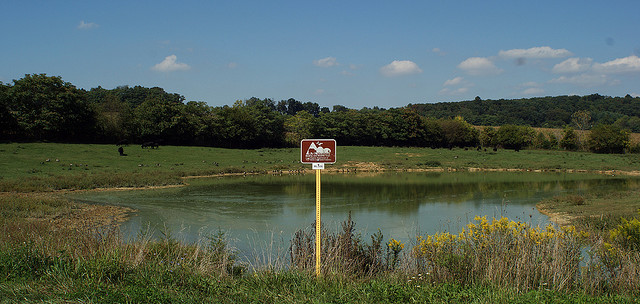
    Virginia Birding and Wildlife Trail sign at Leonard’s Pond by Stephen Little,
    Flickr Creative Commons, CC BY 2.0.

    The Virginia Department of Game and Inland Fisheries is looking for help from VA Master Naturalists to update information on the 637 sites along the 65 loops of the Virginia Birding and Wildlife Trail. Established over the span of several years from 1999-2004, this is a driving trail with stops in areas known to offer choice habitat conducive to viewing diverse wildlife. VMN Chapters are being asked to “adopt” loops of the trail within their service areas.

    Maintaining inviting wildlife viewing sites in Virginia serves to enhance the public’s access, awareness, knowledge, and ultimately appreciation and value of some our state’s less developed areas to help protect these natural resources.

    VDGIF Watchable Wildlife Biologist Jessica Ruthenberg wrote about the adoption project in the fall issue of VMN’s newsletter, The Pollinator, here. She is the contact person in DGIF for VMN chapters adopting portions of the trail.

    Adopting a “trail” entails such tasks as monitoring the condition of the signage; communicating with the site owners about amount of usage and recommendations for bringing more visitors to their site; and seasonally monitoring for wildlife, entering sightings into eBird and DGIF’s Wildlife Mapping programs. DGIF is now using iNaturalist.org to collect all Wildlife Mapping data. It is free and open to the public.

    Within Rockingham and Augusta Counties lie three loops of the trail system with a total of 27 sites. The three loops are named Lost Shoe, North River and Forest Trails. Scroll down for a Google map with these loops and sites.

    There are 10 sites along the Lost Shoe Loop:
    (note: due to VDGIF website updates, these links are no longer accurate)

    There are 10 sites along the North River Loop:

    And the Forest Trails Loop has 7 sites:

    Our chapter has been involved with a number of the sites listed. Choosing certain sites is not an option. The request is to adopt one or more complete loops. According to Jessica Ruthenberg this project can help acquaint chapter members with places near them but with which they are not yet familiar.

    To encourage the Headwaters Chapter to adopt all three loops in our area, Jessica suggests a modified wildlife monitoring schedule for us where we could visit the sites of one loop per season. This way, over a three year time span, each site would be visited at least once during each of the four seasons.

    VDGIF plans to offer a training webinar for loop-adopters in March 2016 with hopes that work improving the sites’ information can get started soon after.

    Adopt-A-Trail, Phase 1, Project Proposal by Jessica Ruthenburg and Brian Boyer is here. The Phase 1 checklist for each site is here.

    A key determination for a chapter to adopt a trail is to identify an individual willing be serve as project coordinator. For this project Jessica tells us that, “This person will coordinate everything on your end, such as the sign-up process for who in your chapter is visiting which site, creating a schedule, tracking project progress, compiling data sheets, etc. This person will also be my liaison and point-of-contact- with your chapter.”

    More generally the HMN Project Committee has been working on a generic job description for project coordinators that could apply to all current and future projects:

    The coordinator’s main role is to keep the project current, active and membership aware of it.

    Specifically:

    • Keep VMN VMS listing for project updated. This requires understanding what the project is all about and HMN’s role in the project, acquiring some administrative privileges to the VMN VMS site through the Project Committee Chair, and possibly some VMN VMS editing instructions.
    • Be the contact person about this project for chapter members.
    • Create/add events for this project to VMN VMS calendar.
    • Notify membership of this project’s events and/or needs through email, newsletter, membership meetings, and/or phone calls to ensure event/project gets participation.
    • Coordinate with agency/organization representative(s) as needed.
    • See that our obligations for the project are being fulfilled and/or revise expectations as needed.

    Any takers for a coordinator for Headwaters to Adopt-A-Trail(s) -? Contact Project Committee Chair Sandy Greene: greenes104 [at] aol.com

    – Adrie Voors, Cohort II, December 2015

    Thanks to Carl Droms for creating this map of all the sites for our consideration:

  • Fall Skills Project

    Fall Skills Project

    Byron.Elaine.BRC
    Byron and Elaine hosting the Native Wildflowers table for Nature in a Nutshell.

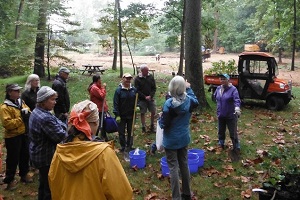
    On Tuesday, October 13 the cohort of 2015 held its culminating skills activity, “Nature in a Nutshell” at Bridgewater Retirement Community (BRC). Headwaters Master Naturalist members, trainees and residents at BRC considered the event a big success.

    Trainees had worked as a group to develop, organize and implement an afternoon activity for the residents at BRC. Class members combined personal interests and talents together with recently learned HMN skills to offer a fun afternoon of nature exploration and interaction.

    Stations open to guests included: Fall Colors, Native Wildflowers, Flood Events in Bridgewater, VA, and Birds of Our Area. The display boards and hands-on activities drew residents into the stations and the interactions began. Residents were encouraged to share their memories and knowledge, and share they did! Some of the residents had been in the area during some historic flood events and shared their experiences. Many of our guests enjoyed sharing their knowledge of wildflowers and birds. Another guest shared titles of some of her favorite books about nature. They included:
    What Has Nature Ever Done for Us? By Tony Juniper
    Seeds of Hope by Jane Goodall
    Blue Gold by Maude Barlow and Tony Clark

    A few short days after the event, the trainees reviewed its successes and areas that might have been improved upon. The group agreed that flexibility and communication as a team played an important role in the process. While we may have “advertised” a bit more and increased the number of attendees, the small group and one-on-one interactions were seen as very rewarding. Ginny and Brian were praised for their sense of fun in wearing life jackets as they shared information about local flood events. What a great reminder to not take ourselves too seriously!

    Cohort 2015 thanks all of our supporting naturalists and our class leader, RoxAnna Theiss for helping with the event.
    – Kathy Byers, Training Class 2015

  • JMU Arboretum Stream Project Update

    JMU Arboretum Stream Project Update

    HMNs gather for instructions on September 22 at the arboretum.
    HMNs gather for instructions on September 22 at the arboretum.

    We are fortunate to be involved in the stream restoration/storm water management project at the Edith J. Carrier Arboretum at JMU.  Over 20 Headwaters Master Naturalists plus some other volunteers from the community and Eastern Mennonite University planted over 200 shrubs and trees over two days, September 22 and September 24.

    Though the ground and soils were often difficult to dig, volunteers worked in teams of two and three to shovel and scoop until the holes were big enough to accommodate the potted plants. At the same time, contractors planted sedge plugs along the newly restored stream banks.

    Native varieties of plants were used when possible and included elderberry, river birch, winterberry, azalea, dogwood, oak, rhododendron, hazelnut, redbud, and spicebush.

    The project combines two important needs for the Arboretum and James Madison University: restoring the stream and managing storm water.  By restoring the stream and adding wetland cells to the flat areas along the stream banks where water can slow down and drop sediment, JMU meets storm water runoff and requirements set forth by state and federal regulations. The project is funded by JMU and several grants some of which require volunteers to provide support for the project.

    Restoring the upper part of the stream  from the “Sycamore Flats”  area to the bridge at the east end of the pond, is phase one of the project.  Restoration and improvements to the pond and down stream from the pond will continue in the coming months and years.

    Arboretum stream on October 2, three days after flooding.
    Arboretum stream on October 2, three days after flooding.

    Post-Flooding Update

    The September 29th rain event significantly impacted the upper stream restoration project and flooded the woods, valley and pond area. By some records, the Arboretum and surrounding areas received over three inches of rain, the majority of which fell in about an hour and a half during the late afternoon from 3:30 – 5 pm. While many of the sedge plugs remained in place, many of the shrubs and trees did not have enough time to root into the heavy clay and rock ground where we planted them and washed away with the flood water. Since then, some have been recovered and are now waiting to be replanted.

    Work Day: Friday, October 23

    We will continue our support of this project from 8:30-12:30 on October 23rd. Currently the work involves planting bare root and tubeling trees and shrubs so there will be less digging and more planting.  The day might also include replanting any remaining trees and shrubs salvaged from the flood event.  Please sign up on the Event Calendar of the VMN-VMS website.

    – Chip Brown, Cohort II, October 3, 2015

  • 2015 Focus Project Celebrated with “Migration” Tour

    2015 Focus Project Celebrated with “Migration” Tour

    monarchonNewYorkIronweedatPurcell
    Monarch on New York ironweed along Sieberts Creek in Purcell Park. Photo credit Trey Jarrels, Harrisonburg Stream Health Coordinator

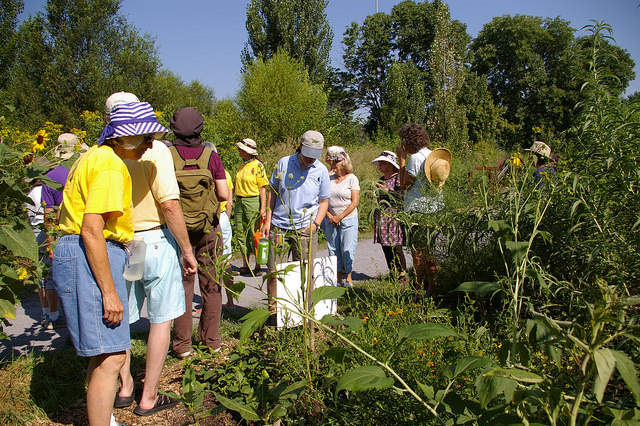
    Headwaters Master Naturalists celebrated the success of our 2015 Monarchs & More! Chapter Focus Project on Saturday, August 15th. It was a beautiful day for HMN chapter members to join area pollinators in the gardens that we created across Rockingham and Augusta counties.

    The Migration Tour was a time of showing and viewing our five chapter pollinator sites. Some members met at the Augusta County Government Center in Verona to take the tour by bus. Other members joined us at individual gardens and for a lunchtime meeting at Natural Chimneys Regional Park. We had a wonderful lunch organized by Ann Murray, with help from Jerry Hopkins and Gretchen Achenbach, and then voted on chapter bylaws updates.

    Early in the morning the group viewed the pollinator garden in Purcell Park in Harrisonburg. The garden at Cooks Creek Arboretum in Bridgewater was next on the tour. After lunch, we stopped by the garden at Natural Chimneys in Mt. Solon. Then, the bus took us to the Frontier Culture Museum in Staunton. The pollinator garden at Project Grows in Verona was our last stop.

    Each garden on the tour offered a beautiful and successful pollinator environment based on its individualized setting.  We spotted many Monarchs while on the tour. It was a great day in the gardens for both pollinators and humans!  Special thank yous go to Sandy Greene for arranging the Monarchs and More Migration Tour and to all those who presented the gardens that they helped create!

    by Stephanie Gardner, August 2015

  • Frog Habitat Day

    Frog Habitat Day

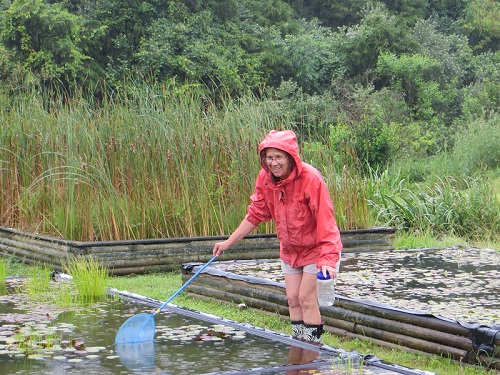
    Judy at Frog Habitat Day. Photo credit: Peggy Plass.
    Judy Tammi at Frog Habitat Day. Photo credit: Peggy Plass.

    On Saturday, July 11, 2015, seven members of the Headwaters Master Naturalist group attended the Frog Habitat Day at Springdale Water Gardens in Greenville, VA. In spite of a rainy start to the day, HMN volunteers had a great time assisting at the event — talking with attendees about dragonflies and tadpoles, identifying plants, and searching for macroinvertebrates using a D-net in the stream. Visitors were able to participate in the hands-on events facilitated by the HMN volunteers at multiple stations throughout the grounds.

    Carol Heiser of the Department of Game and Inland Fisheries co-hosted the event along with Springdale Water Gardens proprietor Keith Folsom.

    The gardens are beautiful, and well worth a drive to Greenville for chapter members who were unable to attend the Frog Day!  – Peggy Plass, CoHort IV

    Photos by Sandy Greene except as noted.

    As listed on the Springdale Water Gardens website:

    Special Program! Building a Water Garden for Frogs, July 11, 9:30 to Noon

    Installing a home water feature is a great way to provide much needed habitat for frogs, salamanders and other aquatic wildlife, if you provide all the “right” ingredients these creatures need. Carol Heiser, Habitat Education Coordinator and Education Section Manager of the VA Department of Game and Inland Fisheries, will give a short presentation at Springdale about frogs and aquatic habitats, as part of the DGIF “Virginia is For Frogs” campaign (http://www.dgif.virginia.gov/wildlife/virginia-is-for-frogs/) Then Carol and Master Naturalist volunteers will take you on a walk around the grounds to point out habitat features and look for evidence of frogs and other aquatic species. The field experience will be followed by a demo of a new frog pond installation, with practical tips and other information about effective water features for wildlife habitat.

    Wetland Walk and Frog Pond Talk, August 8, 9:30 to 11:30AM

    We’re doing an abbreviated version of our Frog Pond Day since we had so much rain that day. Enjoy a walk in the wetland habitat, looking for anything that we can stir up. Birds, flowers, reptiles, and amphibians live in this unique environment. We will look for whatever we can find. Bring shoes that can get wet. I’ll provide dip nets for this family-friendly exploration event. Come scoop around and learn about the water creatures and the importance of protecting our wetland habitat. After our wetland walk, we’ll go up to the gardens to see the frog pond, built specifically for native species. A short program on its construction shows you how easy it is to make your own.