Category: Continuing Education

  • Rain = Mushrooms!

    Rain = Mushrooms!

    mushroomfieldtrip.es.9.23.18

    What’s all the rain good for?

    MUSHROOMS!

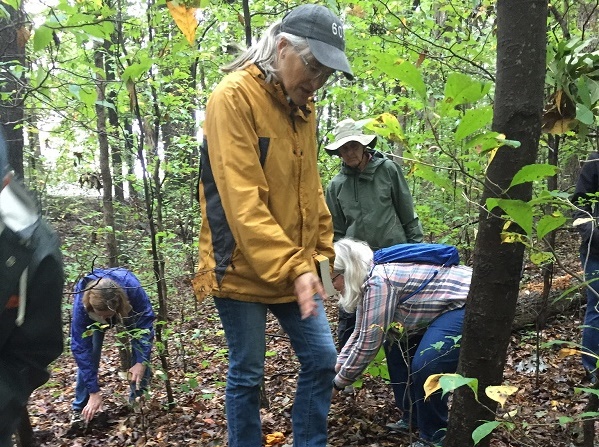
    This was made abundantly clear to fifteen Master Naturalists who met Peggy Plass at the Edith J. Carrier Arboretum at James Madison University on Sunday, September 23rd to walk, search for and learn about mushrooms. It was awesome! Peggy’s enthusiasm was infectious and soon people were traipsing off the trails on the hunt. People would call out, “Peggy!” and we would all take notice.

    We saw many very cool ‘shrooms like Jack O’ Lantern (Omphalotus olearius), which has bio-luminescence. Yes, that’s right! It glows in the dark! Another great find (and a new one for our fearless leader!) was the “stinky squid” (Pseudocolus fusiformis) which did, indeed smell like rotten seafood.

    People who attended: Allen and Shelley Baker, Derek Blyer, Chip Brown, Kathy Byers, Andrea Dono, Stephanie Gardner, Sue Gier, Kathleen Mahanes, Ben and Morgan Martindell, Kathy McKenzie, Ann Murray, Elizabeth Pass, and Elaine Smith.

    In addition to the mushrooms mentioned above, we found: giant puff balls, turkey tail, Coral mushroom, lion’s mane, wood ear (Auricularia auricula-judae), red polypore (Phlebia incarnata), death cap, red and green Russula, stinkhorn, elegant stinkhorn (Mutinus elegans), gem studded puffball (Lycoperdon perlatum), and bicolor bolete (Baorangia bicolor).

    The Continuing Ed Committee is going to make sure we schedule this field trip every fall!

    – Elaine Smith, Cohort IV, September 2018

    Top photo by Elaine Smith is of Peggy Plass pointing out a cluster of Jack O’Lantern mushrooms at the Edith J. Carrier Arboretum at JMU on September 23, 2018.

    Click on a photo below to see a slide show of the photos and find their captions.

    Find more photos from this trip in Elaine Smith’s Flickr album Mushroom Field Trip and Chip Brown’s Google photos album Mushroom Walk at Arboretum.

  • VMN Annual Conference and Training

    VMN Annual Conference and Training

    2018VMNConferenceHMNattendees.cb

    Nothing is better than gathering a hundred Master Naturalists for a weekend of field trips, skill building, and celebrating the biological diversity of the Commonwealth.  On September 7-9, in Fredericksburg, Virginia, the Virginia Master Naturalists held their annual conference and training. Six members of the Headwaters Chapter participated in at least part of the three day program that offered over 15 hours of continuing education. We enjoyed sessions on building interpretation skills, planning nature walks, and programs on trash in Virginia, bees, trees, and bats.

    Other highlights included:

    Program and field trip highlighting research and citizen science projects to document vernal pools in Virginia hosted by Anne Wright (Virginia Commonwealth University) and Susan Watson (Virginia Department of Game and Inland Fisheries).

    A session that provided a hundred “Green Thumb Gadgets and Apps, Websites, and Tech Tricks” from the creator/owner of plantsmaps.com, Bill Blevins. The Headwaters Chapter used Plantsmap to create tree tags for the Cooks Creek Arboretum as the Basic Training Class project in 2015 (www.plantsmap.com/organizations/23252/collections/23253).

    The keynote presentation at Saturday lunch included previewing “Hometown Habitat,” a documentary film about the growing movement to create habitat in yards and community spaces (themeadowproject.com/hometown-habitat/). Following the film, there was a panel discussion with Virginia Witmer (www.plantvirginianatives.org), Gem Bingol (www.pecva.org) , and Brent Husinger (www.brentsnativeplantings.com) who fielded questions from the audience on promoting native planting in Virginia.

    Michelle Prysby (Coordinator of the Virginia Master Naturalist) officially announced that the location of the 2019 VMN Annual Conference and Training will be held at Massanetta Springs Camp and Conference Center outside of Harrisonburg.  If you’d like to be a part of the planning and organizing committee, contact Chip Brown (cbrown2001 [at] gmail.com) and/or attend the October 10 informational meeting (see announcement in our October newsletter).

    – Chip Brown, Cohort II, Vice President, September 2018

    Top photo provided by Chip shows HMN state conference attendees (L to R) Chris Bowlen, Chip (kneeling), Pam Gray, Lincoln Gray, Kathy McKenzie, and Elizabeth Pass, in front of the HMN display board. 

  • HMNs Gather at Grand Caverns

    HMNs Gather at Grand Caverns

    GrandCaverns.pic

    Recap of July 22, 2018, Membership Summer Gathering

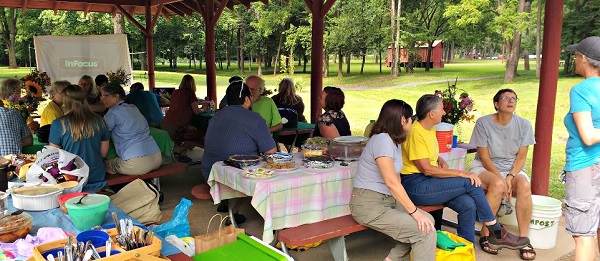
    What started out as an opportunity to gather as many Headwaters Master Naturalists as possible for a summer event, turned into a full day of community building, field trips and continuing education at Grand Caverns Park in Grottoes.

    Highlights from the day included:

    Board Meeting with reports regarding:

    • Upcoming continuing education opportunities
    • Purchase of a flash drive to continue to archive and preserve chapter documents
    • Requests for members to update their profiles on the VMN-VMS website and the members-only website accessible from the VMN-VMS homepage (squirrel photo)
    • Recent Outreach Committee meeting which started a renewed effort of “Inreach” to encourage participation and interaction between all HMN volunteers
    • Summary of midyear volunteer hours logged
    • HMN participation in Bat Monitoring, and subsequent approval by the board to purchase a second bat monitor (iPhone compatible)

    cavernspicnic.7.23.18.10

    Peggy Plass gathered volunteers together to show off a recently purchased bat monitor and discuss opportunities to participate in local and national bat monitoring programs. Contact Peggy for more information or to volunteer!

    cavernstalk2.pic.cb

    About 10 volunteers and their families and friends toured Grand Caverns while 20 volunteers listened to Joe Guthrie, Survey Coordinator for Virginia Working Landscapes (VWL). Joe gave a great overview of projects and opportunities for volunteering for VWL, which will soon have an expanded presence in Rockingham and Augusta Counties. Check out their website for more information and watch for announcements about upcoming volunteer opportunities.

    The day wrapped up with some great food and social time. Thanks to all the members who attended, provided food and drink, and helped organize and support the event.

    Save the afternoon of Sunday, October 21 for another opportunity to get together with Headwaters Master Naturalists. The program committee is working on an afternoon focused on raptor migration. Hope you’ll join us!

    – Chip Brown, Cohort II, Program Committee Chair

    Click on a photo below to see a slide show of the photos and find their captions. Photos taken by Adrie Voors except for the second photo above which is by Chip and the cavern photos below which are by Stephanie Gardner.

  • Ribbit!

    Ribbit!

    frogcall.augustawetlanda.5.4.18

    On the evening of Friday, May 4th a group of four Headwaters Master Naturalists and one guest journeyed to the Augusta Springs Wetlands Trail to try our ears at frog and toad call identification. Under the tutelage of HMN and Frogwatch Monitor Kate Guenther we listened to the recorded voices of the frogs and toads native to our area. Kate encouraged everyone to create their own description of what the call sounded like to them, sort of a word association game.

    We learned that frogs call most readily in their own “season”. The Wood Frog is the earliest, beginning sometimes as early as January and going until April. Spring Peepers begin in February and go until June, but may also call again as late as October.

    Then, after dark when the chorus really geared up, we headed out onto the trail to put our newfound knowledge to use. We first heard the “house of chicks” cacophony that is the song of thousands of Spring Peepers. We heard the “sustained trill” of the American Toad, the “vu, vu, vroom” of the American Bullfrog, the “gunk, gunk, gunk” of the Green Frog, and the “woodpecker call-like” sound of the Gray Treefrog. Sometimes what you always thought was a bird is actually a frog! We also observed crayfish, bats, and one snake, possibly a Queensnake, but we had our frog hats on so we weren’t sure.

    Who knew frogs and toads could be so fascinating? Their calls, their appearance and their homes are unique. Thanks for a great time Kate!

    – Allen Baker, Cohort V, May 2018

    Photo by Sandy Greene. Left to right are Shelley and Allen Baker, guest Jane Cox, and Kate.

  • Geology Field Trip in Shenandoah National Park

    Geology Field Trip in Shenandoah National Park

    geology.snp.4.12.18.mc

    Geology Field Trip in Shenandoah National Park
    April 12, 2018

    After being snowed out in December and postponed in early April, this field trip was finally held on Thursday, April 12. Malcolm Cameron led the trip with Jerry Hopkins attending.

    Malcolm gave an overview of geologic history of the Blue Ridge and Shenandoah National Park (SNP) area and then the pair headed south on Skyline Drive from Swift Run Gap. They stopped at Sandy Bottom Overlook to see mountain ridges with younger sedimentary rocks to the west and an outcrop of Pedlar formation granite, the oldest rock formation in SNP. Next they stopped at Loft Mountain Overlook and examined the Catoctin formation greenstone, formed by metamorphism from ancient lava flows. They spent time examining several interesting features of this rock by the parking lot. The rocks in the stone wall nearby contained skolithos, the only fossil found in SNP. Next they stopped at Rocky Top Overlook which has sedimentary layers from the Hampton-Harpers formation. Their final stop was Doyles River Overlook with a short hike on the AT to see the Weverton formation, metamorphosed sedimentary rock.

    Malcolm provided handouts with a general overview, a road log, and the basic geologic history and structure of the Blue Ridge and surrounding area. The handouts may be accessed here:

    – Malcolm Cameron, Cohort III, April 2018

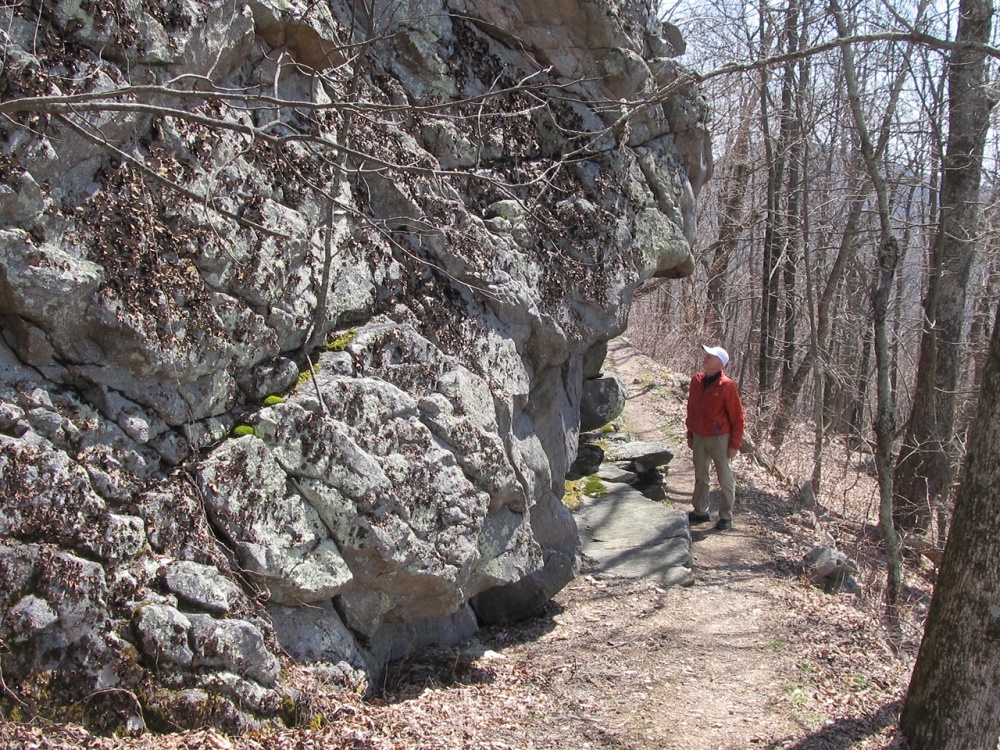
    Top photo shows Jerry checking out the metamorphosed sedimentary rock at the Weverton formation. Below he is at the Loft Mountain Overlook Catoctin formation greenstone. Photos by Malcolm.

    geology.snp.4.12.18.2.mc