On Sunday, September 24, nine HMNs met at Sandy Greene’s log cabin for an informative program on Leave No Trace principles. Guy deBrun, Assistant Director for Adventure and TEAM (Team Empowerment with Adventure for Madison) Programs at James Madison University’s UREC (University Recreation Center) was our presenter.
Leave No Trace is a set of principles we all should follow in order to minimize our impact on the wild places we visit. The seven principles are:
– Plan Ahead and Prepare
– Travel and Camp on Durable Surfaces
– Dispose of Waste Properly
– Leave What You Find
– Minimize Campfire Impacts
– Respect Wildlife
– Be Considerate of Other Visitors
After breaking us up into three groups of three, Guy gave each group two or three of the principles to illustrate in a short skit (complete with props!) We were given the choice of portraying people doing everything right, or ones doing everything wrong. Of course, all three groups chose to show their characters doing it all wrong! After each skit, Guy discussed the principles involved, and we were given the chance to ask questions and comment about them.
Amusing as they were, the skits served to reinforce the principles, even to a group of Master Naturalists who probably are (or should be!) more aware of them than the average person. All-in-all, it was an informative and useful program.
To learn more about Leave No Trace, visit the website https://lnt.org/
Thanks to Chip Brown for organizing this insightful presentation and Sandy Greene for providing the perfect venue.
– Carl Droms, Cohort II, September 2017
Top photo is of Guy with HMNs Peggy Plass, Dave Wendelken and Kathy McKenzie. Photos by Carl except where noted.
Kate, Chip and Carl work on the “Keep to Durable Surfaces” principle. Photo by Adrie Voors
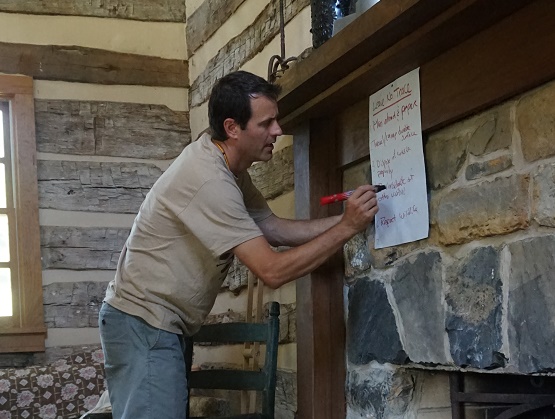
Guy deBrun listing the Principles of Leave No Trace
Even though I am still just getting my legs under me for this program, being in the most recent HMN Cohort and not yet even having all of my volunteer hours, I am glad I took the opportunity to attend the Conference. We had the wonderful advantage of the Conference being so close in proximity to us this year, right there in Front Royal, VA. Even though I didn’t stay overnight with most others, but rather drove the hour to and from each day, it was a time of adventure and education.
On the first evening, not only was the scenery at the 4-H campground very, well, scenic and gorgeous, but the rooms full of displays from other areas were fun to look at. We are made so different with so many different interests and, with that, it creates such a wide variety of opportunities. One area was focusing on purple martin housing, others had a lot of child education with nature artifacts, and one had even partaken in a mastodon excavation project…WHAT! There, of course, were a few of the cooperating departments and organizations as well that were engaging people and handing out fun literature and SWAG. There was the Department of Game and Inland Fisheries, Department of Environmental Quality, and the Virginia Native Plant Society, among others.
This first night was the awards ceremony and photo contest winners. Unfortunately nobody from Headwaters won in a photo category (don’t know how many from Headwaters had entered…it seems worth entering next year; they are continuously adding new categories), however, I am proud to say that our own Paul Bugas from DGIF won the Partner Chapter Advisor of the year. So yay! It was nice to begin to get to know other individuals from around the state and put names to faces as they were called up for awards. I must say that VMN president Michelle Prysby did a wonderful job presenting a multitude of information.
Now on to Saturday. It was a perfectly weathered morning and I was personally excited because my most anticipated field trip was coming close. Unfortunately I wasn’t able to get into any other field trip for this particular conference. (Future learning tip for myself and others for future conferences, I thought I had registered very soon in the early bird season and still all of the field trips were filled up! Luckily I was able to get a space on the wait-list for one, and even more luckily there was a spot to open up. So if, in the future, you want a lot of the fun, adventurous field trips, register ASAP!)
Now where was I…oh yes! Field trip, one and only, a tour of the Smithsonian Conservation Biology Institute. Being as passionate about endangered exotic wildlife as I am for our own backyards, I was in heaven. We got to see the breeding areas for their populations of cheetahs, Przewalski’s horses, mane wolves, scimitar-horned oryxes, Persian onagers, dama gazelles, and various birds. What most people don’t know about SCBI, however, is their focus on native plant and habitat studies as well! The tall-grass meadows and the native tree-relationship studies they have are amazing. They happened to point out the overlooked thought that, with most of the test plots having been planted within the past 7 years (including the trees), this very well may be a 100 year span scientific study. Talk about perseverance! We traveled by caravan of three vans to the different locations, one of which enabled us to find a bunch of monarch butterfly caterpillars picturesquely swaying on their stalks of milkweed. This area, which we learned covers 3200 acres was much more elevated than expected, but which offered some amazing scenic views.
Bear skull on bear skin. This bear was poached so is now used to teach about living with bears. Credit: Stephanie Gardner
We just barely got back to the 4-H camp for lunch (the food, by the way on the field trip was pleasantly varied and delicious.) After lunch, I had a seminar on black bears in Virginia and their management. The presenter, Seth Thompson, was a biologist from DGIF down in southwest Virginia. He spoke of biology, behavior, misconceptions, interactions with humans, and ways to coexist. Fun fact #1: Did you know that black bears can come in about 5-6 different colors including gold, auburn, and paisley? Nah, just kidding on the paisley 🙂 And fun fact #2: “the most dangerous animal is a mama bear” is not true! They typically tree their cubs then run a separate direction to lead away a predator or stand passively at the base. Still be wary around them, though. They are coming out with some innovative bear-resistant trash cans and other repellent systems to help us live in peace with the black bears in our area, especially since we have one of the highest populations in the entire state.
My second seminar was one I equally loved and have learned that I have a secret passion for (even if I haven’t yet had the opportunity to put it into practice.) The presenter, Megan Whatton from the Nature Conservancy, came to speak about a new backyard habitat survey system they are developing in cooperation with Cornell Lab of Ornithology, called “Habitat Network.” (Here’s a link to it to find out more or participate: https://www.nature.org/ourinitiatives/urgentissues/nature-in-cities/the-habitat-network.xml)
It is a citizen science movement to get individuals to make wildlife friendly backyard habitats and record it. I already have my own Pinterest page with a plethora of ideas, and it was fun to learn more and get inspired further. To see such peaceful birds, bees, frogs, reptiles, and butterflies right outside one’s window seems so relaxing.
After the seminars, we were on to a reception where I met some wonderful people from the Historic Rivers Chapter and the Peninsula Chapter, dinner, some door prizes (I won one!), and a keynote speaker. After that, sorry to say, I did not stay for the campfire and was not able to return for Sunday’s seminar, but boy was it a fun weekend! I hope that I have convinced others in the chapter to go to the conferences in coming years. We need a good HMN presence there to represent our area and our projects! If you have any more questions about the conference, feel free to email me at kmd_005 [at] yahoo.com.
– Kristina Oates, Cohort V, September 2017
Top photo by Stephanie Gardner of the view from the Northern Virginia 4-H Educational Center in Front Royal where the 2017 Virginia Master Naturalist Statewide Volunteer Conference and Training was held.
Bee hotels opened at Kate LeCroy’s presentation: Virginia Mason Bee Monitoring Project 2017: Current Findings and Future Directions. Photo by Stephanie Gardner
Seeing the bees at Kate LeCroy’s presentation: Virginia Mason Bee Monitoring Project 2017: Current Findings and Future Directions. Photo by Stephanie Gardner
Crown-beard, Verbesina occidentalis, aka stickweed, next to milkweed along a fenceline at the VMN Conference. Photo by Kristina Oates
Marion Lobstein at right along with Sally Anderson (not pictured) presented Overcoming the Fear of Flora: Learning to Use the Flora of Virginia at the VMN Conference. Photo by Elaine Smith
Leave No Trace Vision
To sustain healthy, vibrant natural lands for all people to enjoy, now and into the future. Every person who ventures outside puts leave no trace practices into action.
The organization that administers the Leave No Trace program is called the Leave No Trace Center for Outdoor Ethics.
Leave No Trace Mission
The Leave No Trace Center for Outdoor Ethics is a national, 501 (c) (3), nonprofit organization dedicated to protecting the environment by teaching people to enjoy it
responsibly.
About the Leave No Trace Center for Outdoor Ethics
The Leave No Trace Center accomplishes this mission through education, research, partnership and volunteerism. The Leave No Trace Center has delivered successful educational program in the United States and internationally since 1994. The Leave No Trace program is built upon the premise that conservation of our outdoor resources is possible only when people know how to respect them and prevent impacts from their activities.
Today, many trails have become human highways, wildlife are harassed and put down due to heavy human interaction, human-caused invasive species are strangling native flora, and trash clogs our waterways. At the Leave No Trace Center for Outdoor Ethics, we understand that if we neglect to protect our natural environment, fail to help our children appreciate and respect the relevance of our wild lands, and forgo practices that minimize our human impacts, we then risk allowing our behavior and attitudes to irreversibly change our world, destroying the magnificence of nature in the process. This is why Leave No Trace education is imperative. Leave No Trace Education provides a
foundation to build a nationwide outdoor ethic of critical importance.
What began as a calling to preserve the wilderness has evolved into an endeavor to inspire a more global, daily commitment to Leave No Trace. The environmental stewardship created by the Leave No Trace Center extends beyond outdoor enthusiasts to include anyone concerned about people’s relationship with nature. Join the movement. Enjoy your world. Leave No Trace.
Have some Naturalist Projects you are excited about?
Want to share the experience you had at the Virginia Master Naturalist Conference?
Join us for some business and some socializing:
Sunday afternoon, September 24th
At Sandy Greene’s Home Property:
123 Foxwood Lane, Mount Sidney
1:30 pm: Guy deBrun on Leave No Trace
2:30 pm: Committee and Project meetings. Contact Committee Chairs if you’d like to join a committee. Project coordinators, contact your volunteers and encourage them to join you for a check in!
3:30 pm: HMN Board Meeting
5:00 pm: Baked Potato Party! Bring a topping to share! Potatoes provided!
For questions, contact Chip at cbrown2001 [at] gmail.com
or 507-459-1839.
On the damp, dark and cloudy night of August 18, three carloads of Headwaters Master Naturalists and friends, including guests of the Camerons from Alaska, headed up Shenandoah Mountain to Reddish Knob with James Madison University’s Billy Flint to learn about terrestrial salamanders. We were especially looking for both Cow Knob and Shenandoah Mountain salamanders, two endangered species with a penchant for higher elevations and which are found nowhere else on earth. The rains of earlier that day made for perfect conditions to bring out these cute little carnivores.
We hit the jackpot and saw both rare species, especially over a dozen Cow Knob salamanders of various ages which had ventured out from beneath rocks and logs on a perfect night for them to feed. Billy Flint explained how they preferred rocky, north-facing slopes and moist conditions to keep them from drying out. Malcolm took the photo of the young Cow Knob salamander at right. It is one of the few of many taken by several of us that is in focus!
Wet weather will bring out up to 10% of the area’s population according to Billy. They take turns emerging from the ground to check out feeding opportunities. Like other terrestrial salamanders, the Cow Knob salamanders lay their eggs in the ground, nurture them there until they hatch and do not have an aquatic stage to their life cycle as do many other salamanders.
Preferring slightly drier conditions, we were fortunate to get to see a single Shenandoah Mountain salamander resting on a trail-side fern as spotted by Rachael Baczynski’s son Nick. These terrestrial salamanders also require selective habitats which are threatened by ongoing development and climate change.
The more common and also terrestrial Eastern Red-backed salamanders were in abundance this evening. The photo at left is of one found hanging out trail-side on some cohosh leaves. (Thanks to Shelley Henry for the plant ID!)
Billy suggested we drive slowly on the long road up and down the mountain to watch for snakes and frogs in the road. Sure enough on the way down, we found two copperhead snakes which had unfortunately been run over. One was a fair-sized adult and the other a juvenile with a fading sulfur-colored tail.
Many thanks to Billy for his fearless leadership and expertise; Malcolm for organizing the trip; Ann Murray for generously plying us with homemade cookies; Sandy Greene, Chip Brown and Rachael’s husband Mike for daring to drive the dark, narrow winding road up Reddish; and to all the other participants for making it a rewarding and fun night out!
– Malcolm Cameron, Cohort III with Adrie Voors, Cohort II, August 2017
Billy points out features of a male Cow Knob salamander.
Ann Murray hunting salamanders. Photo by Sandy Greene.
Volunteer Training Offered by the Virginia Department of Game and Inland Fisheries with assistance from the University of Virginia Department of Environmental Sciences
Thursday, August 17, 2017 • 9:30 am – 4:00 pm Massanetta Springs Conference Center and Lake Shenandoah
This workshop brings together members of multiple volunteer organizations who are willing to collaborate on education outreach to the general public about the importance of pollinators and healthy wildlife habitats.
WHO’S INVITED: This workshop is being offered to volunteers and other community leaders interested in learning about pollinators and pollinator habitat and who will also plan and conduct subsequent pollinator habitat programs for the general public, either at Lake Shenandoah in Rockingham County, or in their own local community.
Volunteers from many organizations are encouraged to register, such as the following:
Master Naturalists • Master Gardeners • DGIF Complementary Work Force (CWF) Volunteers • Tree Stewards • Virginia Native Plant Society • Beekeepers Association leaders • Izaak Walton League • Youth Leaders (e.g. 4H, Scouts, Boys and Girls Clubs) • Garden Club leaders • and other conservation and community service leaders
WORKSHOP CONTENT: The training will begin at the Massanetta Springs Conference Center with an overview about pollinators. Then we’ll caravan to Lake Shenandoah (about 5 minutes from the Center).
During the visit to the Lake, we’ll conduct several field investigations to observe and identify pollinators, collect bee specimens, and learn about the native plants that form this biodiverse habitat.
In the afternoon, we’ll return to the Conference Center for lunch and additional instruction, including a “mini-lab” to look more closely at the specimens we collected.
During the last portion of the training, we’ll discuss how to target conservation messages to specific audiences, and participants will work in small groups to brainstorm and plan collaborative programming strategies. Our goal is to help you come away with several ideas for working together on subsequent pollinator programs for the public, such as for homeowners associations, school groups, etc.
BE PREPARED TO GO OUTSIDE: Workshop will be held RAIN OR SHINE.
NO CHARGE to attend. IN EXCHANGE FOR THE FREE TRAINING, WE ASK THAT YOU AGREE TO VOLUNTEER A MINIMUM OF 10 HOURS IN THE NEXT 12 MONTHS to help promote DGIF’s pollinator habitat project at Lake Shenandoah, and/or collaboratively plan and conduct public education outreach in your own community about the importance of pollinators and the value of native plants for pollinator habitat.
LUNCH WILL BE PROVIDED ON SITE, at no charge. This is a working lunch, and there won’t be enough time on the agenda to go out to eat.
WORKSHOP SPEAKERS and topics include the following:
T’ai Roulston, bee expert and Research Associate Professor for University of Virginia Department of Environmental Sciences (also Curator of State Arboretum at Blandy): Importance of Pollinators; Bee Diversity; and Plant Ecology
Jason Hallacher, Assistant Fisheries Biologist, DGIF: Pollinator Habitat at Lake Shenandoah
Carol A. Heiser, Education Section Manager, Habitat Education Coordinator, DGIF: Key Messages for Habitat Education Outreach
WHAT YOU WILL RECEIVE:
U.S. Fish and Wildlife Service Native Plants for Wildlife Habitat and Conservation Landscaping booklet
Massanetta Springs Conference Center is located at 712 Massanetta Springs Rd., Harrisonburg VA 22801 (approx. 3 ½ miles east on Rte. 33 from I-81 Exit 247-A). Please plan to arrive by 9:15 to check-in.
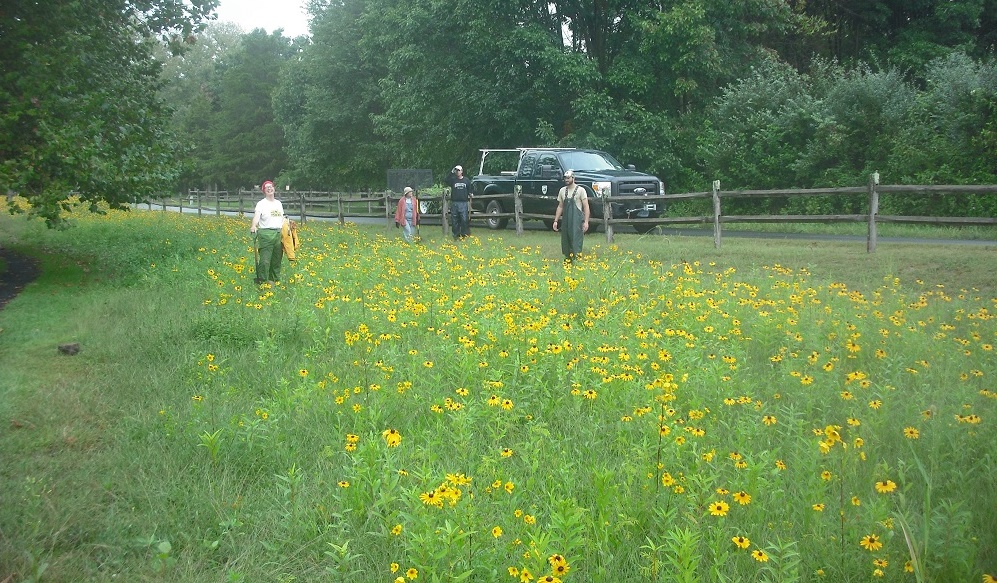
Lake Shenandoah is a 36-acre impoundment in Rockingham County, owned by the Virginia Department of Game and Inland Fisheries. In 2015, agency staff converted about one-acre of a conventional field into a pollinator meadow.
Above photo is of HMN Sandy Greene and others assisting project coordinator Jason Hallacher with invasives removal along the Lake Shenandoah Pollinator Trail, September 2015.

 – Plan Ahead and Prepare


 We hit the jackpot and saw both rare species, especially over a dozen
  The more common and also terrestrial