About 20 of us met at Sherando Lake Recreation Area on Sunday, June 19 for a program on “Poisonous Plants, Mushrooms and Animals in our National Forests” offered by Wild Virginia and led by Dr. Chris Holstege, director of the Blue Ridge Poison Center.
After an introduction to some of the poisonous plants that grow in Virginia, we took off on a hike around the Upper Lake, where Dr. Holstege pointed out some of the poisonous plants to be found there. Along the way, he explained how some of the toxins in plants affect you if ingested. He also pointed out a number of common misconceptions about poisons, for example, that you can get poison ivy by brushing against the intact leaves. According to Dr. Holstege, the leaves must be damaged first, which is why people at the back of a line of hikers are more likely to be affected than those at the front.
There are also many misconceptions about how to treat snakebites: suction, tourniquets, ice, cutting, etc, none of which are effective. In most cases, the best thing to do is to support the affected area and try to get to treatment as quickly as possible.
It turns out deaths from poisonous snakes or insects in Virginia are practically unheard of. In most cases, the bite will cause pain and discomfort, but these go away eventually (though not fast enough for the affected person!) In fact, the most serious threats to humans from the animal world are bees, wasps and … dogs.
With plants and mushrooms, it’s a different story; there are a number of things that will kill you if you ingest them (notably, certain of the Amanita mushrooms, but also some varieties of Hemlock, etc). My personal policy is not to eat anything unless I’m sure of its origin!
All-in-all, this was a very informative and enjoyable outing.
– Carl Droms, Cohort II
Photos by Carl Droms
This northern watersnake is the only snake we encountered on the walk and it is nonvenomous.
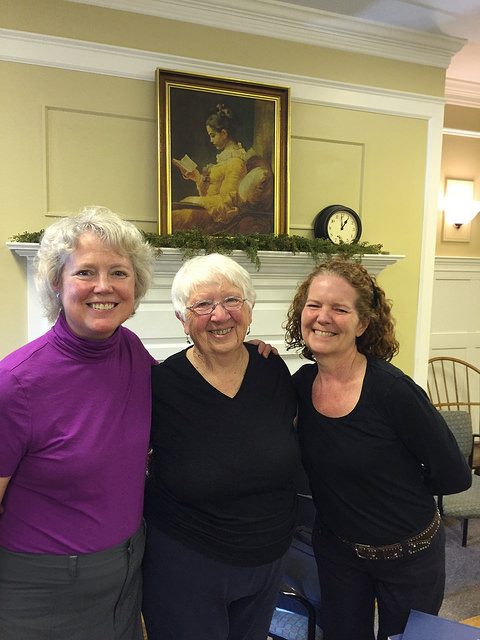
HMN Elaine Smith with Nicky Staunton and Nicky’s daughter Lou
Twenty-four people packed the comfortable and welcoming conference room at the North River Branch of the Massanutten Regional Library System in Bridgewater, Virginia, Saturday, June 4th. These twenty-four included our presenter, Nicky Staunton and her daughter Lou as well as Headwaters and Allegheny Master Naturalists, members of the Virginia Native Plant Society and guests of each group.
Nicky began with quotes from various readings, including this one from Baba Dioum, a Senegalese forestry engineer and conservationist:
In the end we will conserve only what we love. We will love only what we understand. We will understand only what we are taught.
One of the intentions of her talk was to explore the integrated roles of Curiosity, Nature and Art in support of her path as an artist of the natural world. In addition she discussed the guidance she seeks to give others as they break their paths as naturalists, observers and recorders. She discussed some of the “hardware” involved in recording nature, photographic and so forth, and shared some of the results of her journey (notebooks, brochures and published books). But most importantly she sought to expand our understanding of the senses from the five familiar to seven, to include Intuition and Awe. These seven senses aid us in our decision-making regarding what it is we are seeing and how we might label and record it. The foundation for naturalist observation and recordation is Curiosity, she said. Curiosity underpins our knowledge and learning by broadening understanding and the ability to see more than we ordinarily might: Deep seeing, so to speak, instead of surface seeing.
Deep seeing requires learning through the commitment of “living with” your subjects. The more familiarity you have with what you are observing, the easier it is to understand and record all those details and connections in the natural world that bring your subject to life. The process can be described like so: “the more you look, the more you see, the more you see the more you want to know, the more you know, the more you understand, the more you understand the more you see; and on and on it repeats. Truly observing dives deeper and deeper into your subject while simultaneously ascending higher and higher above it; including more and more on all levels – representing unending discovery and growth.”
Learning to trust and discover is just as important a way to develop the skills of spontaneous and unpremeditated seeing, Nicky counsels. Knowing your subject intimately is the best way to observe and record its ongoing and cyclical life in the natural world. Fortified with knowledge and understanding we are often surprised by the “sudden” spontaneous and unpremeditated insights we experience. We have all had that learning adventure: OMG – why didn’t I see that before …?
Nicky’s passion is conservation and the path described above has informed and strengthened her commitment to her conservation efforts. She detailed some of her quests with the United Plant Savers, whose mission is to protect native medicinal plants of the USA and Canada and their habitat, ensuring a renewable supply for generations to come. Nicky has also worked with dedication for the Virginia Native Plant Society where she was the State President for three terms. Her explorations have resulted in sightings of rare and unusual plants such as False Cape plant: Bartonia verna (Spring bartonia). Digital Atlas of Virginia link. Also Burmannia biflora L. (Violet Burmannia). Digital Atlas of Virginia link. Nicky says none of us is likely to see that one, unless we go further south toward Florida.
She studies dry brush watercolor with Lara Call Gastinger; is a member of the Guild of Natural Science Illustrators, American Society of Botanical Artists, and Southern Appalachian Botanical Society. Her botanical taxonomic skills are from studies with Marion Lobstein. Nicky is also a member on the Advisory Board of the Flora of Virginia Project.
We were so pleased and honored to have her as a presenter and enjoyed every minute of what she shared.
– RoxAnna Theiss, Cohort I and Elaine Smith, Cohort IV
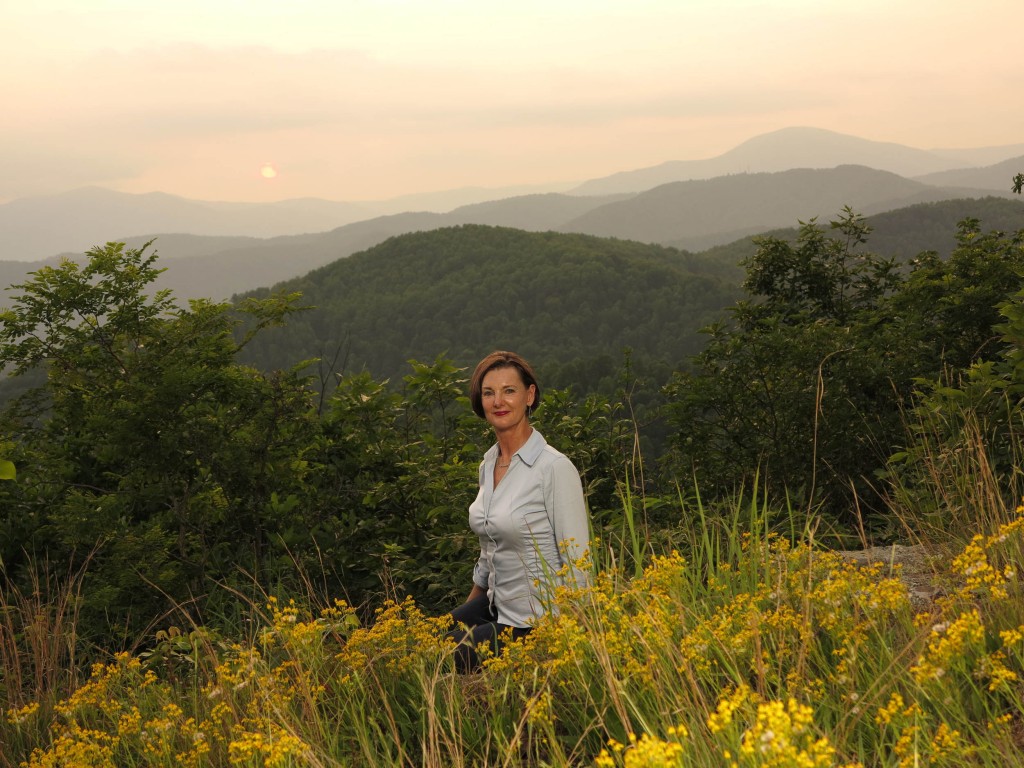
March 15th, a beautiful spring afternoon, found eleven people gathered in the Bridgewater library to listen to and watch Marcia Mabee talk about the journey she has taken since she and her first husband bought Naked Mountain in Nelson County in 1988. Jerry Hopkins, Mike Smith (a Virginia Native Plant Society member), Ann Murray, Eric Jones, Chris Bowlen, Art Vasy, Judy Tammi, RoxAnna Theiss, Elaine Smith, and Dwayne and Pat Martin were in attendance. Scones and sassafras tea treats were provided by RoxAnna. The Ides of March technical difficulties were overcome with the assistance of Eric Jones, just in the nick of time!
In the 1980s Marcia and her husband were self-described Northern Virginia “know nothings” when they decided they wanted a weekend getaway and buying a mountain seemed like a good idea. At first they would spend one weekend night in a truck camper, but eventually they built a small house near the top of the mountain. Gradually the mountain revealed its secrets to them, and Marcia became an avid student of nature. With the help of many experts, she learned that Naked Mountain is part of the Great Amphibolite Dike. Amphibolite is composed of calcium and magnesium and one of its main features is that is promotes biodiversity. Marcia soon found fringetrees, Canada milkvetch (Astragalus Canadensis), fame flower and shooting stars (Primula meadia), the first found in Nelson County. This spurred much interest in the mountain and experts from multiple disciplines were eager to survey the property. The globally rare Torrey’s mountainmint was found and consequently the mountain was declared a Virginia Natural Area Preserve.
Marcia discussed the challenges of invasives (tree of heaven, garlic mustard, oriental bittersweet, etc.) and natives (timber rattlesnakes and black bears).
Marcia’s Naked Mountain: A Memoir is due out in September. It promises to be fascinating reading.
More information can be found on Marcia’s blog and the DCR site.
Please join us for a lecture by Marcia Mabee: “The Delights and Challenges of Owning One of Virginia’s Natural Area Preserves.” Marcia will tell us how she and her husband came to purchase and conserve Naked Mountain, and will talk about the ecological features, including Torrey’s mountain mint and thousands of shooting stars, that make the area so special. She will also discuss some of the challenges that she has faced, such as invasive plants, rattlesnakes, and visiting bears.
Marcia Mabee’s presentation is the story of how the Naked Mountain Natural Area Preserve came to be and the discoveries and obligations inherent within the preserve that continue to this day.
Tuesday, March 15, 2016, 2-3:30PM, North River Branch of the Massanutten Regional Library, 118 Mt. Crawford Ave., Bridgewater
– RoxAnna Theiss, Cohort I
Naked Mountain Natural Area Preserve was established in 2006. It covers 278 acres in Nelson County protecting several sensitive and rare ecosystems. More about the Naked Mountain Natural Area Preserve here.
More about Marcia and her life on Naked Mountain through her blogsite here.
Top photo is of Marcia Mabee on Naked Mountain from Marcia’s Naked Mountain Blog website.
Workshop Plant Identification and Introduction to the Flora of Virginia Harrisonburg, VA
Hosted by the Shenandoah Chapter of the Virginia Native Plant Society
Date: April 15-16. (Friday- Saturday) Time: 9:30am-1:30 pm. Two day class, same time both days Instructor: Marion Lobstein, Botanist and Professor Emeritus, Northern Virginia Community College
(Contact information: mblobstein [at] earthlink.net, 703 622-0676) Assistant: Sally Anderson, Botanist and former Virginia Native Plant Society president Location: Music Room, Lucy F. Simms Center, 620 Simms Ave., Harrisonburg, VA 22802
Major areas of focus:
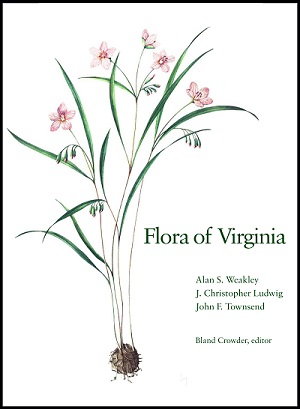
• Overview of Flora of Virginia and its use in plant identification
• Characteristics of major plant families that will be encountered during plant surveys such as field “weeds,” wildflowers, and grasses
• Proper plant collecting and record keeping in your survey fieldwork
• Use of the Flora of Virginia in identifying specimens collected
Tentative schedule:
• Lecture with PowerPoints and handouts
• Introduction to the Flora of Virginia
• Use of dichotomous keys in plant identification
• Field characteristics of major plant families you may collect during your plant surveys this summer
• Field collecting of and recording information on plants to identify
• Work on identification of specimens using the Flora of Virginia
Additional information for workshop participants:
Our focus will be on introduction to and use of the Flora of Virginia.
Please bring any copies you may have of the Flora of Virginia, Flora of West Virginia, and/or Newcomb’s Wildflower Guide, Identification Terminology: An Illustrated Glossary by James G. Harris Paperback**. We will share copies if you do not have these books.
If you do have a copy of the Flora of Virginia, please overview the following pages in the Flora:
• Introduction (pp. 1-5)
• Approaching the Keys (pp. 87-92 up to the actual Key to the families)
The following will also be helpful for you to bring:
• 10X ocular (hand lens–there will be some available for purchase at the class)
There are NOT enough microscopes for each participant
• Notebook, pens and pencils for taking notes
• Lunch
Water and coffee/tea and snacks will be provided but please bring your lunch and any other drinks you may want.
Registration: Contact Chris Bowlen. bowlenchris [at] comcast.net. 540-289-6801.
Class limit is 15. Cost for both days is $25.
**Identification Terminology: An Illustrated Glossary by James G. Harris is an excellent companion text to Flora of Virginia as it helps you understand botanical nomenclature. Available from Amazon Books
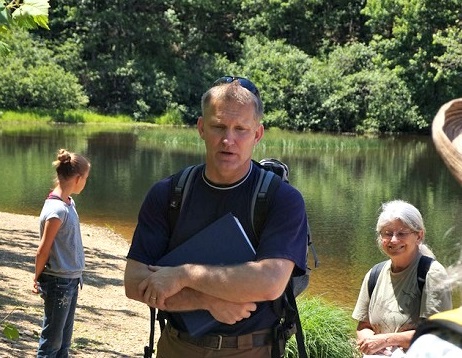
 About 20 of us met at Sherando Lake Recreation Area on Sunday, June 19 for a program on “Poisonous Plants, Mushrooms and Animals in our National Forests” offered by Wild Virginia and led by Dr. Chris Holstege, director of the Blue Ridge Poison Center.




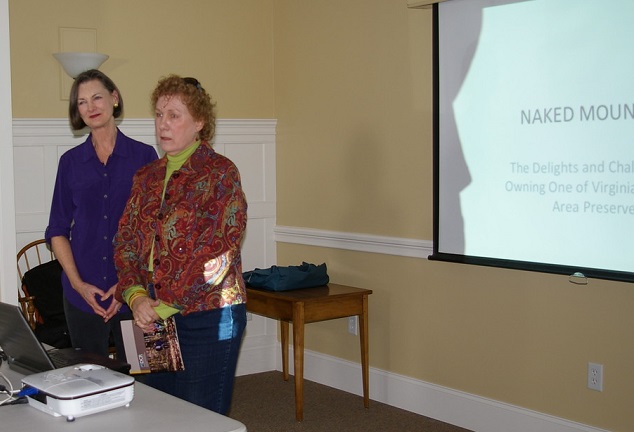
 March 15th, a beautiful spring afternoon, found eleven people gathered in the Bridgewater library to listen to and watch Marcia Mabee talk about the journey she has taken since she and her first husband bought Naked Mountain in Nelson County in 1988. Jerry Hopkins, Mike Smith (a Virginia Native Plant Society member), Ann Murray, Eric Jones, Chris Bowlen, Art Vasy, Judy Tammi, RoxAnna Theiss, Elaine Smith, and Dwayne and Pat Martin were in attendance. Scones and sassafras tea treats were provided by RoxAnna. The Ides of March technical difficulties were overcome with the assistance of Eric Jones, just in the nick of time!