Category: Continuing Education

  • Weather Everywhere and Climate in the Shenandoah Valley

    Weather Everywhere and Climate in the Shenandoah Valley

    Kate presenting on weather in September 2014.
    Kate presenting on weather in September 2014.

    On December 15, 2015, Headwaters Chapter members Kate Guenther and Malcolm Cameron gave a lively presentation at the Bridgewater Public Library on the basics of weather on our planet, recording weather observations, and about climate and how it’s changing.

    Kate gave an excellent PowerPoint review of how weather tries to solve the problem of the unequal heating of the earth’s surface due to the curvature of our globe. Warm air is lighter and rises, while cold air is heavier and sinks. The resulting differences in air pressure create the dynamic air flow of our winds and form low and high pressure centers. These lows and highs pull air in or push it out, respectively, and the Coriolis effect causes the air to curve to the right as it moves in the northern hemisphere. Thus, low pressure systems rotate counterclockwise and high pressure systems rotate clockwise.

    An easy way to tell when we’re outside which direction the high pressure center is involves standing with your back to the wind. Rotate 30 degrees to the right and your right hand extended points to the high. For finding the low pressure center, do the same except extend your left hand as a pointer.

    Cold fronts and warm fronts separate the high and low pressure centers and the changing positions of all these elements are determined by the jet stream, a fast moving wind stream at roughly 30 thousand feet altitude. The jet stream patterns shift over time and change with the seasons. Cold fronts produce low clouds and rain or thundershowers just out ahead as they move by and then higher, drier clouds after they pass. These fronts are a wedge of cold, dry air pushing under warm, moist air. Warm fronts do the opposite and the warm, moist air rides over top the cold air. They start with very high clouds moving in hundreds of miles ahead of them. As the warm front moves closer, clouds lower and steady and increasing rain is felt. After both fronts pass, the sky usually quickly clears.

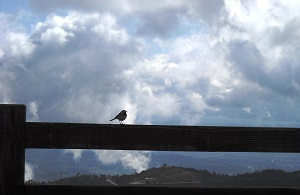
    cloudswithbirdKate covered cloud basics with picture examples; cirrus high clouds, alto middle level clouds and strato clouds closer to the surface. Cloud types or forms are puffy cumulus, sheet-like stratus, and nimbus rain clouds which are dark and change texture. Cumulonimbus clouds are fast rising cauliflower-like columns that form into thunderstorms with an anvil-like top when mature.

    During a break, folks went outside to practice identifying clouds and pressure centers.

    Malcolm Cameron finished up the class with pointers on how to setup a home weather observation routine and summarized evidence and impacts of climate change.

    Malcolm has taken and recorded daily weather observations for 30 years in Rockingham County. The proper type of instruments, either old-fashioned manual thermometers and rain gauges or the remote sensor digital varieties will work. A max-min. glass tube thermometer with reset has worked well and a wedge-shaped plastic rain gauge resists cracking if the water freezes. These are inexpensive. A digital remote station can be setup as far as 300 to 500 feet from your house, but more elements measured and features offered will increase the price from about $15 up to $400 plus for station units with everything like wind speed and rain gauges. Some top of the line units offer computer software.

    Proper location of instruments were covered. Thermometers must always be in the shade and not too close to houses and other sources of heat, generally at least 25 feet away. Wind gauges and rain gauges need to be well out in the open for accurate measurement.

    Recording your data should be consistent in nomenclature, and observations should be taken at about the same time each day. Just before sunset works well if you only observe once a day.  If you must be away, try to get someone to fill in.  Local newspapers or airports can provide proxy data, but this can vary greatly from what occurred at your house, especially precipitation.

    You have lots of options on how to use and analyze your data. The most useful are monthly total rainfall, season total snowfall and average temperatures. Data over 15 years or longer can begin to show trends.

    NASAEarth.600
    Climate: long term weather patterns for areas and regions.

    After defining climate as long term weather patterns for areas and regions, Malcolm briefly covered climate change. Climate change is becoming increasingly more obvious as the burning of fossil fuels continue and greenhouse gases like carbon dioxide and methane buildup in the atmosphere. Current global emissions of these gases equals over 47 gigatons a year. He covered many of the effects like heat waves, droughts, severe storms and more rapid melting of sea ice, glaciers and icecaps. All of the effects predicted by climate change computer models in the 1980’s have begun to happen in the years since then. Just in the last 3 or 4 years, melting and breakup of coastal glaciers in Greenland and Antarctica has increased significantly. Global average temperatures have risen 1.2 degrees Celsius since 1860, but one degree of that has been since about 1960. Carbon dioxide levels have risen from around 280 parts per million in pre-industrial times to 400 ppm today.

    Malcolm related personal stories of impacts such as eroding shores and islands in the tidal Rappahannock River area where he grew up and nearly having tornadoes hit his house near Weyers Cave in April 2011. Prior to 1995, tornadoes only hit The Valley during hurricanes.

    MalcolmCameronMany resources exist to study the topic, including NASA, NOAA, the National Science Foundation, and The Washington Post.

    Some good news is the agreement reached this month by nearly 200 nations in Paris to set strict carbon diets in all of their future energy production, moving towards mostly clean renewables. The goal is to limit the total global temperature increase to 2 degrees Celsius.

    – Malcolm Cameron, Cohort III

    DaleEnterpriseTemps
    Click here for Dale Enterprise weather data. Dale Enterprise is just west of Harrisonburg.

    The Dale Enterprise station is the oldest operating weather station in Virginia and the third oldest in the nation, and has been operated by the same family since its founding. The station is located in a farm field, “well away from buildings or hard surfaces.” As of early 2010, the station’s original thermometer remained as a back-up to an electronic temperature sensor installed in 1994. – Wikipedia
  • DCR Discusses VA Natural Heritage Program

    DCR Discusses VA Natural Heritage Program

    Tom Smith, long-standing director of the Natural Heritage Program is also on the board of the Flora of Virginia Project.
    Tom Smith, long-standing director of the Natural Heritage Program is also on the board of the Flora of Virginia Project.

    On Wednesday, October 28, 2015, Tom Smith, Adam Christie and Ryan Knopf —from the Natural Heritage Program of the Virginia Department of Conservation and Recreation (DCR) gave a lively presentation and discussion for Headwaters Master Naturalists on the state’s program and the Deep Run Ponds Preserve.

    Tom Smith, Director of the Natural Heritage Program, gave an overview noting that there are now 62 natural area preserves in all areas of Virginia that protect unique natural communities with rare plants and animals.  DCR owns 41 of the preserves, 21 with public access, with the rest under easement, all together protecting 421 unique species and natural communities.

    The Natural Heritage Program consists of teams which provide inventories, information management, environmental review, natural area protection (including public lands) and natural area preserve management. They also perform development site reviews such as for the proposed Atlantic Coast Pipeline. Databases and software are shared with all 50 states, including a conservation lands database and species distribution models to predict rare species locations. So far over 8700 rare population locations and 2006 conservation sites have been identified. Our area of the state is one of the country’s significant biodiversity hotspots and the cave and karst systems are a part of that. Besides 110 globally rare species, the karst systems provide 75% of the groundwater for 27 western Virginia counties.

    Adam Christie is the Shenandoah Valley Area Steward for the Program and manages 9 preserves between the Roanoke and Winchester areas. His duties include protection of habitats, research and education through compatible public education and outreach, vegetation monitoring and management, invasive species control, prescribed burning, habitat restoration and hydrologic restoration. Fire was a natural component of many area landscapes in the past until fire suppression was the norm before the 1990’s. The Program staff have conducted over 500 prescribed burns since 1998, helping to bring back native vegetation to places like the Cowbane Wet Prairie Preserve in Augusta Co.

    Scirpus_ancistrochaetus
    Northeastern Bulrush, Scirpus ancistrochaetus

    The Deep Run Ponds Preserve consists of roughly 800 acres along Ore Bank Road in southeast Rockingham County. The 8 ponds harbor the globally rare Virginia Sneezeweed, and other rare plants such as Northeastern Bulrush and Buxbaum’s Sedge in a system where the water level varies seasonally with the groundwater table. Management activities include prescribed burns and some careful selective tree removal for habitat restoration. Headwaters Master Naturalists have already helped other groups to remove invasive plants and similar or other activities are available for the future. HMN will work on setting up a tour of the Deep Run Ponds Preserve.

    To find out how you can help, contact Adam at his Verona Office at (540)332-9226 or at adam.christie[at]dcr.virginia.gov .

     – Malcolm Cameron, Cohort III, November 2015

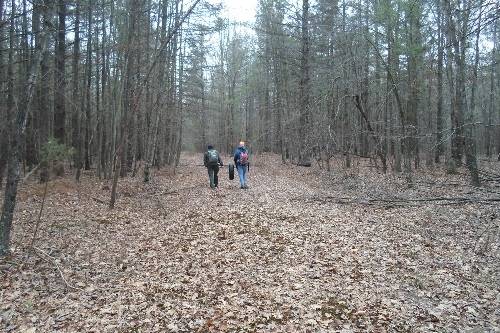
    Ryan Knopf and Wes carry out a tire dumped in the Deep Run Ponds Preserve during a Headwaters Chapter trip in February 2014.
    Natural Heritage Stewards Ryan Knopf and Wes Paulos carry out a tire dumped in the Deep Run Ponds Preserve during a HMN Projects Committee trip there in February 2014.
  • VMN Regional Conference at Holiday Lake

    VMN Regional Conference at Holiday Lake

    VMNConference.8.29.15.cd
    Attentive VMN audience for the post-lunch panel discussion with representatives of our sponsoring agencies.

    It was an early start, even for someone who gets up every weekday at 5:30am. On Saturday August 29, 2015, I met Chris Bowlen and Adrie Voors at 6:45am in Grottoes to go to the Holiday Lake 4-H Educational Center in Appomattox for the Virginia Master Naturalist regional conference. Jerry Hopkins made the two hour drive separately, filling his car with Sandy Greene, Gretchen Achenbach and Carl Droms.

    It was worth the early rising!

    We arrived late (due to extenuating circumstance) but quickly got ourselves settled in our morning sessions. Eric Jones joined Chris and me for the Blue Ridge PRISM (Partnership for Regional Invasive Species Management) session about invasive plants. Rod Walker provided a lot of good information about the PRISM program, including the Mid Atlantic Early Detection Network and the EDDMapS (Early Detection & Distribution Mapping System) app.

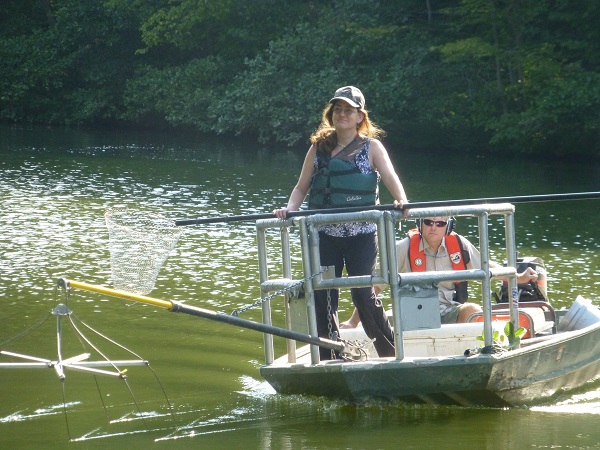
    Adrie and Carl attended the session on freshwater fish ecology presented by HMN Chapter Advisor Paul Bugas, Aquatics Manager for the Virginia Department of Game and Inland Fisheries. See Carl’s photos from this below.

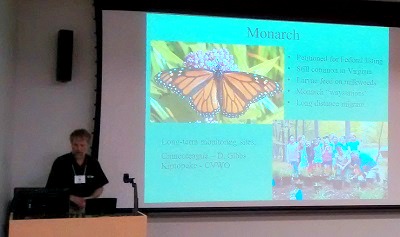
    We had brought along our striking monarch display board which we were able to show off in the dining room during lunch, alongside other chapters’ displays. After a good lunch and some socializing it was time for the afternoon sessions. Again Chris and I were together, along with Eric Jones, at the RareQuest presentation. Chris Ludwig and Tom Smith talked about this exciting new initiative through the Natural Heritage Program. Recruiting has closed for this project, but more information can be found on the original announcement webpage.

    Afternoon sessions included a presentation by Kate Guenther, HMN CoHort I, on wildlife emergencies: how to Assess, Assist, Capture and Transport Injured and Orphaned Wildlife, knowledge Kate has earned on the job working at the Wildlife Center of Virginia for the past four years.

    Adrie, Jerry and Carl spent the afternoon learning about GPS navigation from Bill Perry, Area Forester Specialist for the VA Department of Forestry in the James River area. Adrie says she was really impressed with Bill’s ability to clearly explain how to use a compass and particularly enjoyed the outdoor orienteering part of the class.

    It was a great day, a long day, but lots of good information in a lovely setting.

    – by Elaine Smith, 2015 Training Class

  • State of Virginia’s Environment

    State of Virginia’s Environment

    Steven Roble presents on insects of Virginia.
    Steven Roble presents on insects of Virginia.

    On May 21, 2015, Adrie and I spent the day at the Environmental Symposium organized by the Virginia Academy of Sciences at their annual meeting held this year at James Madison University in Harrisonburg. There were two sessions, the one we attended which dealt with the various organisms (Plants, Fish, Insects, etc) and another one dealing with ecosystems (Rivers, Forests, Tidal Wetlands, etc). See list of presenters below.

    Most of the speakers in our session began with a brief introduction to their particular type of organism; it felt a little like being back in Basic Training, which was good, because everyone can use a little review, right? Then it was on to a description of the current state of affairs. Not surprisingly, many life forms in Virginia are endangered, and in most cases, the principal underlying causes are habitat loss and climate change.

    Just before lunch, we were addressed by Molly Ward, Virginia’s Secretary of Natural Resources, who talked about her path from Hampton city treasurer to her current position. She reiterated some of what we had been hearing in the scientific talks, since as a resident of the Tidewater area, she has seen up close the effects of development and sea level rise.

    We enjoyed meeting Master Naturalists from the Central Blue Ridge Chapter based in Nelson County, the Old Rag Chapter which covers Madison, Rappahannock, Culpeper, Orange, and Fauquier Counties and the Banshee Reeks Chapter out of Loudoun County. These far traveling naturalists made us feel fortunate that this unique opportunity was practically in our backyard, accessible by bicycle.

    All-in-all, the Symposium was very well organized, and very well worth attending.

    – Carl Droms, Cohort II, May 2015

    TV3VAEnvironmnet.250Find WHSV TV-3’s report on this event by clicking on the image to the right.

    See Elaina Sauber’s article in the May 22, 2015, Daily News-Record about the symposium here: Virginia’s Environmental Health In Question

    The presenters were as follows:

    Air Quality, Dr. James Blando, School of Community & Environmental Health, Old Dominion University

    Amphibians, Dr. Jennifer Sevin, Center for Leadership in Global Sustainability, Virginia Tech & Research Associate at the Smithsonian Institution and John Kleoper, Virginia Department of Game and Inland Fisheries

    Birds, Dr. Bryan Watts, Director, Center for Conservation Biology of the College of William and Mary & Virginia Commonwealth University

    Fish, Dr. Paul Angermeier, Cooperative Fish and Wildlife Research Unit & Department of Fish and Wildlife Conservation, Virginia Tech and Mike Pinder, Virginia Department of Game and Inland Fisheries

    Forests, Dr. Christine Small, Biology Department, Radford University

    Geology, David Spears, State Geologist, Virginia Department of Mines, Minerals and Energy

    Insects, Dr. Steve Roble, Natural Heritage Program, Virginia Department of Conservation and Recreation

    Land Use, Dr. David S. Hardin, Department of Biology & Environmental Science, Longwood University

    Mammals, Dr. Nancy D. Moncrief, Virginia Museum of Natural History and Dr. John F. Pagels, Department of Biology, Virginia Commonwealth University & Research Associate, Virginia Museum of Natural History

    Mollusks, Dr. Jess W. Jones, U.S. Fish and Wildlife Service & Co-Director, Freshwater Mollusks Conservation Center, Department of Fish and Wildlife Conservation, Virginia Tech

    Ocean & Marine Environments, Dr. Larry Atkinson and Dr. Tal Ezer, Department of Ocean, Earth & Atmospheric Sciences, Old Dominion University

    Plants, Dr. Mike Renfroe, Department of Biology, James Madison University

    Reptiles, Dr. Tom Akre, Director, Virginia Working Landscapes, Smithsonian Mason School of Conservation, Smithsonian Conservation Biology Institute

    Rivers in Central Virginia, Dr. Paul Bukaveckas, Department of Biology, Virginia Commonwealth University

    Tidal Wetlands, Dr. William G. Reay, Director, Chesapeake Bay National Estuarine Research Reserve, Virginia Institute of Marine Science

    Water Quality, Dr. R. Christian Jones, Potomac Environmental Research and Education Center, George Mason University