Category: Continuing Education

  • June Naturalist Meet-up at Todd Lake

    June Naturalist Meet-up at Todd Lake

    ToddLake.700

    Thanks to the dozen or so Master Naturalists who joined us for the June 24th Naturalist Meet-up at Todd Lake.

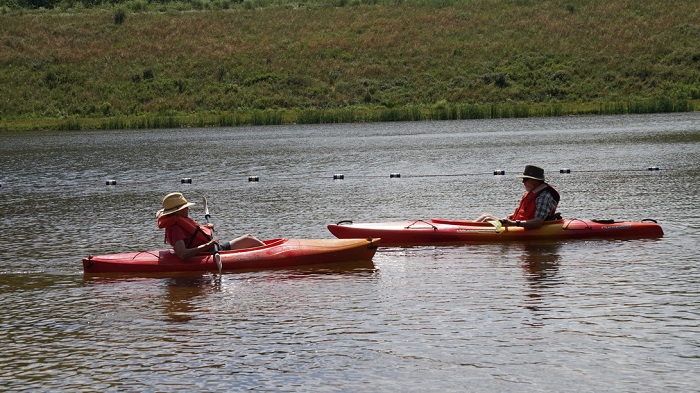
    Chapter Advisor Paul Bugas provided a great history and overview of flood control dams in Virginia and the National Forests. Most recently there are efforts to decommission older dams that are in need of repair rather than repair them. He also brought several canoes so we could explore Todd Lake.

    Our enthusiastic leader, Sandy Greene, challenged us to find exuvia, the exoskeletons left behind when a dragonfly makes its final transition from nymph to adult. These small, brownish, empty bodies can often be seen on grasses, twigs and rocks at the water’s edge. This ephemeral evidence of dragonflies eluded us though dozens of species patrolled the edge of the pond.

    Todd Lake is one of the Virginia Birding and Wildlife Trail sites that our chapter has adopted. Over the past few years we have been monitoring the sites of the North River Loop of the Mountain Trail. This year we are adding the Forest Trails Loop that has 7 additional sites including Montgomery Hall Park, Shenandoah Mountain, and Augusta Springs Wetland Trail. If you are interested in adopting a site as one of your projects, contact Cheryl Shull (North River Loop) or Sandy Greene (Forest Trails Loop). For more information about other trails, loops and sites, see https://www.dgif.virginia.gov/vbwt/

    toddlake.1.6.24.17.cs

    With nets in hand, we wrapped up the day by capturing and attempting to identify the numerous species of dragonflies and damselflies hunting along the shore. Some of the species we were able to distinguish before the day’s end were the common whitetail, the widow skimmer, the common darner, and the comet darner. A bigger challenge was narrowing down which of the 40 bluet damselflies zipped by us as we poured over field guides.

    Thanks again to all who joined us. Watch for more Headwaters Master Naturalist Meet-ups in the future!

    Chip Brown, Chair, Program/Hosting Committee
    July 2017

    Top photo by Carl Droms of Janet Joseph and Malcolm Cameron

    Second photo by Cheryl Shull of Sandy Greene

    reddragonfly.d.wendelken

    Find more beautiful photos taken by David Wendelken like this one of a Calico Pennant dragonfly (above) of  finds along Todd Lake by scrolling from HERE on facebook.

    Photos below by Carl, Cheryl, and Sandy:


  • HMNs Enjoy JMU Planetarium Program and Night Hike to Learn About Dark Skies, Past and Present

    HMNs Enjoy JMU Planetarium Program and Night Hike to Learn About Dark Skies, Past and Present

    shanilShanil Virani, Director of the John C. Wells Planetarium at James Madison University and Assistant Professor in the JMU Department of Physics and Astronomy, provided a captivating two hour program at the planetarium for Headwaters Master Naturalists and other invited guests on Sunday evening, March 5.

    The topic was the profound changes in the number of stars in our night skies compared to just a generation ago and how light pollution from excessive and inappropriate lighting has brought us to this situation. Examples of poorly planned lighting in Harrisonburg and elsewhere were shown and Virani noted that studies show that more light only adds to glare and energy waste and reduces our security.

    We then were shown the major constellations visible in our winter night skies. Virani passed out cardboard tubes which we used to count stars visible in various portions of the planetarium dome (sky). This was done in eight areas of the sky under fully dark conditions and then under ‘bright’, city sky conditions. Star totals were summed up for each condition and when a formula was used allowing for the narrow tube, the total number of stars in the ‘sky’ was calculated. Estimates exceeded 4500 stars visible in our original, pre-development night skies.

    Shenandoah Mountain Nighttime Star Hike

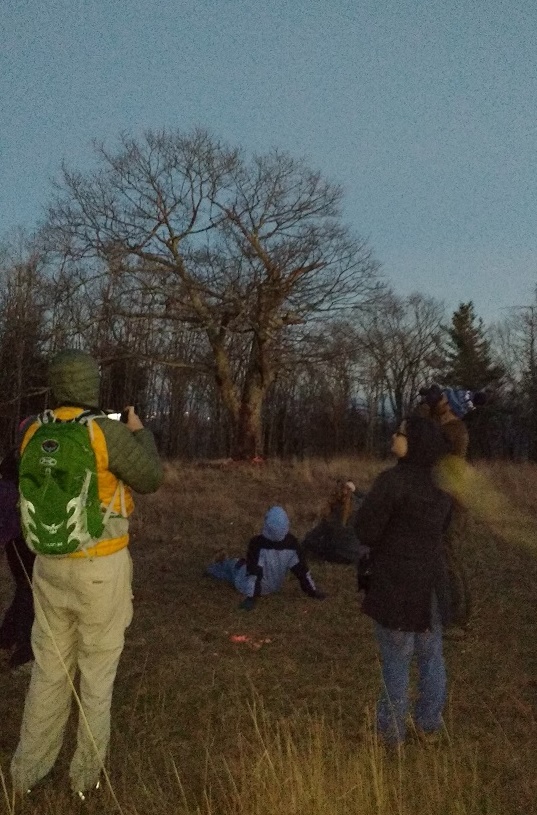
    nightsky1.crop.avA night sky hike was provided on Wednesday, March 8 as a follow-up to the planetarium program. Malcolm Cameron led seven Master Naturalists and friends on a half mile round trip hike on Shenandoah Mountain in the George Washington National Forest. We began the hike on a forest road to a clearing and arrived at sunset.

    Venus was the first planet observed, shining bright at sunset. Within 15 minutes, Sirius showed up in the southeast. Then as time went on, Orion, Taurus, the Big Dipper, Polaris, the Pleiades and Cassiopeia were observed. Some sky glow or glare was noted from the direction of Harrisonburg and Staunton, but overall these dark skies were a marked improvement over what we see in local cities and towns.

    Mother Nature also rewarded us with the sights and sounds of a couple of woodcocks in elaborate flight displays above the meadow.

    We concluded the sky viewing after one hour in a chilly wind, but happy to have seen a grand celestial display more like what our grandparents would have viewed.

    – Malcolm Cameron, Cohort III, March 2017

  • Rocky Mount Fire to be Featured at the HMN Annual Member Meeting January 21, 2017

    Rocky Mount Fire to be Featured at the HMN Annual Member Meeting January 21, 2017

    rockymtnfire2snp

    The Headwaters Chapter is planning its annual membership meeting to be held on Saturday, January 21, 2017, 11PM-3PM at Arey Hall, Bridgewater Municipal Building, 201 Green St., Bridgewater. Snow date is Saturday, January 28th.

    Thanks to our Programs Committee Chair Judy Tammi for organizing this meeting!

    Come for a potluck, a short business meeting including board elections, CE opportunities, social time, a book sale, and the highlight of the gathering which will be a presentation by Shenandoah National Park’s Sally Hurlbert at around 1:45PM about the Rocky Mount wildfire, the second biggest in Park history. Find more about Sally below. A big thanks to our Continuing Education Committee Chair Margaret Speicher for her work in arranging this presentation!

    SNP – The Rocky Mountain Fire: Then, Now and into the Future

    On April 16, 2016 it was reported that a fire was burning in the South District of Shenandoah National Park. When firefighters first arrived on scene the fire had already burned through 30 acres of forestland and was growing quickly. The fire shrouded areas in Rockingham County in a thick layer of smoke; caused the closing of portions of Skyline Drive and many trails within the park and surrounding areas including the Appalachian Trail. By the time the fire was fully contained, over two weeks later, the blaze had burned over 10,000 acres within the Park.

    Sally Hurlbert will join Headwaters Master Naturalists with a presentation detailing the Rocky Mountain Fire. She will share a PowerPoint presentation that was developed by Park Fire Ecologists while telling the story of what happened during the fire, describe how the park is recovering from the fire, and explain how the park is studying the effects of the fire into the future. There will be a short Q & A, as time permits, after the program.

    More about the Annual Membership Meeting on January 21

    This is our big meeting of the year! All members welcome and encouraged to come.

    Self Guided Computer Time: Still not quite sure of all of the ins-and-outs of the VMN VMS system?  Or really want to have someone walk through iNaturalist with you?  At 11:00 we will have stations set up for self and tour guided computer work to answer some of those questions and earn some extra CE credits!!

    Stations will include eBird and iNaturalist for use on the VDGIF Birding and Wildlife Trail projects, surfing of VMN VMS website, and a flash card challenge for the Birding and Wildlife Trail species mentioned for our sites.

    Bring a potluck dish, and enjoy a scrumptious lunch.

    Meet other HMN’s from other classes, including our newest members.

    Talk to the Project Coordinators for a variety of projects, and decide what to sign up for.

    Earn some Continuing Education credits learning some secrets about Shenandoah National Park.

    There’s a book sale…bring yours to recycle, and buy someone else’s…field guides, nature books, naturalist gear like binoculars …

    There will also be a short business meeting which will include the r/election of several board positions that require filling this year. Past President Jerry Hopkins chairs the nominating committee and sent out the list of nominees on January 6:

    • Vice President: Chip Brown
    • Treasurer: Carl Droms (current Treasurer)
    • Historian/Parliamentarian: Ginny Joseph
    • Chair of the Basic Training Committee: Brian Lux (current Basic Training Committee Chair)
    • Chair of the Newsletter and Website Committee: Adrie Voors (current Newsletter/ Website Committee Chair)

    Those elected take office immediately and serve for two years. Roughly half the board positions come up for election every year. Each position can be filled by the same individual for up to two consecutive two-year terms.

    Jerry adds “Only members in good standing [having paid their dues] are eligible to vote. Members-in-training, having not yet completed their training class, are encouraged to attend the meeting but are not eligible to vote and have no dues to pay until the beginning of the year following their graduation from training class. During the Annual Meeting nominations can be made from the floor for the Officer Positions provided the person being nominated has agreed in advance their willingness to serve.”


    Sally Hurlbert is currently the Management Specialist at Shenandoah National Park in Luray, Virginia. She has worked at Shenandoah for 20 years since 1996. She worked as an Interpretive Park Ranger in the Interpretation and Education Division until this past June, when she moved into her new position as Management Specialist. In her new role, she has five main responsibilities. First is External Affairs where she works with local, state and federal government officials and other stakeholder groups. Second is Public Affairs where she works in media relations, public relations, and managing tourism and marketing partnerships. Third is Lands issues where she helps manage the lands along the 300 miles of park boundary. Fourth, she is the park’s Freedom of Information Act Officer. Fifth, she is the liaison with the park’s philanthropic partner, the Shenandoah National Park Trust.

    Prior to joining the National Park Service, Sally worked for 11 years as a geologist with the Department of Interior Minerals Management Service in Anchorage, Alaska.

    Sally graduated with a Bachelor’s degree in Geology from Stanford University and a Master’s degree in Geology from Oregon State University. She resides in Stanley, Virginia with her husband Dan, who is the Geographic Information Systems Specialist at Shenandoah. Her two children have flown from the nest and now reside in New York City and Denver.

    Photo at top by Alan Williams, ecologist, data manager, wildfire fighter with the Shenandoah National Park; taken on April 17, 2016
  • VMN Conference 2016

    VMN Conference 2016

    VMNConference2016

    Headwaters Chapter was represented by our chapter president, Sandy Greene, at the annual VMN conference:

    Amazing CE, field trips, and idea sharing at the state conference this weekend at the 4H center at Smith Mountain Lake. More than 250 Master Naturalists.

    In case you didn’t see all the offerings, (it was hard, and you had to start the registration process to get the menus) here’s a sampling:

    • Behind the scenes at the Science Museum of VA and Mill Mountain Zoo
    • Mycology at Claytor Nature Study Area
    • Mist-netting
    • Plantation Forestry
    • Prep for Breeding Bird Atlas
    • Autumn Dragonfly migration in the Blue Ridge
    • Ticks and Disease
    • Zebra mussels
    • Keynote Speaker Tim McCoy on Native Bees
    • bioblitz at Booker T Washington National Monument
    • Hummingbirds, Raptors of SW VA
    • Birding By Ear
    • Sedges
    • Box Turtle population monitoring
    • best practices for communicating ocean and climate change
    • (And another dozen more at least)

    Next year’s conference will be in Front Royal in September. These are fabulous opportunities, so let’s register early and take a van next year!

    – Sandy Greene, Cohort I

  • Black Bear Composting Tour

    Black Bear Composting Tour

    BBC.af.1.800

    On the afternoon of Thursday, June 9 Eric Walter of Black Bear Composting took a dozen of us associated with the Market Compost Drop-off project on a tour of his facility off highway 340 in Crimora. Started in October of 2011, the business currently occupies just a few of Eric’s 47 acres allowing most of the property to be a natural buffer.

    First steps in the composting process involve emptying the 65 gallon bins collected throughout the Black Bear Composting service area which includes Charlottesville, Waynesboro, Staunton, Harrisonburg and Shenandoah National Park. This day’s route happened to pick up from Shenandoah National Park. This step includes one of several efforts to pick out non-organic contaminants to the composting process. Common contaminants include non-compostable plastic bags and wrappers, plastic bottles and utensils.

    Green wastes are mixed with about four times their volume of equal parts dried leaves and wood chips. The leaves are delivered each fall from curbside collections in the Waynesboro area. Wood chips come from local landscapers. The water from bin washing is added to this mix which is arranged in long windrows and covered with a special black fabric which allows moisture to escape but sheds rain water. It is also very effective at keeping down odors and keeping out hungry wildlife.

    The freshly assembled piles must be turned five times in the next 15 days to assure a ready supply of oxygen for the busy microbes breaking down the organic wastes. After the frequent turning phase, the piles stay covered for another two months and are monitored to verify they are reaching temperatures of at least 130 ° F but not more than 170°, the range within which pathogens and weed seeds are effectively killed without killing off the helpful microbes. Samples are sent to the Virginia Department of Environmental Quality to test for Salmonella and a pathogenic roundworm egg.

    The piles then continue to cure uncovered for about four months after which they may be sifted through a 1/2 inch screen for the final end product. About 40% of the material from any one “finished” pile successfully makes it to this end stage with the remaining “overs” going back into the beginning of the composting process.

    A newer, less labor intensive method of composting has been undergoing a trial period at Black Bear Composting since late last fall. Large concrete pads are overlaid with a grid of 4-6″ perforated PVC piping connected to a blower similar to those used to blow up bounce houses. The PVC piping is covered with wood chips and/or “overs” on which the incoming green waste mixed with leaves and/or wood chips is piled and then capped with 8-12″ of wood chips and/or “overs.” The blower is rigged to a timer to fire up for 5 minutes out of every 15 minutes 24 hours a day, effectively aerating the pile without mechanical turning. This process brings the pile to the required temperatures faster and more evenly and is proving a time, space and labor saving alternative.

    Our tour ended with Eric helping us shovel up some finished compost for our home gardens.

    Many thanks to Eric for the inspiring tour and offering such a great service for our valley! Black Bear Composting is an impressively low-tech, productive and scenic operation fighting environmental degradation with each binful of compostable material diverted from the landfill.

    – Adrie Voors, Cohort II

    Reposted from the Climate Action Alliance of the Valley website which hosts the project’s webpage. Find lots of photos of our tour in the original posting HERE.

    Thanks to Kate Guenther, Art Fovargue and Carl Droms for their photos!