Category: Continuing Education

  • Mushroom Hunt

    Mushroom Hunt

    MushRmLittleBrownWithBiteMarks
    Photo: by Adrie Voors
    My personal favorite, a “little brown” with signs of critter sampling bite marks.
    The recent dry spell kept our mushroom count on the low side as Peggy Plass, Lacey and her son, Jack Dean, his friend, Hayden Terry, and I searched around the Edith J Carrier Arboretum for these visual treats on Sunday, October 13. But with Peggy’s help and ID skills, we delighted in the discovery of a variety of bracket, gilled, and club mushrooms including turkey tails, coral and coral-pink mushrooms, a “little brown,” a potato-shaped puffball, and some dead man’s finger fungus, providing appropriate decor for the upcoming Halloween celebrations. Thanks to Peggy for this fun walk and talk on a gorgeous fall afternoon!

    MushRmLacey
    Photo: by Adrie Voors 
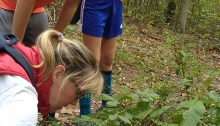
    Lacey examines a new find for identifying features with her son, Jack Dean and his friend, Hayden Terry.

    MushRmCoralPink
    Photo: by Adrie Voors
    Coral-pink mushroom.

    MushRmCoralOnDecayingLog
    Photo: by Adrie Voors
    Coral mushrooms on a decaying log.

    MushRmPuffballMaybe
    Photo: by Adrie Voors
    Likely puffball but we did not cut it for a better ID.

    By Adrie Voors

  • Learn to be an Active Watershed Steward! Participate in CBF’s 2019 VoiCeS Course

    Learn to be an Active Watershed Steward! Participate in CBF’s 2019 VoiCeS Course

    ChesBayWPSite

    Thursday evenings, October 10 through November 21, 6-8:45 pm. Waynesboro Public Library, 600 S. Wayne Avenue, Waynesboro. The Volunteers as Chesapeake Stewards (VoiCeS) program engages local volunteers and their communities to create a deeper understanding of the Bay and the efforts to restore it. VoiCeS is CBF’s most in-depth adult education program available to its members and the public. Attendees will leave knowing how their everyday actions can help restore the Bay and local waterways. Participants learn from engaging and thought-provoking speakers about the Bay’s biology, how farmers are reducing runoff, the critters that call the Shenandoah streams home, and how to protect them.

    Special presenters include Senator Emmett W. Hanger, Shenandoah Valley farmer Bobby Whitescarver, and Delegate Tony Wilt. Participants are expected to attend at least six of the seven classroom sessions, as well as a field trip. The program culminates in a service requirement of 40 hours on a clean water-related project of your choosing. Successful graduates receive CBF’s designation as “Chesapeake Stewards.” Materials fee: $30/individual, $50/couple. Registration deadline: October 7, 2019. Space is limited! For question, contact Robert Jennings or 434-826-0958.

  • About VA Groundwater with Joel Maynard

    About VA Groundwater with Joel Maynard

    Virtual Hydro-Geologic Tour of Rockingham and Augusta

    joeltalk.pix.cropVirginia Department of Environmental Quality’s Groundwater Characterization Geologist Joel Maynard lent his expertise and enthusiasm to Headwaters Master Naturalists and guests in a program at the DEQ’s local office on Wednesday, June 26.

    The presentation was attended by ten master naturalists and eight guests. Before zeroing in on the local hydrogeology,  Joel described the work his Groundwater Characterization Program performs statewide. He briefly discussed the different geology and hydrogeology of the five different geophysical provinces. Particularly interesting was the recently-discovered effect that a large impact crater near the mouth of the Chesapeake Bay has on aquifers in the eastern part of the state.

    Joel also provided graphs showing how the pumping of huge quantities of water by paper mills in Tidewater lowered the water table over a surprising distance (up to 50 miles) from their wells. Closer to home, Joel presented maps showing the high-volume wells in Rockingham and Augusta, and he explained that, unlike in the coastal plain, here, there are no restrictions on how much water a municipality, industry, or farm can pump from a well … as long as high-volume users report their quantities periodically to DEQ.

    He shared really cool videos of the inside of wells showing water flowing in and out of fractures and solution channels in the rock. He even had a video of the water in a well rippling during an earthquake, and showed graphs indicating how water levels in DEQ’s monitoring wells fluctuated during earthquakes occurring as far away as Ecuador.

    Joel is fascinated by our area’s springs and has improved and expanded DEQ’s database on the Valley’s springs from 158 springs in 2006 to 1583 springs in 2019. In addition to studying the quality and volume of these springs, just the establishment of a baseline database of our springs will undoubtedly prove invaluable as development strains our groundwater resource. He also mentioned that, as a result of his work, a construction/staging area proposed for the Atlantic Coast pipeline was moved to protect the water supply for the community of Deerfield. It’s likely that Joel’s work will result in future spring and well-head protection measures in the Valley.

    – David Forrer, Cohort VI, June 2019

    bottomofthewell

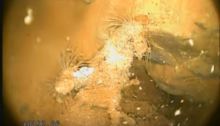
    Click on the image above for one of the videos featured in Joel’s talk. What’s at the bottom of this well?!

    wellandspringdatamap

    Click on the image above for an interactive map of Virginia wells and springs data which Joel has been instrumental in developing.


    joel.dave_.pix_.400.jpgThanks to Dave Forrer (at left in photo) for hosting this presentation!

  • The Water Beneath Us

    The Water Beneath Us

    joel

    Want to learn about the water beneath us?  Attend the “Virtual Hydro-Geologic Tour of Rockingham and Augusta” on Wednesday, June 26.  Joel Maynard, the Virginia Department of Environmental Quality’s Groundwater Characterization Geologist for our region, will be describing the occurrence and movement of groundwater in our area. His presentation, which will include photos and fascinating underwater videos of boreholes and springs, will educate those who attend about groundwater concepts and provide a rare opportunity to see how groundwater actually operates in our area.  Further, it will demonstrate the interconnectedness of surface water and groundwater in the area’s karst regions, and how important it is that we protect our water resources.

    Joel obtained his Master’s degree in geology from Virginia Tech in 1999, with a master’s thesis on the influences of tectonic and climatic-related subsidence on the formation of sedimentary rocks in the Appalachian Basin.  Joel worked with the DEQ’s Petroleum Remediation Program for about five years before joining the agency’s newly-formed Groundwater Characterization Program in 2006.  Joel is the agency’s expert studying the quality and quantity of the groundwater in the Valley and Ridge and Appalachian Plateau Provinces of Virginia.  Joel is frequently pulled away from “his” region to assist with the groundwater studies in eastern Virginia where groundwater resources are managed by DEQ to prevent overuse.  Hopefully, Joel will have time to mention some of those issues; however, other than a brief overview of the Groundwater Characterization Program, his presentation will focus primarily on groundwater in our area.

    Dave Forrer is the event coordinator for this CE event.  (Dave spent 25 years with the DEQ’s Petroleum Remediation Program…making sure leaks from petroleum storage tanks were properly investigated and cleaned up.)  For more details about this presentation, please contact Dave at davidforrer07 [at] gmail [dot] com or 540-271-2539.

    Joel’s talk will be held in the:
    DEQ conference room, 4411 Early Rd, Harrisonburg
    Wednesday, June 26, 2019, 7-9:00PM

    Top photo is of Joel Maynard on the job. Photos courtesy of Joel. 

  • Spring Outing at Maple Flats Ponds

    Spring Outing at Maple Flats Ponds

    mapleflats.1

    Sunday, March 10 turned out to be a beautiful, warm, spring-like day for 14 Headwaters Master Naturalists and five guests who enjoyed a very informative outing to Maple Flats Ponds near Sherando with James Madison University Instructor in Biology Billy Flint. Billy’s hope was that we would see at least 6 to 8 species of salamanders and frogs. The ponds and surroundings surpassed his expectations by providing us a look at 10 species all together.

    We explored three sinkhole ponds of various sizes and a couple of streams which drain or flow into them. These sinkhole ponds are unique to the western base of the Blue Ridge in our area and form when limestone dissolves locally beneath a mantle of colluvial soils which washed off the mountains. A layer of clay forms several feet below the surface of this area and creates a perched surface water table that reaches up into the sinkholes during the wet season.

    A common Eastern Red-Backed Salamander beneath a log along a small stream was our first find. These may or may not have a red stripe on their back and are nocturnal like most salamanders. The ones without a red stripe are called ‘Lead Backs’. Like all salamanders, they’re carnivorous in every stage of their lives.

    Billy explained how the three species of mole salamanders (all terrestrial as adults that stay mostly underground) found at Maple Flats have different breeding periods so that the competition for resources is minimized. They only enter the pond areas to breed and lay their eggs. Billy found an adult Spotted Salamander next to a small pond. These are fairly large at 4 to 7 inches and are black with distinctive yellow spots. They mate and lay eggs in February to March and have an elaborate, swimming ‘mating dance’. The other mole salamander species common to the Maple Flats area are the smaller Marbled Salamanders which mate and lay eggs in the fall, and the state endangered Tiger Salamanders that breed in January.

    Shelley found a Spring Peeper frog hopping on the leaf litter as we were leaving this first small pond. Only the males call in the chorus we hear each year.

    The second pond was much larger, but very heavily grown-in with greenbriers, making access challenging. This pond was currently larger than any of our group had ever seen it before. Billy waded into it and found a salamander larva which was probably a Marbled Salamander. A few Cricket Frogs were found on surrounding soggy ground. These are smaller than Peepers at just over an inch and have more warty skin.

    Billy found and held up a large gelatinous mass of salamander eggs with small larvae of the Spotted Salamander.

    red.ELKids are usually better at finding things and Merrilee’s son Eli located a typically 5 inch Red Salamander under a rock away from the pond. These showy copper-red salamanders were named the Virginia State Amphibian by Virginia lawmakers last year. They are not to be confused with the Red Eft stage of the smaller Red-Spotted Newt.

    A young Northern Dusky Salamander was also among the day’s finds. Billy noted that they’re mostly aquatic and lungless, breathing through their moist skin and mucous membranes. A young Four-Toed Salamander and an aquatic adult male Red-Spotted Newt rounded out our salamander discoveries. The Four-Toed Salamander is named for having only four toes on each back leg. Most salamanders have four toes on each of their front legs but five on the rear. At only 2-3 inches in length, we could not count the toes on Billy’s find but their distinctive white belly with black spots is a giveaway characteristic of this species. They lay their eggs in moss at the edge of the pond and the larvae can then easily wiggle into the water. The aquatic adult Red-Spotted Newts have lungs and are toxic to fish. They can spend up to six or seven years as juvenile, terrestrial Red-Spotted Newt Efts looking for suitable habitat and conditions to reach their reproductive form.

    Ben described seeing a tadpole which Billy determined was most likely a Bullfrog considering the time of year. Bullfrogs actually mate in early summer, but their tadpoles often don’t complete metamorphosis until the following summer, and so will remain as tadpoles for a whole year.

    We enjoyed about three hours exploring the ponds and all wished we had more time to see what other wonders could be found in these unique habitats.

    We are extremely fortunate to have such a knowledgeable and enthusiastic herp guide in Billy Flint. Our sincerest thanks to him for taking the time to share his wealth of expertise and sharp eye for us to experience a bit of the fascinating world of amphibians associated with vernal pools and sinkhole ponds.

    – Malcolm Cameron, Cohort III, March 2019

    And many thanks to Malcolm for organizing this trip!

    Thanks to Cheryl Shull, Eli Lianez, and Debbie Pugh for taking and sending in the great photos below! Click on any one to enlarge it and get a slide show. Uncredited photos are by Adrie.