Category: Continuing Education

  • A Fine Forest Walk for Fungi

    A Fine Forest Walk for Fungi

    On a very fine September Sunday morning, about 12 members of the Headwaters Chapter of Master Naturalists enjoyed quite the treat on the Mushroom and Lichen Hike with credentialed mycologists Jack Wilson, Chris Vacher, Vicki Vacher, and Mark Jones. Within the state of Virginia, just 10 people have passed the difficult examinations that give them credentials to collect and sell wild mushrooms and to give reliable advice about identification and edibility. On this day, we were lucky to have 40% of Virginia’s mycologists leading our hike near Braley Pond.

    Before hiking, we gathered in a pavilion with a long table of information sheets and mushroom samples. Jack’s wife, Mary, fed us a minor feast featuring at least three kinds of wild mushrooms: chicken-of-the-woods roasted with winter squash, black trumpets in a cream cheese spread, and cream-of-wild-mushroom soup topped with more black trumpet mushrooms. Big thanks to Rose, the cook of White’s Wayside, who had prepared some of the dishes.

    First we visited a rust garden–a sort of sculptural area filled with metal relics left behind by previous property-owners. Jack showed us the colorful crustose lichens growing on the iron-rich surfaces. Jack quipped that about 80% of the mushrooms can be referred to as LBMs (“little brown mushrooms”) and pointed out several growing in the mulch in and around the rust garden.

    Next, we headed into the woods with a quick stop to view the remains of an unfortunate ash tree that met its demise due to the work of the Emerald Ash Borer. Jack and Mary had saved some chunks of trunk where the work of the borers had formed intricate patterns like script or runes just underneath the bark. We couldn’t help but acknowledge the beauty along with the sadness.

    Then we strolled along a trail in the George Washington National Forest with our mycologists pointing out interesting fungi and lichens along the way.

    Below are some of the highlights.

    1.

    Phil holds a Cordyceps fungus sprouting from an insect larva. Photo by Sharon Landis.

    Someone discovers a striking orange fungus along the path. The fungus is bright orange like a newt and resembles tentacles or horns emerging from the earth. The mycologists call us to a halt to take a closer look. Chris bends close to the ground and suggests this could be a Cordyceps fungus. The word Cordyceps means nothing to us at first–just a mysterious collection of Latin syllables that we struggle to spell in our notebooks. But soon, the word Cordyceps will mean something terrifyingly specific.

    Amidst hushed murmurs of “what is it?” and “look at that bright color,” Chris and Mark explain that Cordyceps is a type of parasitic fungus that feeds on insects. Like the fungus that infects the brains of ants in the Amazon rainforest, this fungus also feeds on living animals. The spores penetrate the integuments, the narrow gaps between segments on a larva, and become somewhat like seeds, nourishing themselves from the nutrients in the larva as it grows mycelium, root-like threads, throughout the larva’s body. Eventually, the fungus bursts through the larva’s exoskeleton and emerges, treelike, killing the larva.

    After passing around this particular fungus and photographing it, we gently brush away the dirt and debris at the base of the orange sprouting body. Sure enough, beneath the brown duff, we see the glossy, shiny black of the larva, only partially reincarnated as a Cordyceps fungus.

    2.

    Jack with a Russella emetica find. Photo by Sharon Landis.

    We find many little brown mushrooms (or LBMs, as the professionals call them) throughout our morning walk. More interestingly, we find mushrooms with reddish colored caps. All four mycologists with us each warn us never to eat this kind since it is commonly called “The Sickener.” “It won’t kill you,” Jack and Chris warn us, “but it might make you wish you would die.” Russella emetica is more subtle in its hues than the Cordyceps, but the coral tones contrast brightly with the otherwise green and brown palette surrounding us this late summer day.

    Nearby we find Amanita, commonly called “Death Angel” because it really will kill its eater. Its parts above the soil could be mistaken for a delicious edible mushroom that tastes almost like mozzarella cheese called a puffball mushroom–but if you cut the puffy part in half and see the shape of a mushroom, then you know it’s the deadly kind instead.

    Jack wants us to know that these mushrooms, though incredibly toxic or even deadly to humans, play a vital role in feeding the trees around us. The trees send chemical messages from their roots into the mycelium of the fungi that say, “I’m a tree! Feed me!” and then the fungi send nutrients from their mycelium into the tree roots. Jack calls this the “Universal Theory of Happiness” because it highlights the interconnectedness of everything, and how all the different organisms exchange important services to help each other flourish. Even an organism that is “nasty” to some creatures will be nutritious and life-giving to others. Without healthy fungi, a forest will die.

    There are some wild-card players out there, too. The exquisite Indian pipe is not a fungus, though it looks like one. It is not green and doesn’t make its own food, lacking chlorophyll.

    It glows in the dark. It plays a trick on the fungi by releasing a chemical signal into the ground that says, “Feed me! I’m a tree!” (To be clear, reader, Indian pipe is NOT a tree). The Amanita and Russella emetica obey, sending nourishment from their mycelium into the Indian pipe roots, feeding it Thus, the Indian pipe is fed without having to bother with making its own food.

    Jack points out that Indian pipe, if ingested by people, is both hallucinogenic and perfectly legal. Someone quips, “Aha, so this is how you came up with Jack’s Universal Theory of Happiness!”  NOTE: The Virginia Master Naturalists do not endorse ingesting Indian pipe. Neither does Jack, really.

    3.

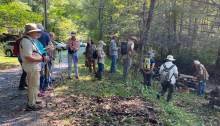
    Jack Wilson on left speaks to an attentive audience: Lincoln behind tree, Karen seated, Pam, Chris Vacher, Jay, Elaine (hidden in orange shirt), Malcolm, Phil and Josie Henning seated. Photo by Sharon Landis.

    Along a fallen hardwood tree, we find thousands of turkey tail fungi. Our guides explain that these have medicinal value and are commonly used as cancer treatments in China and in Japan. The mycologists shared anecdotes of people who had been diagnosed with cancer and survived after using turkey tail treatments, then bolstered their claims with research studies. One example of someone cured by turkey tail compounds was the mother of Paul Stamets, the mycologist featured in the documentary Fantastic Fungi.

    The best turkey tail specimens to collect are those that are fresh, indicated by the bright colors on top and the smooth white undersides beneath. These can be soaked in alcohol such as vodka or whiskey to make a tincture. Alternatively, the turkey tail fungus can be eaten raw, but only the water-soluble compounds will be absorbed by the body. Jack clarified that the turkey tail fungus includes both water-soluble and alcohol-soluble compounds, and both are beneficial to the field of medicine.

    Display at the The Necessary summing up their mission. Photo by Elaine Smith.

    After a wonder-filled hike, we headed to The Necessary, a community space that Jack, Mary, Chris, and Vicki have been working to renovate as a resource for all things “necessary” in a small town: bee-keeping supplies, mushroom products and information, milk, cheese, butter, meat, honey, maps, and other odds and ends.

    Inside The Necessary, on a large high-tech screen, Chris taught us more in detail about the fungi and lichen we had seen using a detailed slide presentation of photos and graphics. A few key takeaways:

    • A lichen is a symbiotic relationship between an alga (which is a photobiont that can make food/chlorophyll) and a fungus, which can not make food but provides a structure or home for the alga. Without the fungus, the alga can easily dry out and die–but within the structure of the fungus, the alga can live indefinitely. Some lichen contain a third component called a cyanobacteria. A cyanobacteria is a prokaryotic cell, which means it lacks a nucleus.  The alga, on the other hand, is eukaryotic, meaning that it has a nucleus and other things.
    • Lichen can also contain pigments to help protect them from harsh conditions like a desert and overexposure to full sun. Parietin, for example, gives some lichen an orange color.
    • Lichen come in three main forms, or morphologies (and 11 subtypes!). The three main forms are:
      • crustose, which is embedded into a substrate and cannot be removed without damaging it
      • foliose–leaf-life shapes that can be broken off
      • fruticose–shrub-like shapes that are sometimes used as holiday or garden decorations (but should not be harvested).
    • All lichens are extremely slow-growing, so when you see a palm-sized lichen, you know it has taken decades to get that size. Unfortunately, during the 1940s, some fruticose lichens were so popular as Christmas decorations that they were badly over-harvested. In addition to supporting trees and helping to regulate moisture, lichens also serve important roles as markers for radiation and indicators for air quality. Some insects use lichen bits as camouflage and nesting materials. These are just a few of the vital roles that lichen plays in ecosystems.
    • To see stunning close-up photographs of lichen, you can look up the work of Sylvia and Stephen Sharnoff in print and online. To schedule your own mushroom and fungus hike, which we highly recommend, contact Chris and Vicki Vacher at https://enchantednaturetours.com
    • You can delve deep into the art of mushroom cultivation at a workshop offered by Mark Jones at his Sharondale Mushroom Farm near Charlottesville.

    – Anna Maria Johnson, Cohort VII, September 2021

    The photo at the very top of this post showing the whole group is by Elaine Smith.

    Thanks to Malcolm Cameron, Cohort III, CE Committee member; and Elaine Smith, Cohort IV, CE Committee Chair, for making this event possible and contributing to this post!

    Click on a photo below to start a slide show to see them better. Photo credits: Anna Maria (AMJ), Elaine (ES), and Sharon Landis, Cohort VII (SL).

  • Black Bear Composting Tour 2021

    Black Bear Composting Tour 2021

    On Thursday, September 23rd, 2021, members of the Headwaters Master Naturalists chapter visited Black Bear Composting facility in Crimora. Eric Walter, the owner, showed us around the property and walked us through the composting process. They obtain the compostable waste from residential houses, businesses, and even institutions such as the local Bridgewater College.

    Once brought to the facility, the food and lawn waste are combined with wood chips and leaves. The compost is then placed into large compost bins with pipes running along the bottom. The pipes pump air up through the pile to keep the bacteria happy, continuing their aerobic respiration and decomposing the waste. Temperatures can get up to 140°F within the piles from the heat given off by the bacteria hard at work. After this process, the piles of compost are left to sit and finish decomposing while being moved occasionally. The compost then goes through a huge sifter machine to separate out any larger items not fully decomposed yet from the finished compost product.

    This process from start to finish takes around 6 months. The end result they are left with is beautiful and ready-to-use compost great for any garden. It is amazing how our waste can be transformed into something that goes back into replenishing the earth! Visiting this facility and learning more about the process of composting reminds us all to check and sort our items before we throw them into the compost bin.

    Allison O’Brien, Cohort VII, September 2021

    In the photo at the top of this post, Eric shows us his new, “more expensive than my house”, screening machine. Photo and caption credit Art Fovargue, Cohort VII.

    Click on a photo below to start a slide show to see them better. Photo credits: Art (AF), Allison (AO), and Adrie Voors, Cohort II (AV).

  • Mushroom and Lichen Outing for HMNs

    Mushroom and Lichen Outing for HMNs

    Once again, we are being treated to the wealth of knowledge and generosity of local fungi experts Jack Wilson and Chris & Vicki Vacher on a walk/talk and more, on Sunday, September 12, starting at 9:30AM.

    Jack shares this “draft plan” for our outing:

    “To avoid hot weather, we should start at MoonDance Camp (Braley Pond Road) at 9:30AM.

    We will be at 2000’ and that helps some with summer heat.

    After a brief orientation, we would hike much of the route we did for the (February 2020) Lichen Hike, plus a look at the Calfpasture River.

    We will do a scouting expedition a few days ahead of time to see what’s out.

    I would suggest that we add Summer Pollinators to the agenda. The pollinator garden in front of the Wayside solar panels is in it’s third year and was developed with help from Master Naturalists.
    It would make an interesting stop, if we add pollinators as a topic.

    After what is an easy 2 mile hike, we would head to Churchville and The Necessary.
    Lunch can be either bring-your-own or pre-ordered and waiting for us at The Necessary.
    The Necessary has a video kiosk for the inside portion of the program.
    The Necessary is an outlet for White’s Wayside and is also home to both Necessary Bees and Friends of Fungus.

    No Pets, No Smoking, 10–12-person limit is our preference.

    Hiking poles, long pants, creek hopping shoes and a camera with good macro features are suggested.”


    “Jack Wilson, along with Chris & Vicki Vacher, are residents of the George Washington National Forest, likers of lichens, beekeepers and certified/state-approved mushroom foragers.

    Jack is the proprietor of White’s Wayside Diner. When not busy with the above-mentioned activities, he is attempting to train Bella the Diner Dog to find morels.

    Christopher is a licensed landscape contractor who has installed well over 10,000 plants, practices small-scale organic agriculture, and has worked on many conservation projects.

    Vicki is a degreed horticulturist who enjoys creating landscapes with natural beauty that improve the environment and provide habitats for biodiversity.” – from our February 2020 Headwaters Highlights HERE.

    Thanks to Malcolm Cameron with our CE Committee for making this happen! He is our Chapter host for this trip and can be reached at malcolmgcameron [at] gmail.com

    Sign up to attend in the current VMN VMS: Better Impact. You will be given directions to get to this outing once you’ve signed up. Sign up early. Space is limited!

    Rain date is Saturday, September 18.

    Read about our November 2017 Lichen Hike with Jack HERE.

    Photo above is of Jack and a lichen-covered log from our 2017 outing with him. Photo by Jerry Hopkins, Cohort I.

  • Monarch Butterflies Webinar

    Monarch Butterflies Webinar


    Get some CE from VMN State Program Coordinator Michelle Prysby

    Click on the image above to watch Michelle’s webinar on Monarch Butterflies

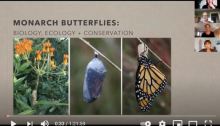
    Virginia Master Naturalist Program Director Michelle Prysby presented the webinar Monarch Butterflies: Biology, Ecology & Conservation hosted by Wild Virginia on the evening of April 19th. You can find a recording of the webinar linked HERE.

    This informative hour and a half-long program has been approved for HMN Continuing Education credit.

    Michelle educates on the lifecycle of Monarchs, speaks on their conservation concerns, and discusses ways that we can help Monarch Butterflies and other pollinators.

    Locating authoritative information on Monarchs is one important take away from the webinar. Michelle noted that there are many misconceptions about these fascinating creatures. For example, they don’t liquify and reform within the chrysalis as many people believe; and collecting Monarch Caterpillars to raise and release is not considered a valid activity for aiding species conservation. Michelle recommends Monarch Joint Venture as a source for current and accurate information.

    Another focus of the webinar is citizen science. Michelle speaks on ways citizen scientists have helped Monarchs in the past and continue their efforts.

    She highlighted five good citizen science projects working with Monarchs in Virginia. They are:  

    – Stephanie Gardner

  • CoCoRaHS: Volunteers Tracking the Weather

    CoCoRaHS: Volunteers Tracking the Weather

    On Saturday, February 20, several HMNers were treated to a Zoom introduction to the CoCoRaHS organization by the Augusta/Rockingham coordinator, Tommy Le Beau. Despite a slight snag at the beginning (this was Elaine’s first time as Zoom host) it was an enjoyable presentation. Karen Milne, Peggy Plass, and John Bauman Zoomed in. Jean Stephens had internet issues and so wasn’t able to stay.

    Tommy is passionate about the weather and it certainly showed. He says about himself: “I have been interested in meteorology since I was 11. In 2015 I volunteered with CoCoRaHS. Then, in 2016 I joined Skywarn as a weather spotter and the American Meteorological Society in 2018. In 2019 I became the CoCoRaHS County Coordinator for Augusta County.”

    CoCoRaHS (Community Collaborative Rain, Hail, & Snow Network) is a grassroots volunteer network of backyard weather observers of all ages and backgrounds working together to measure and map precipitation (rain, hail, and snow) in their local communities. Their work is vitally important, especially considering the impacts of climate change. Volunteers across the country take and report daily measurements, using the 4-inch, high capacity gauge available through the CoCoRaHS website.

    A dense network of volunteers is needed, and that is why Tommy came to us. Rockingham County only has a few volunteers, so any HMNers who want to join would be welcome! This is an approved citizen science project, and the training (including the hour Zoom introduction, Meeting # 83694296549, Password 620160) counts as continuing education. There are also webinars available through CoCoRaHS.

    The data collected by volunteers is used by numerous agencies, including the National Weather Service, USDA, NOAA, farmers, and planners. Tommy pointed out that reporting zeros can be extremely important. Data collection only takes a few minutes a day and is preferably done in the morning. A commitment of at least one season is ideal.

    Links that Tommy shared:
    Training Slide Shows 

    Observer Application Chooser

    Uses of CoCoRaHS Data

    Twitter

    Facebook

    YouTube Videos

    Regular Training 

    Snow Training 

    For questions or more information, email Tommy


    by Elaine Smith