Category: Continuing Education

  • Wild Foods 4 Wildlife by Kate

    Wild Foods 4 Wildlife by Kate

    katestalk

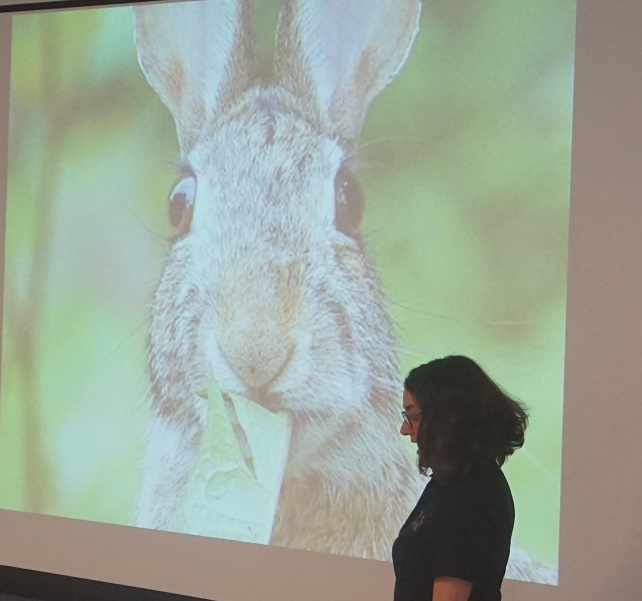
    The Headwaters Chapter’s Annual Meeting on Saturday, January 26 featured HMN Kate Guenther, Cohort I, presenting about her work to connect wildlife in rehabilitation with their natural-state “wild” foods through her website Wildfoods4Wildlife.com.

    Note from Kate: 

    Thank you all for allowing me to share my passion for animals and plants with you at the annual meeting. You all asked great questions and I felt warmly supported. I am so proud of what our chapter has become and what you all are doing. I forgot, though, to make it easy for you to engage in the kind of work we discussed foraging for wild plant foods for rehabilitators. Please click on the following links to download the two handouts from the session:


    Andrea Dono, Cohort V, took some notes on the talk and was willing to share them with us:

    We can forage for food for our local wildlife rehabilitators. When wildlife are recuperating, they can’t get their preferred or favorite food and some of them might stop eating.

    Kate started teaching herself identification of plants in the wild and then created a website that shows plants and provides information that can help you see what is available and which animals will eat them.

    Orphaned animals that are brought in to centers may not have learned which foods to eat, what their foods smell and taste like, or how to open seeds and nuts.

    Cottontails, bears and deer are the top animals brought to rehabilitators that need to eat wild food. They need to be trained up on wild and natural foods. Deer see the entire world as a salad bar but they need to eat the things that benefit them the most. Bears shouldn’t be learning to eat human foods or interact with humans at all.

    Greenbrier leaf and spinach leaf comparison: greenbrier has more protein, fat, carbs, and fiber than spinach. Wild food is healthier than the grocery store foods. Spinach is 92% water, for example, while greenbrier is 55% and it is packed with so much more.

    Foods on the landscape are a hand-in-glove evolutionary fit to the natural environment and what animals need. Clover leaf at its best happens to come up when baby rabbits leave the nest. When the nuts start falling from trees in the fall is when bears start looking to put on their weight to prepare for hibernation.

    Wild food is a comfort food for comfort behaviors. Stress alone can kill animals that are in captivity, a condition known as capture myopathy. Giving them food that they prefer can help reduce their stress and play a role in preventing this.

    Prey animals are naturally geared toward stress; their nervous systems are built for flight. Common prey animals are rabbits, chipmunks, and deer. They eat a lot of wild plant foods and benefit the most from them.

    What food should we collect if we want to help?

    Your yard is a good spot to look for food because it is easy to access and monitor frequently.

    Foraging ethics:

    • Rule of thirds – if you found a food source, don’t take more than a third so you can leave enough behind for other animals and for the plant to propagate.
    • Be gentle – don’t rip at things, leave the plant intact and don’t kill anything.
    • Get permission, don’t trespass.
    • Don’t harvest things that have been exposed to toxins: don’t collect from along railroad lines or roadways, or places where pesticides are used. Wash what you’ve collected.

    Ask rehabilitators what they might need, what timing works, when it can be dropped off. You would want to wash the items and catalog what you are bringing and make a note of who eats what. Ask if they have a place to store the food items to know how much they can accept. If they can’t store eight buckets of black walnuts, then you probably don’t want to waste your valuable foraging time collecting that much.

    www.wildfoods4wildlife.com

    This website allows you to search by plant and by animal. It will also tell you which part of the plant an animal will eat. Through the menu bar on this site, you can find suggestions for things you might want to grow yourself, places where you can get seeds, and how to store foods among many other resources.

    Top photo shows Kate presenting to the Annual Meeting attendees. All photos by Carl Droms.

    Click on a photo below for a slide show and captions.


  • VoiCeS

    VoiCeS

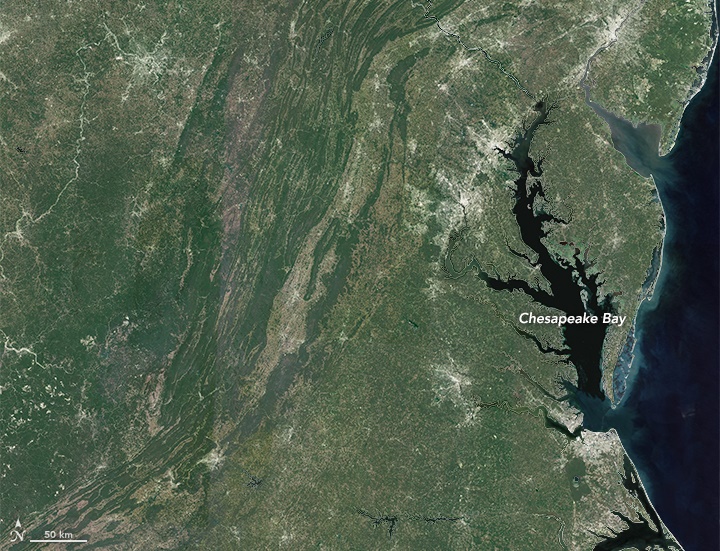
    NASAbayimage

    Robert Jennings of the Chesapeake Bay Foundation recently coordinated a six session training for local volunteers taught by various experts in water quality— a thorough introduction to understanding impacts and water management strategies for our local streams and rivers which feed the Chesapeake Bay. These VoiCeS (Volunteers as Chesapeake Stewards) classes have been held throughout the Chesapeake Bay watershed since 2004. This was the first time they were offered in the Valley.

    Kate Guenther, Cohort I, attended and learned about the “blueprint” that has been developed to heal the bay over a 15 year period through 2025. We are halfway through that period, but not quite halfway to all the goals set. One of the biggest culprits—nitrogen pollution—comes from the five Bay states: Virginia, Maryland, Pennsylvania, West Virginia, and Delaware.

    Nitrogen pollution sources:

    • Agricultural runoff- 41%
    • Air pollution- 25%
    • Wastewater treatment and factories- 16%
    • Urban/Suburban storm water runoff- 15%
    • Septic- 3%

    The class learned about the best management practices (BMPs) that can help all rivers and streams— practices such as fencing cattle out of streams, improving riparian buffers, no-till agriculture practices, reducing impervious surfaces, using retention ponds, upgrading water treatment facilities, reducing turf, and rainwater harvesting. We also learned about water risks due to construction of pipelines over mountainous terrain.

    We learned about the Watershed Implementation Plan (WIP) that set the goals for the states to reach by 2025. In 2018, the EPA is supposed to be rolling out a new state-of-the-art model to assess the health of the Chesapeake Bay, which is showing signs of improvement with a return of underwater grasses and increased clarity of the water. Much of the “low hanging fruit” of improvement strategies have been implemented, so from here on out it will be a bit of a heavy lift.

    While the Bay is improving now, pollution is still expected to increase due to forecasted growth in the five states. Urban and suburban storm water runoff controls will be enormously important to improve and expand as the WIP plan goes forward.

    Chesapeake Bay Foundation brought a great class to our region and now our locale has about 15 new nominally trained volunteers to help us save our streams.

    – Kate Guenther, Cohort I, November 2018

    The two photos below courtesy of Robert Jennings. Click on them to get a full view and caption.


    Photo at the top of the page was taken from a NASA Earth Observatory image by Mike Taylor, using Landsat WELD data from Valeriy Kovalskyy and David Roy (South Dakota State University) and water data from Steve Foga (USGS).

    Image below: NASA Earth Observatory map by Joshua Stevens, using data from the Chesapeake Bay Program

    chesapeake_gis_2015

  • Our Virginia Wildlife Veterinarian

    Our Virginia Wildlife Veterinarian

    paul.megan.chip.10.18.crop

    The life of our state wildlife veterinarian is varied and full … and full of responsibility.

    On October 22, at the Augusta County Government Building in Verona, members of our HMN Chapter were treated to a presentation by Dr. Megan Kirchgessner, who has been the Virginia state wildlife veterinarian with the Department of Game and Inland Fisheries for the last seven years. She finds the job both wonderful and challenging.

    After trying out other fields of veterinary medicine and steadily adding to her academic resume, Dr. Megan feels she can make more of a positive impact by helping wildlife populations instead of through caring for individual animals.

    Her days include meeting and consulting with diverse agencies and audiences, travel and outreach, field work in “Carhartts” to lobbying in heels.

    Among many other duties, big chunks of her time are devoted to:

    • Helping to maintain the health of the aquatic life in fish hatcheries operated by the DGIF.
    • Monitoring for and implementing measures to slow the progression of chronic wasting disease (CWD) in our white-tailed deer population. Although currently confined to two counties near the West Virginia border, the number of cases is rapidly increasing.
    • Keeping on top of rabies virus infections in Virginia wildlife. Virginia consistently ranks second among all the states for having the most positive tests for rabies in wildlife, with raccoons being by far the most commonly affected. Only Texas has more.
    • Monitoring and evaluating the spread of sarcoptic mange in our American black bear population. Those affected are currently concentrated in Frederick and Shenandoah Counties, mirroring the areas with CWD in deer.

    Dr. Megan’s combination of enthusiasm, energy and expertise make her a perfect fit for her job. It was a real pleasure for us to hear from her about the issues and challenges regularly confronting her and the VDGIF.

    Many thanks to Dr. Megan, and to Paul Bugas and Chip Brown for organizing this presentation!

    Stay tuned for an upcoming volunteer opportunity to help out at one of the CWD Check Stations located in the CWD containment area of Frederick, Shenandoah, Clarke and Warren Counties, on November 17 and 24.

    – Adrie Voors, Cohort II, October 2018

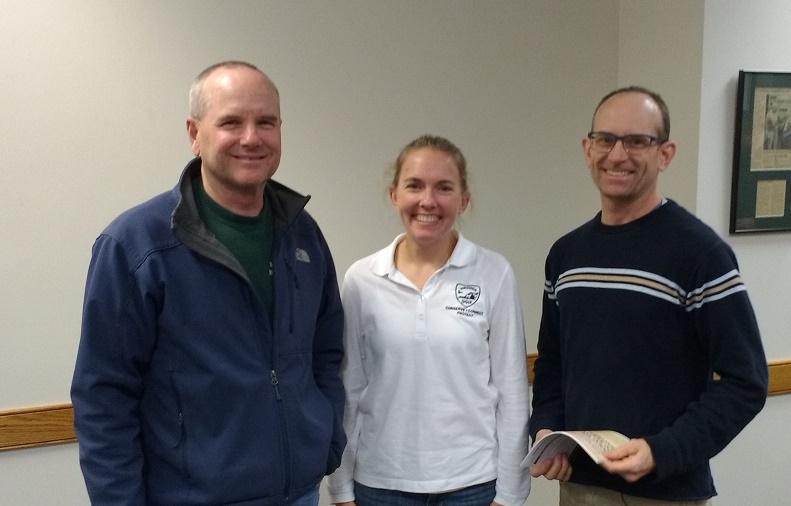
    Top photo is of Headwaters Chapter advisor and DGIF fisheries biologist Paul Bugas, Dr. Megan Kirchgessner, and HMN Program Committee chair Chip Brown.


  • Herp Hike 2018

    Herp Hike 2018

    cowknob.10.18.eli.lianez

    October 8 was a cool, foggy and breezy night on Reddish Knob when 10 Headwaters Master Naturalists and friends joined Billy Flint of James Madison University to look for and learn about terrestrial salamanders. The thick fog made driving up the narrow road tricky, but conditions were perfect for salamanders.

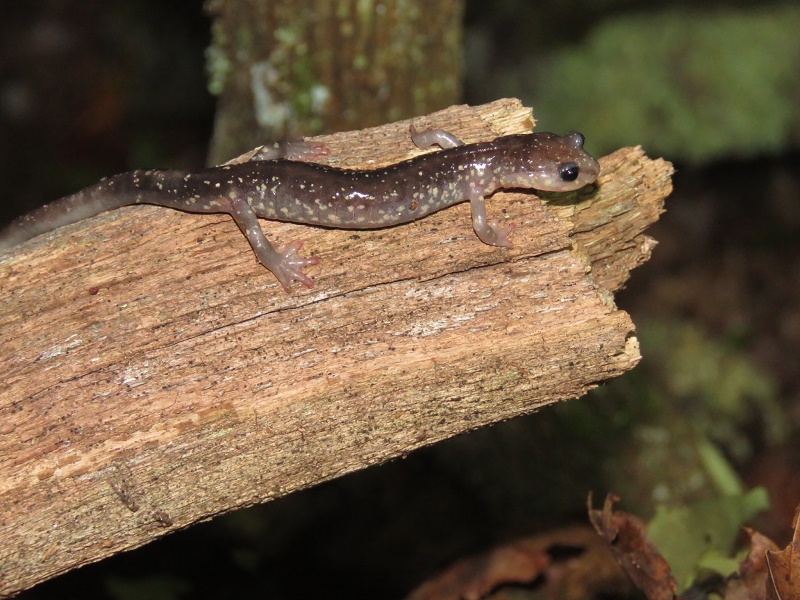
    The Cow Knob Salamander is an endangered species found only on Shenandoah Mountain and Elliot Knob. We also hoped to see the endangered Shenandoah Mountain Salamander. A quarter mile walk down the road from where we parked on top of Reddish Knob brought us to the Timber Ridge Trail on the east slope. This proved to be great habitat for Cow Knob Salamanders.

    We hit the jackpot and saw 8 or 9 Cow Knob Salamanders of various ages which had ventured out from beneath rocks and logs on a perfect night for them to feed. Billy Flint explained how they preferred rocky, north-facing slopes and moist conditions to keep them from drying out.

    Wet weather will bring out up to 10% of the area’s population according to Billy. They take turns emerging from the ground to check out feeding opportunities. Like other terrestrial salamanders, the Cow Knob Salamanders lay their eggs in the ground, nurture them there until they hatch and do not have an aquatic stage to their life cycle as do many other salamanders.

    We did not, unfortunately, see any Shenandoah Mountain Salamanders. These terrestrial salamanders also require selective habitats which are threatened by ongoing development and climate change.

    The more common and also terrestrial Eastern Red-backed Salamanders were maybe easiler to spot and found in even larger numbers this evening than the Cow Knob Salamanders.

    Many thanks to Billy for his fearless leadership and expertise; Malcolm for organizing the trip; the daring drivers who navigated the dark and foggy, narrow, winding road up Reddish; and to all the other participants for making it a rewarding and fun night out!

    – Malcolm Cameron, Cohort III, October 2018

    Photos at top and bottom are of Cow Knob Salamanders taken by HMN Merrilee Lianez’s son Eli Lianez.

    cowknobsalamanderonReddish.eli


  • HMN Night at Stokesville Observatory

    HMN Night at Stokesville Observatory

    StokesvilleObs2.600

    HMN Continuing Education Committee Chair Margaret Speicher arranged for Headwaters Chapter members to spend the evening of Friday, October 5th at the Stokesville Observatory to learn more about our extraterrestrial world from knowledgeable astronomy enthusiasts.

    Their were ten members and guests in attendance. The evening started with an interesting power point presentation about astronomy given by Earl Downs, a Solar System Ambassador with the NASA Jet Propulsion Lab. Topics covered included identifying constellations, interesting facts about nebulae, all about our solar system, different star temperatures, the Milky Way and how the North Star changes due to the Earth’s axis of rotation’s 26,000-year cycle of precession. He explained how the current north star (Polaris), in about 8,000 years, will change to be the star Deneb and in about 12,000 more years to the star Vega.

    Joey Reece, President of the Shenandoah Valley Stargazers astronomy club, assisted Earl in helping us navigate the night skies.

    Because it decided to rain that evening, there was no opportunity to view anything through the observatory’s telescope or open the roof but they gave us a thorough tutorial on the history of their telescope and how to work it. Margaret’s daughter was the star at working the handheld computer to set the telescope to find certain points of interest had it been a clear night.

    They invited us to come back the next weekend for the club’s open house to have an opportunity to view the night skies through the observatory telescope and interact with club members.

    Quite a few HMN members went the following week and had a delightful evening viewing the stars (and planets). Club members shared their telescopes and expertise finding planets Saturn, Mars and Jupiter, the Andromeda Galaxy and much more.

    A great CE opportunity for sure!

    – Chris Bowlen, Transferee, and Margaret Speicher, Cohort III, October 2018

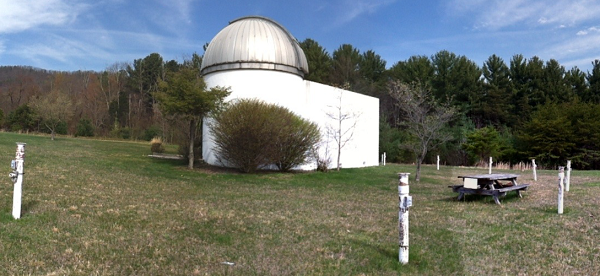
    Photo: “The back of the Stokesville Observatory showing the main tower and the circle of powered piers” by Rcc105 is licensed under CC BY 3.0