Category: Continuing Education

  • Peregrine Falcon CE Program 

    Peregrine Falcon CE Program 

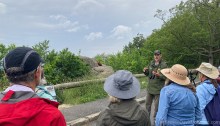
    Shenandoah National Park biologist Rolf Gubler addresses our group of Master Naturalists, June 7, 2022. Photo by Steven David Johnson.

    “It was AWESOME!”

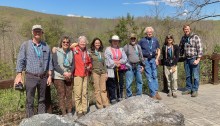
    On June 7th, a group of 15 Headwaters Master Naturalists arrived early to Franklin Cliffs (milepost 49) in the Shenandoah National Park to observe four young peregrine falcons and learn about the program that has been taking place annually in the park since 1989. The forecast was for rain and clouds to move into the area, but we were eager enough to beat the weather. In attendance were John Bauman, Kathy Byers, Malcolm Cameron, Lacey Dean, Tina Dove, Pam and Lincoln Gray, Anna Maria and Steven David Johnson, Diane Lepkowski, Kate Mahanes, Ann Murray, Zack Perdue, Peggy Plass and Elaine Smith.

    My cousin, Rolf Gubler, is nearing retirement as a park biologist, and kindly invited us. He and two other park employees (Cat and Matt) helped us observe the young peregrine falcons using spotting scopes and binoculars as the birds enjoyed an early meal. They told us the story of these particular birds. 

    These four chicks were hatched in a large planter box on a condo porch near Virginia Beach. Many of the previous chicks that were relocated, were hatched in nests located under bridges, where the fledging success rates are low due to being too close to the water and not having sufficient updrafts. Typical nests for these birds are called “scrapes”, just a small depression in some gravel!

    The chicks are relocated to a “hack” box, on a high cliff ledge, observed, fed, and protected from predators, such as raccoons. By seven weeks old they are full grown and making short flights. By late July, they begin extended flights of over 200 miles. Late August they leave the area, migrating south or east. Most of the chicks raised in the park move to the coast or near rivers. The park is hoping some will stay in the area. I’m planning to go back and hopefully see them in flight!

    – Ann Murray, Cohort II, with contributions from Elaine Smith, Cohort IV, June 2022

    Elaine’s Flickr album

    Steven David Johnson’s album


    June 30, 2022 photo by Cat McGrath at the SNP hack site. One of these young peregrine falcons is from the Richmond nesting site featured on the DWR Falcon Cam.

    The Virginia Department of Wildlife Resources hosts a peregrine falcon webcam in Richmond. It just concluded documenting the successful fledging of three chicks this spring, including one who was recently transferred to the SNP hack box site. Find the blog posts chronicling the nest activity HERE.

  • Quarry Gardens Tour

    Quarry Gardens Tour

    Our group at Quarry Gardens on April 16, 2022. Photo by Steven David Johnson.

    A recent continuing education opportunity provided a chance for Headwaters Master Naturalists to combine birding, geology, botany, history and getting together in person. The Quarry Gardens are located in Schuyler, Virginia. In 1991, Bernice and Armand Thiebolt were able to purchase 600 rural acres of land in Nelson County which included the abandoned quarry. 

    The quarry was mined for soapstone from 1890 to 1975. The Lynchburg Formation running through Schuyler is 1200 feet deep, and one of three sites in the world where soapstone is deep enough to mine. In the past, soapstone had a multitude of uses such as laboratory benches, sinks and laundry tubs among many other things.

    The quarry was filled with water and had been used as the local dump area for many years. The Thiebolts, with help from the Center for Urban Habitats, have worked diligently to restore native habitat for plants and animals: 950 species of natives are found on the property; 650 are plants. Using controlled fire burns to restore some of the areas has provided the opportunity for these species to thrive. The area was important to indigenous people and many artifacts have been found on the property.

    The Quarry Gardens comprise 40 acres with 30 galleries of native plant communities linked by 2 miles of trails that wander through piles of cast-off soapstone. The 40 acres of garden are surrounded by 400 acres of forest placed in a conservation easement. One of the first native communities we saw was a large area of fruticose lichen (a.k.a. Reindeer Moss). Umbrella magnolia tree, Hearts-a-burstin’ and yellow sessile trillium are just a few of the many other things that you can see there.

    Two avian highlights were Blue-headed Vireo and Yellow-throated Warbler. Thanks to Kathy Byers for the IDs!

    Don’t miss an opportunity to visit!

    – Chris Bowlen, April 2022


    Here is a sample of the photos you will find at the links at the bottom of this post (click on a photo to enlarge and advance as a slideshow):


    Botanical notes thanks to Sharon Landis:

    ·      Bank of Reindeer Moss is not moss, but lichen. Each piece could be hundreds of years old! Reindeer lichen needs good quality air to grow. The Reindeer moss was brittle and would crumble if touched.

    ·      They are testing different species of native grasses for use in various parts of the gardens to see which one looks nice when mowed.

    ·      Trout Lily needs two leaves before it flowers. Also called Adder’s Tongue, Fawn Lily, Dog-toothed Violet.

    ·      Devil’s Walking Stick has many spikes! This tree has the biggest leaves of any North American plant.

    ·      Pasture Rose (Carolina Rose) is similar to Swamp Rose. Swamp Rose likes wetter feet. 


    In attendance were: Chris Bowlen, Kathy Byers, Tom Engle, Phil Henning, Anna Maria and Steven David Johnson, Jay and Sharon Landis, and Elaine Smith. Big thanks to Phil for making the arrangements! And thanks to Elaine for hosting the outing and compiling this post!

    Link to Elaine, Chris, Jay, Sharon and Tom’s photos.

    Link to Steven David Johnson’s photos.

  • SNP Peregrine Falcon Population Restoration Program

    SNP Peregrine Falcon Population Restoration Program

    CE Opportunity for HMNs!

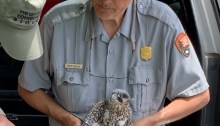
    Rolf holds a peregrine falcon chick for banding.

    On Tuesday, June 7, 2022, at 10am, Shenandoah National Park biologist Rolf Gubler will host a field visit to the park’s peregrine falcon (Falco peregrinus) restoration site at Franklin Cliffs Overlook (milepost 49). It will last about an hour. There will be an extra spotting scope set up, but if anyone has one, please bring it, as well as binoculars and cameras. The observation area is in full sun.

    Sign up in Better Impact and get CE credit.

    Participants limited to 16.

    This event will be postponed to Thursday, June 9 at 10am in case of bad weather: steady rain, thunderstorms, or even heavy cloud cover (no visibility).

    Shenandoah National Park’s peregrine restoration project is a longstanding partnership with the Center for Conservation Biology at William and Mary, the Virginia Department of Wildlife Resources and the Virginia Department of Transportation.

    For this cooperative project, partners bring peregrine falcon chicks from eastern Virginia bridge nest sites to a suitable cliff site (or “hacksite”) that mimics a mountain nesting area. These “foster” chicks are removed from specific bridge nests where fledgling survival has been low due the lack of updrafts at these nests. Biologists hope the young peregrines will imprint on the park’s cliffs and return as breeding adults in three to four years.

    The goal of this project is to boost peregrine populations in the park and the Central Appalachians where peregrine recovery has been slow. In addition, using at-risk Virginia coastal peregrines as hacking stock serves the dual purpose of improving the survival of these young raptors while restoring peregrines to the mountains of Virginia. This restoration work directly supports the conservation and long-term recovery efforts of state-threatened peregrines in Virginia.

    About Rolf Gubler – Biologist 
    Bachelor of Science – Wildlife Science – Pennsylvania State University
                                        Forest Science – Pennsylvania State University

    Mr. Gubler has worked with the National Park Service for over 33 years. Previous assignments at Shenandoah National Park have included Biological Technician, Environmental Protection Specialist, and Resource Management Specialist. Most of his professional experience has been focused on natural resource management. For the past 15 years, he has managed the terrestrial wildlife program, human-wildlife interactions program, and forest insect and disease program at Shenandoah.

    Big thanks to Ann Murray for facilitating this. It’s gonna be awesome!

    – Elaine Smith, CE Committee Chair, March 2022

    HMN contact for this event is Elaine Smith – smithes [at] jmu.edu.

    More about this project here: https://www.nps.gov/shen/learn/nature/falconhacking.htm

    More about peregrine falcons here: https://www.nps.gov/shen/learn/nature/falcon.htm

  • Safe Passage for Wildlife

    Safe Passage for Wildlife

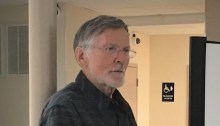
    Bear expert Mike Pelton giving a talk to Headwaters Master Naturalists on December 6, 2021.

    On December 6th, bear expert Mike Pelton presented photos, maps and information to a group of about 12 Headwaters Master Naturalists about improving wildlife corridors across roads in Virginia. With the fragmenting of undeveloped lands, wildlife increasingly encounters roads and traffic as they move through the landscape.

    Mike’s 50-year career has focused on researching bears, going back to the black bear research project he initiated in the Great Smokey Mountains National Park in 1968, which continues to this day. He has also coordinated the Southern Appalachian Black Bear Study Group. He founded the International Association for Bear Research and Management, and he is an Emeritus Professor of Wildlife Science at the University of Tennessee. So, this guy knows what he is talking about—especially when the topic is bears!

    While there are only two current projects aimed at modifying wildlife movement patterns that cross roads here in Virginia, Mike thinks that will increase in the near future as Virginia gets a large bump of infrastructure development money from the government. Other countries in Europe and Canada are far ahead of the USA in enacting safe passage for animals. And within the USA, Virginia is slow to get started. So, we have a lot of room to grow. Virginia is in the top ten states for deer-vehicle collisions. 60,000 deer are hit by cars a year in Virginia.

    The two main ways that safe passage is facilitated is by adding culverts under, or bridges over, major roads. Fencing helps funnel wildlife to use the strategically placed crossings. The Interstate 64 culvert crossing that was added in recent years on Afton Mountain has demonstrated a 92% reduction in deer collisions. Prior to the project Afton experienced nine deer collisions per mile per year. These projects are considered cost-effective if they decrease one deer collision per mile per year. These will do much more than that.

    Across the country, the motivator for building these bridges and culverts is usually charismatic megafauna like elk, bear, bison, and mule deer. But they benefit animals of all sizes.

    Interstate 81 traffic has tripled in the past 25 years and is expected to double again by 2030. Mike is interested in helping to figure out how to connect wildlife corridors between the Allegheny Mountains and the Blue Ridge Mountains, which will have to cross I-81 somehow. Currently the most likely spot for a successful project to connect these two regions is at Buchanan’s Buffalo Creek area.

    Headwaters Master Naturalists are lucky to have such a knowledgeable expert among us and available to us. Bears everywhere are lucky to have Mike Pelton on their side. We all can be encouraged that long-needed wildlife corridors are starting to get the attention they deserve in Virginia.

    Kate Guenther, Cohort I, December 2021

    Photos by Kate!

  • Wildlife Corridors in Virginia

    Wildlife Corridors in Virginia


    HMN CE Opportunity

    Monday, December 6 at 6:30 PM

    Arey Assembly Hall meeting room in the Bridgewater Town Hall
    201 Green St, Bridgewater

    Wildlife mammalogist Mike Pelton will discuss the importance of safe passage issues for wildlife in general, and specifically for large mammals in Virginia. Wildlife corridors are becoming critical as highways become death traps for mammals. These barriers also are erasing the connectivity of critical wildlife habitats. Mike will also discuss some of the methods to locate and create safe passages in Virginia.

    About our presenter:

    Michael Pelton is an Emeritus Professor of Wildlife Science at the University of Tennessee. For 32 years, he conducted 94 research projects on 18 mammal species. Black bears were his main focus. He and his graduate students delved into numerous aspects of the ecology and life history of black bears and other bear species internationally. Mike assisted numerous national and international private and public organizations and agencies on management issues regarding bears; several involved the impacts of human developments, including roads and safe passage corridors. Dr. Pelton was a founder and past president of the International Association for Bear Research and Management (IBA); this organization consists of 900 biologists and managers represented by 45 countries. From 1976 until 2000 he also was coordinator of the Southern Appalachian Black Bear Study Group, a consortium of biologists and managers responsible for managing black bears in the region. He is currently technical advisor to a variety of bear projects and wildlife organizations and agencies regarding bear issues. The black bear research project he initiated in 1968 in Great Smoky Mountains National Park is the longest continuous research project of any bear species in the world. In 2000 Mike and his wife Tamra moved to Virginia. Tamra is a Professor Emeritus at Mary Baldwin University. They currently reside on their mountain farm in Augusta County. Mike has 4 grown sons.

    The inclement weather backup date is Thursday, December 9 at the same time.

    Save your spot by signing up on Better Impact! Limited seating available.

    Brought to you by the HMN Continuing Education Committee.


    Find a helpful preview of this topic from Wild Virginia HERE.

    Check out the story map about Virginia’s successful wildlife fencing project along Interstate 64 HERE.