Category: Continuing Education

  • Rockingham Bird Club meeting

    Rockingham Bird Club meeting

    From the Newlen-Bradford Special Collections, Bridgewater College. Photo by Stephanie Gardner.

    Headwaters Master Naturalist Stephanie Gardner gave a most interesting presentation to the Rockingham Bird Club (RBC) on December 7 entitled “When Archives Take Flight: The Bridgewater College Birding Journal, 1918 and 1947 – 1950”. As the Special Collections Librarian at Bridgewater College’s John Kenny Forrer Learning Commons, Stephanie told the story of a composition book she uncovered while inventorying the Collection six or so years ago. Her interest was immediately captured when she saw it was labeled “Birds of Bridgewater”. The first of three sections in the book is a list of birds identified by Charles S. Driver while taking a class under a Dr. Scott in the spring of 1918. After doing some detective work, Stephanie uncovered that Charles Driver was a Bridgewater College graduate, but in 1916. Dr. Scott was probably a professor at Indiana University where Charles Driver did graduate work in 1918. So much for Birds of Bridgewater! There are 117 species listed, from Robin to Kentucky Warbler. Notes include taxonomy info, field marks, dates seen, and nesting habits (for many).  

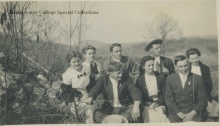
    Stephanie said that Charles Driver appeared to be quite socially inclined; here are some images from Special Collections of him with others. Note the string he is pulling to activate the camera in the second image; a hundred-year-old “selfie”. (Images from the Robert R. Newlen ’75 & John C. Bradford Special Collections, Bridgewater College.)

    This photo was probably taken by Charles Driver, who also directed the nature hike. But it doesn’t show him.

    For this photo, Charles Driver is pulling a string to activate the camera; a hundred-year-old “selfie”!

    Charles Driver is pictured here at back between the two young women in the bonnets.

    The second section in the notebook is titled “Birds observed in the vicinity of Bridgewater, Va  1947 – 48 – 49”. These pages list the first date in the year the species was seen, and some numbers observed. Of particular local interest is that Dr. Jopson (Harry “Doc” Jopson) and Max Carpenter were in the list of contributors. These two were founding members of the RBC and organized the first Christmas Bird Count in Rockingham County in 1954.

    Bridgewater College, Professor Harry G. M. Jopson showing cat skeleton to students, circa 1952. “Doc” Jopson was a founding member of the Rockingham Bird Club and, along with Max Carpenter, organized the first Christmas Bird Count in Rockingham County in 1954.

    The last section lists the 108 species of birds observed by a group of 65 on a Virginia Society of Ornithology field trip. They visited Silver Lake, Mossy Creek, and Hone Quarry on a sunny, 82°F, day in May 1950.

    In all three sections, it is interesting to see the numerous species which have since had their official names changed. Turkey Buzzards are now Turkey Vultures, Sparrow Hawks are now Kestrels, etc.

    Many thanks to Stephanie for her sleuthing endeavors in revealing this piece of local historic natural history and for the great presentation. We are most fortunate to have Stephanie amongst our group with her knowledge combining nature and archiving practices.

    For anyone interested in seeing this composition book, a copy can be downloaded from this page. Also, Special Collections are open by appointment; please contact Stephanie Gardner at sgardner [at] bridgewater.edu to schedule.

    – Art Fovargue, Cohort VII, December 2022
    Art currently serves as Historian for the Rockingham Bird Club
    .

  • When Archives Take Flight

    When Archives Take Flight

    From the Newlen-Bradford Special Collections, Bridgewater College. Photo by Stephanie Gardner.

    CE Opportunity!

    “When Archives Take Flight: The Bridgewater College Birding Journal, 1918 and 1947- 1950” with Stephanie Gardner

    The program for the Rockingham Bird Club‘s December meeting will be presented by HMN Stephanie Gardner. The public is invited.

    While inventorying treasures of the library vault, Bridgewater College Special Collections Librarian Stephanie Gardner rediscovered a historic birding notebook. This ledger has secrets to share and a few mysteries to explore. Stephanie will present a story about bringing modern methods of preservation and access to a historic manuscript and meet the fascinating people (and the birds) who make it a one-of-a-kind primary source.

    Wednesday, December 7 at 7PM
    Park View Mennonite Church, Fellowship Hall, 1600 College Ave, Harrisonburg

  • Stargazing

    Stargazing

    HMN-Led Presentation and Possible Future CE Opportunity for HMNs

    I led a small and informal stargazing session on Thursday, October 27, at Starry Meadows, a farm near Linville owned by Sharon and Jay Landis, participants in the most recent Headwaters class. They have been hosting numerous bird walks there, but had expressed an interest in taking advantage of their dark skies for astronomy outings. I intentionally limited the number of participants and did not post it on Better Impact, since I thought there might be technical and logistical problems on this first attempt. Although all went well, it took some time to find a suitable spot, not blocked by trees or buildings.

    We had a great time using binoculars and my conventional refracting telescope, but the images obtained by my EvScope, essentially a telescopic camera that can take very long exposures, seemed to create the most excitement. It has the particular advantage of being able to connect with smartphones and tablets, such that up to ten participants can view astronomical images forming over seconds to minutes. At top is an image of the Lagoon Nebula, a star-forming region in the constellation Sagittarius, with a cluster of recently-formed stars to the upper left.

    We are hoping to schedule such sessions with members of the Master Naturalist group in the future, with continuing education credit. We are also hoping to do some outreach to youth groups in the area.

    – Zack Perdue, Cohort VII, October 2022

  • Black Bear Tour 2022

    Black Bear Tour 2022

    HMNs Host Their Annual Tour of a Local Large Scale Composting Operation

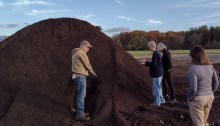
    Under a recent late afternoon, cloud-streaked, vivid blue sky, some 15 folks from around the Valley gathered at the compost facility in Crimora, run by Black Bear Composting, to learn how microbes are managed to turn waste into a valuable product. Owner/ operator Eric Walter walked us around the yard explaining how he controls natural processes to achieve this alchemy of sorts.

    Hosted by HMN members and Harrisonburg’s Community Compost Drop-off program coordinators Adrie Voors and Art Fovargue, this annual offering for HMNs and friends allows us to share about the fun and magic of composting on the large scale provided at the Black Bear Composting facility.

    We learned that the unassuming dark piles rising up around the yard are teeming with hard-working microbes enjoying a steady diet of carbon- and nitrogen-rich organic matter and oxygen. In the early stages of the composting process, their activity heats the piles up to 130-160°F which kills off organisms pathogenic to humans and seeds that would be problematic in the finished product. As the piles start to cool, other decomposers, including fungi and worms, move in to help complete the process.

    With a focus on kitchen scraps and yard waste from households, schools, and businesses, Black Bear’s collection service is available to subscribers from Charlottesville to Harrisonburg. Charlottesville, which has tiered public trash collection fees that incentivize diversion, provides the bulk of Black Bear’s collections. From delivery of the raw materials by the array of Black Bear collection trucks, through an active aeration period, curing, and finally screening, the process takes roughly six months.

    Thanks to HMN Kate Guenther, Watershed Administrator, Friends of the Middle River, our recent tour welcomed members of this Headwaters Chapter partner organization. They came with special appreciation of the fact that compost-amended soils have an amazing capacity to hold stormwater and filter out pollutants, thereby protecting the water quality of our streams. (Find a deeper dive into the water/compost relationship in soils from BioCycle HERE.)

    A big thanks to Eric Walter for always making himself available for these inspiring learning opportunities!

    – Adrie Voors, Cohort II, October 2022

    Photo at top shows our tour group being led through the composting process at Black Bear Composting by owner/ operator Eric Walter, October 25, 2022.

    Photos by Adrie

  • Salamander Hunt

    Salamander Hunt

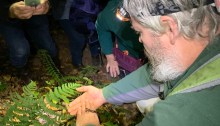
    Cow Knob Salamander crawling up Billy’s hand. Photo by Lacey Dean.

    On the evening of Saturday, October 15th, a group of about 12 master naturalists and friends
    met in Harrisonburg to carpool up to Shenandoah Mountain in search of salamanders and
    possibly other amphibians. Billy Flint, a James Madison University herpetologist who has devoted his life to studying salamanders and preserving their habitats, led us along the trail following the ridge south,
    looking for salamanders that might be out foraging or simply hiding under rocks or logs. Weather
    conditions were excellent for the comfort of participants, but the dry air was not so enticing to
    the salamanders. Billy had warned us that he had been out recently and seen not a single
    salamander. Although numbers were not large, he did manage to spot a Cow Knob Salamander
    as well as a rather lethargic Four-toed Salamander. Our search for a Shenandoah Salamander
    was unsuccessful.

    Cow Knob Salamanders (Plethodon punctatus) are currently listed as threatened. These terrestrial amphibians are of medium size, dark and spotted . They have a very narrow range of altitudes at which they can live, generally above 2500 feet, and have been found only in a few counties in Virginia and West Virginia along Shenandoah Mountain. They emerge from their hiding places under rocks and logs at night to hunt all manner of ground-dwelling arthropods. It was the habitat of this particular salamander that forced a rerouting of the Dominion pipeline, which had originally been projected to go straight through the middle of this fragile ecosystem.

    The smaller Four-toed Salamander (Hemidactylium scutatum) enjoys a much more extensive range from Southeastern Canada to the Gulf of Mexico and as far west as Oklahoma. These are not strictly terrestrial: although they mate and lay eggs on land, the larvae make their way to water after hatching.

    Even if we had seen no salamanders, the nocturnal hike was delightful in its own right. There is
    talk now of having a very different salamander hunting outing in the spring, looking for aquatic
    species.

    We were all very grateful to Mr. Flint for leading us on a truly unique outing. Thanks also go to
    Malcolm Cameron for organizing this unique excursion.

    – Zack Perdue, Cohort VII, October 2022