Category: Continuing Education

  • Gardening with Native Plants Talk

    Gardening with Native Plants Talk

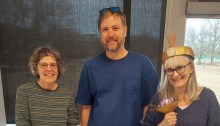
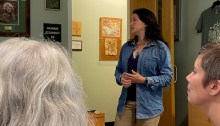
    Photos of Anna Maria, Ann and Peggy by Elaine Smith, June 14, 2023.

    Native Plant Brown Bag Presentation, Edith J. Carrier Arboretum

    On June 14, Anna Maria Johnson gave a great presentation on gardening with native plants at the Edith J. Carrier Arboretum at JMU. The room was packed with avid listeners. There were several HMNers in attendance (Ann Murray, Peggy Plass, Dave Forrer and Elaine Smith).

    After a nice introduction from the Arboretum Director Jan Sievers Mahon, Anna Maria started with a plug for the native plant gardening guide. Then she advocated for thoughtful use of the land, in order to share it with all the other “people” (plants, animals, bugs etc.).

    Key points she covered included:

    Ecological Gardening, which means choosing plants that feed and shelter wildlife, improve the soil and protect the water, as well as redefining “beauty” to include less pristine specimens.

    Some considerations: removing invasive species; using straight species vs cultivars; maximizing diversity; considering eco-regions; “mild, styled or wild” options of approaches, and not needing to be perfect.

    She discussed four kinds of diversity: species, structural, functional and genetic. She also urged us to “learn and edit our landscape, rather than trying to control it.”

    All in all, it was a wonderful presentation to a large, receptive audience!

    – Elaine Smith, Cohort IV, June 2023

    Reprinted (and adapted) from the June 2023 issue of the Shenandoah Chapter of the Virginia Native Plant Society’s newsletter, thanks to Elaine!

  • Lesesne State Forest Tour

    Lesesne State Forest Tour

    HMNs at Lesesne State Forest on May 6, 2023. Photo by Scott Jost, Cohort VIII.

    Saving the American Chestnut

    On Saturday, May 6, Headwaters Master Naturalists were treated to a tour of Lesesne State Forest in Nelson County by forester John Scrivani. Thanks to Malcolm Cameron and Elaine Smith for organizing and hosting the trip and to Malcolm for this report!

    John Scrivani retired from the Virginia Department of Forestry to work for the American Chestnut Foundation (ACF). He is the president of the Virginia Chapter of the American Chestnut Foundation and is involved with ACF at Lesesne State Forest.

    Lesesne State Forest was established in 1968 when it was gifted to VDOF by Mrs. Anne DuPont Vaulk for the purpose of research to save the American chestnut. It is adjacent to the George Washington & Jefferson National Forest in Nelson County and has several chestnut orchards and open fields within a total of 422 acres. ACF plants and crossbreeds American chestnuts there with Chinese and Japanese chestnut trees.

    The chestnut blight infected chestnut trees across its range in the Eastern U.S. in the early 1900s and by the 1940s they were mostly wiped out except for smaller shoots sprouting from the stumps. They were a foundation species before the blight and once comprised about 25% of Appalachian forests, serving as a key economic resource in many local economies. American chestnut trees were favored by fire which was more frequent in past decades.

    ACF employs various methods to crossbreed the chestnut species, primarily by covering the female flowers on American Chestnut trees with paper bags once they bloom in June and hand application of pollen from the Chinese or Japanese species. Less than 10% of the catkins have female flowers. These methods have resulted in hybrid species that are 15/16 or more of the American genotype. The chestnut trees start producing nuts at age 7 years. 

    Chestnut tree leaves. Photo by Elaine Smith.

    The ACF works with the State University of New York in aiding SUNY’s transgenic research in developing stronger chestnut tree hybrids. SUNY inserts genes from wheat into the American chestnuts and ACF of Virginia has planted some of those hybrids at Lesesne Forest. ACF at Lesesne strives for trees that are at least 80-90% American genotype and that have a blight resistance score of 60+. The score is largely determined by how well the trees are able to wall off the cankers in their bark and limit the impact to the tree health.

    The Japanese-American chestnut hybrids are more blight resistant than the Chinese hybrids. John’s tour took us through several orchards in the lower field with various back-cross hybrids and at the end of day he showed us the upper orchard where several trees that were irradiated for the blight had been planted. Most of those trees died and other trees were grafted onto the stumps in the early 80’s with mixed results. Some trees in the upper orchard were backcrossed with transgenic chestnut trees. 

    ACF plans to begin doing more plantings of hybrid American chestnut trees at various locations in the next few years. ACF Virginia has already planted hybrids in a few locations in the GWJNF.

    ACF Virginia welcomes volunteers to assist with their activities at Lesesne State Forest and elsewhere including at the VDOF nursery in Crimora.

    Malcolm Cameron, Cohort II

    Find more photos of the tour from Scott Jost HERE and from Elaine Smith HERE.

  • HMNs Attend Black Bears 101

    HMNs Attend Black Bears 101

    Part 1 Training for a Statewide “Living with Bears” Project Through the VDWR

    Headwaters Master Naturalists came together for a beary good training on the evening of Monday, April 24th. We met at the McKinney Center for Science and Mathematics at Bridgewater College to hear from the Virginia Department of Wildlife Resources (Virginia DWR) for “Black Bears 101: General Biology and Ecology of Black Bears in Virginia.” The program was presented by District Wildlife Biologist Justin Folks and facilitated by Courtney Hallacher, DWR Statewide Wildlife Education Coordinator, who has developed a bear awareness public education partnership with Virginia Master Naturalists.

    Black bears are the wild bears of Virginia. They were nearly wiped out after European settlement of Virginia but have made a comeback to their home range, and their range is most of the state. We learned a little about how the wild bear population is professionally managed in Virginia and how their population and their behavior fluctuate during low to high mast (fruit and nut production) years. Human/bear interactions also fluctuate between seasons with higher activity in warmer weather.

    We quickly learned that “bears are a walking stomach” and they are incredibly omnivorous and wily at acquiring food. We saw a series of pictures of a black bear balancing on a wire to reach a hanging birdfeeder. (Birdseed is surprisingly high in calories!) However, feeding bears is illegal in Virginia. This of course pertains to baiting bears for hunting and feeding them for wildlife watching. But it also means that it is illegal to unintentionally feed bears such as allowing them to get in unsecured birdfeeders, garbage, compost or beehives.

    We learned some of the recommended ways to deter bears from property. Folks recommended electric fences, hazing them with airhorns, and harmlessly shooting them with paint ball guns. However, for first encounters, he recommends just shouting or banging pots and pans to scare the bear off the property.

    Should someone encounter a black bear in the wild, calmly walk away (don’t run) while getting the bear’s attention by announcing your presence, perhaps by saying, “hey, bear.” Folks said the wild black bear will likely want to avoid human interaction. Bears cannot see well so they may stand up to get a better look and they may bluff charge. 

    He said that most problem bear situations in this area begin when a bear enters a yard to eat from a food source such as from a birdfeeder or pet food left outside. Residents often think such encounters are cute and do not deter the bear. However, bears quickly become habituated regarding where to easily find food and how to associate food with humans. Such habituated bears are hard to repel. They cause property damage, and they keep returning. And if a bear enters a human’s living structure or inappropriately makes contact with humans, the animal may be put down or “dispatched.”

    We also learned some about bear mothers (sows) and their cubs’ behavior. Folks said that biologists and conservation officers do not assume that a lone cub is orphaned unless the mother’s carcass is found. Often a mother will try to get her cubs to safety and come back later when she feels it is safe to retrieve them. Folks told about a situation at a garbage dumpster by which cubs were apparently left alone. The worried public came to frequently check on the cubs. VA DWR authorities suggested leaving them in peace, and the mother bear left with the cubs.

    We also learned some about humans’ reactions to black bears in trees in residential areas. Folks stated that if a bear is up a tree, it is either feeding or frightened. Again, the bear needs to be left alone by people, and dogs, before feeling safe enough to move to safety.  

    Mange, a sometimes devastating and highly contagious skin disease caused by a mite, is a problem that bears face in Virginia. Bears with mange should be reported to Virginia DWR at bearmange@dwr.virginia.gov  Or call the VA Wildlife Conflict Helpline: (1-855-571-9003). We heard a little about how mange has progressed and is managed in Virginia’s wild bear population.

    Finally, we learned about resources for living with bears in Virginia. Bear Wise (www.bearwise.org) helps people live responsibly with black bears. DWR operates a telephone VA Wildlife Conflict Hotline: (1-855-571-9003).  Linda Masterson’s “Living with Bears Handbook” revised and expanded second edition is another recommended resource. You can purchase the book through bearwise.org.

    The April 24th presentation was part one of a two part Living with Bears Training for Headwaters Master Naturalists. Those who attended may participate in the optional part two which will be Wednesday, May 10th at 6:30 pm, again at Bridgewater College’s McKinney Center, Room 124. Sign up for this session on the Opportunities calendar in Better Impact.

    After HMNs are fully trained by both sessions, we will be eligible to work with chapter coordinator Pam Gray on behalf of Virginia DWR to help educate the public about best practices for limiting negative human/bear interactions. You can read more about the program from Pam’s earlier article here: Living with Black Bears in Virginia. Or contact Pam for more information on this exciting new collaboration between the Virginia DWR and Virginia Master Naturalists chapters.

    – Stephanie Gardner, April 2023

    Photo at top courtesy of the Shenandoah National Park, from their Facebook post about being “Bear Aware.”


    From Living with Bears HMN project coordinator Pam Gray:

    Living with Black Bears in Virginia Part 1 Training is available in video for those who missed the in-class session on April 24th. It is not a recording of the class, but an official DWR training video. Those of you who were unable to attend Part 1 in person, but want to attend Part 2 and participate in the Living with Black Bears Project may watch this video (and earn the same CE) and be eligible for project participation.

    Also, VMN volunteers may watch this training video and receive CE credit just for watching, even if you’re not interested in working on the project for volunteer hours.

    You may watch this training video here:

  • Night Sky at Starry Meadows

    Night Sky at Starry Meadows

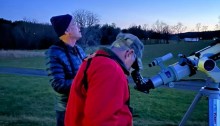
    Jay Landis at the telescope with Zack Perdue at Starry Meadows Farm. Photo by Sharon Landis.

    Headwaters members are treated to guided star gazing of the early spring sky

    On March 26, 2023, Zack Perdue led a stargazing party at Starry Meadows Farm in Linville. Sadly, this event had to be postponed due to cloud cover earlier in the week, so only four Headwaters members could come. The sky this night was clear and beautiful! Venus put on a show. So did the crescent moon. The bright moon did hinder some of our views, as even the Milky Way was not visible.

    We were able to see quite a few constellations: Andromeda, Orion, Cassiopeia, Canis Major with Sirius the Dog Star, Pleiades, Ursa Major, Ursa Minor, and even Mars with the naked eye and binoculars. Seeing the moon through a telescope with a moon filter lens was really a treat!  We all enjoyed using binoculars and Zack’s refracting telescope. We saw a reddish tint to Mars and that Sirius was bluer than Mars. Blue stars are younger and hotter stars. I learned that Cassiopeia is a constellation in the Milky Way, and how to use the moon to find Pleiades, Aldebaran, the fiery eye of Taurus the Bull, and Mars.

    We especially enjoyed seeing images on our own phones connected by Wi-Fi to Zack’s EvScope, a telescopic camera that can take very long exposures. 

    Using the EvScope we saw Sirius (so cool!), M42- Great Nebula in Orion, Uranus, M51-Whirlpool Galaxy, M1 Crab Nebula, and M46- an open cluster of stars with a planetary nebula in the middle! (A planetary nebula is not related to planets but is a cloud of gas shed from red giant stars late in their lives.) 

    Zack told us the “M” stands for Charles Messier, a French comet hunter. The Messier Catalogue might be the most famous astronomy catalog, detailing deep-sky objects such as galaxies, globular clusters, and nebulae. It includes some of the best objects to see in the night sky with a telescope. But the Messier Catalogue didn’t start out as a list of desirable astronomical objects: rather, it was Messier’s record of targets to avoid in the night sky since he was chiefly interested in comets. 

    Sharon Landis, Cohort VII, March 2023

    All photos by Sharon.

    Click on an image to start a slide show with captions. Thanks to Sharon for these great labeled shots and Zack for his expertise and cool equipment!

  • HMN Annual Meeting 2023

    HMN Annual Meeting 2023

    Past presidents Chris Bowlen and Brian Lux honor our newly elected Chapter President Peggy Plass with a crown and scepter on January 28.

    Thanks to the organizational skills of our outgoing Vice President and Programs Committee Chair Mary Gatling-Finks, last Saturday, January 28, we celebrated our 2022 accomplishments with our first in-person annual meeting in three years. Blue Ridge Community College in Weyers Cave graciously gave us use of their spacious meeting room in the Houff Student Center where we gathered for conversation, presentations, an election and a meal.

    In addition to brief reports from other board members, Projects Committee Chair Pam Gray provided a look at last year’s work as compiled for our annual report that was sent to the state office on January 10. Our numbers show good chapter member engagement in a wide variety of activities. She highlighted a few of these, then shared about a new activity she is coordinating involving community outreach to educate about Living with Black Bears. See Andrea’s notes below.

    Our annual election seated Peggy Plass as our new president, Carl Droms as treasurer, Lincoln Gray as Basic Training Committee Chair, and re-elected Adrie Voors to the Newsletter and Website Committee Chair position. Continuing in their Board of Directors’ roles from last year are Andrea Dono as Historian/Parliamentarian and acting Secretary; Jean Stephens, Membership Chair; Elaine Smith, CE Chair; and Pam Gray as Projects Committee Chair. Our Outreach and Vice President/ Program Committee Chair positions remain vacant. Contact a board member if you’re interested in filling either of these roles!

    After an abundant and delicious potluck meal, Isaac Matlock of the Clifton Institute and founding member of the recently revived Shenandoah Chapter of the Virginia Native Plant Society, provided a comprehensive look at his ambitious work in “Launching the Native Wildflower Seed Industry in Virginia,” with “Local Native Plants and Seed Collection,” and how we can help. See Andrea’s notes about this project below. Anna Maria Johnson, also instrumental in reviving the local VNPS chapter, gave us an update on her project of compiling a Ridge and Valley Plant Guide for VNPS. Our meeting concluded with a brief first meeting of our new board.

    2023 is off to a great start! Among our other activities, we’ll be welcoming 22 new members comprising Cohort VIII!

    – Adrie Voors, Cohort II, January 2023


    Thanks to Andrea Dono, Cohort V, for her skilled notetaking on the presentations below! And thanks to Andrea and Carl for their photos, also below.

    Pam Gray presents about an upcoming new bear project for HMNs.

    Department of Wildlife Resources Living with Black Bears in Virginia 

    Pam Gray, Volunteer Service Projects Committee Chair, and Shenandoah National Park Bear Patrol volunteer

    • Outreach project that helps educate the public on how to be bear-aware and how to live with bears. Focus is on residential areas. It just takes one food reward for a bear to start looking for easy rewards and breaking into homes, trash cans, bird feeders, etc.
    • 20,000 calories a day must be consumed before hibernation
    • Some bears can smell scents from 20 miles away
    • The growth of black bear population since the 90s has been significant even despite mange outbreak. We should see a boost in numbers in the SNP this year.
    • DWR wants to partner with us to train us to be educators. They offer Black Bear 101 training (which counts as CE) and teaches us the basics of bear behavior and what humans should do. This will be offered soon.
    • They would provide us with swag and informational materials.
    • The state’s black bear biologist will meet with the volunteer group for an intensive training. Then our volunteers will proactively reach out to community groups and festival organizers to begin doing outreach.
    • Pam is looking for folks to join her in launching this project for our chapter.

    More about this from Pam HERE.


    Isaac Matlock presents about native seed saving at our Annual Meeting, January 28, 2023.

    Native Seed Pilot Project and Wild Seed Collection

    Isaac Matlock, Native Seed Project Coordinator

    • He will submit a project for all chapters to consider but lives in Harrisonburg and is working with us first.
    • He is with the Clifton Institute that is a 501c3 that does education, research, and conservation based in Fauquier County.
    • Some of their work focuses on kestrels and foraging and nesting habitats, box turtles habitats, vernal pools research, and experimental grassland restoration.
    • Ecoregions are defined by abiotic and biotic patterns (geology, landforms, soils, vegetation, climate, land use, wildlife, and hydrology). Harrisonburg is in the mountains ecoregion (Alleghanies and Blue Ridge). The others in Virginia are piedmont and coast plain (swamps marshes flatwoods and river deltas). This is important as populations adapt to local sites. For example, switchgrass is influenced by the soil – the same species will look different in each of the three ecoregions.
    • Native seeds are used in meadow restorations, pollinator-friendly solar installations, roadside plantings. Many aren’t for sale commercially.
    • Small farmers (less than 5 acres) are participating in this new program.
    • Growing native seeds can be a high-value crop for farmers.
    • Target species: 18 plants including common milkweed, purpletop, narrow-leaf mountain mint – they aren’t spring ephemerals or hard to grow. The list is here.
    • Timeline for the project (in fall/winter)
      • Build database of seed collection localities
      • Develop seed collection protocol
      • Obtain permission
      • Clean and process seeds by Ernst Seed company pro-bono
      • Meet with prospects
      • Prepare plots for out-planting
      • Build greenhouse at Clifton Institute
      • Sow seeds for greenhouse in March
    • Spring /Summer
      • Grow seedlings
      • Set up demo plots
      • Meet with farmers and provide technical assistance
      • Weed
    • Probably won’t get seeds the first year.
    • They have a protocol volunteers will follow (permission, confirm positive identification, population size assessment, ensuring that plant has at least 50 in population producing seed so you can conduct a sustainable harvest, take photos).
    • There are many different types of seeds. Some examples are ballistic, fluffy, milkweed, shakers, beaks, shattering, hitchhikers
    • Seed maturity is important, you need to know when the seed is ready to collect. iNaturalist is a great resource to help you identify when a seed is ready and when it is too early or too late. Usually if you can squeeze a seed and it doesn’t break, then the timing is right. Old seeds also aren’t good to collect.
    • There are a lot of resources to help you identify plants and confirm they are native to Virginia as well as what a mature seed for each plant looks like.
    • There are specific ways to store seeds properly.
    • They hope to have access to DWR land for this project. Working on this now.
    • The national parks base their permits on research and this project is not research-based. This project probably won’t happen in national parks for this reason.
    • For now, you can use this form to get involved.

    Logo for the Ridge and Valley Native Plant Guide. Artist Elise Lintelman.

    Northern Ridge and Valley Native Plant Guide Project Update

    Anna Maria Johnson, Cohort VII


    Click on any image below to start a slide show of the photos and see captions.