Category: Training

  • Headwaters Entomology Event

    Headwaters Entomology Event

    Photo by Steven David Johnson.
    Photo by Steven David Johnson

    Held at the confluence of the North and Dry Rivers

    Rescheduling the canceled Bug Dance at Wildwood Park proved to be quite a challenge, but we managed in the end to match availability dates and a fantastic location at the confluence of the North and Dry Rivers in Bridgewater on the evening of September 5th.

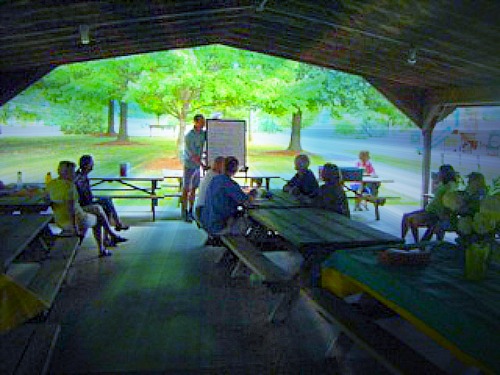
    We all met on the property of Shelia and Sanford Helmuth situated on the banks of the North River. Chapter Vice-President and Program Chair Ann Murray brought wood and quickly made and excellent fire so we could roast the s’mores for which she also brought the ingredients. Headwaters member Janet James brought her daughter Jenna and her husband Tom Benzing. Other Headwaters members participating were Stephanie Gardner, Judy Tammi and RoxAnna Theiss. Joining in on the fun were some of our “Trainees in Waiting”: Stephen Pietrowski who discovered he lived on the same street in Staunton as our entomologist, Brian Lux and Kathy Byers who carpooled together from Harrisonburg as well as Anna Maria Johnson and her nature photographer husband Steven.

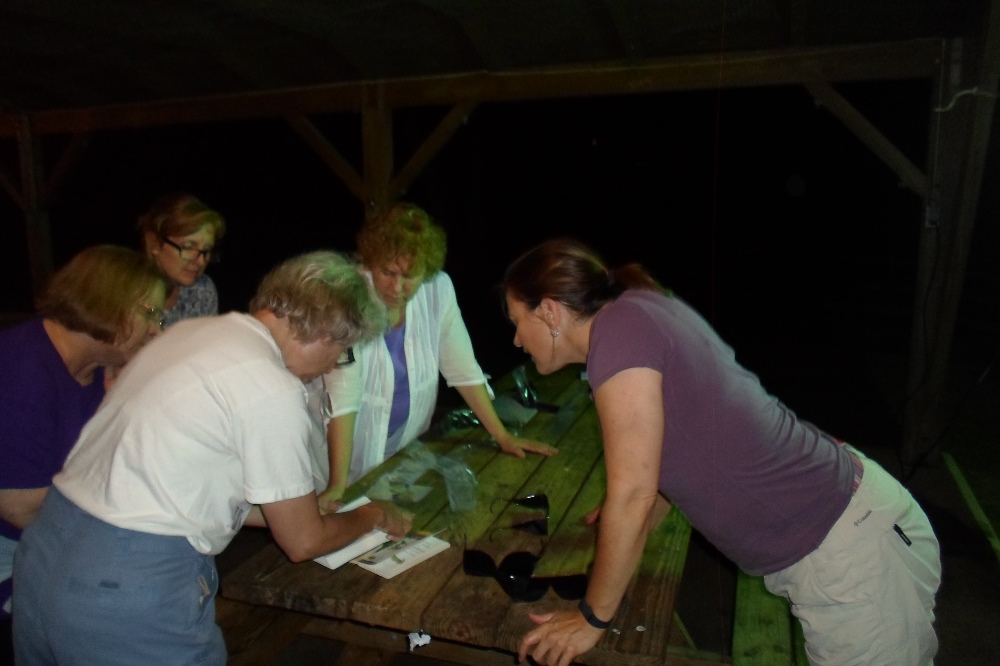
    Our entomologist, Edie Kretch, instructed us on the variety of flying insects attracted to the Mercury Vapor light set up with a white sheet to aid in identification. We saw several species of adult caddisfly – Jenna Benzing is skilled at these identifications. The caddisflies are an order, Trichoptera, of insects with approximately 12,000 described species. Caddisflies have aquatic larvae and are found in a wide variety of water habitats. These macro-invertebrate larvae are among those used to determine stream health in our benthic monitoring projects. The larvae of many species use silk to make protective cases of gravel, sand, twigs or other debris.

    We also saw several species of the Geometrids and a variety of small beetles and moths – like the leafrollers. Although we collected a variety of our bugs in glass jars and used magnifying glasses to help examine them, identification was difficult no matter how hard RoxAnna tried to find them on her laptop at the Encyclopedia of Life website. We did learn something about life cycles, insect anatomy and habitat ecology though. The big bugs did not come to our sheet that night but we got to know each other better and we also had fun roasting and eating our s’mores.

    It was a good evening for bugs and Headwaters.

    – RoxAnna Theiss, September 2014

    Find more photos of the event by Steven David Johnson on the Headwaters Chapter facebook group page. Please join the group if you haven’t yet. The photos are probably not visible to you otherwise.

  • Exploring Maple Flats Ponds

    Exploring Maple Flats Ponds

    The Headwaters Chapter of the Virginia Master Naturalists is inviting the public to join them in exploring the special sinkhole pond ecology of the Maple Flats Ponds in the George Washington/Jefferson National Forest near Stuarts Draft on Sunday afternoon, September 7 from 2:00 – 4:00 PM.

    Home to rare and endangered plants and animals, these Shenandoah Valley sinkhole ponds are at least 15,000 years old, dating from the end of the Pleistocene epoch.

    butterflyweed
    Asclepias tuberosa, butterfly weed

    We’ll have two educational experience stations with some easy hiking in between by which to gently explore this unique geological and ecological treasure:

    • Plant life and history with Dr. Eric Jones,

    Botanist and Ecologist from Mary Baldwin College, Headwaters Master Naturalist, and author of the online resource: Wildflowers of Augusta County, VA.

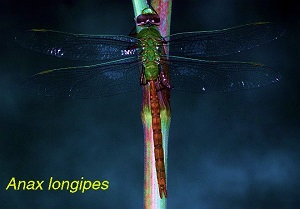
    This dragonfly is only found in 3 places in Virginia, one of them is Maple Flats.
    This dragonfly is only found in 3 places in Virginia, one of them is Maple Flats.
    • Dragonflies 101 with Edie Kretsch,

    Entomologist and Master Naturalist, formerly at Douthat State Park, and now with the Virginia Department of Game and Inland Fisheries.

    An introduction to dragonfly natural history and behavior, identification and monitoring. Maple Flats sinkhole ponds are home to 55 species of Odonata dragonflies and damselflies, many rare and endangered.

    Bring binoculars if you have them!


    Maple Flat PondsThe Maple Flats Ponds are about 45 miles from Harrisonburg, 25 miles from Staunton and 12 miles from downtown Waynesboro. Click on the image at left to find Google map directions to Maple Flats Ponds. You will access the Ponds from Forest Road 42, the Coal Road. You’ll see a semi-circular parking area on the right marked with big boulders. If that’s full, go ¼ mile further to the next parking pullout.

    Parking is limited … please consider carpooling. You may meet at 1:30 at the Park & Ride at Shenandoah Village on Rt. 340, Waynesboro exit.

    A light rain won’t cancel this event.

    Event coordinator and contact: Sandy Greene: 540-487-1224, greenes104[at]aol[dot]com

    Virginia Master Naturalists can earn two hours continuing education credit at this event!

    Sign up through VMN VMS or give Sandy a call if you plan to attend. … Or use the contact form below. Any of these options will constitute “registration” or “signing up” for this event. 🙂

    ← Back

    Thank you for your response. ✨

  • Wildwood Bugs Night Out

    Wildwood Bugs Night Out

    SAM_1119_ConvertedWe Came to See What Would Show Up

    Although our Entomologist felt it wise to postpone the Entomology Event on August 22nd due to unsettled weather, a few determined bug lovers showed up just to see what we could get to come to the Mercury Vapor light.

    Gail Napora joined Betty Forrest and RoxAnna Theiss of the 2011 class and gave an impromptu talk on the Monarch Butterfly – one of her special interests. Adrie Voors came with her trusty point and shoot and helped get the light and sheet set up which worked just fine although we did not draw any big bugs to said sheet. What we think was an Io Moth did flit over our heads briefly.

    flickermothTrainee in Waiting Elaine Smith came with two friends: Rinn shared some of her photos on Flicker.

    Gail also brought some “faux” s’mores that were wonderful! So we owe her a double thank-you for her valuable input to the evening!

    We are trying to get some identification going of the bugs we saw, but that is taking some time. We did identify the Hebrew Moth and a caddis fly or two. A lonely cicada showed up for the party and maybe even some chiggers – Elaine ended up with some nasty bites on her bare legs – the rest of us wore long pants.

    But we had a good time enjoyed some new and renewed friendships and, of course, it never rained or thundered – not a drop, not one clash or flash.

    Event rescheduled for Friday, September 5th on the banks of the North River.
    See VMN-VMS for details.

    – RoxAnna Theiss, August 2014

    SAM_1136_ConvertedSAM_1134_Converted

  • Reflections and Relaxed Revelry  at Oakdale Park

    Reflections and Relaxed Revelry at Oakdale Park

    training.strategy.pmWe were not many but we were a perfect mix of the three Headwaters classes to date.  Sandy Greene, Gail Napora and Betty Forrest from the first Basic Training class in fall of 2011 met with Carl Droms, Judy Tammi and Ann Murray from the 2012-13 class joined by Bob Forrest, Malcolm Cameron and Janet James of the 2013-14 class to reflect upon their Basic Training experiences.

    Fortune smiled upon the endeavor when Rob Alexander from our 2012-13 class offered to facilitate the evaluation event.  We gathered at the Oakdale Park shelter #3 at 3pm on Friday, July 18th along with a crowd of Little League enthusiasts who were in Bridgewater for a weekend Play-off Tournament.  Parking was a problem but we managed.

    Joining in on the process were Anderson “Andy” and Frances Sales who have recently transferred to Headwaters from the Central Virginia Chapter in Lynchburg.  They generously agreed to be record keepers for each break-out group, so that each participant’s focus could remain on the tasks at hand and we could move quickly from break-out group to break-out group. RoxAnna Theiss was a record keeper as well.

    We had three participants in three break-out groups for three separate rounds.  The first round mixed the participants so that each Basic Training class was represented in each of the three groups.  Note taking/record keeping was facilitated by color coded paper upon which each HMN recorded first the one-word associations of his or her experience in Basic Training and then gave oral reports of their most memorable experience which the keepers recorded for them.  For the second break-out session the groups were reformed so that the HMNs were in groups representing their Basic Training class entirely.  This time they were asked to write down their expectations of the training experience and then discuss what expectations were met or not met.

    These expectations were then reported out to Rob and he recorded the responses on large flip chart sheets along with the notations regarding the realizations (or not) of each.  With these exercises accomplished the three groups were then reformed as mixed Basic Training classes to first brainstorm and then discuss which elements of their training they would Add, Remove, Intensify or Modify.  Time constraints prevented us from reporting out to the big sheets but the keepers did a fine job of recording the discussions and Rob assured the participants their efforts would be reviewed by the Training Committee over the next year to develop and deliver a consistent, common training experience for HMN trainees.

    Carol Heiser, DGIF who generously gave her time to speak to our chapter prior to the July Board meeting the previous day, reinforces this aim of a common and consistent training experience.  Carol is on the State Steering Committee for the VMN Program and updated those present on the state goal to offer a standardized template for Chapter Basic Training within the next year or so.  This is something the Training Committee must also consider in the development of future Basic Training.

    With the formal part of our evaluation job complete by 5pm we sat down together to enjoy the company, learn more about each other and partake in some wonderful food brought by all.  Talk and relaxed revelry continued until about 7pm when we all bid each other adieu until next time.

    – RoxAnna Theiss, August 2014

  • Opportunity knocking!

    Opportunity knocking!

    trainingflyer1

    Update September 2014: this Fall basic training class has been postponed until Spring 2015. Contact us at headwatersmn.info[at]gmail.com to stay informed about the application process. Thanks for your patience!

    It’s arrived! Our chance to share our chapter’s amazing learning opportunity with our friends, families, community at large. More than discovering secrets and relationships of the natural world around us, becoming a Master Naturalist is also an opportunity to make a difference through the collaborations and status afforded Master Naturalists and to find community among a gifted group, passionate about all the creatures, plant life, rocks, soils, and waters … that make our life possible.

    The Headwaters Chapter is now taking applications for its 2014/2015 basic training class! Class starts in early September and will again be held at the Community Center of the Bridgewater Retirement Community. The weekly three hour sessions on Thursday afternoons will be supplemented with plenty of weekend field trip possibilities. As done with the previous two classes, the training course will be divided into two 10 week sessions, one in the fall and one in the spring, with a long winter break offering opportunities to hone your skills.

    Applications are currently due on August 1, 2014, but this date may be extended as needed. More information here. Please contact RoxAnna with questions or concerns at headwatersmn.info[at]gmail.com.