Category: Training

  • Wilderness First Aid: Another Way to Make a Difference

    Wilderness First Aid: Another Way to Make a Difference

    Margaret fixing up RoxAnna.
    Margaret fixing up RoxAnna.

    Six Headwaters Master Naturalists and one interested individual met over the weekend of June 28th and 29th to learn from Brad and Paula Neher of Emergency Prep in Harrisonburg about handling common injuries and illnesses in the field when medical care is an hour or more away.
    boy scout quoteBut first things first: let’s define what’s meant by Wilderness First Aid.  Wilderness First Aid (WFA) is the assessment of and treatment given to an ill or injured person in a remote environment where definitive care by a physician and/or rapid transport team is not readily available.   In addition to assessment and treatment, possible emergency containment techniques might be taught.   Going beyond what you may know as “first aid”, you discover the deeper purpose of WFA is to train participants to prevent acute situations and only when necessary, manage them.  While it contains substantial medical information and teaches skills required for medical emergencies in the wild, the bottom line is this: it’s more effective to prevent an incident than to manage it.  But accidents do happen and better decision-making at the incident scene miles from medical facilities or help can save valuable time and human resources.  It can save lives too.

    Malcolm stabilized.
    Malcolm stabilized.

    Generally speaking, any WFA course is a 2-day training that provides introductory medical skills to those of us who may be involved with group activities in remote environments.  Through a hands-on and scenario-based approach, WFA offers the skills and confidence needed to make informed medical decisions when accidents happen in these remote locations.  The WFA course includes short lectures along with increasingly challenging practice scenarios that help us master the central concepts of remote medicine and learn effective responses to an emergency.

    Here’s the typical practice scenario outline: Accidents happen.   People get hurt, sick, or lost.   The temperature drops, the wind picks up, and it starts to rain.   What can you do to offer positive and worthwhile help?   Although many backcountry emergencies are preventable, when bad things do happen sometimes the wrong care can make things worse.   By learning a few basic skills, you can make the difference between a good outcome and a bad one.

    Making that difference is what we worked on the weekend of June 28/29.  It surprised me how clear it became, when faced with a simple beginning scenario, how unprepared I was.  We learned how to assess the situation for safety, how to safeguard ourselves and then how to address primary and secondary patient assessment using simple mnemonics and acronyms.  Using “at hand” materials we practiced splinting, bandaging and dealing with shock, hypothermia, heat exhaustion and heat stroke among other conditions such as insect bites, snakebites, allergies and anaphylaxis.  It was a lot of information to assimilate but it was thoroughly engaging and we felt fully supported by the teaching team of Brad and Paula.  They watched us closely and listening to our questions responded with thoughtful care and whatever detail we needed.  The practice scenarios were both inside and outside and we got pretty darn creative with them.  My comfort level increased and I moved from “frozen” to decisive.

    Courtney attended to by Jo-el and Heather Lantz.
    Courtney attended to by Jo-el and Heather Lantz.

    This WFA course was a re-certification for Malcolm Cameron and he felt the training here in Harrisonburg was comparable to the SOLO training he received almost two years ago in Charlottesville.  He even learned some new things.  Courtney Hallacher liked the small size of the class and felt the learning achieved was well worth the time spent: although a model of shorter classes over a longer time frame would have been her preference to aid in memory retention.  Margaret Speicher greatly appreciated the hands-on practice scenarios and was pleased the course did not go for distracting and overly graphic injury drama.  Jo-el Nelson also felt the course met her expectations and echoed the same willingness expressed across the board to consider this course for WFA re-certification. Sue Eckroth was unable to complete the second day of the course but plans to finish with the next group that goes through WFA. Personally, I found the course to be very valuable in exposing my own deficiencies regarding the “how tos” in handling an acute emergency situation and increasing my comfort level with challenging situations.  I remain mindful of the need to “practice” these skills regularly.

    With that in mind, the Chapter can look forward to seeing some WFA concepts incorporated into the Basic Training and Advanced Training programs.  It will be eye opening.  I guarantee it!   – RoxAnna Theiss, photos courtesy of Paula Neher of Emergency Prep

  • Future of Citizen Science

    Future of Citizen Science

    VMN Citizen Science Coordinator David Mellor recently launched CollaborativeScience.org.
    VMN Citizen Science Coordinator David Mellor recently launched CollaborativeScience.org.

    The May 21, 2014, Headwaters Chapter Virginia Master Naturalist Basic Training Class included of a panel of experts who discussed the exciting and growing world of citizen science. David Mellor, Ph.D, chair of the panel and Citizen Science Coordinator of Virginia Master Naturalists, began by challenging panel members to define the concept of citizen science. Panel members agreed that citizen science is scientific data collection, research and analysis carried out by a person who is either not a professional scientist, or as David stated, who is doing unpaid scientific work.

    Panel members discussed the increasing popularity of citizen science, the varying opinions of professional scientists regarding data collected by volunteers, the role of citizen scientists in the scientific process, and ways that citizen science may increase the scientific world of knowledge. The panel also discussed the possibility of citizen scientists as advocates who use their data findings to educate others in the community.

    Panelists Michelle Prysby, Tom Benzig and Kate Guenther
    Panelists Michelle Prysby, Tom Benzig and Kate Guenther

    Headwaters Chapter Virginia Master Naturalist Kate Guenther and visitor Wayne Webb of the Lord Fairfax Soil and Water Conservation District were two panel members who currently practice citizen science. Both Kate and Wayne spoke of a deep-seated interest in collecting scientific data to study the natural world. Audience members learned that many citizen scientists, such as Wayne, have careers as professional scientists before volunteering as retiree citizen scientists.

    Panel members Thomas Benzing, Ph.D., an Integrated Science and Technology professor at James Madison University and Michelle D. Prysby, Director of Science Education and Public Outreach at the Graduate School of Arts & Sciences, University of Virginia, talked about their work with citizen science projects and discussed the ways citizen science contributes to the scientific process.

    Karen Andersen, Program and Laboratory Director for Friends of the Shenandoah River, spoke as a panel member with firsthand accounts of how data collected and analyzed by citizen scientists is perceived by the scientific community. She stressed how the professional scientific community holds citizen scientists to a high standard of accuracy. She noted the struggle to have citizen-collected water monitoring results recognized as valid and authoritative data.

    Panel members agreed that citizen science is an important and growing field. New technologies, such as geographical and biotechnology, will allow even greater forms of future data collection. David stated how new programs are being developed for Virginia Master Naturalists who wish to volunteer as citizen scientists. David is interested in projects that allow volunteers to not just gather data but to analyze and format questions and hypotheses using their collected findings.

    The evening also included an amazing meal with curry by Sandy, rice and condiments by Judy and bread by Bob. Everyone went home both better educated and well nourished.

    – Stephanie Gardner


  • American Chestnut Appreciation

    American Chestnut Appreciation

    Goin’ up to Reston, Reston, Reston …

    Headwaters own Betty Gatewood - woman of many talents!
    Headwaters own Betty Gatewood: educator, artist, Master Naturalist!

    Three Headwaters members set out on Sunday morning, January 19th to the Walker Nature Center in Reston, Virginia, to hear one of our own present on the History of the American Chestnut as a teaching story for children.  RoxAnna and Betty Forrest are from the same Headwaters 2011 Basic Training class as Betty Gatewood – the program presenter.   Stephanie joined the Headwaters Chapter from the New River Chapter in Blacksburg and provided safe navigation to our Reston destination.

    On the way, Betty Forrest expressed her excitement over hearing that Betty Gatewood was going to talk about the American Chestnut.  She shared with Stephanie and RoxAnna how very important to Betty G. and her husband Mark the restoration of the American Chestnut trees is.  Of Betty Gatewood she says: “Betty G. always greets you with a smile and you know she is going to  impart knowledge in a very exciting manner, with her excellent illustrations of plants on her book marks.  Both Betty and Mark are avid hikers and are perfectly suited to be the ones to talk on this cause”.

    We reached the Walker Nature Center in plenty of time to meet some of the other participants.  The small conference room was filled with an assortment of attendees to the tune of over twenty people.   The Virginia Master Naturalist Program was well represented.  In addition to our Headwaters Chapter, the VMN Pocahontas Chapter based in Chesterfield County and the Richmond Metro Area and the VMN Banshee Reeks Chapter 
based in Loudoun County joined members of The American Chestnut Foundation (who organized and sponsored the event), the Virginia Master Gardeners Program, the Frontier Culture Museum, Fox Haven Nature Center and Johns Hopkins Environmental Studies Program to be guided by Betty’s experiences and hopes for the future of children and young people learning from and in the natural world.

    The American Chestnut, Castanea dentata, was one of the most important eastern forest trees before being practically eliminated by the airborne bark fungus causing chestnut blight.
    The American Chestnut, Castanea dentata, was one of the most important eastern forest trees before being practically eliminated in the early 1900s by an airborne bark fungus causing chestnut blight.

    The program began with introductions by all attendees.  Betty G. then presented a number of excellent resources that educators can use in teaching the history, preservation and reintroduction of the American chestnut. The resources we were shown place emphasis on hands-on learning and are curricula that focus on getting children outdoors.  Betty noted how a variety of learning goals can be met with such outdoor education.  Through work with American chestnuts, children will learn and improve skills of observation, problem solving, use of technology and stewardship of resources.  Outdoor education is also beneficial to children’s physical and mental health.

    The American Chestnut Foundation is a great source of chestnut related information and learning activities.  We were shown their Charlie Chestnut curriculum for elementary and junior high age students.

    Presentation attendees enjoyed exploring the Chestnut Learning Boxes on our tables.  The boxes are available from The American Chestnut Society.  These big plastic tubs contain binders with curricula detailing activities using the box’s many specimens including leaf samples, burr specimens and tree ring slices.  The learning boxes are designed for junior high and high school students.

    The American Chestnut Foundation –VA Chapter is very active, hosting citizen science opportunities and providing learning resources.   Presentation attendees were introduced to the Appalachian Trail Mega-Transect Chestnut Data Project, an effort using volunteers to identify, map and collect data on the American chestnut trees along the Appalachian Trail.  Details are found on the VA Chapter website.

    We also learned of the Trail to Every Classroom Project of the Appalachian Trail Conservancy and the National Park Service. This program provides resources enabling teachers of kindergarten to high school-aged students to use the Appalachian Trail as a site for service learning.

    The Virginia Governor’s School is another institution that is building science, technology and problem solving skills in young people through innovative hands on education.  We learned of a cutting edge scientific project carried out by students concerning the preservation and reintroduction of the American chestnut.  The Valley/Ridge Regional Summer Governor’s School serves our area and has a component at James Madison University.

    And just as Betty Forrest promised, a final highlight of the presentation was the lovely bookmarks given to us by Betty Gatewood and featuring her beautiful watercolor artwork of chestnut burrs and leaves.  Thank you, Betty!

    After the presentation, some participants went for a brief hike outside the Walker Nature Center. We visited a young American chestnut tree on the property.  It was good to see a living example of what we discussed in the presentation. We enjoyed searching for and examining leaves dropped by the chestnut.  Unfortunately, the tree we saw had the chestnut blight.  It is being monitored frequently by one of the many talented volunteers we met at the program.

    Betty’s program provided Virginia Master Naturalists with a variety of excellent resources we can share and use in education.  There was a focus on young people as future stewards of the American chestnut.  We met many dedicated people who are realizing this goal by actively teaching future generations how to appreciate and preserve nature.

    By Betty Forrest, Stephanie Gardner and RoxAnna Theiss

  • When Continents Collide – Rocks Get Messed Up:

    When Continents Collide – Rocks Get Messed Up:

    Rodinia, Pangaea, and the rise of the Appalachian Mountains

    Story and pictures by: Tom Long, Fort Valley Community Center, December 19, 2013

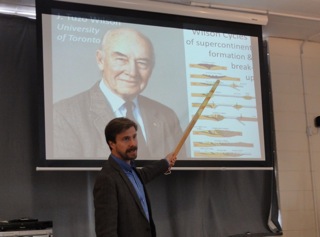
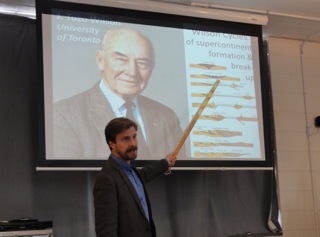
     Callan Bentley begins his description of the Wilson Cycle.

    Callan Bentley begins his description of the Wilson Cycle.

    A full morning of exciting geology activities awaited about a dozen members of Headwaters Chapter of Virginia Master Naturalists who made the trek to Fort Valley Community Center. But before the learning began there was time for a bit of socializing over coffee, juice, and pastries between members from each of the chapter’s three classes.

    First up was Callan Bentley’s high energy presentation on the Wilson Cycle, the process by which continents collide to form supercontintents and then rift to form small and more continents. Using layman’s terms and stunning graphics, Bentley, an assistant professor of geology at Northern Virginia Community College in Annandale, described how the collisions and rifts of supercontinents of Rodinia (between 1.1 billion and 750 million years ago) and Pangaea (between 300 million and 200 million years ago) reformed rocks while creating folds in the Earth’s crust that formed Virginia’s mountains. Saying “the present is key to the past,” Bentley explained how current geological processes along with fossil evidence, the continuity of mountain chains, and paleomagnetic studies support the theories of continental drift.

    After a short break, Dr. Eric Pyle, a geology professor at JMU, lead a hands-on presentation called “Sticky Rocks.” Not having millions of years and the tremendous heat and pressure of continents crashing into each other to “make and remake rocks,” we used a toaster oven, hard candy, and rock samples to recreate some of the common, and commercially valuable, rocks found across the Commonwealth. A specialist in geoscience education, Dr. Pyle used his demonstration to not only teach Headwaters Master Naturalists, but to demonstrate how science education can be fun and assessable to all ages.

    Wrapping up the day, Callan Bentley made a brief presentation on “Snowball Earth” explaining how some 650 million years ago the Earth’s surface was believed to be almost totally frozen. The theory offers answers on how glacially formed sedimentary deposits are found in tropical regions.

    Headwaters Chapter shouts out a big Thank You to Callan Bentley and Eric Pyle for enlightening and entertaining us. Thanks also to RoxAnna Theiss for organizing the symposium and to Fort Valley Community Center for the generous use of their facility.

  • Class of 2012-2013 in Video

    Class of 2012-2013 in Video

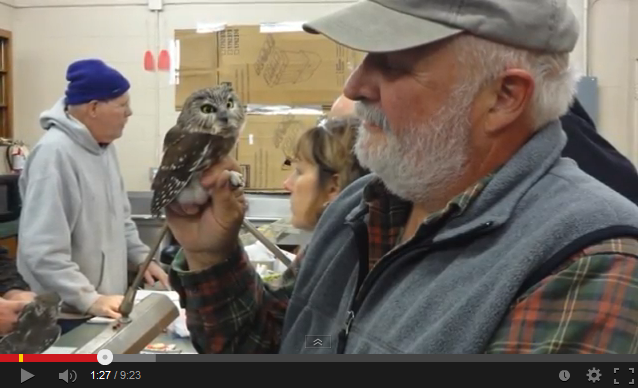
    Class member Tom Long produced this video to show the world what a great class this was!

    Tom's videoThanks Tom!