Category: Training

  • Headwaters Starts Its Fourth Cohort!

    Headwaters Starts Its Fourth Cohort!

    FirstDayCohortIV.300On April 2nd the class of 2015 got its official start. Unofficially, 9 of these 13 trainees have been participating in chapter activities since last September. There were two field trips (Entomology and Saw Whet Owl) along with two training presentations (The Gestalt of Weather thanks to Kate Guenther and A Presentation in Your Pocket compliments of Gail Napora) and it culminated in a trip to the Smithsonian Museum of Natural History in D.C. for a behind the scenes tour of two collections: Birds and Mammals.

    Of the thirteen new trainees, 11 were able to make the day trip to D.C. for which we can thank Byron Hukee. I think we will be thanking Byron quite a lot over the next seven and one-half months. We also thank Brian Lux for making the travel arrangements stress free and comfy.

    The trip in our 15 passenger van presented the perfect opportunity to get some administrative business out of the way, so they were briefed on their choice options concerning the number of hours in which they might or might not engage over and above the 60 hour program announced in their membership applications. They had a week to think about it and on the first day of class a majority of 77% voted to opt for the inadvertent over-planning of training hours. There were reservations about time commitments regarding the skills project over and above time allotted in class but with all cards on the table we decided those issues would be part of their skills project planning as teams.

    The next order of business for this class was to decide on their class project. Three options were discussed. Two options were offered to them and they were encouraged to come up with an option of their own. The final choice will be made in the next class but the project option they proposed on their own would be an amazing effort and something of which their class could be very proud, should they pull it off! I’ll leave that reveal for the May Newsletter.

    Finally, they were given two options to address the task of getting familiar with the VMN Program Sponsoring Agencies. They could choose to play Agency Jeopardy or host a sponsoring agency representative reception. They chose to host. This is a very bold and confident group we have for 2015! I seriously doubt I am going to be able to keep up with them.

    Michelle Prysby differentiating phenology from phrenology.
    Michelle Prysby differentiating phenology from phrenology.

    They are a vocal, excited and exciting bunch. I do believe Michelle Prysby, Special Projects Coordinator for the Virginia Master Naturalists Program, was quite impressed with them as she listened to them making decisions before her presentation: Introduction to the VMN Program, as well she should be. They were quite impressive in their interactions with her as well. They have duly impressed me with their eagerness and ability to navigate VMN-VMS. As soon as they were set up in VMN-VMS, several were using it – without any instruction!  They were forthright and honest on the new class evaluation form created in the Training Committee.  No punches pulled, they paid close attention to what Michelle had to say and if the presentation did not match what the evaluation indicated – they politely but firmly noted it.

    I’ll need to be on my toes every minute with this class.  It is quite fortunate that several members of the Training Committee have already committed to share an increasing amount of the training responsibility because I’m going to need all the help I can get to keep this fourth cohort challenged and free from boredom. But I know I am going to love every minute of it and I am sure they will too because they are primed and ready to seize every opportunity we can give them!

    – RoxAnna Theiss, April 2015
  • Shenandoah Summit 2014

    Shenandoah Summit 2014

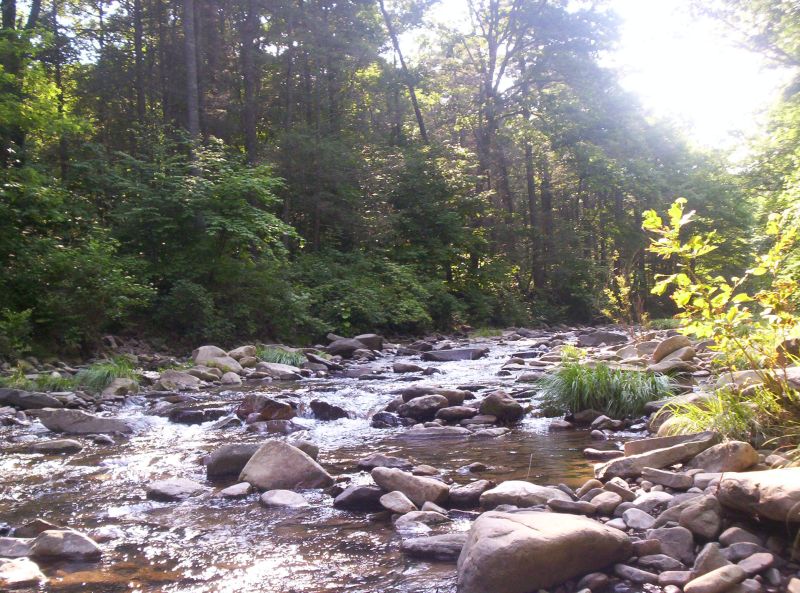
    North_River_(South_Fork_Shenandoah_River)On December 16, 2014, Region 4 Department of Game and Inland Fisheries (DGIF) Aquatics staff organized the first annual Shenandoah Summit at Shenandoah University in Winchester. This stakeholders meeting was called to discuss ongoing water quality and fish health issues in the Shenandoah River watershed.

    Presentations included DGIF fish population studies, observations from fishing guides, intersex research on smallmouth bass from the United States Geological Survey, nutrient input updates, mental modelling, and blue-green algae research.

    The Summit attracted 35 participants from federal and state agencies, academia, Northern Shenandoah Valley Regional Commission, Friends of the Shenandoah River, Friends of Middle River, Riverfest, Friends of the North Fork Shenandoah River, Virginia Master Naturalists, the Smithsonian, biologists from West Virginia Department of Natural Resources, two smallmouth bass fishing clubs, fishing guides, and interested citizens. The Summit fostered frank and open conversation regarding the decade-old issues revolving around the eutrophication of this river system. Plans to organize resources to address future research needs will take place beginning in 2015.

    – Paul Bugas, DGIF, December 2014

    Headwaters Master Naturalists Bob and Betty Forrest attended the Summit and provided their insights:

    Betty and I hustled across the drizzle-wetted parking lot of Shenandoah University campus en route to the Shenandoah River Summit Conference. The large meeting room was brim full of energized people. As we squeezed into the last two seats, the participants settled down, and Paul Bugas kicked off the agenda.

    It was great that Paul chose as opening speakers two representatives from the commercial recreational fishing sector. Their decades of experience as river guides and fishermen gave them a rich fund of empirical observations indicative of river ecosystem and fisheries health to share. It was clear the river is troubled. Everyone listened, questioned, and discussed intently. A great opening to the remainder of the agenda!

    The interesting and articulate speakers during the remainder of the day represented diverse groups of university and governmental scientists and volunteer-based citizen scientists. Their topics all were very relevant to Summit goals.  The many discussions yielded a consensus that the river ecosystem is in serious distress from complex and little understood events and that future Summits ought to be scheduled, beginning at six-month intervals if feasible.

    220px-Potomac_green_waterDuring introductions, we and Chip Brown appeared to be the only VMN participants; one of the speakers was a member of the West Virginia Master Naturalists. Attending the Summit provided us with an invaluable overview of the riverine system, its need for proactive conservation, its societal and ecosystem values, the historical and present misuses leading to existing eutrophication and other maladies, and the multiple caring interests within State and private entities.

    – Bob & Betty Forrest, December 2014

  • Latest Developments in Basic Training for Spring 2015

    Latest Developments in Basic Training for Spring 2015

    trainingcommittee
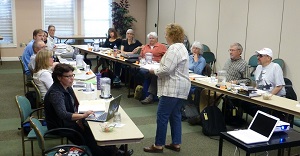
    October 20, 2014 training committee meeting.

    The Training Committee has been working hard on a concerted push to improve and solidify the Basic Training program.  We have always tweaked and improved as we deliver training classes but for this next class, we have worked out a concrete start on unclear Policy issues, Curriculum concerns, Evaluation improvements, Assessment approach and overall Committee structure.  Our next step will be to develop the class and field trips for Spring 2015 while we continue to hone and improve the above aspects of training.

    Starting in April of 2015, our class will be weekly from 1pm – 4pm (timing may prove to be slightly shorter because we are not feeding trainees this go-round) on Thursdays.  It will continue in the same format of a Spring Session for two months with a summer break and then the concluding session in the Fall for two months.  Because of the shift to a calendar year format we will be able to finish up training in seven months instead of nine.

    We are indeed still recruiting.  We have reached out to the Headwaters Board for assistance on this and hope the Executive Committee can come up with a strategic plan for a recruitment push.  Currently we have 14 interested but that is not a big enough buffer to hold for another five months.

    Recruiting talent from our last Basic Training cohort has emerged and she has done an amazing job of making contacts with interested and interesting people.  When Janet James accompanied her husband Tom Benzing to the Annual Pure Water Forum meeting in Luray last month, she did a tabling there for Headwaters and recruited four potentials.  She shared with me how exciting it was to talk to them about Headwaters and how interested they were in us.  A few more have come in to us from Adrie’s amazing outreach efforts but we need something more solid and reliable.

    It is looking good and we are energized and encouraged!  If you know of anyone you think would be a good candidate, send them our way – any Training Committee member would be happy to get the reference.

    Contact: headwatersmn.info[at]gmail.com

    We are:

    RoxAnna Theiss, Chair
    Eric Jones, Curriculum
    Judy Tammi, Chip Brown and Carl Droms, Assessments
    Gail Napora, Evaluations
    Margaret Speicher, Policy
    Jerry Hopkins, ex officio and Policy

    – RoxAnna, November 2014

  • Putting a Presentation in Your Pocket

    Putting a Presentation in Your Pocket

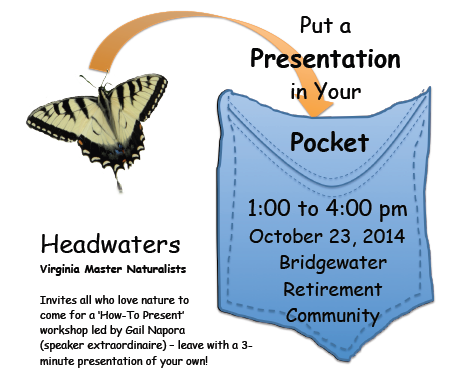
    pocketpresentationflyerGail Napora fills more than your pocket.  Her presentation skills go beyond technical.  She inspires and lifts up.  She knows you can do it and helps you know it too!

    On Thursday afternoon October 23rd some Headwaters volunteers and some Trainees in Waiting got a real treat – both literally and figuratively!  Gail guided seven of us on a trip to “you can do it” land.  Headwaters volunteers from two different cohorts: Sandy Greene, Judy Tammi, Ann Murray and RoxAnna Theiss were joined by Trainees in Waiting: Kathy Byers, Byron Hukee and Elaine Smith on an adventure to learn the passionate nature of presentations.

    Gail’s teaching style is structured but easy going.  Encouraging and chock full of “why didn’t I think of that?” pointers and “this makes soooo much sense” take aways, the workshop did more than give each of us a three minute presentation of our own – it gave us each other.

    Gail has developed her own “Ask, don’t Tell” method.  She taught us about invitational posture, posture’s relationship to “stage fright” and active participation.  She led us through the logic of her ASK method:

    Attention:        Invite your audience to listen – without telling them, give them a reason to pay attention
    Specifics:         Your research supports what you intend for them to do, feel or want from your presentation
    Keeper:           Your message in one thought – this is what they will remember and walk away with

    Gail breaks the process into three’s.  Her workshop is in three parts.  She teaches you to structure your 3- minute in three parts (and each of your three parts can have three parts).  Gail believes in the power of threes!  She also believes in “goodies”.  We got lots of goodies: write on tools, write with tools and take it with you tools.   And we each got our own really cool take away pocket!

    We didn’t have the time you would need to take for a lot of practice, but practice you must if you want your passion to flow.  We did our first practice run on each other after our break of treats and beverages (like I said – lots of goodies) and it was amazing!  Just as a sample:  Judy was on her knees with passion about Saw Whet Owl banding, Sandy’s passion was about alternative energy, Ann’s passion was farming, Kathy’s passion was about making environmentalism “cool” for youth, Elaine was passionate about gardening with natives and Byron belted out passion for the Condor!

    When you talk about something that is your passion you are very close to your most true self and that grabs attention.   We all took that journey together with eye opening results.  If we can talk Gail into doing this again for Headwaters, you all need to take this trip!

    BTW – RoxAnna was passionate about making a difference by volunteering with the Virginia Master Naturalist Program and Headwaters!

    – RoxAnna, November 2014

  • Headwaters Goes On Display

    Headwaters Goes On Display

    In Newport News

    Display Board - Newport News.500It was all very last minute but somehow we pulled it off.

    The day before registration closed for the Virginia Master Naturalist 6th Annual Statewide Volunteer Conference and Training in Newport News, RoxAnna decided to make the commitment and registered successfully for the Basic Training Symposium, Annual Reports/Certification Spreadsheets Help and the Modeling for Citizen Science sessions scheduled for Saturday, September 27th. The field trips and the local accommodations were full but she found a sweet B&B in Hampton about 10 miles away as the crow flies.

    We saw the e-mail call come through for a tabling display and weren’t sure we should attempt it but Malcolm lent us a very fine display board (we had used it for the 2013-14 Class Spring Skills Project at Riverfest) and knowing we had the expertise of Janet James from that same Cohort, we decided to “go for it.” Janet accepted the challenge to earn volunteer administrative hours and used her training in Marketing to create bold and colorful posters we then Velcro-ed to the display board.

    While RoxAnna worked on the center panel that would be dedicated to Headwaters history with related sections on Training and Serving, Janet soloed on the panel depicting our wildly successful 2014 Focus project with the Wildlife Center of Virginia. She used bold blues, oranges and yellows to create an eye-popping poster that would tie into previously created posters for future use. RoxAnna and Janet spent several hours on the details of a third panel that would highlight the Riverfest Class Skills Project. Janet then used the same bold colors to tie all three panels together. Again at the last minute, RoxAnna made a display sized HMN knit hat and t-shirt to fill in the center panel along with buttons created by The Arc of Harrisonburg and Rockingham, Inc. for our chapter. If time had allowed she would have used more of the orange and blue in the center panel but . . . that will be for the next opportunity for display. Also for continued development will be the digital picture frame added to our table for a rolling display of several Headwaters photos in addition to the ones one the display board.

    The preparation was a fantastic teamwork experience and the Headwaters display table got a great deal of attention and many flattering remarks at the Conference. RoxAnna made some valuable connections throughout the weekend that she recorded in the complimentary spiral notebook provided to all participants. Opportunities recorded included: inter-chapter vernal pools project possibilities, citizen science modeling, basic training ideas, and instructions for annual reporting including the re-certification spreadsheet.

    The Saturday night dinner keynote speaker was author, lecturer, photographer, and radio broadcaster Arthur V. Evans D.Sc. The lecture featured plenty of colorful images and engaging anecdotes of beetles from not only Virginia, but also across North America and around the world. Dwayne Martin would have loved it!

    The venue at the Virginia Living Museum was amazing and the Historic Rivers and Peninsula hosting chapters did an outstanding job of making all 225 of us welcome and keeping us engaged while providing a schedule of excellent training opportunities and field trips. They set a high bar for future conferences that portends exciting and engaging events: something to which we may all look forward.

    – RoxAnna Theiss, September 2014