Category: Training

  • Fall Field Trips

    Fall Field Trips

    While the HMN Basic Training class was in full swing during its fall session, chapter members were given opportunities to join in on a wide variety of field trips. Thanks to Kate Guenther for her organizational skills that made this happen.

    Here is a sampling of where we went in October:


    mccormickfarm-10-16

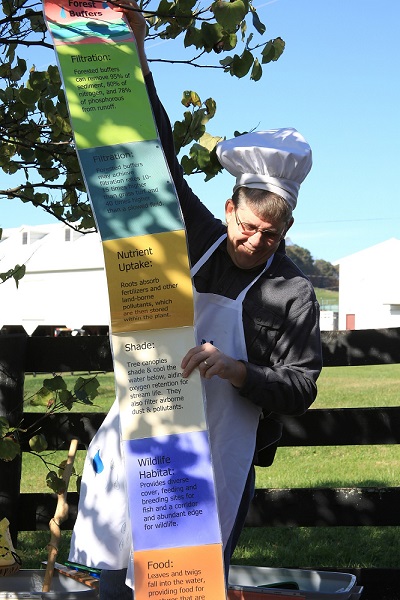
    Forestry Management at Historic McCormick Farm, October 29. Allen Baker, Cohort V, shown at left above, takes on the role of Water Chef in an activity led by Sandy Greene. The two cooked up a “soup” starting with fresh water then adding local ingredients in the way of some of the many types of pollutants that make their way into our waterways. Pouring the dirty water on a sponge offered a graphic demonstration on the function of riparian buffers and why they are so important. Allen assures us that “… the ‘pollutants’ we were using were safe stand-ins.” This was one of several activities available in the education boxes in the education shed at McCormick Farm which members can use when classes come to the farm.

    Retired forester Charlie Huppuch, in the above photo on right, leads an interpretive talk of forestry and riparian buffers on the Shenandoah Valley Agricultural Research and Extension Center trail at McCormick Farm. He discussed autumn olive and Ailanthus and other invasives, and how he is trying to preserve this old-growth section of trees. Pictured left to right: Charlie Huppuch, and cohort trainees, Rachel Kreiger, Kim McCray, Janet James, Allen Baker, Barbara Phillips, and Shelley Baker.
    Thanks to Deb Pugh, Cohort V, for the photos and Deb, Janet James and Allen Baker for reporting.


    benthicmonitoring10-16-16-300Macroinvertebrate Benthic Stream Monitoring, October 16. Through Friends of the Middle River, HMNs help sample, identify and count aquatic insects, snails, worms and other small creatures living on the rocky bottoms of different sections of the Middle River. The data is used to help determine the water quality and overall health of the stream.

    In the photo at left, Cohort V basic training class members Kathy McKenzie, Kim Atkins and Chris Shaw examine a netting from the Eastwood site.


    carbonheroes-gh-10-15-16Carbon: The Unsung Nutrient for Soil and Water, October 15. Conservationist Bobby Whitescarver discussed soils, riparian buffers and native grasses on his farm in Swoope to illustrate important farm management concepts for healthy ecosystems. Learn more from Bobby’s blog: Getting More on the Ground.
    Thanks to Ann Murray, Cohort II, for the photo and Ginny Hoffman, Cohort III, and Kate for input.


    cordage-10-12-16-2-cropMake Rope Cordage Out of Local Wild Plants, October 12. Kate Guenther, Cohort I, led this workshop out of her home near Churchville to “work with and experiment with local plants that can be used for cord making—dogbane, yucca, cattail, burdock, greenbrier, black walnut, grape and milkweed.”

    In the photo at left, Kate shows a plant from a wetland near her home to Janet James, Cohort III, and Cohort V trainees Sue Gier and Kim McCray.


    bbctour2-1-af-300Black Bear Composting Facility Tour, October 6. Black Bear founder and Chief Composting Officer Eric Walter led the group through his commercial scale composting process in Crimora. His company was instrumental in the diversion of four tons of kitchen wastes through the HMN-supported Market Compost Drop-off Program this year. More HERE.
    Photo credit Art Fovargue

  • HMN Training Class Scheduled

    HMN Training Class Scheduled

    HMNtrainingimage

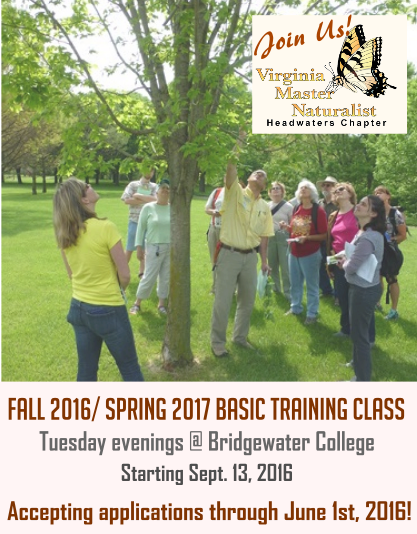
    • Headwaters Chapter Basic Training Class 2016/2017
    • Weekly evening classes starting Tuesday, September 13, 2016
    • McKinney Science Center, Bridgewater College, Bridgewater
    • ~ 6:00PM-8:30PM
    • Two ten-week sessions separated by a winter break
    • Field trips!
    • More HERE

    Please share this exceptional opportunity to learn with and become part of our diverse, talented and passionate Naturalists’ community working to protect and conserve our life-sustaining natural resources through education, stewardship and citizen science.

    ScienceCenterThe Training Committee is looking forward to holding the class in Bridgewater College’s McKinney Center for Science and Mathematics. We are pleased to be in this facility and thank the Bridgewater Retirement Community for their past donation of space for this training.

    With the help of Bridgewater College’s Associate Professor of Biology Kim Bolyard, and BC’s community outreach, the HMN training class 2016/17 will be enjoying the fine facilities and resources available through Bridgewater College’s Science Center on Dinkel Avenue in Bridgewater.

    The class format involves two and one-half months of one night a week evening classes in the fall and various field trips, followed by a winter break which will include opportunities to continue learning. The course concludes with another two and one-half month session of weekly evening classes in SPRING 2017.

    HMNClass2.5.7.15.500With each class we look for those individuals who are curious about the natural world, enjoy the outdoors, and want to develop the necessary skills for volunteering and contributing to natural resource management, preservation and conservation in Virginia.
    The $200 cost of the 60 hour training class for 2016-17 covers field manuals, reference guides, digital and other reference materials, multi-modal learning and field experience opportunities. For the first time, some limited need-based scholarships will be made available.

    Applications are due JUNE 1st, 2016.

    More information and a link to the application HERE.

  • Weather Everywhere and Climate in the Shenandoah Valley

    Weather Everywhere and Climate in the Shenandoah Valley

    Kate presenting on weather in September 2014.
    Kate presenting on weather in September 2014.

    On December 15, 2015, Headwaters Chapter members Kate Guenther and Malcolm Cameron gave a lively presentation at the Bridgewater Public Library on the basics of weather on our planet, recording weather observations, and about climate and how it’s changing.

    Kate gave an excellent PowerPoint review of how weather tries to solve the problem of the unequal heating of the earth’s surface due to the curvature of our globe. Warm air is lighter and rises, while cold air is heavier and sinks. The resulting differences in air pressure create the dynamic air flow of our winds and form low and high pressure centers. These lows and highs pull air in or push it out, respectively, and the Coriolis effect causes the air to curve to the right as it moves in the northern hemisphere. Thus, low pressure systems rotate counterclockwise and high pressure systems rotate clockwise.

    An easy way to tell when we’re outside which direction the high pressure center is involves standing with your back to the wind. Rotate 30 degrees to the right and your right hand extended points to the high. For finding the low pressure center, do the same except extend your left hand as a pointer.

    Cold fronts and warm fronts separate the high and low pressure centers and the changing positions of all these elements are determined by the jet stream, a fast moving wind stream at roughly 30 thousand feet altitude. The jet stream patterns shift over time and change with the seasons. Cold fronts produce low clouds and rain or thundershowers just out ahead as they move by and then higher, drier clouds after they pass. These fronts are a wedge of cold, dry air pushing under warm, moist air. Warm fronts do the opposite and the warm, moist air rides over top the cold air. They start with very high clouds moving in hundreds of miles ahead of them. As the warm front moves closer, clouds lower and steady and increasing rain is felt. After both fronts pass, the sky usually quickly clears.

    cloudswithbirdKate covered cloud basics with picture examples; cirrus high clouds, alto middle level clouds and strato clouds closer to the surface. Cloud types or forms are puffy cumulus, sheet-like stratus, and nimbus rain clouds which are dark and change texture. Cumulonimbus clouds are fast rising cauliflower-like columns that form into thunderstorms with an anvil-like top when mature.

    During a break, folks went outside to practice identifying clouds and pressure centers.

    Malcolm Cameron finished up the class with pointers on how to setup a home weather observation routine and summarized evidence and impacts of climate change.

    Malcolm has taken and recorded daily weather observations for 30 years in Rockingham County. The proper type of instruments, either old-fashioned manual thermometers and rain gauges or the remote sensor digital varieties will work. A max-min. glass tube thermometer with reset has worked well and a wedge-shaped plastic rain gauge resists cracking if the water freezes. These are inexpensive. A digital remote station can be setup as far as 300 to 500 feet from your house, but more elements measured and features offered will increase the price from about $15 up to $400 plus for station units with everything like wind speed and rain gauges. Some top of the line units offer computer software.

    Proper location of instruments were covered. Thermometers must always be in the shade and not too close to houses and other sources of heat, generally at least 25 feet away. Wind gauges and rain gauges need to be well out in the open for accurate measurement.

    Recording your data should be consistent in nomenclature, and observations should be taken at about the same time each day. Just before sunset works well if you only observe once a day.  If you must be away, try to get someone to fill in.  Local newspapers or airports can provide proxy data, but this can vary greatly from what occurred at your house, especially precipitation.

    You have lots of options on how to use and analyze your data. The most useful are monthly total rainfall, season total snowfall and average temperatures. Data over 15 years or longer can begin to show trends.

    NASAEarth.600
    Climate: long term weather patterns for areas and regions.

    After defining climate as long term weather patterns for areas and regions, Malcolm briefly covered climate change. Climate change is becoming increasingly more obvious as the burning of fossil fuels continue and greenhouse gases like carbon dioxide and methane buildup in the atmosphere. Current global emissions of these gases equals over 47 gigatons a year. He covered many of the effects like heat waves, droughts, severe storms and more rapid melting of sea ice, glaciers and icecaps. All of the effects predicted by climate change computer models in the 1980’s have begun to happen in the years since then. Just in the last 3 or 4 years, melting and breakup of coastal glaciers in Greenland and Antarctica has increased significantly. Global average temperatures have risen 1.2 degrees Celsius since 1860, but one degree of that has been since about 1960. Carbon dioxide levels have risen from around 280 parts per million in pre-industrial times to 400 ppm today.

    Malcolm related personal stories of impacts such as eroding shores and islands in the tidal Rappahannock River area where he grew up and nearly having tornadoes hit his house near Weyers Cave in April 2011. Prior to 1995, tornadoes only hit The Valley during hurricanes.

    MalcolmCameronMany resources exist to study the topic, including NASA, NOAA, the National Science Foundation, and The Washington Post.
    Some good news is the agreement reached this month by nearly 200 nations in Paris to set strict carbon diets in all of their future energy production, moving towards mostly clean renewables. The goal is to limit the total global temperature increase to 2 degrees Celsius.

    – Malcolm Cameron, Cohort III

    DaleEnterpriseTemps
    Click here for Dale Enterprise weather data. Dale Enterprise is just west of Harrisonburg.

    The Dale Enterprise station is the oldest operating weather station in Virginia and the third oldest in the nation, and has been operated by the same family since its founding. The station is located in a farm field, “well away from buildings or hard surfaces.” As of early 2010, the station’s original thermometer remained as a back-up to an electronic temperature sensor installed in 1994. – Wikipedia

  • Commencement 2015

    Commencement 2015

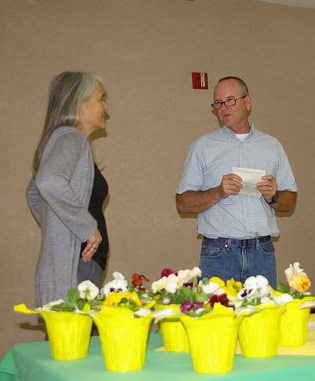
    Peggy Plass receiving her certificate.
    Peggy Plass receiving her certificate from Paul.

    On November 12th, the Headwaters Chapter of the Virginia Master Naturalists held commencement for its fourth cohort. The room and facilities at the Bridgewater Town Office Building were the perfect venue for the afternoon. Table settings were a fun mix of nature’s autumn offerings. Delicious refreshments were enjoyed as attendees gathered and socialized.

    Trainees were honored by the presence of many chapter members and administrators. It was a special privilege to have our state Program Director Michelle Prysby from Charlottesville in attendance. Chapter Advisor Paul Bugas, with the Virginia Department of Game and Inland Fisheries, shared the trainees’ backgrounds and added personal congratulations as certificates were presented. With her trademark positive enthusiasm, Sandy Greene assisted in welcoming the new class of master naturalists.

    Ten trainees graduated, with three having completed all training and hours necessary to be fully certified.  All the graduates received special gifts and hugs from our dedicated leader, RoxAnna Theiss. The cohort presented her with a small token of our appreciation for her hard work and leadership over the last several months.

    The class of 2015 would like to thank chapter members, presenters and our supporting agencies for the amazing experience of becoming Virginia Master Naturalists. We plan to do the Headwaters Chapter proud!

    – Kathy Byers, Cohort IV

    Thanks to Elaine Smith and Peggy Plass for these photos! We regret we missed getting a photo of Lacey Dean who is also among the graduating class of 2015. If anyone has one, contact Adrie ahvoors [at] gmail.com.

  • Fall Skills Project

    Fall Skills Project

    Byron.Elaine.BRC
    Byron and Elaine hosting the Native Wildflowers table for Nature in a Nutshell.

    On Tuesday, October 13 the cohort of 2015 held its culminating skills activity, “Nature in a Nutshell” at Bridgewater Retirement Community (BRC). Headwaters Master Naturalist members, trainees and residents at BRC considered the event a big success.

    Trainees had worked as a group to develop, organize and implement an afternoon activity for the residents at BRC. Class members combined personal interests and talents together with recently learned HMN skills to offer a fun afternoon of nature exploration and interaction.

    Stations open to guests included: Fall Colors, Native Wildflowers, Flood Events in Bridgewater, VA, and Birds of Our Area. The display boards and hands-on activities drew residents into the stations and the interactions began. Residents were encouraged to share their memories and knowledge, and share they did! Some of the residents had been in the area during some historic flood events and shared their experiences. Many of our guests enjoyed sharing their knowledge of wildflowers and birds. Another guest shared titles of some of her favorite books about nature. They included:

    What Has Nature Ever Done for Us? By Tony Juniper
    Seeds of Hope by Jane Goodall
    Blue Gold by Maude Barlow and Tony Clark

    A few short days after the event, the trainees reviewed its successes and areas that might have been improved upon. The group agreed that flexibility and communication as a team played an important role in the process. While we may have “advertised” a bit more and increased the number of attendees, the small group and one-on-one interactions were seen as very rewarding. Ginny and Brian were praised for their sense of fun in wearing life jackets as they shared information about local flood events. What a great reminder to not take ourselves too seriously!

    Cohort 2015 thanks all of our supporting naturalists and our class leader, RoxAnna Theiss for helping with the event.
    – Kathy Byers, Training Class 2015