Category: Training

  • Training Class Back in Action

    Training Class Back in Action

    OLYMPUS DIGITAL CAMERA
    “Nature in a Nutshell,”  October 13, 2015, for the Bridgewater Retirement Community

    On Thursday, September 3 the 2015 cohort of Headwaters Master Naturalists started their second term. Happy greetings all around, many stories of summer’s adventures and travels soon gave way to the business at hand: more training and a fall skills project. We were sad that two of our classmates had to step back, temporarily we hope, from the training, but the remaining ten of us are moving forward!

    At the DOF plant nursey on Sept 12.
    At the VDOF plant nursery in Crimora on Sept 12.

    Field trips to the Augusta Forestry Center were informative. Unfortunately, the weather, so far, hasn’t cooperated for the Afton Hawk Watch trip. Hopefully in October. So far we have had guest speakers covering forest management, aquatic and terrestrial entomology, and interpretive presentation skills.

    On Tuesday, October 13 the class will be hosting an afternoon of information and fun at Bridgewater Retirement Community: “Nature in a Nutshell: Exploring Our Own Backyard.” We will have stations dealing with fall colors, birds, native plants and flood plain issues. We are hoping many residents join us, as we share some of our knowledge and express our appreciation to the community.

    – by Elaine Smith, 2015 Training Class

  • Dowells Draft and Chimney Hollow Ecology Hike

    Dowells Draft and Chimney Hollow Ecology Hike

    Goodyera pubescens, downy rattlesnake plantain
    Goodyera pubescens, downy rattlesnake plantain. Photo by Elaine Smith.

    The Headwaters Chapter 2015 Basic Training Class participated in a field trip along the Dowells Draft and Chimney Hollow trails in the George Washington National Forest, on July 29, led by “field naturalist and muddy boots plant ecologist” Eric Jones. He is the author of Wildflowers of Augusta County VA.

    Notes and photos contributed by Elaine Smith, Peggy Plass, and Byron Hukee.

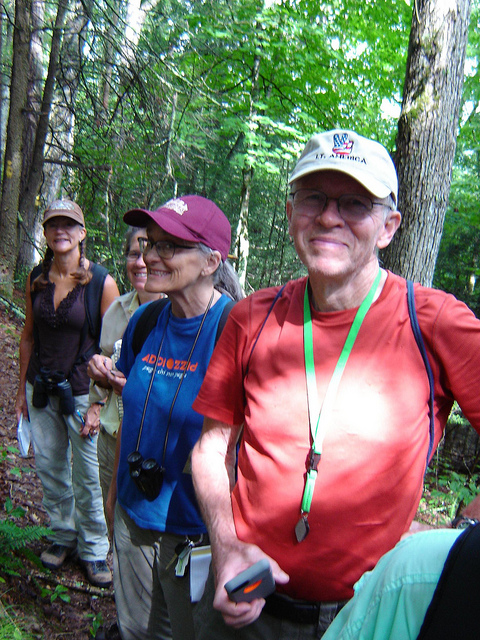
    Wednesday, July 29 was a clear day for a nice, informative walk in the woods with Eric Jones. Bill and Selah Sprinkel, Byron Hukee, Kathy Byers, Peggy Plass, Elaine Smith and Judy Tammi participated.

    Plant list:

    Disturbed Area:

    • Milkweed
    • Teasel
    • Goldenrods
    • Queen Ann’s Lace
    • Wild carrot
    • Chicory
    • Crown vetch (doesn’t like shade)
    • Spotted knapweed
    • Bush honeysuckle
    • Poison Ivy (also prefers more sun than shade)
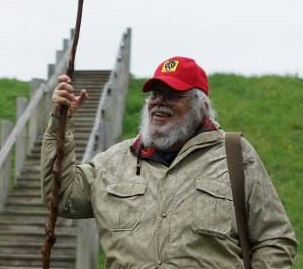
    Botanist Eric Jones. Photo by Elaine Smith
    Botanist Eric Jones. Photo by Elaine Smith.

    Forest Interior:

    • White Pine
    • Virginia Pine
    • Eastern Hemlock
    • Pignut Hickory
    • Sassafras (bird dispersed since no parent trees present. It was a major export crop for the colonists.)
    • Indian pipe (in all stages)
    • Nodding onion
    • Ebony spleenwort
    • Rattlesnake weed, not in bloom
    • Coral fungi, which is a decomposer
    • Rue leaves
    • Wintergreen
    • Black locust
    • Lichen, needs good air quality, doesn’t like acid rain
    • Pileated woodpecker holes, rectangular
    • Moss can break down cellulose
    • Bracken fern (linear growth makes it hard to eradicate)
    • Trailing arbutus
    • Mountain laurel
    • Red maple
    • Narrow-leaved Houstonia (Houstonia tenuifolia) (related to Bluets)
    • Teaberry
    • Partridgeberry in fruit stage
    • Rattlesnake plantain in bloom and were able to see the difference in the basal leaf venation
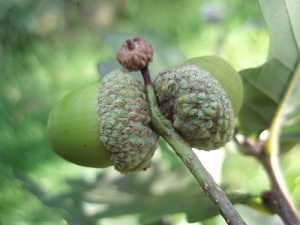
    • White and chestnut oak acorns sprout quickly. To make acorn flour, use white or chestnut oak which has less tannin than red and black oaks. Gypsy Moths are not hit as hard by Tannins as most of our native caterpillars. And it seems that they are able to use the tannins as a defense against a virus that has been introduced to control them.
    • Striped maple, or Mountain maple (unstriped)
    • Oak apple gall, wasp
    • Woodfern
    • Running cedar, lycopodium
    • Hepatica, round lobe
    • Christmas fern, sori only on some fronds
    • Wild yam
    • Turkey tail mushrooms
    • Gall on witchhazel. See Byron’s photo below. He suggests this site for more information.
    • Naked-Flowered Tick Trefoil (Desmodium nudiflorum)
    • Maple leaved viburnum
    • Chanterelles
    • Oyster mushrooms
    • Shagbark hickory, bat habitat
    • Red cap mushroom, Russula, have a beneficial relationship with pines
    • Yellow star grass
    • Heal all
    • Lactarius mushroom, give off their spores in a milky liquid
    • Smooth False Foxglove, Gerardia virginica
    • Wild cucumber
    • New York fern, tapers at both ends
    • American chestnut
    • Rhododendrons, Great Laurel growing next to stream
    • Ironwood
    • Chrysogonum virginianum, Green and Gold
  • Visit to the Center for Coldwaters Restoration

    Visit to the Center for Coldwaters Restoration

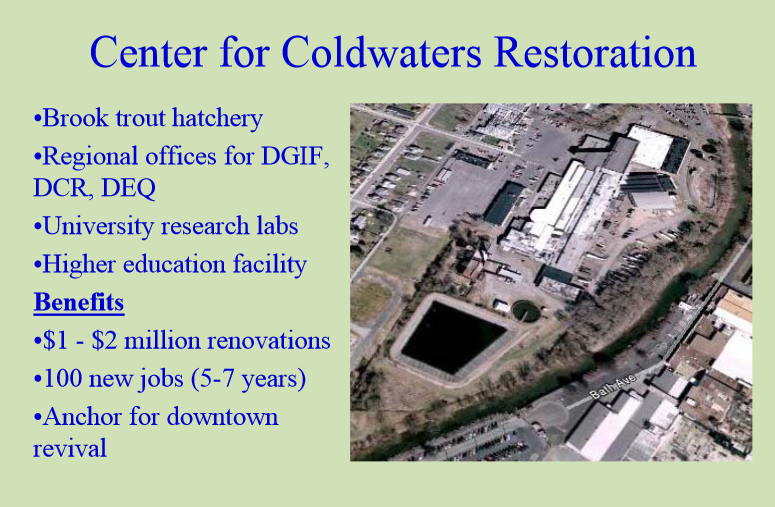
    CCRIn mid May, the Headwaters Master Naturalist training class was introduced to the Center for Coldwaters Restoration (CCR) exhibit show room for a sampling of what promises to be a world class facility in downtown Waynesboro. The Center for Coldwaters Restoration, an idea home-grown in Waynesboro, is all about the natural world (ecology) of the South River and making it a naturally healthy home to native aquatic life.  Since we know that we all live “downstream,” this is a far reaching endeavor that will have unlimited benefits for as far as the imagination can go.

    The history of the CCR goes back to the days of the law suits against Dupont for the toxic waste it contributed to the surrounding earth and water in Waynesboro.  Fishing in the South River continues to be problematic because of the mercury that continues to leach out of the stream bank soil making a less than desirable home for unstocked, wild trout that used to populate the stream. Fed by cold water springs the South River was, and should once again become, one of the natural treasures of the East Coast.

    CCR has joined with many partners to conceive of and build a facility that will incorporate four essential components located in one place. The South River as it runs through Waynesboro and a re-purposed industrial site in the City will be the basic foundations of:

    1. The Blue Ridge and Valley Interpretive Center and Aquarium – which will utilize the Virginia Museum of Natural History as a model. More here.

    2. University Research and Education Center – to establish a center for an artificial stream laboratory shared by universities and colleges in VA for the purpose of education and research of watersheds and their environments. More here.

    3. Campus for physically locating State and National agencies that share common missions, thereby eliminating duplication of facilities and increasing information exchange and accessibility among agencies studying natural resources.

    4. Hatchery – Brook Trout is our State fish and used to be wild in the South River. Now we can only hope that centers like CCR will repopulate our streams with genetically appropriate fish. To this end, the Center will be able to scientifically determine the environment and ecology that best sustain Brook Trout.  Be assured that partners such as Trout Unlimited, the Department of Conservation and Recreation, and the National Fish and Wildlife Fund will be enthusiastic about contributing to this component. The Science Team is dedicated to eliminating man made problems with South River and related streams.

    An unofficial component of this grand scheme is our Master Naturalist program.  There is a very fruitful place for us as interpreters in the galleries of the Center. After receiving specialized instruction, Master Naturalists can guide guests knowledgeably as well as provide Standards of Learning (SOL) information for students.  There will most likely be outside presentations as well.  AND…if we are willing to have specialized training, laboratory work at the Center may be available to Master Naturalists.

    It is hard to imagine a place richer in access to all levels of environmental study and research than CCR.  The design concept for the project is state-of-the-art beautiful.

    To read more about what is happening, please Google CCR, Waynesboro, VA.  To arrange for a tour of the exhibit center at 301 West Main St., Waynesboro, 540-942-6705 is the phone number of the Waynesboro Development Director who can put you in touch with the most available person for the tour. In the next couple of years, this institution will indeed be just that as well as a must visit for any visiting guests.

    – Sandi Rose, 2015 Training Class
  • Meet & Greet with our Sponsoring Agencies

    Meet & Greet with our Sponsoring Agencies

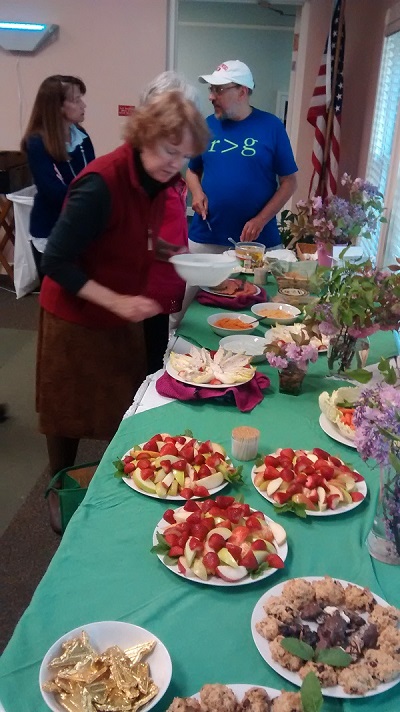
    buffet.400The table was laid with plates of beautifully arranged fruit, wedges of endive stuffed with salmon, several kinds of cheeses, crackers, chocolates, two kinds of home-made hummus, and smoked salmon slices. Mint and fruit infused water and sassafras tea slaked our thirst. Cascades of lilacs, redbud branches, and ornamental pink cherry blossoms spilled from vases. But even this lavish feast paled in comparison to our enthusiasm in response to the generosity and wisdom of our guests, each of whom represented one of the sponsoring organizations that support the Virginia Master Naturalist Program.

    This was the first event of its kind, in which a Master Naturalist trainee group initiated a meet-and-greet to facilitate face-to-face interactions with representatives of each of our six sponsoring agencies. We wanted to share a few tidbits from that experience with the broader Headwaters community.

    In preparation for the meet and greet, trainee Peggy Plass summarized the role of the Virginia Department of Forestry (VDOF) and the potential for volunteers to become more involved with that organization:

    While much of the work of the VDOF requires professional credentials, there are also ways in which the agency might be able to make use of volunteers.  These include assistance with monitoring forests for signs of disease or insect infestation and collecting acorns to be used in the growing of seedlings and trees which the VDOF offers for sale.
    Volunteers might also be able to assist in some of the educational efforts of the VDOF.  For example, currently there are geo-caching activities in the Appomattox-Buckingham State Forest which are presented as a “family activity” to encourage greater involvement of adults and children in the state in the understanding and care of our forests.  There’s currently no such “treasure hunt” available in Rockingham or Augusta counties.   In addition, the VDOF also offers a “narrated” driving tour of the Appomattox-Buckingham State Forest.  Volunteers could possibly assist in creating a similar resource for forests in Rockingham and Augusta.

    (Does anyone feel inspired for a geo-caching treasure hunt?)

    In person, Justin Barnes, senior forester from the Virginia Department of Forestry (VDOF), joined us and talked about how the region has changed over the past few decades. We now have more trees than we did a hundred years ago, but many of them are now in cities and suburbs—a new kind of forest with different characteristics.

    In contrast, according to trainee Elaine Smith’s interview with Graham Simmerman, the Department of Environmental Quality (DEQ) is highly regulated, making volunteer research inappropriate, but public education and outreach are highly encouraged. Most importantly, Graham emphasized the value of attending public meetings and commenting. We VMN people are also invited to visit the DEQ sometime to see what they do in person; please call a week in advance. Graham’s most surprising statement was that “pouring a gallon of milk into a creek is environmentally more devastating than pouring a gallon of diesel fuel!” He explained that this is because the nutrients in milk settle in one place, fostering an algae bloom that disrupts the stream’s ecology and can lead to fishkill. Diesel, on the other hand, tends to float and break apart, dispersing over a larger area and thus, causing little damage in one particular area. One might ask, “Who pours milk into a stream?” Well, we don’t anymore, but dairy farmers in the past used to clean their milk cans in a Buttermilk Creek, which was how it earned its name.

    Paul Bugas from the Department of Game and Inland Fisheries (DGIF) joined us, carrying a copy of Virginia Wildlife and a large map of Virginia to share with us so that we could get a picture of the different management regions.

    Adam Christie from the Department of Conservation and Recreation’s Natural Heritage Program (DCR-NHP) chatted with RoxAnna after the reception and offered to become more involved with Headwaters. He has enjoyed participating with other VMN chapters in their monthly general membership meetings and wants to do the same with Headwaters when we are ready to get to that point. As a chapter, we can think about when we want to begin holding such meetings. (Now who’s feeling inspired to organize that?)

    Virginia Cooperative Extension’s (VCE) unit coordinator, Jeremy Daubert, shared about his work with connecting farmers to needed agricultural practices. Did you know that Rockingham County has hundreds of dairy farms—the most in Virginia?

    The representative from the Virginia Museum of Natural History (VMNH) was not able to be with us, but earlier in the week, Len Poulin, a Board member of its future second location, shared with VMN trainee Lacey Dean via phone conversation about the up-and-coming additional location to be built in Waynesboro in the coming year. He said that in the future, there may be need for volunteers as docents and tour guides, but for now, the organization is deep in the fund-raising stage. Volunteer grant writers would be plenty welcome.

    agencymeet2.400All in all, it was a lovely experience to see one another’s faces, to shake hands, to chat informally about our kids taking Agriculture classes, to compare notes on stream quality, and to brainstorm ways that we can become more closely networked for the good of our future projects and natural communities.

    – Anna Maria Johnson, Cohort IV, May 2015

  • Botany with Eric Jones

    Botany with Eric Jones

    Eric Jones from photo by Matt Meyers
    Eric Jones from photo by Matt Meyers

    We were truly fortunate to have Dr. Eric Jones address our class on April 16.  If enthusiasm is the hallmark of a great teacher, he is the best.

    Here are some things he taught us about exploring for wildflowers:

    There are clues about natural settings that will help us determine what we can expect to find in an area.  If we are looking for diverse and plentiful wildflowers for example, we are advised to turn away from shopping centers, plowed fields and building developments.  It is “disturbed land” that generally limits the diversity of our local flora.  We would want to cast our gaze elsewhere to quiet openings or very steep slopes that are “un-plowable.”  Certain kinds of trees being seen from a distance (cottonwood and sycamores) will tell us we will find water at their location, most likely.

    Being a naturalist consists largely of being a very curious and careful observer of what is before us; asking how it got there and why does it want to thrive there.  That characteristic of intense inquiry will lead to asking important questions such as what is the natural history and biology of the plant in question.  Does it have ingenious, “built in” defenses that have eliminated the competition?  Is the soil where it thrives crummy?, acidic?, loamy?, and finally, what is the geology of the area that has provided that kind of soil over the ages?  How does their location help them deal with challenges of life on land?

    Although taxonomy is a large part of the naturalist’s language, Dr. Jones tells us it’s the story behind the name that helps us care about the extent and specialness of plant diversity in Virginia.  Speaking the same language about our plants helps us to communicate clearly with one another.  If you ask your nurseryman for Lonicera sempervirens, you won’t get a lovely variety of Lonicera that poops out over the winter failing to shield your sight from that awful garbage heap next door.  Taxonomy also helps us organize what we see so that similar characteristics borne by other plants will help us locate their place on the “family tree.”  Family lineage makes identification easier and more likely to be accurate.  But if you really want to grasp and teach caring and concern for the special diversity of our Virginia plants, learn a story about them and pass it on.

    Time evaporated and class was over all too soon.  But the last thoughts that Dr. Jones left us with are that botany, like many of the sciences, has left long-practiced Linnaean methods of plant identification and related scientific detective work in the dust bin of history – as they say.  DNA discovery is “where it’s at.”  But for the people in this class, the visible beauty of nature will always be the appeal and challenge of knowing not only the name but the history of that plant we are just getting to know.

    – Sandi Rose, Cohort IV, April 2015

    Note from RoxAnna:  A regular class exercise for our 2015 trainees is to summarize the previous class experience for the next class date.  Sandi Rose wrote a light-hearted yet heartfelt summary for our April 16, 2015, class with Eric Jones.  She gave me permission to publish it in the May eNewsletter and I have taken the liberty to make some small editorial changes.  It is apropos to have this summary of Botany in our eNewsletter as it was Eric’s suggestion to use this learning technique in our classes.

    Editor’s note: Eric Jones is also a Cohort I Headwaters Master Naturalist. As a faculty member at Mary Baldwin College, he has developed and maintains a comprehensive website on Wildflowers of Augusta County.