Category: Training

  • Pollinator Habitat Training

    Pollinator Habitat Training

    LakeShenPollinatorTrail.9.12.15.crop

    Be a Habitat Partner© and share your passion for wildlife and wildlife habitat!

    Volunteer Training Offered by the Virginia Department of Game and Inland Fisheries with assistance from the University of Virginia Department of Environmental Sciences

    Thursday, August 17, 2017 • 9:30 am – 4:00 pm
    Massanetta Springs Conference Center and Lake Shenandoah

    This workshop brings together members of multiple volunteer organizations who are willing to collaborate on education outreach to the general public about the importance of pollinators and healthy wildlife habitats.

    WHO’S INVITED: This workshop is being offered to volunteers and other community leaders interested in learning about pollinators and pollinator habitat and who will also plan and conduct subsequent pollinator habitat programs for the general public, either at Lake Shenandoah in Rockingham County, or in their own local community.

    Volunteers from many organizations are encouraged to register, such as the following:

    Master Naturalists • Master Gardeners • DGIF Complementary Work Force (CWF) Volunteers • Tree Stewards • Virginia Native Plant Society • Beekeepers Association leaders • Izaak Walton League • Youth Leaders (e.g. 4H, Scouts, Boys and Girls Clubs) • Garden Club leaders • and other conservation and community service leaders

    WORKSHOP CONTENT: The training will begin at the Massanetta Springs Conference Center with an overview about pollinators. Then we’ll caravan to Lake Shenandoah (about 5 minutes from the Center).

    During the visit to the Lake, we’ll conduct several field investigations to observe and identify pollinators, collect bee specimens, and learn about the native plants that form this biodiverse habitat.

    In the afternoon, we’ll return to the Conference Center for lunch and additional instruction, including a “mini-lab” to look more closely at the specimens we collected.

    During the last portion of the training, we’ll discuss how to target conservation messages to specific audiences, and participants will work in small groups to brainstorm and plan collaborative programming strategies. Our goal is to help you come away with several ideas for working together on subsequent pollinator programs for the public, such as for homeowners associations, school groups, etc.

    BE PREPARED TO GO OUTSIDE: Workshop will be held RAIN OR SHINE.

    NO CHARGE to attend. IN EXCHANGE FOR THE FREE TRAINING, WE ASK THAT YOU AGREE TO VOLUNTEER A MINIMUM OF 10 HOURS IN THE NEXT 12 MONTHS to help promote DGIF’s pollinator habitat project at Lake Shenandoah, and/or collaboratively plan and conduct public education outreach in your own community about the importance of pollinators and the value of native plants for pollinator habitat.

    LUNCH WILL BE PROVIDED ON SITE, at no charge. This is a working lunch, and there won’t be enough time on the agenda to go out to eat.

    WORKSHOP SPEAKERS and topics include the following:

    • T’ai Roulston, bee expert and Research Associate Professor for University of Virginia Department of Environmental Sciences (also Curator of State Arboretum at Blandy): Importance of Pollinators; Bee Diversity; and Plant Ecology
    • Jason Hallacher, Assistant Fisheries Biologist, DGIF: Pollinator Habitat at Lake Shenandoah
    • Carol A. Heiser, Education Section Manager, Habitat Education Coordinator, DGIF: Key Messages for Habitat Education Outreach

    WHAT YOU WILL RECEIVE:

    1. U.S. Fish and Wildlife Service Native Plants for Wildlife Habitat and Conservation Landscaping booklet
    2. a packet of numerous pollinator resources
    3. other habitat education materials; and
    4. a certificate for 6 hours of instruction.

    Details and registration information here:
    https://www.register-ed.com/events/view/106239
    Register by 5:00pm Sunday, August 13.

    Massanetta Springs Conference Center is located at 712 Massanetta Springs Rd., Harrisonburg VA 22801 (approx. 3 ½ miles east on Rte. 33 from I-81 Exit 247-A). Please plan to arrive by 9:15 to check-in.

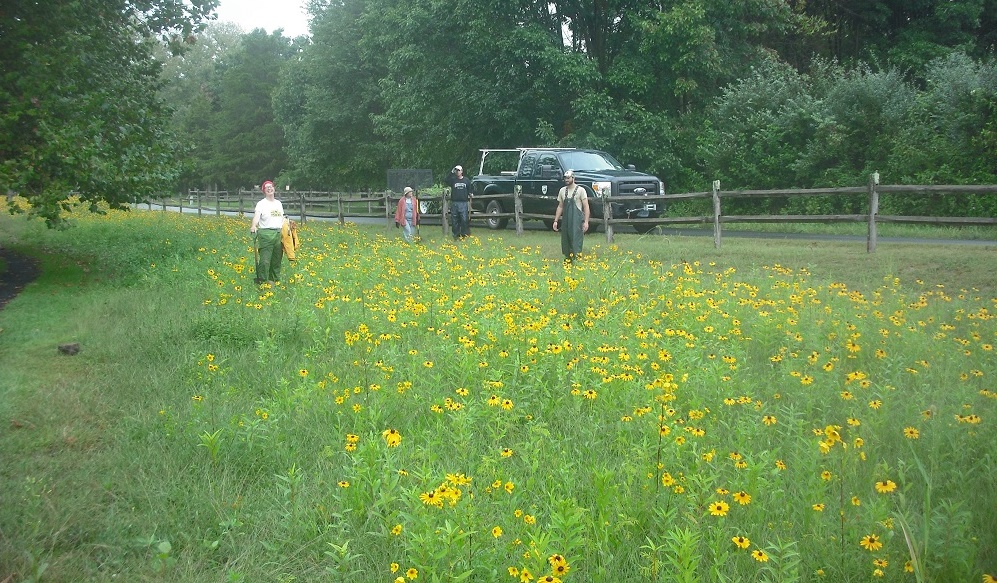
    Lake Shenandoah is a 36-acre impoundment in Rockingham County, owned by the Virginia Department of Game and Inland Fisheries. In 2015, agency staff converted about one-acre of a conventional field into a pollinator meadow.

    The Virginia Department of Game and Inland Fisheries wants to help you help wildlife on your property. The Habitat Partners© program encourages corporate landowners, private landowners, schools, and homeowners to improve habitat in their community that will benefit Virginia’s songbirds, mammals, amphibians and other wildlife.

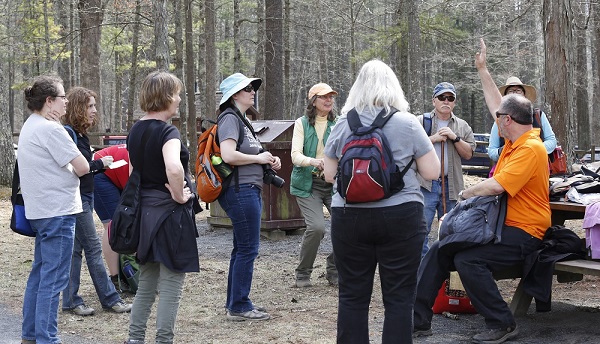
    Above photo is of HMN Sandy Greene and others assisting project coordinator Jason Hallacher with invasives removal along the Lake Shenandoah Pollinator Trail, September 2015.

  • HMN Graduates 5th Class!

    HMN Graduates 5th Class!

    5.9.17.13.cd.pic

    Congratulations to the 23 graduates of Headwaters Chapter’s Cohort V Basic Training class! Their accomplishments were celebrated on Tuesday, May 9, 2017, with dinner and the distribution of certificates, name tags and t-shirts in the community room of Eagle Carpet in Harrisonburg.

    Space constraints meant the entire chapter could not attend the festivities but the entire chapter does join in welcoming the new members and looks forward to working with them on our diverse slate of projects.

    Many thanks to Brian Lux and the HMN Basic Training committee, Chip Brown and his work as Programs Committee Chair, Eric Jones as educator and presenter for the graduation ceremony and the many others contributing to a successful class and commencement.

    Top photo left to right:

    back row: Brian Lux, Breyette Lorntz Covington, Ben Martindell, Rachel Kreiger, Andrea Dono, Kathy McKenzie, Kim McCray, Mary Gatling-Finks (not visible), Allen Baker, Shelley Baker, Jan Worthy

    front row: Rachel Baczynski, Cheryl Shull, Sue Gier, Morgan Martindell, Emily Harvey, Kim Atkins, Barbara Phillips, Deborah Pugh, Kristina Oates.

    Not pictured: Chris Shaw, David Wendelken, Kathy Whitten, Larry Whitten

    Photos by Carl Droms

  • Cohort V Adopt-A-Trail Project Initiation

    Cohort V Adopt-A-Trail Project Initiation

    Buckhorn Inn MN Field trip (1).600

    On Saturday, March 25th, the current Headwaters Master Naturalist Training Class met at Buckhorn Inn for a scouting field trip of part of the Virginia Department of Game and Inland Fisheries Forest Trails Loop of the Virginia Birding and Wildlife Trail, which they are adopting as their class project.

    We had a chance to look around Buckhorn Inn with the owner, and learn a little of its history over 200 years as a wayside inn, gambling hall and Civil War hospital. Lynn Cameron, of Friends of Shenandoah Mountain, spoke to us on their proposal for Scenic Area designation, embedded wilderness, and multiple use, supported by many diverse stakeholders. She highlighted Shenandoah Mountain as a world biodiversity hotspot, the largest roadless area east of the Mississippi, the only dark skies designated on the east coast. She also clarified that all the current management activities and access stay the same with scenic area designation, although mining and drilling would not be permitted. We carpooled west…

    Group in Braley Pond.600

    Our first site visit was Braley Pond, where we undertook a short Bioblitz, with each person assigned a particular aspect of interest, from mosses to raptors to people and amenities. We were also all tuned in to herpetofauna, as prompted by DGIF, for inclusion in the iNaturalist Virginia Wildlife Mapping Project. Rainbow trout had recently been stocked at Braley, so there were lots of happy anglers there, armed with powerbait. Braley Pond site was the first to be adopted, by new HMN Barbara Phillips.

    We moved on to Ramsey’s Draft, where we split into three groups to honor the wilderness requirements of no more than 10 people in a group. Kate Guenther took a group on one trail to explore Bird Language. Lynn Cameron’s group was on a wildflower hunt (lots of hepatica blooming), and my group fished up macroinvertebrates (stonefly, hellgrammite, mayflies) while looking for brook trout, and attempting to “match the hatch” of caddisflies with a tied fly. No bait is allowed at Ramsey’s Draft for the native brook trout. Ramsey’s Draft has been adopted by Dave Wendelken.

    Last stop, at the top of Shenandoah Mountain, Confederate Breastworks Trail, a jaunt on the trail, with a sound map, a toast of water pure to public lands and service, a little trash picked up, and return to Buckhorn. The observation bioblitz formed the background canvas for the first monitoring of the Forest Trails Loop of the Birding and Wildlife Trail, with six of the seven sites adopted through the class so far. And this trip was a delightful day of getting to know each other better!

    Monitoring the Birding and Wildlife Trails (North River Loop, and now Forest Trails Loop), gives us an excellent opportunity to really get to know our public lands, to share the experience with others on regular monitoring trips, to get better at ID and using eBird and iNaturalist to contribute to citizen science online.

    This is the assembly of life that took a billion years to evolve… Biodiversity is the key to the maintenance of the world as we know it… it is the property that makes resilience possible…it holds the world steady… it can be eroded away fragment by fragment. – E.O. Wilson

    – Sandy Greene, Cohort I, March 2017

    All photos by Deb Pugh, Cohort V

    Photo at top is of Jan Worthy on the porch of Buckhorn Inn. Second photo above is of group gathered at Braley Pond.

  • Wild Cave Trip

    Wild Cave Trip

    The well-dressed caver.crop

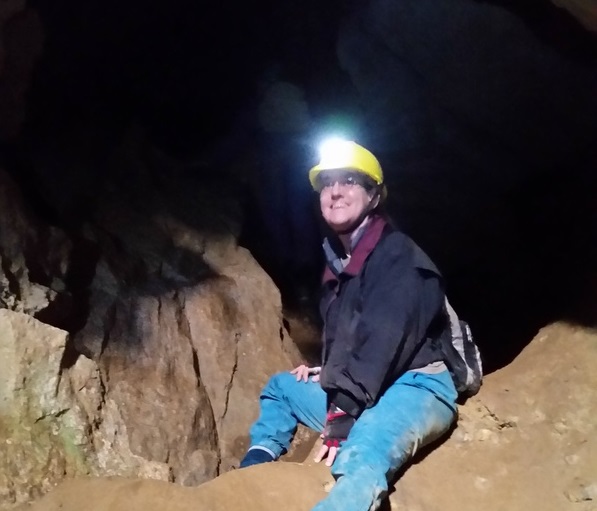
    On Tuesday, March 21, six HMNs (including three members of this year’s training class) joined host Brian Lux and our guide, Daniel Greenawalt, on a caving adventure. Our destination was Church Mountain Cave, located off Runion’s Creek Road in Rockingham County.

    At the entranceAfter parking the cars, a short hike up a logging road and a section of trail led to the cave entrance, which is at the top of steep climb. The opening is wide, with a scramble down into a fairly large room. Because of the size of the opening, there is a lot of light coming into this room. Consequently, some of the rocks are covered with bright emerald-green mold, something you rarely see in wild caves.

    The part of the cave that we saw is pretty dry, which means the formations are not actively growing. Nonetheless, we saw a few, notably a large column—that is, a stalagmite and stalactite that have grown so long that they touch, making a single formation. This particular column appears to have settled at some point, leaving a three-inch gap about a foot below the ceiling.
    We also saw fossils embedded in the rock. The floor of the Shenandoah Valley features a thick layer of limestone, which is why there are so many caves here: surface water is slightly acidic from contact with carbon dioxide in the air and with organic material in the soil. This slightly acid water slowly dissolves the limestone, forming underground caverns. The fossils are there because the rock itself formed at the bottom of an ocean that was here before the collision of continents that created the Appalachian Mountains.

    In the big room.cropHaving explored the big room, some of us chose to follow Daniel down into the lower section of the cave. This part was also quite dry, which made easier going, since the mud which covers most of the floor is not so slippery. We eventually worked our way down to a small stream. The cave continues in several directions at this point, but we decided not to explore any further, as the passages got quite tight. Instead, we all turned out our lights for a few minutes in order to experience total darkness.
    At this point, we began the short climb back out of the cave. Some in our group had never before been in a “wild” cave, so this was a new experience. Thanks again to Daniel for being our guide, and to Brian for organizing!

    – Carl Droms, Cohort II, March 2017

    Photos by Peggy Plass, Cohort IV. At top is Kate Guenther. Kristina Oates and Daniel Greenawalt are at the cave entrance in the second photo and the third one is of the big room.

  • Tree ID Trip

    Tree ID Trip

    treeid-pp-5-pattin-crop2
    VDOF Forester Patti Nylander

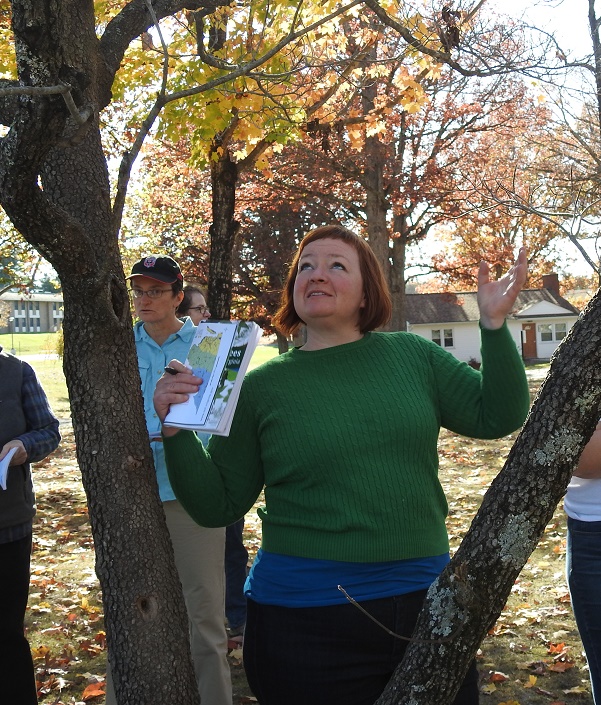
    On Sunday, November 13, Virginia Department of Forestry Senior Area Forester Patti Nylander hosted a tree identification trip for 13 members of this year’s Headwaters Master Naturalist basic training class. Trainees were joined by two current HMNs as Patti led a walk around the grounds of the Woodrow Wilson Rehabilitation Center in Fishersville, VA.

    While the field trip was intended as a “winter tree identification” outing, many of the beautiful trees at Woodrow Wilson still had their leaves, which made identification a little less challenging! Trainees had an opportunity to practice using keys from the Common Native Trees of Virginia text in determining the identity of trees like Scarlett and Black Oak and Virginia Pines.

    – Peggy Plass, Cohort IV


    Photos by Peggy Plass