Fire Season: Field Notes from a Wilderness Lookout
by Philip Connors
Set in the Gila Wilderness, this book seemed to be an appropriate read while I was on the road for my November adventure in New Mexico and Arizona. Connors, a copy editor for the Wall Street Journal, leaves his existence of a concrete city in New York City for a 7’x7′ wilderness outlook tower at 10,000 feet in the wilds of the Gila. Connors has participated as a lookout for a decade and for this book, he journals his day to day activities and contemplations for one fire season, April through August, in 2009. Each chapter is exclusive to the month with amusing ‘subtitles’ of sort……. “helicopter beer run,” “trout fishing by moonlight,” ” an encounter with the Electric Cowboy,” etc.
He is great writer and storyteller and touches on many topics including the establishment of wilderness areas (Gila was the first ever), the changing views of fire management, the problems of cattle ranching on public lands, Chief Victorio of the Apache as well as naturalist writers, Leopold and Abbey and Beat author Kerouac who was a fire lookout once in the Cascades. Connors manages weaving all of this into a beautiful reflection of nature, solitude, and our place in the wild. It’s an engaging and informative read from a writer with a typewriter in the middle of nowhere!! Connors never wants his fire season to end and I, in turn, did not want this book to end.
à la Thoreau… Connors writes ” …. since, as we know,
every day spent in a lookout is a day not subtracted
from the sum of one’s life.”
– Penny Warren, Cohort I, December 2016 Past president, Augusta Bird Club
Bur oak along the banks of the South Fork of the Shenandoah River. Photo credit Chip Brown.
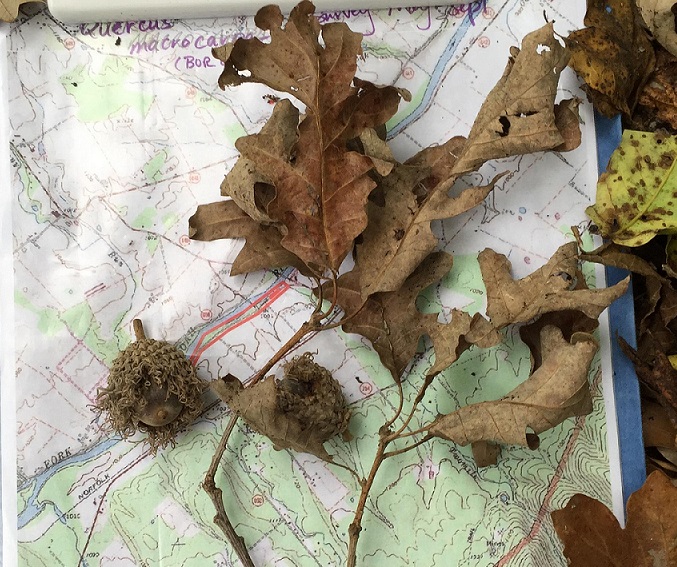
Headwaters Master Naturalist RareQuest Team 2 (Ginny Hoffman, Elaine Smith, and Chip Brown) conducted their final outing for the season on September 25th to search for Quercus macrocarpa (bur oak) in Rockingham county.
To get an idea of what they were looking for Elaine suggested they make a stop at a known specimen found in downtown Elkton, VA. Indeed, this tree was magnificent. A recent measuring records a circumference of 229 inches and a height of 96 feet. That’s a diameter of just over 6 feet! There are several bur oaks at the site and each were producing the giant and unique acorns characteristic of this white oak species. This tree is listed on the “Remarkable trees” website that highlights great trees in Virginia here.
According to the Flora of Virginia, the bur oak is mostly restricted to the mountain valleys west of the Blue Ridge mountains, particularly along the banks of the Shenandoah River. But the bur oak is a common tree elsewhere in the Eastern United States, especially in the mid-western prairie states. It is well adapted to fires and does well when planted in suburban and urban areas which may account some for its widespread status.
With their search image for the bur oak established, the three continued on to the area where wild specimens of the tree were last observed in 1991, along the South Fork of the Shenandoah River outside of Elkton. Sure enough, at least three bur oaks still survive at the site. The original observation in 1991 stated “One medium-sized tree and several small specimens nearby. Healthy, but no sign of fruit.” On the current visit, there were three medium to large trees, the largest of which measured at least 3 feet in diameter; not as large as the “remarkable” tree in Elkton, but impressive none-the-less. And, while no young trees or sapling were observed, several acorns were scattered beneath two of the three trees.
For this team, the RareQuest season was a success: they were able to verify two of the three historical observations they were assigned. More than that, they had several great adventures in places they might not have otherwise explored.
For more information about the RareQuest Project, see the Virginia Master Naturalist website here.
– Chip Brown, Cohort II, September 2016
Photos below by Elaine Smith.
Leaf and acorn specimen of Quercus macrocarpa (bur oak)
RareQuest Team 2: Chip Brown, Elaine Smith, Ginny Hoffman
Not all of the figures and data are in but as of February 25th, checklists that have been submitted surpassed 158,000 and 5,500 species were reported, topping 50% of the world’s birds from more than 130 countries. The collective spirit of such an event provides an impressive weekend of tallying birds around the world. The US submitted 128,000+, Canada 13,000+ and India placed third with 7,200+!!!!
As I reviewed the local data, I was impressed by Bell’s Lane being ranked 11th in Hotspots in Virginia!!!! The private pond on Bell’s Lane, one of the few ponds not completely covered with ice, gave us a good variety of waterfowl and helped push the species count to 40. And then, my curiosity was piqued with all of the participants both in Staunton and Augusta County and not knowing a lot of the names. I wish we could bring them into the fold of the bird club, field trips, master naturalists, etc. Any ideas?
It was a fun weekend and the snow on Monday added an extra layer of fun for me. While the snow was falling, I took a beautiful walk throughout my neighborhood and over to the Virginia School for the Deaf and the Blind (VSDB) soccer field and picked up a few more species for my list of Great Backyard Bird Count birds. A great ending to the Great Backy!
Looking forward to spring and spring bird counts!!!
Penny Warren, Cohort I President, Augusta Bird Club
My new ‘nest away from nest’ for the next couple of years will be New Mexico as my youngest son decided to attend St. John’s College in Santa Fe. Many thanks to him for choosing the Land of Enchantment!
All went well for the late August orientation and start up of the freshman year and once again I left my son with the classics, Homer, Aeschylus and Herodotus for starters as I took off in search of Buteogallus anthracinus, Toxostoma crissale, Nucifraga columbiana, etc.!!
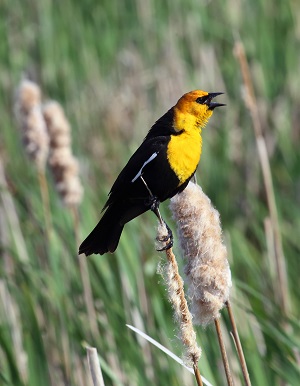
It was an early start for the first day of birding as I headed with a bird guide to Santa Rosa to a private ranch, Spirit Haven, in search of the Common Black-hawk and hopefully much more. A pre-dawn surprise were a few meteors greeting us and then followed by a spectacular sunrise as we raced down route 285. Along the way, we stopped at several small ‘ephemeral pools’ that had been formed due to much rain in New Mexico. A few highlights were Swainson’s Hawk, Cinnamon Teal, Lark Buntings, Ruddy Ducks and Eared Grebes. We arrived at Spirit Haven and spent the better part of the morning birding. We never did see the Common Black-hawks but many great treats included Mississippi Kite, Says Phoebe, Cassin’s Kingbird, Ladder-backed Woodpecker, Lazuli Bunting, a flyover of 100 or so Yellow-headed Blackbirds (life bird) and for this part of the world an unusual visit by a Carolina Wren!
Burrowing Owl
On the trip back toward Santa Fe and again flying down the road, the guide noticed some prairie dog mounds so we doubled back to check for Burrowing Owls and sure enough, there were four owls! Back in the car, we headed for Galisteo Basin Preserve, a 13,000 acre expanse promoting a blend of thoughtful conservation and community development. Although it was not particularly ‘birdy’ when we were there, the 360 degree, panoramic views were breathtaking and what New Mexico is all about …. and it was so, so quiet! We did find Sage Thrashers but not the Crissal. Additional bonuses included one beautiful coyote and a huge bull snake in the middle of the road. Under the bird guide’s watch and with a bit of encouragement, the snake safely crossed the road! It was a marvelous day full of many beautiful birds, creatures and enchanting landscapes.
The following day, I returned to the Randall Davey Audubon Center for their volunteer-led Saturday morning bird walk. The Center offers 135 acres of beautiful, diverse landscapes, various ecosystems, plant zones from riverside riparian to pinon-juniper woodlands and all of this is surrounded by the Santa Fe National Forest and Santa Fe River watershed. The morning gave us a smattering of southwest birds including Broad-tailed Hummingbird, Juniper Titmouse, Canyon and Spotted Towhees, Lesser Goldfinch, Mountain Chickadee and Townsend’s Solitaire (a lifer).
In the final moments of my time in Santa Fe, I went with the bird guide to the Sandia ski basin in search of Clark’s Nutcracker. We spent almost an hour walking around the woods approaching dusk searching for this one bird and just as we were heading to the car to leave not only one, but two of the nutcrackers flew overhead! We enjoyed watching them fly to and fro, landing for a bit and then taking off again. Another lifer for the list.
Thanksgiving will take me back to New Mexico and I hope to head south this time to Bosque del Apache for the wonders of Sandhill Cranes and Snow Geese.
– by Penny Warren, Cohort I, President of the Augusta Bird Club,September 2015
This was written by HMN and Wildlife Center of Virginia (WCV) Front-Desk Coordinator Kate Guenther and published on the Wildlife Center’s website on May 8, 2015. It is reprinted here with Kate’s permission. The WCV pond was part of our Headwaters Master Naturalists’ 2013/2014 Focus Project, coordinated by Kate, to create wildlife habitat around the Wildlife Center. This article demonstrates our success!
After we installed the pond in front of the Wildlife Center last year, new neighbors are moving in! Varieties of frogs are checking the place out, and some are definitely calling 1800 South Delphine “home.”
In recent weeks, more than 100 tadpoles have been seen sunning themselves in the warm afternoon waters of the pond’s edge. Who are the parents? It’s hard to say because a Green Frog, a Pickerel Frog, and a Gray Treefrog have all been seen in the vicinity! And, earlier this spring, director of outreach Amanda rescued an American Toad out of Maggie the Peregrine Falcon’s enclosure and relocated it to the front garden, before Maggie could claim it as a snack.
Fish and frogs in this pond are an essential component of the ecosystem for keeping the mosquito population in check and for controlling the algae that develops in the pond.
The Wildlife Center does not frequently admit amphibian patients. Since 2011, we have admitted 25 frogs and toads as patients:
• 10 American Toads, Anaxyrus americanus
• 4 Bullfrogs, Lithobates catesbeianus
• 8 Green Frogs, Lithobates clamitans
• 2 Gray Treefrogs, Hyla versicolor
• 1 California Treefrog, Pseudacris cadaverina
These patients have come to us for a variety of reasons, including dog and cat attacks, lawn mower encounters, entrapment in pools, and other unknown causes.
If you are interested in learning more about frogs and toads, the Virginia Department of Game and Inland Fisheries puts out a wonderful booklet and CD set to help you identify frogs by sight and by their nighttime calls. Identifying frogs by their calls is easier than identifying birds calls because 1) there are far fewer species to be familiar with and 2) the calls are very unique. Also, visual and auditory identification is available through the Virginia Herpetological Society’s website.
If you have frogs in your area and want to help scientists learn more about these fascinating species, you can do citizen science volunteering through a couple of different frog programs: FrogWatch USA or the North American Amphibian Monitoring Protocol.
I started volunteering with FrogWatch this year. I have a marsh in front of my house, so I can report what I’m hearing by monitoring twice a week for five minutes. Of the 11 species that are in this part of the state, I’ve already heard four this spring!
Take your passion for nature deeper by participating in citizen science — let your inner scientist emerge!
–Kate
Front-desk coordinator
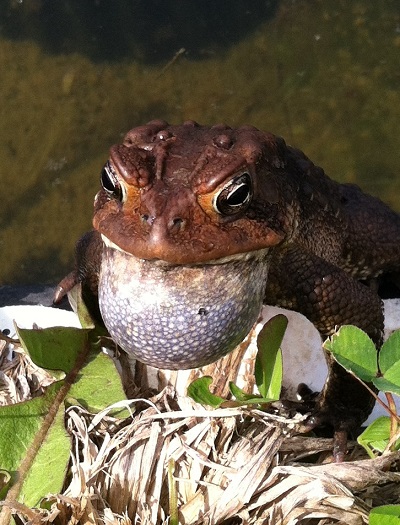
This handsome American toad was photographed by HMN Frank Deckert at the Springdale Water Gardens last May 2014. Both Frank and Springdale Water Gardens were instrumental in building the WCV pond as part of HMN’s 2013/14 Focus Project.
Photos of the HMN Wildlife Gardens at WCV in May 2015 taken by Kate and Adrie:

 Set in the Gila Wilderness, this book seemed to be an appropriate read while I was on the road for my November adventure in New Mexico and Arizona. Connors, a copy editor for the Wall Street Journal, leaves his existence of a concrete city in New York City for a 7’x7′ wilderness outlook tower at 10,000 feet in the wilds of the Gila. Connors has participated as a lookout for a decade and for this book, he journals his day to day activities and contemplations for one fire season, April through August, in 2009. Each chapter is exclusive to the month with amusing ‘subtitles’ of sort……. “helicopter beer run,” “trout fishing by moonlight,” ” an encounter with the Electric Cowboy,” etc.