Category: Nature Notes

  • Taking a Birthday Hike Up “Cliff Trail”

    Taking a Birthday Hike Up “Cliff Trail”

    Rose600

    Photo: by Dave Forrer
    Fringed Polygala (Polygala paucifolia), Cliff Trail Hone Quarry

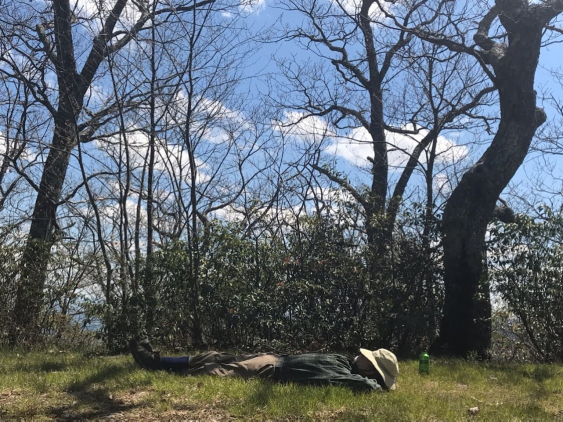
    It’s always fun to discover a new trail. For my birthday hike (May 12), Patsy and I walked up “Cliff Trail” across from the Hone Quarry picnic area. There’s a beautiful outcrop/overlook only about 30 minutes up the trail.  And beyond that, there were lots of wildflowers. A real bonus was that the pink mountain azaleas were blooming. And 3 miles up, at Oak Knob, the trees hadn’t displayed their leaves yet; so we had a wonderful, almost 360 degree view. (Another couple of bonuses: We only saw 2 other people on the trail, AND they’ve patched the awful potholes in Hone Quarry Road!)


    iris600

    Photo: by Dave Forrer
    Crested Dwarf Iris on Cliff Trail Hone Quarry


    nap600

    Photo: by Patsy Neese
    Birthday Hike snooze at Oak Knob

    by Dave Forrer and Patsy Neese


  • Beautiful Sights on the Chessie and McCormick Farm Trails!

    Beautiful Sights on the Chessie and McCormick Farm Trails!

    bluebells600

    Photo: from Cyane Lowden
    Virginia bluebells on the Chessie Trail.


    Recently, Cyane Lowden walked the Chessie and McCormick Farm Trails and shared some photos of the wonderful sights she enjoyed. Thank you, Cyane!

    If on your walks you find some beautiful flora or fauna, or if you find that great flora and fauna in and around your house, get some photos and email me with them. That way, we can share our own little virtual field trips!

    snake600

    Photo: from Cyane Lowden
    A rat snake resting in a tree on the Chessie Trail.


    McCormickBluebells600

    Photo: from Cyane Lowden
    The McCormick Farm Trail with Virginia bluebells.
  • Book Announcement: A Great New Field Guide from One of Our Own!

    Book Announcement: A Great New Field Guide from One of Our Own!

    BugasBook400
    Photo: Johns Hopkins University Press
    Book Announcement:
    Field Guide to Freshwater Fishes of Virginia

    Congratulations, Paul E. Bugas, Jr.!  

    In Field Guide to Freshwater Fishes of Virginia, the foremost experts on Commonwealth fishes bring their decades of field experience to readers, offering a complete reference to the fishes of the entire state of Virginia. Gathering information that until now could only be found scattered across numerous reference works and online databases, this book provides everything you need to know to identify fish families and species in the Virginia region.

    Covering how to collect, handle, observe, conserve, and protect these unique fishes, the book’s key features include:
    • more than 175 vibrant, full-color illustrations set side by side with descriptions of each fish
    • helpful line drawings that depict reliable diagnostic characteristics for field identification
    • descriptions of Virginia’s freshwater habitats
    • tips on observing fish in the wild and in captivity
    • a key to freshwater fish families of Virginia
    • up-to-date distribution maps
    • a complete glossary of terms

    Publication date: September 2019  Pre-ordering is now available!

    by Johns Hopkins University Press

  • Rattlesnake Encounter

    Rattlesnake Encounter

    elkhornlakerattlesnake.CherylShull.crop

    By Cheryl Shull, Cohort V

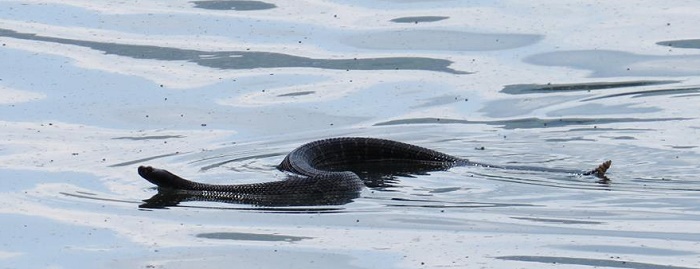
    During a recent fishing trip at Elkhorn Lake, my husband and I observed what we believed to be a brown water snake swimming towards us. As I began shooting photos, we quickly realized that we had a timber rattlesnake in our midst. We enjoyed the afternoon watching the snake quietly resting his head on a rock watching us watching him. Eventually he slithered on his way in the opposite direction. This being the closest encounter that I have had with a rattlesnake, I was interested in learning more about the species.

    timberrattlesnake.cherylshull

    The timber rattlesnake, also known as canebrake or banded rattlesnake, is a species of venomous pit viper that is found in the eastern region of the United States. Generally, this species is found in deciduous forests in rugged terrain but can be found in many types of rural habitats. The timber rattlesnake has a brown or yellowish to a grayish body, but some individuals are very dark, almost a solid black. It has a wide head and narrow neck and is a large, heavy-bodied snake with the characteristic rattle on the end of the tail. Adult snakes range from 30-60 inches in length and can weigh on average between 1.1 and 3.3 lb but can be much heavier.  When they feel threatened or are harassed they will vibrate their tail causing the loosely connected segments to make the distinct rattling sound. Their lifespan may be anywhere from 16 to 22 years in the wild.

    During the summer, gravid (pregnant) females seem to prefer open, rocky ledges where the temperatures are higher, while males and nongravid females tend to spend more time in cooler, denser woodland with more closed forest canopy. Females give live birth to 5 – 20 babies every two to three years. The young snakes may remain near their mother for a period of 7 to 10 days after birth, but no parental care is provided by the female. The juvenile timber rattlesnakes are born fully venomous, however, they don’t have the amount of venom that a full sized adult snake does.

    Timber rattlesnakes eat mainly small mammals, but their diet may also include small birds, frogs, mice, other small animals or even other snakes. The timber rattlesnake is the 3rd largest venomous snake in the US and is one of North America’s most dangerous snakes, due to its impressive size, long fangs and high venom yield. However, the species relatively mild disposition and a long hibernation period mean there aren’t that many bites.

    Due to their wide distribution and presumed large population numbers, the timber rattlesnake is not considered to be a threatened species. However, the population has been steadily decreasing over their historic range, mainly due to habitat destruction and other human activities.

    There was a time when a simple picture of a snake would send me into hysterics.  Then one day my young daughter’s fascination with a corn snake at a children’s museum led me to do some serious soul searching.  It took time and effort, but I’ve come to admire and respect these shy creatures and now enjoy photographing them whenever I get the chance.  Education is paramount to ensuring all snakes get the recognition and protection that they deserve.

    elkhornlakerattlesnake.2.CherylShull

    Photos by Cheryl Shull


    More on Timber Rattlesnakes from the Virginia Herpetological Society here.

    VA Tech graduate student David Garst on the Timber Rattlesnake in Virginia:

    VDGIFRattlesnakeSurvey

  • Viceroys and Pussy Willows

    Viceroys and Pussy Willows

    viceroy2

    Pollinator Gardeners, expand your plant lists to include Pussy Willows.

    So much effort has gone into making pollinator gardens to benefit the Monarch butterflies that migrate through our area every year. And rightly so. All pollinators benefit from restoring even just a small amount of habitat. I want to talk to you about a butterfly that has been very prevalent in my gardens this year that might have also visited yours: the Viceroy butterfly, Limenitis archippus.

    The Viceroy butterfly is commonly listed as a mimic for the Monarch butterfly. The Viceroy is said to benefit from its resemblance to the Monarch because the Monarch tastes bad. The bad taste came from the Monarch’s larval food, milkweed. It turns out that the Monarch also benefits from its resemblance to the Viceroy. The larval food of the Viceroy comes from the family Salicaceae which includes willows, poplars, aspen and cottonwoods. These plants contain salicylic acid (active medicinal in aspirin) which is also apparently distasteful to birds. To learn how to identify both butterflies, follow this link: https://www.learner.org/jnorth/tm/monarch/Viceroy1.html

    If you are looking to add some useful trees to your pollinator garden, consider the pussy willow. Native species are always preferred for meadow and large field plantings. Gardens have a bit more flexibility. Non-native pussy willow is not listed as an invasive in our area. The American pussy willow ranges from Alaska, across Canada south to Maryland and is a wetland shrub so it is not found in our area.

    Non-native cultivars of the European pussy willow are numerous and most are adapted to grow in dry areas as well as wetter places. They are easily pruned to stay small. If purchasing from a nursery, care should be exercised in obtaining them. Recent cultivars are advertised as pollenless. This makes them useful to the florist industry but useless to the pollinator garden. The pussy willow is an excellent pollen source for native and honey bees that are out foraging in the early spring as well as a host plant for many species of moths and butterflies.

    If this article has made you say where can I get one of these awesome plants, I have three, one-year old starts that are in need of good garden homes. Fall is a great time to plant trees. Contact me if you would like one: bowlenchris [at] comcast.net

    – Chris Bowlen, HMN, October 2017

    Top and bottom photos are of Viceroy caterpillars on pussy willow, September 2017, by Chris Bowlen

    viceroy