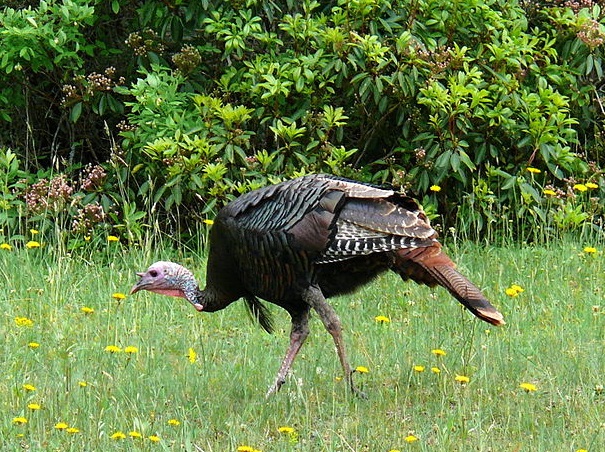
A male Eastern Wild Turkey (Meleagris gallopavo silvestris) feeding along the Blue Ridge Parkway in North Carolina.
Just how did the phrase, ‘talk turkey’ or ‘let’s talk turkey,’ originate? As with many phrases, there are quite a few versions but one that was recorded in an 1872 publication of phrases states that to ‘talk turkey’ was to talk in a silly, foolish way because of the way a male gobbles during courtship. It was also noted later that that it meant to talk pleasantly because of the Thanksgiving holiday, eating a meal of turkey with family and enjoying the event. It eventually evolved into a meaning to talk serious business or to talk frankly.
Where did the name originate? The first European explorers to discover and eat turkey were those in Hernan Cortez’s expedition to Mexico. The new delicacy was brought back to Europe. The turkeys started to be brought to England via merchant ships from the eastern Mediterranean and those merchants were called ‘turkey merchants’ and people thought they came from Turkey and thereby, the name. Shakespeare used the term, Turkey-cock, in Twelfth Night so it didn’t take long for the name to become commonplace.
During the late 1800’s, overhunting and deforestation were taking a toll on the turkey’s population and numbers dwindled until the 1930’s. Conservation measures were put in place, and with efforts of trap-and-transplant programs and such, the population started to grow. Eventually in 1947, the first unofficial presidential pardons were granted to a symbolic pair of Thanksgiving turkeys.
Wild turkeys evolved about 11 million years ago.
Turkeys have 5000-6000 feathers.
Snood length is associated with male turkey health…. and females prefer males with longer snoods.
A turkey’s gender can be determined from its droppings … males produce spiral-shaped and females’ droppings are shaped like the letter J.
They are known to have 20 distinct vocalizations including a distinctive gobble produced by males that can be heard a mile away. Each turkey has a unique voice allowing them to recognize each other.
They have exceptional geography skills with the ability to learn precise details for a range of over 1,000 acres.
They are intelligent and sensitive, creating lasting social bonds and are very affectionate, rather similar to dogs.
Click on the image to watch My Life as a Turkey
As an aside, if you’ve never seen the nature film, My Life as a Turkey, it is a very interesting account of one man’s total immersion of raising 16 turkey chicks that imprinted on him and how he roosted with them, took them foraging, etc. for one full year.
Average lifespan is up to 10 years in the wild.
And lastly, Benjamin Franklin did not propose the turkey as a symbol for America but rather praised the turkey as a more respectable bird than the Bald Eagle!
So whether you are having a turducken, tofu turkey, or just plain ol’ roasted turkey, Happy Thanksgiving!
Penny Warren President, Augusta Bird Club October 2014
Click on this image to download the VNPS brochure on Coral honeysuckle
by Stephanie Gardner
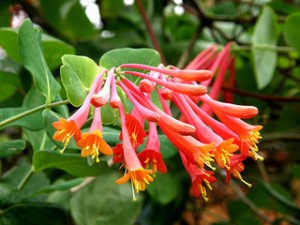
Hurray for Coral honeysuckle (Lonicera sempervirens), recently succeeding Redbud as Virginia Wildflower of the Year (WOY)! Coral honeysuckle was voted WOY 2014 by the Virginia Native Plant Society Board of Directors after consideration of all wildflowers nominated this year by Virginia Native Plant Society members.
Coral honeysuckle is one of three native honeysuckles growing in Virginia. It is a climbing, twining woody vine but lacks the aggressiveness of the infamous invasive honeysuckles. It produces two inch long tubular sessile flowers from April to October. According to the VNPS the low odor flowers are often red with yellow inside although they can also be totally red, orange or yellow. It has opposite leaves that differ in shape by growing season. It usually remains evergreen, retaining some leaves through the winter. Coral honeysuckle also produces a red or orange berry August through March.
Coral honeysuckle is well suited for use as an ornamental plant. It produces nectar and will attract butterflies, bees and birds, including hummingbirds. According to the Virginia Native Plant Society, it serves as a host for the larvae of spring azure butterflies. It also hosts the larvae of snowberry clearwing moths, sphinx moths that resemble bees!
Coral honeysuckle leaves have traditional uses in Native American medicine. The berries are toxic to humans.
Coral honeysuckle is more commonly found in Eastern and Piedmont Virginia than in the Virginia Mountains although a map provided by the Virginia Native Plant Society indicates its presence in Augusta, Rockingham and Page counties.
Coral honeysuckle, our Wildflower of the Year 2014, is widely available in ornamental nurseries. VNPS offers a list of nurseries that propagate native plants and collect native seeds in a responsible manner. They do not advise gathering native plants from the wild for use in cultivation.
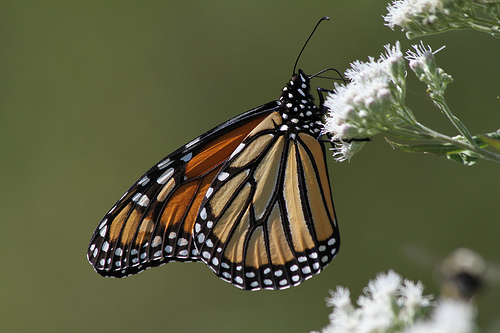
Once a bright and sure sign of autumn, monarch butterflies are now in worrisome decline. Scientists have tracked their decreasing numbers for several years. A recent study showed the lowest ever population of migrating eastern monarchs.
A number of factors have contributed to the decline of the monarch butterfly. Here in the United States, industrialized farming involving wide scale spraying of pesticide that kills all vegetation but the food crops modified to be immune to it is a major factor. We are losing high percentages of the native flora, especially milkweeds, which monarchs need to survive, in favor of homogenized landscapes. Farms growing only one crop and non-native green spaces such as lawns and pesticide-treated roadways, contribute to the problem.
In Mexico, deforestation, especially illegal logging, contributes to the habitat loss of monarch butterflies and reduces their numbers.
Additionally, severe weather such as extreme cold and drought has been identified as a factor leading to the loss of monarchs.
We can help as individuals by using less pesticides and growing our own milkweed to welcome back the monarchs.
Learn more about their situation and what you can do through MonarchWatch.org.
More from NationalGeographic.com, October 10, 2014, here:
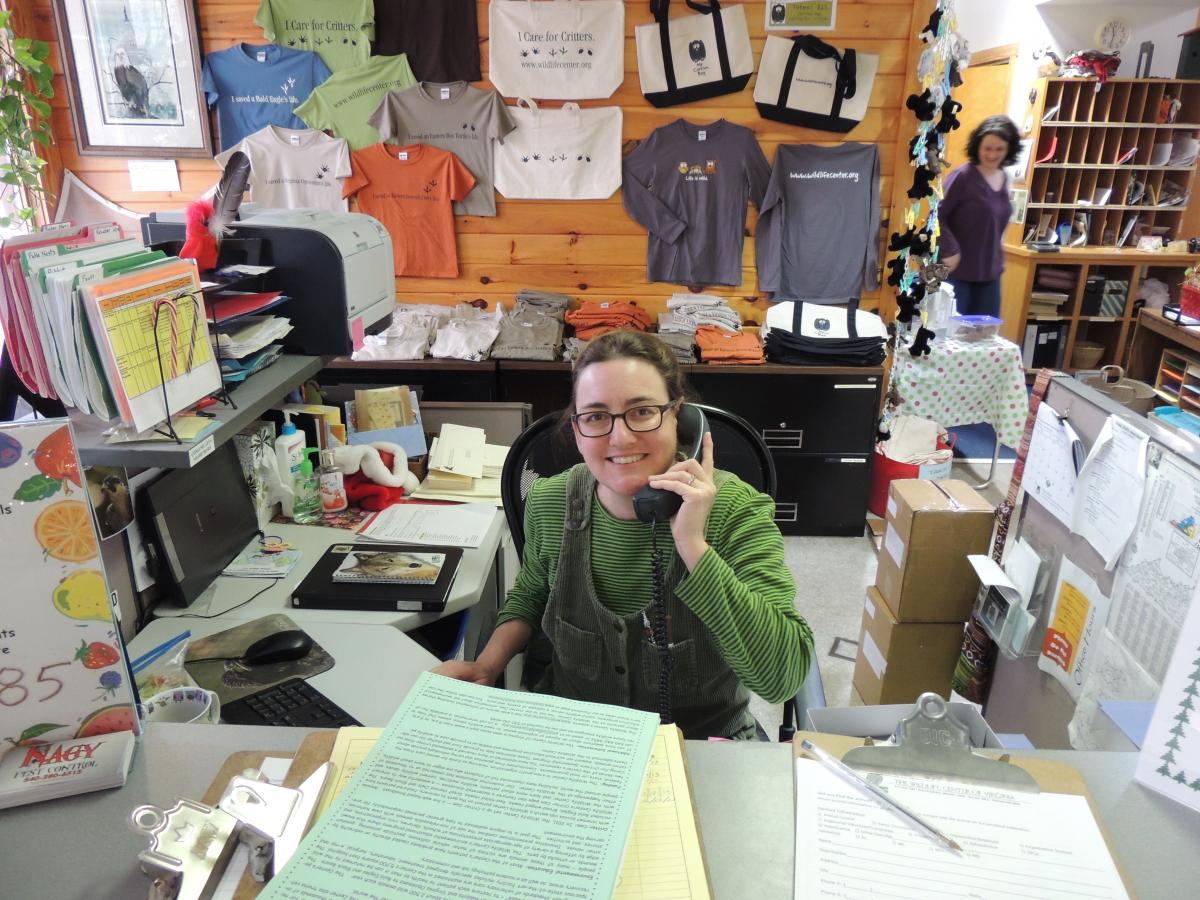
Kate at her busy post managing the Wildlife Center’s front desk.
The story that grabbed my heart this year is of a critter that never entered our doors.
JANUARY 2013
Last winter I got a call from a woman named Becky in far southwest Virginia who wanted to know what she could do to keep her female hummingbird warm during the anticipated cold snap that was coming in February.
WHAT??!!!
Becky explained to me that this bird, a somewhat larger-than-usual female Ruby-throated Hummingbird, had not migrated in the fall when all her cohorts had left. And, somehow, the hummingbird was surviving through the cold January nights, albeit with the help Becky was providing by continuing to offer the nectar feeder around the clock every day. When a Ruby-throated Hummingbird overwinters here it usually is because it is ill, injured, or a “genetically inferior” individual, and it would be likely to die in migration if it tried to go.
Each day, Becky changed the nectar mix to make sure the feeding holes didn’t ice over. She went out periodically and brushed snow off the perch. The bird roosted at night in a dense holly which afforded some protection from the snow and wind. That was all the bird had as protection. Becky was investing a huge amount of time and energy into providing the only sustenance this bird could have found anywhere in the area. Without her dedicated attention, it seems surely the bird would have frozen or died of hypoglycemia.
Becky asked whether she should increase the ratio of sugar to water to give more calories. We cautioned her against this, and instead offered that if she wanted to do something more, she could buy a professional quality hummingbird feed that would replace some of the proteins and minerals that the bird would have normally gotten from eating insects; this product is more complete than the simple carbs of sugar water. Unfortunately, that food would cost her about $100 to order online. She said she was going to consider it. I hung up with a feeling of sadness knowing that snows and colder temperatures—into the teens or lower—were forecasted.
JUNE 2013
Becky’s committed effort had touched my heart. I kept her phone number, arguing with myself about whether or not I wanted to hear the outcome of her winter’s effort. In June, I nervously dialed the phone to check up on the outcome. Astounded, I learned that the female hummingbird had survived the winter and rejoined with the other half dozen or so ruby-throats that had returned in the spring! Becky had decided to name this bird “Mira” for miracle, and had earned the right to do so, I thought.
NOVEMBER 2013
Writing up this story, I decided to call Becky one last time to clarify some details. She informed me that a late season hummingbird was at her house — again – after the others had left for the season. It is roosting in the same holly bush and is slightly larger than most other hummingbirds of summer were. She suspects it is “Mira.” Ruby-throated Hummingbirds usually leave Virginia by mid-October to winter in Mexico and Central America.
Again, there is nothing to indicate why the bird didn’t leave with the others a month ago—no known injury or disability. This year, Becky is planning to take down her last feeder to encourage “Mira” to leave before it is too late again this year. Leaving feeders up does not cause birds to delay migration. It is the change in day length that triggers the migration instinct in birds, not availability of food. Still, maybe it will encourage her…
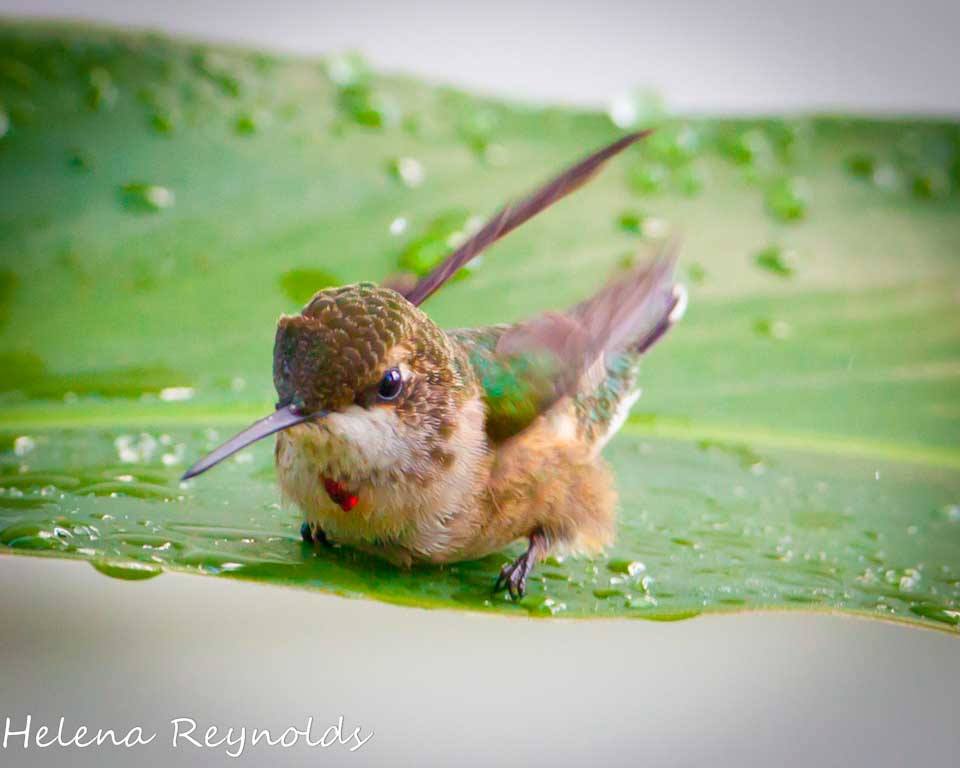
Could this be Mira? photo of Rufous Hummingbird by Helena Reynolds/Project FeederWatch
There is another additional possibility. Sometimes, hummingbirds that overwinter in the east may not be our native ruby-throated hummingbird species, but instead the slightly larger, more cold-tolerant vagrant species Rufous Hummingbird (Selasphorus rufus) which have been seen with increasing frequency in the eastern USA. Could this be her Mira?
I don’t know if I’ll have the heart to check in with Becky again or not. But I have saved her phone number just in case.
–Kate Guenther, Virginia Master Naturalist and Wildlife Center of Virginia Front Desk Coordinator | Reprinted here with her permission. Originally published in the Wildlife Center of Virginia blog on December 29, 2013.
by Rob Alexander June 7, 2013 … as posted to the Headwaters facebook page
This spring, due to my teaching schedule, I missed the botany lecture for my Virginia Master Naturalist class. In order to make up this lecture and complete the course with my classmates, I elected to explore a bit of phenology and hike the length of the North River Gorge Trail and report back with a photo essay on what flowers were present on the first of June, 2013.
The following set of Facebook posts is my report back from this hike. In each post, I will present a photo, and identification, and a description of where on the trail and in what setting I found the flower or plant plus any additional information I had.
Overall, it was a beautiful day in terms of having mixed sunshine and clouds, moderate humidity, and temperatures in the mid-80s . . . . a great day to be in George Washington National Forest with Chip and Quincy.
We entered the trail off of Forest Road 95 and Stokesville Rd. and hiked south up to the last river crossing before encountering the North River Campground area. The entire trail is fairly flat and wide, being a gated forest service road accessible to hikers, horses, and cyclists. There are several river crossings that provided both an opportunity to explore the aquatic environments as well as providing a great opportunity to cool down. The trail meanders through a mix of oak/maple tracts and then pine forests with one or two small meadows included.
Our field guide of choice was Newcomb’s Wildflower Guide and its handy three-part key classification based upon flower type, plant type, and leaf type. Making a decision about each of these three flower components provides you with a three digit number that then refers you to a section in the book, drastically narrowing down the amount of book searching required.
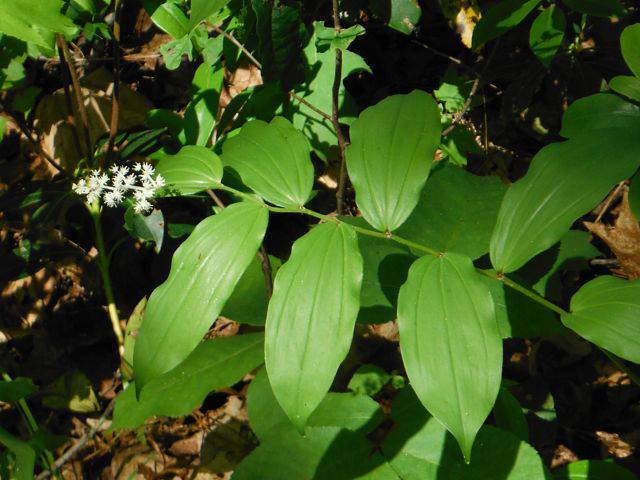
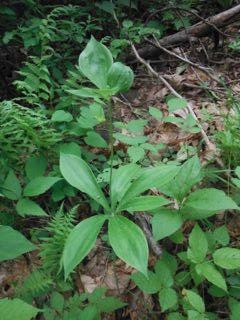
False Solomon’s Seal
Our first encounter was with False Solomon’s Seal, a flower with six parts and leaves alternate and simple. It was the first of several flowers from the Lily Family and a reminder that we were out just at the crossover between spring and summer with several flowers apparent from each season.
Barren Strawberry
Next was Barren Strawberry of the Rose family (of which all strawberries are members). This is a plant that often fools me when it appears in our own backyard, making me think that we have a wild edible strawberry appearing, but the Barren Strawberry has dry and inedible fruit, not to mention its indicative yellow flower.
White Clintonia
Our second member of the Lily Family was the White Clintonia. This flower is very much like a cultivated garden flower with it’s dark green, simple basal leaves. Newcomb’s indicated that this Clintonia appears in rich woods over a certain swath of the east coast, leading us to feel that we were seeing something not as common as the first two flowers.
Wild Geranium
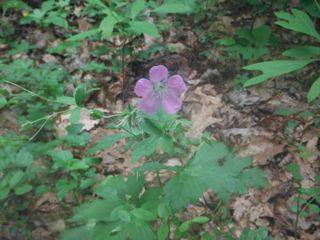
Our next flower, the Wild Geranium, is a special flower to me because it is one of the flowers appearing in the elevations of Colorado where I first became a naturalist, working at an environmental education summer camp. Kind of like seeing the same constellations wherever you are at night, seeing the Wild Geranium is like seeing an old friend – a familiar “face” in an area of high levels of biodiversity.
Obviously from the Geranium family, this flower is also known as the Spotted Cranesbill, which was a new piece of information for us. It is readily identifiable by its deeply cleft palmate leaves.
Golden Star
Our first member of the Composite Family was the Golden Star that happens to be of the species Virginianum. This is a popular cultivated ground cover that is also a native species, making us think about whether or not it appeared where we found it by the creek naturally or via introduction from horse poop.
Another Lily (and another flower with a species name related to our state – virginiana) that was striking in its subtlety was the Indian Cucumber Root, noted for its distinctive whorled leaves arrangement and nodding blossom. We will have to look in late summer for the berries on this one which are to be a dark purple. Intrigued by its name, I did a quick online investigation and found information (http://www.mbc.edu/academics/wildflowerstudy/mono/Liliaceae/Medeola.html) that this flower is a) the only species in its genus, and b) has a peppery, white root that can be eaten raw but that care should be given to not over-harvest.
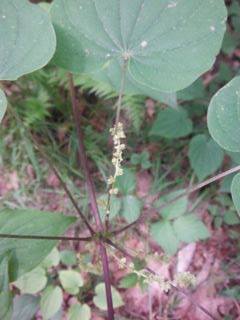
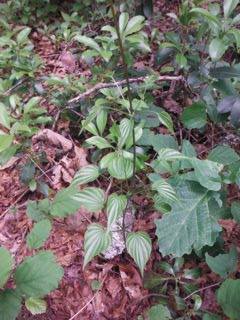
Indian Cucumber RootIndian Cucumber Root flowerWild YamrootWild Yamroot flower
On the theme of things edible, we also came across a new favorite of ours – Wild Yamroot of the Yam Family. This interesting plant starts as a self-supporting plant with unique, heart-shaped leaves palmately veined connected to the main stem in a whorled fashion but then grows into a vine with the leaves appearing in alternate fashion. This particularly species is D. quaternata, the southern relative of the Dioscorea villosa described by Newcomb. A quick online search (http://mason.gmu.edu/~sy/projects/plant/plant.htm) revealed a more interesting use history of wild yamroot (in particular the D. villosa species) as medicinal for menstrual cramps by Native peoples. Despite its common sounding name, eating the root raw will induce vomiting. Note the subtle flowers.
Pink Lady’s slipper
We were very lucky to catch the tail end of a cluster of Pink Lady’s Slippers from the Orchis Family. Chip reminded me how these are highly evolved flowers particularly designed for pollination by creating a one-way passage for insects interested in feeding on their nectar.
Rattlesnake WeedRattlesnake Weed flower
A fun discovery was the flower of the Rattlesnake Weed, another member of the Composite Family, part of the Hawkweed group, and very dandelion-like in its blossom. This was a fun discovery because we had been seeing its distinctive basal leaves with their vivid green and purple veins all spring and were having a hard time distinguishing this plant from similarly leaved ones in the Rattlesnake Plantain group.
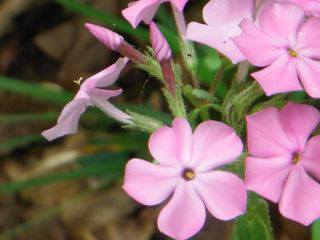
Downy Phlox
Familiar to many due to its common appearance in cultivated form is a member of Phlox Family, the Downy Phlox. We really liked the close-up picture of the swirled bud. Nature generates fascinating design elements, doesn’t it?
Yellow Stargrass
Next up is the Yellow Stargrass of the Amaryllis Family that looks grasslike but produces a pretty, six-part yellow flower that blooms all season long, so keep your eyes peeled for this one throughout your hiking season.
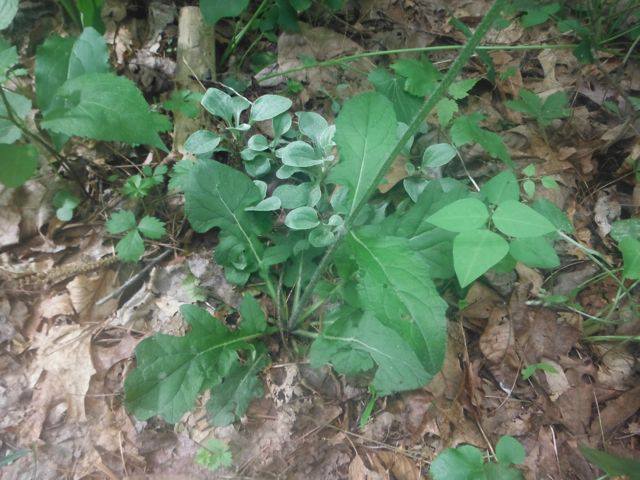
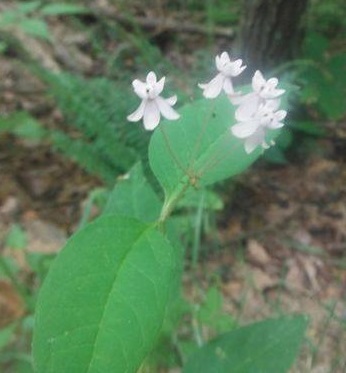
While there were a few other plants, ferns, and flowers identified, I will end this phenology display focused on wildflowers with two that are sort of stumpers to us in that we have not been able to identify them with Newcomb’s (which doesn’t mean they aren’t there . . .) and would like to give you a chance to suggest an ID. … . . . our guesses are some kind of Lobelia for the purple flower and a member of the milkweed family for the cool looking upwards and downward bending flowers.
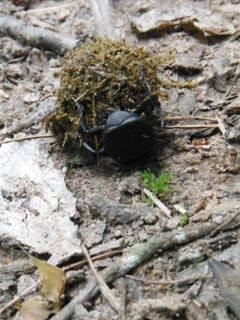
Finally, a few other naturalist sightings like these Eastern Swallowtail Tiger butterflies and a dung beetle rolling some horse manure off the trail for egg laying purposes.
Eastern Tiger Swallowtail butterfliesDung Beetle
This was the second time we saw these butterflies – the first time, there were hundreds scrambling around what appeared to be a spring in the rock. When we captured the photo above, we realized that what we thought was a spring of water was actually the butterflies themselves squirting large amounts of water out of their abdomens as they drank. A quick review of research on this species indicated that this is called “pumping” and is likely related to flushing wastes from the system. There must be minerals and salts in the fluid based upon the interests of the other butterflies in drinking what was pumped in an act of “puddling” as they do around mud puddles. Very cool…
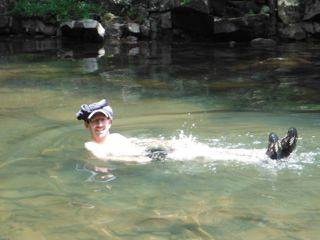
I can’t forget to give credit to my hiking side kicks . . . Chip and Quincy!And a visit to the North River Gorge Trail would not be complete without a jump in the river!